
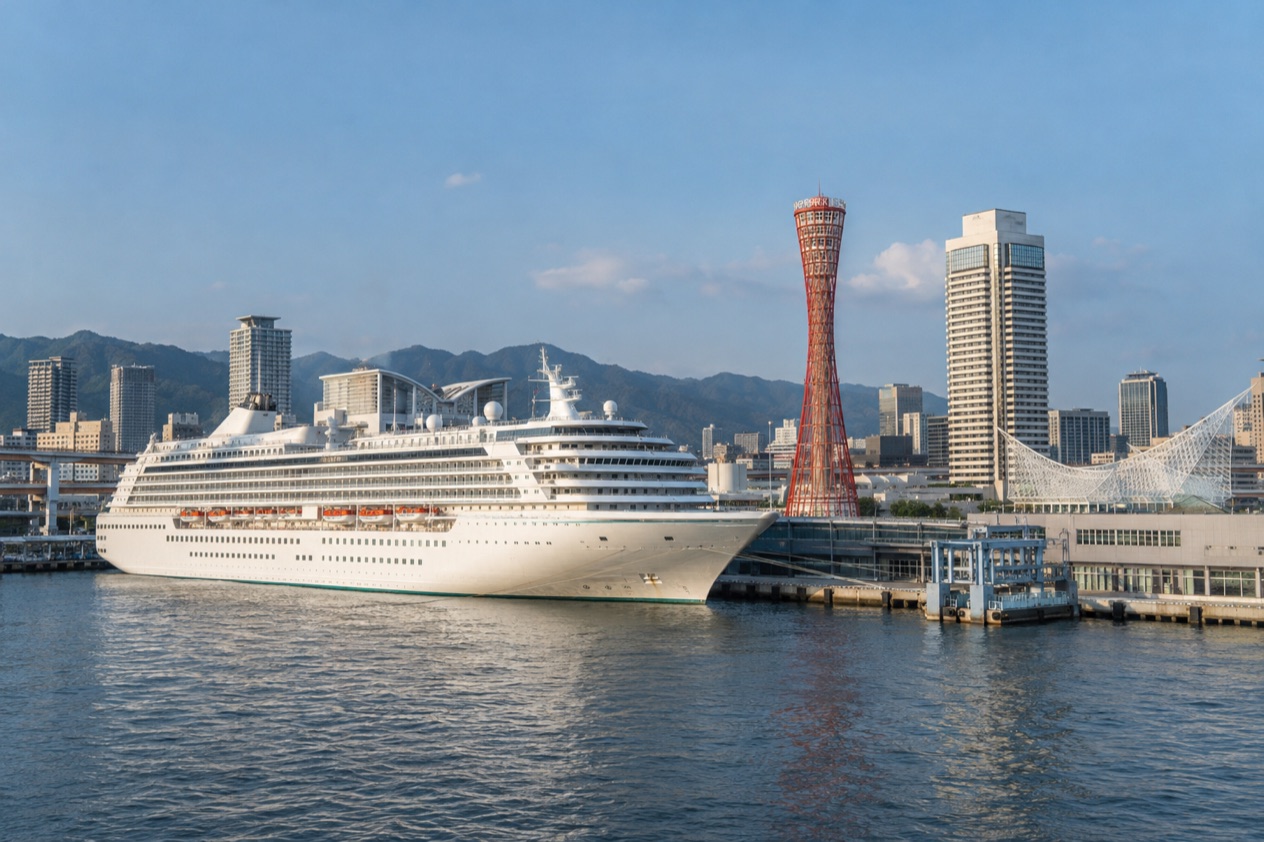
Standing on the Kobe waterfront, with the port’s cranes in front of you and the Rokko hills rising behind the city, it is easy to picture a cruise vacation in Japan. Royal Caribbean is a name many Americans already know, and the question is how that line fits into Japanese waters. The answer starts with the company itself, then moves to the harbor of Kobe and the private destinations the line runs elsewhere.
What do Royal Caribbean cruises in Japan offer?
A Royal Caribbean cruise offers a floating vacation in the manner of a big resort: a cabin, meals, entertainment and a changing view, all run by a line based in Miami, Florida. The ship is both your hotel and your transport, and the shore days become short tastes of a place rather than a full stay.
For Japan, that rhythm suits a country of harbor cities, each with its own food, its own neighborhoods and its own temples or shrines within reach of the water. You sleep aboard, then step into a city that has a long habit of dealing with visitors from the sea.
A Miami line with Norwegian roots
Royal Caribbean International was founded in 1969 in Norway, and today its headquarters are in Miami, Florida. That mix explains the feel of the brand: an American-run company, built around the idea of the large modern cruise ship as a destination in itself, with the vacation starting the moment you step on deck.
For an American traveler this is a comfortable starting point. The line speaks your language, the daily rhythm aboard is familiar from other cruises, and the unfamiliar part is saved for the shore, where Japan takes over with its ticket machines, its bowing shopkeepers and its tiny cups of green tea.
Dining and daily life aboard
Dining on almost all cruise ships is included in the cruise price, and that is a real change from a hotel stay in Japan, where a night in a ryokan with dinner and breakfast or a string of izakaya meals each carry their own bill. Aboard, mealtimes become part of the routine: a sit-down dinner, a buffet breakfast, a late snack after the show.
The pleasure comes from the contrast. A morning of sushi counters or noodle shops ashore, then an evening in a dining room at sea, makes a cruise a good way to taste Japan without packing and unpacking at every stop. Cruise ships are large passenger ships used mainly for vacationing, and the whole setup is built around that idea of leisure.
Staying connected at sea
In August 2022, Royal Caribbean International announced a partnership with SpaceX to use Starlink technology across all its ships to improve internet connections. For travelers, that means the line has invested in connectivity as part of the onboard experience, which matters when you want to look up a train station, a restaurant or a temple while you are still on deck.
It also changes how a cruise feels. You can share a photo of the harbor lights at Kobe with family at home, or read about the neighborhood you are about to visit, without waiting for a port to catch a signal.
Which routes does Royal Caribbean sail?
Royal Caribbean sails routes that reach well beyond Japan, from a home base in Miami to private destinations on several coasts, and among Japanese harbors Kobe is one with a distinctive story. A cruise line’s route is the thread that links such places, and understanding the ports on that thread is what lets you plan the shore days.
The line is known for building its own beach destinations, and it has plans for more. Japan sits in a different category: a country of working harbors and old port cities, where the shore day is about streets, markets and temples rather than a private stretch of sand.
The private destinations that shape the line
Royal Caribbean International operates a private resort called Labadee on the northern coast of Haiti, and it is planning to open another on Lelepa Island, Vanuatu. These places show how the company thinks: a cruise is not only a list of cities but also a day at a place the line controls, designed around the ship’s passengers.
That is a useful contrast with a Japanese port. At a private resort the setting is built for the visit. In a city like Kobe, the setting is a real working city that was there long before the ship, with commuters, shopkeepers and neighborhoods going about their day.
Kobe, a port built on reclaimed land
The Port of Kobe is a Japanese maritime port in Kobe, in Hyogo, in the Keihanshin area, with the Hanshin Industrial Region behind it. Flat land is limited here, since the city is squeezed between the hills and the bay, so the harbor has grown through artificial islands: Port Island, Rokko Island and the island of Kobe Airport.
Seen from the water, that explains the shape of the waterfront: straight edges, wide terminals and cranes, with the hills close behind. It is a port made by engineering as much as by nature, and the contrast with the older streets of the city is striking.
What Kobe offers on shore
Kobe is a city with a taste for the foreign and the good. Its beef is known across Japan, its bakeries and coffeehouses carry a long habit of Western influence, and its sake breweries have a name of their own. A meal of grilled beef, a pastry and a cup of coffee can fill a day happily.
Walkers can wander the Chinatown of Nankinmachi, the hillside streets of Kitano with their Western-style houses, and the harborside parks where the lights come on in the evening. The Rokko hills give the city its backdrop, and the Keihanshin area around it holds other cities that travelers often combine with a stay here.
Where do the ships go?
Royal Caribbean ships go to a mix of ordinary ports and the line’s own private destinations, and in Japan the harbor that can be described is Kobe, in the Keihanshin area of Hyogo. The private places sit far from Japan, while the Japanese ports are working cities with their own character. A cruise day in a Japanese harbor is a day in the middle of a real city, and the pleasure is in the details: a bowl of noodles at a counter, a vending machine of hot coffee, a shrine tucked between office buildings.
Private resorts, near and far
Labadee, on the northern coast of Haiti, is one of the resorts the line runs for its own passengers, and Lelepa Island in Vanuatu is a planned addition. They are the line’s answer to the question of where to spend a beach day, and they sit in a completely different world from Kobe or the rest of Japan.
For a traveler weighing a Japanese cruise, they are a reminder that the company’s network is wide. A ship that visits a Japanese harbor belongs to a line that also runs resorts on other continents, and each stop on a route has its own tone.
The harbor of Kobe and its islands
In Kobe, the geography is the story. Port Island and Rokko Island were made to give the city the flat ground it lacked, and the island of Kobe Airport extends the same idea into the bay. The Port of Kobe sits in the Keihanshin area, backed by the Hanshin Industrial Region, which gives it the look of a working harbor.
That industrial setting does not hide the city. Kobe’s hills, its European-style quarter and its restaurants are all close to the water in spirit, and a cruise visitor can taste the city’s food and wander its streets between the harbor and the slopes.
Beyond the harbor in the Keihanshin area
Kobe belongs to the Keihanshin area, the urban region that also includes Kyoto and Osaka. Travelers who spend a day in Kobe often think of the neighbors: Osaka with its street food, Kyoto with its temples and tea houses, Nara with its deer in the park.
Each of those cities has a different character from Kobe, and each rewards a longer visit than a single shore day allows. A cruise works best as a sampler, a way to decide which of them deserves a return trip by land.
Good to know before you go
On shore in Japan, spending is in yen, and a cruise changes the budget picture because dining on almost all cruise ships is included in the cruise price, leaving shore meals as the occasional treat. Carry a little cash for small shops and shrine offerings, and keep an eye on the weather, since the rainy season and typhoon months can change a plan at a harbor. Shoes come off at the entrance of many temples, ryokan and homes, so socks in good shape are a sensible habit.
Sources
- Wikipedia, Royal Caribbean International (https://en.wikipedia.org/wiki/Royal_Caribbean_International), checked October 11, 2026
- Wikipedia, Cruise ship (https://en.wikipedia.org/wiki/Cruise_ship), checked October 11, 2026
- Wikipedia, Port of Kobe (https://en.wikipedia.org/wiki/Port_of_Kobe), checked October 11, 2026
To plan your stay
- Japan Cruise in March: Weather by Port, Cherry Blossom Timing and What You See
- Cruises from Los Angeles to Japan: Departure Port, Yokohama Arrival and Crossing Length
- How Much Does a Japan Cruise Cost?: What the Fare Covers, Drinks and Shore Excursions
- Japan Cruise in April: Cherry Blossoms, Spring Weather and What You See From Port