
On the waterfront in San Pedro, the horn of a big white ship echoes under the Vincent Thomas Bridge, and someone on the dock always wonders where it is headed. For some ships the answer is the other side of the Pacific. Los Angeles and Japan are linked by cruise ships that change regions, and the arrival is usually a port on Tokyo Bay.
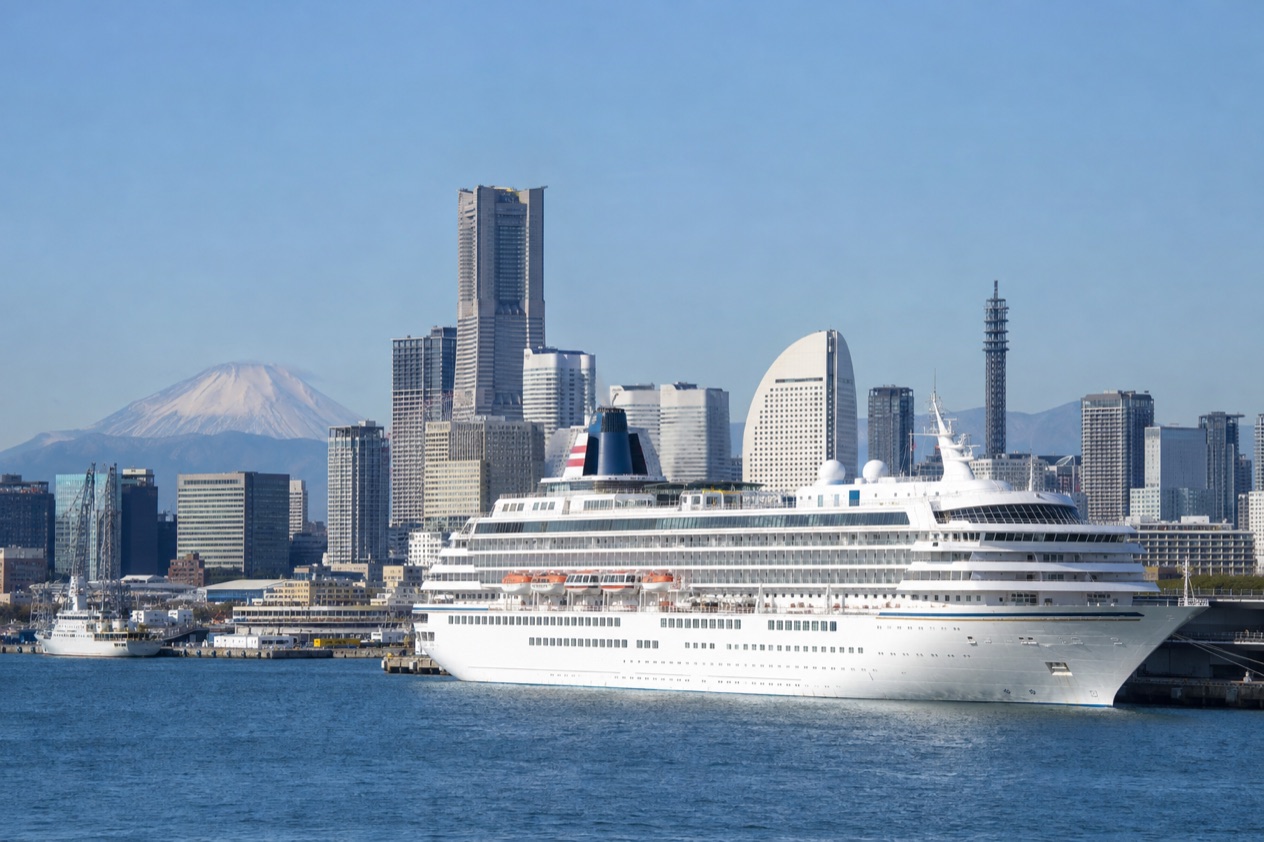
Are there cruises from Los Angeles to Japan?
They exist mainly as repositioning cruises, the voyages a ship makes when it moves from one region to another. A cruise ship that spends one season working out of California and the next in Asian waters has to get there somehow, and the crossing is often sold to passengers rather than sailed empty. That is how a Los Angeles to Japan voyage usually comes about.
It helps to think of it as a different kind of trip from a weeklong loop with a pool deck and a port every morning. A crossing is about the ship itself, its restaurants, its theater, its long quiet decks, and about the moment the Japanese coast finally appears on the horizon.
Leaving from the World Cruise Center in San Pedro
The departure point is the World Cruise Center in San Pedro, which sits beneath the Vincent Thomas Bridge and has three passenger ship berths. The Port of Los Angeles lies about 20 miles south of downtown Los Angeles, so the day of sailing starts with a ride out to the harbor, past container cranes and the long industrial edge of the port.
The terminal shares its dock area with the Catalina Express catamaran, so you may see day-trippers heading to the island while you board a ship bound for Asia. The nearby LA Waterfront, funded and maintained by the Port of Los Angeles as a visitor destination, gives you something to walk around if you arrive in San Pedro with time to spare. The Waterfront Red Car, the heritage trolley line there, is not running.
A port with a long cruise record
The Port of Los Angeles opened on December 9, 1907, and it spreads over 7,500 acres with 43 miles of waterfront. In 2024 it counted 1,112,893 cruise passengers, a sign of how routine boarding here is for the lines that sail from California.
The port has also installed Alternative Maritime Power, with its first berth in 2004. It can feed up to 40 MW of grid power to two cruise ships at once, which lets ships at the dock shut down their engines while passengers come and go.
What comes with the fare
All cruise packages include accommodation, meals and entertainment, and dining on almost all cruise ships is included in the cruise price. Extra fees may be charged for alcohol, fine dining, spa treatments and shore excursions, so the cabin fare is only part of what an onboard week can add up to.
Lines differ in what they offer. Regent Seven Seas operates medium-sized vessels designed so that virtually all of their suites have balconies, while Star Clippers sails tall ships. Saga Cruises welcomes only passengers over 50. Among the largest operators in the world are Carnival Corporation & plc, Royal Caribbean Group and Norwegian Cruise Line Holdings.
Which routes cross the Pacific?
The route that matters here runs from the World Cruise Center in San Pedro to Japan’s ports on the opposite side of the ocean, most naturally Tokyo Bay, where Yokohama receives passenger ships. Which sailing a given ship offers depends on the line and on the way it is shifting its base, since this is repositioning traffic.
A crossing is largely a matter of open water, so the character of the voyage is set by what happens on board. Ships that make this move tend to fill the days with lectures, cooking demonstrations, language lessons and film screenings, because the ocean is the scenery for most of the trip.
Yokohama and Osanbashi Pier
The Port of Yokohama is run by the Port and Harbor Bureau of the City of Yokohama and opens onto Tokyo Bay. It formally opened to foreign trade on June 2, 1859, and it has ten major piers, each with its own job in a working harbor.
For passengers, Osanbashi Pier is the one to know. It handles passenger traffic including cruises, and it has customs, immigration and quarantine facilities for international travel. The other piers are largely for cargo: Honmoku Pier is the core facility with 24 berths, including 14 for containers, and Daikoku Pier stands on an artificial island with a large cargo center.
Other piers you may see from the deck
As a ship works its way into Yokohama, the piers pass by as a kind of industrial skyline. Minami Honmoku has two operational berths built for larger container ships, and seven berths of Mizuho Pier are used by the United States Forces Japan. None of these is a passenger terminal, but they explain why the approach feels like entering a serious harbor rather than a resort dock.
Kobe, a Japanese port built on islands
The Port of Kobe sits in Kobe, Hyogo, in the Keihanshin area, with the Hanshin Industrial Region behind it. Flat land is limited there, so Port Island, Rokko Island and the island of Kobe Airport were built as artificial islands to make room.
It is a useful reminder that Japanese harbors are often shaped by people as much as by nature. If your ship’s itinerary includes more than one Japanese stop, the contrast between a bay port like Yokohama and a port of reclaimed islands like Kobe is part of the pleasure of arriving by sea.
| Port | What the port has for passengers |
|---|---|
| World Cruise Center, Los Angeles (San Pedro) | Three passenger ship berths beneath the Vincent Thomas Bridge |
| Osanbashi Pier, Yokohama | Cruise passenger traffic with customs, immigration and quarantine facilities |
How long do they take?
The length of the voyage depends on the ship, the line and how many stops are built into the crossing, because a repositioning cruise is shaped by the ship’s own move from one region to another. A sailing that goes straight across is a different experience from one that adds calls along the way.
What you can count on is the rhythm of a long sea voyage. People who like this pace tend to love crossings, and people who need a new port every morning may find them slow.
Days at sea and days in port
A cruise ship is a large passenger vessel used mainly for vacationing, and on a crossing that purpose is at its clearest. With few ports, the ship becomes the destination. Meals are included in the cruise price, entertainment is part of the package, and the extras are the ones that cost more: alcohol, specialty dining, spa treatments and shore excursions.
When the coast of Japan finally comes into view, the day turns busy. Immigration and customs are handled at facilities like those of Osanbashi Pier, and the arrival in Yokohama brings you into Tokyo Bay with the harbor piers sliding past.
Choosing a ship for a long crossing
Because you will spend most of the voyage aboard, the kind of ship matters more than on a short getaway. A medium-sized vessel where nearly every suite has a balcony, as on Regent Seven Seas, gives you private outdoor space for watching the ocean. A tall ship under Star Clippers is a very different, sail-driven experience.
Travelers over 50 may also look at Saga Cruises, which sails only with passengers of that age. The holding companies behind the biggest fleets, Carnival, Royal Caribbean Group and Norwegian Cruise Line Holdings, run a wide range of ships, so the choice on a Pacific crossing is as much about atmosphere as about route.
Good to know before you go
Budget for the things that sit outside the cruise package. Alcohol, fine dining, spa treatments and shore excursions can all carry extra fees, and on a long voyage they add up.
Once ashore in Japan, yen is the currency, and the port cities of Yokohama and Kobe are the places where the voyage turns into a trip on land. The typhoon season in the western Pacific is worth keeping in mind when choosing a crossing date.
Sources
- Wikipedia, Yokohama Port (https://en.wikipedia.org/wiki/Yokohama_Port), checked October 11, 2026
- Wikipedia, Cruise line (https://en.wikipedia.org/wiki/Cruise_line), checked October 11, 2026
- Wikipedia, Port of Los Angeles (https://en.wikipedia.org/wiki/Port_of_Los_Angeles), checked October 11, 2026
- Wikipedia, Cruise ship (https://en.wikipedia.org/wiki/Cruise_ship), checked October 11, 2026
- Wikipedia, Port of Kobe (https://en.wikipedia.org/wiki/Port_of_Kobe), checked October 11, 2026
To plan your stay
- Japan Cruise in March: Weather by Port, Cherry Blossom Timing and What You See
- Celebrity Japan Cruises: Asia Voyages, Hiroshima and Tokyo Sights, and the Port of Kobe
- How Much Does a Japan Cruise Cost?: What the Fare Covers, Drinks and Shore Excursions
- Japan Cruise in April: Cherry Blossoms, Spring Weather and What You See From Port