
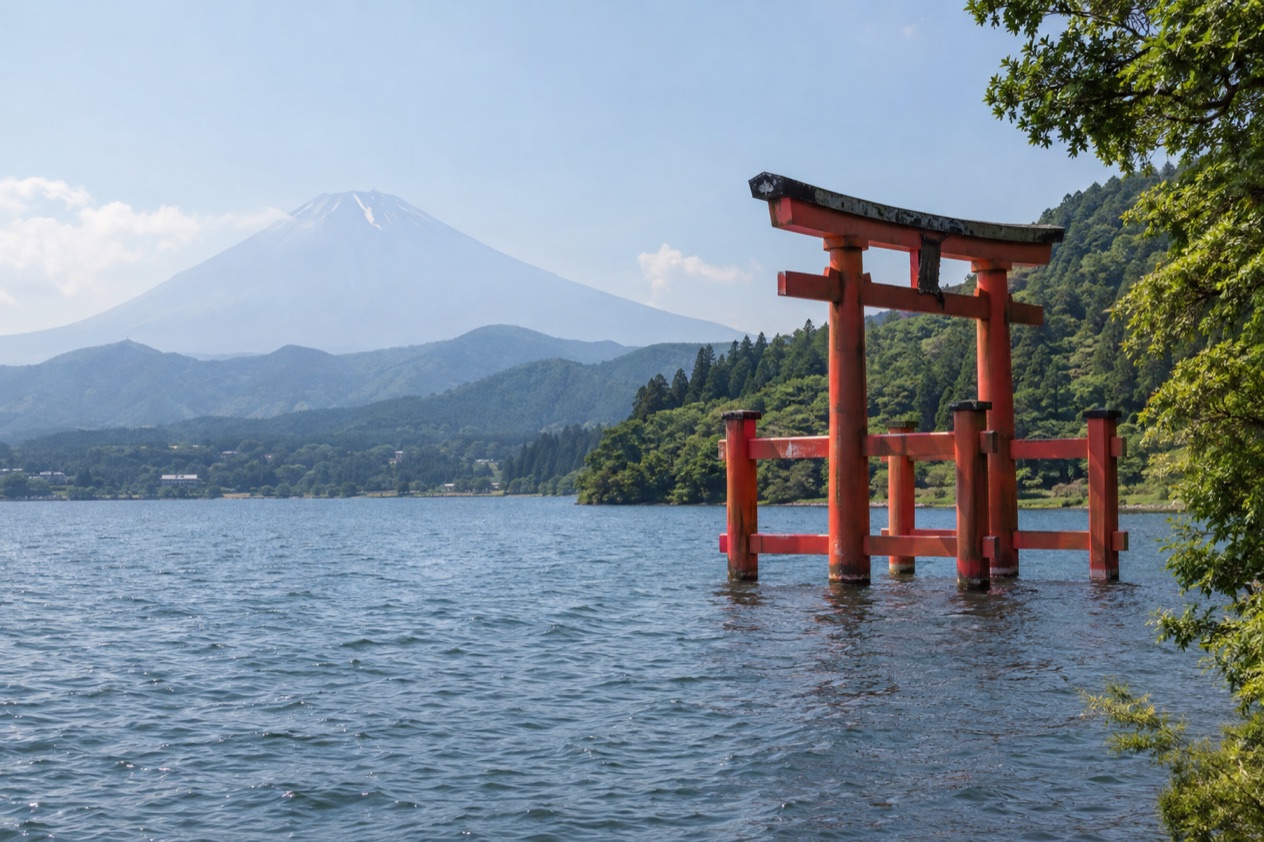
In August the cicadas drone in the trees around Hakone, and a bowl of cold noodles tastes better than anything else after a morning on the move. Steam rises from hot-spring towns, boats cross Lake Ashinoko, and the mountains sit under a thick summer haze that now and then lifts to show Mount Fuji. It is a month of hot, sticky days, long evenings, and soaking in an onsen when the air outside is already warm.
What is the weather like in Hakone in August?
August in Hakone is hot, humid and the sunniest of the three summer months, with rain that is lighter at the foot of the mountains than higher up.
| Month | Average high (°F) | Average low (°F) | Precipitation (in) | Hours of sunshine | Daylight on the 15th |
|---|---|---|---|---|---|
| July | 84.2 | 71.6 | 8.50 | 163 | 14 h 20 min |
| August | 87.1 | 73.4 | 6.58 | 202 | 13 h 32 min |
| September | 81.0 | 67.3 | 9.79 | 138 | 12 h 27 min |
Up on the mountain side the rain is much heavier, with an August total of 13.63 inches, so a day at the lake or around Owakudani can be wetter than the lowland numbers suggest. Honshu summers are humid and sultry, and the air at the foot of the mountains feels that way even when the rain holds off.
What this changes for you: light, breathable clothes for the town level, a thin layer for the higher stops, and rain gear in the daypack rather than at the hotel. Nights stay warm enough that a yukata (the light cotton robe lent by ryokan) is all you need to wander out after dinner.
The light is generous at both ends of the day. August has far more sunshine than July or September, and the evenings stretch long enough for a late walk beside the water or a last soak before bed.
What to do in Hakone in August
Hakone is a spa town set in the Fuji-Hakone-Izu National Park, and August suits it in a particular way: the hot springs are a pleasure for the evening, the lake gives you breeze and a change of scenery, and the art museums offer cool, roofed hours. The Hakone Freepass covers unlimited rides on eight kinds of transport in the area, including the Hakone Tozan Train, the Hakone Ropeway and the Hakone Sightseeing Cruise, so the loop around the mountain is a chain of rides as much as a list of sights.
The season in the wider region is Fuji summer. Mount Fuji’s climbing season typically runs from the beginning of July to about the first week of September, so August is the heart of it, and talk of the summit is everywhere even if you stay at Hakone’s lower level. When the haze clears, the view of Fuji from the mountains is part of why people come.
August is also the month of Obon, the Buddhist custom of honoring ancestors, when people return to family places and visit and clean graves. It lasts three days. In a spa town it shows up as families on the move, with the mood of a homecoming rather than a festival with a stage.
Lake Ashinoko and Owakudani
Lake Ashinoko is the center of the park, and a boat on its water is one of the best uses of a hot day. The Hakone Sightseeing Cruise is one of the eight transport means in the Freepass, so a loop can combine the lake with the ropeway and the mountain train. Wind off the water takes the edge off the August heat.
Owakudani is where the mountain steams and smells of sulfur, and where the black eggs are cooked in the hot springs. They are said to prolong life, and eating one is a small ritual almost everyone repeats. Bring a light layer and a rain jacket, because this is the mountain side where August rain falls hardest.
Hot springs, day and night
Hakone is world-renowned for its natural hot springs, and a hot bath in August follows an old Japanese logic: you sweat, you rinse, you soak, you cool down on the veranda in a yukata. Many visitors book a ryokan precisely to have the bath and the multi-course dinner together, with the futon laid out on the tatami afterward.
The Hako Ticket Plus pairs the Digital Hakone Freepass with unlimited use of applicable art museums, hot springs and activity facilities, and it is valid for 2 days or 3 days. In August that means you can fit a bath between a museum and a boat without counting each entry. Hakone-Yumoto, known for its many restaurants and gift shops, is the place to eat noodles and look for souvenirs.
Art museums and the open-air museum
Sengokuhara is filled with art museums, which makes it a gentle answer to a wet or very hot afternoon. You walk from gallery to gallery with the quiet of indoor rooms around you, and the grassy fields of the area wait outside for when the sky clears.
Hakone also has Japan’s first open-air museum, where sculpture stands among the trees and the mountain. It is the sort of place where the weather becomes part of the art, with mist, sun or a passing shower changing the look of every piece. Dress for both a stroll in the heat and a sudden shower.
A two-day itinerary for Hakone in August
Day 1 belongs to the loop. Start in Hakone-Yumoto with a breakfast of local specialties and a look at the gift shops, then ride the Hakone Tozan Train up into the hills. The ropeway carries you to Owakudani for the black eggs and the steaming ground, and the cruise on Lake Ashinoko cools you down after the sulfur.
Lunch is a noodle shop or a lakeside café, and the afternoon is for the lake itself, with its views toward the mountains and, when the haze breaks, Fuji. Check into your ryokan for the evening bath, the dinner and the walk in a yukata. Plan to arrive at the ryokan before dinner time, since traditional inns keep a dinner hour and a curfew.
Day 2 turns to art and hot water. Spend the morning in Sengokuhara among its art museums, then continue to the open-air museum for sculpture among the trees. After lunch, finish with a soak in one of the hot springs that make the area known, ideally one included in the Hako Ticket Plus if you hold it. If the weather turns, move everything indoors: the art museums are the obvious shelter, and a hot spring is most atmospheric with rain falling on the roof.
Is Hakone busy in August?
Hakone is a popular tourist destination all year because it sits near Tokyo and offers views of Mount Fuji, and August, the time of Obon and of the Fuji climbing season, adds to that pull.
Obon sends many people back to family places, which changes the rhythm of travel across the country. In Hakone, that means the lake, the ropeway and the springs are used by day visitors and overnight guests alike, and the pace feels like that of a holiday resort rather than a quiet village.
The hot weather also shapes the day. Visitors lean toward shaded museums, boat rides and long baths, and the evenings are for the ryokan, where dinner is a fixed event of the day. Rural shops often close earlier, sometimes as early as 6:00 p.m., so souvenir shopping fits better in the hours before dinner than after.
What to pack for Hakone in August
Pack for heat and humidity at the foot of the mountains and for showers higher up.
- Light, breathable clothes, because the days are hot and sticky.
- A compact rain jacket or umbrella, since the mountain side gets the heaviest August rain.
- A thin layer for the ropeway and the lake, where it feels cooler.
- Comfortable walking shoes for museum grounds and the open-air museum.
- A small towel, for the bath and for wiping off the sweat.
- Sunscreen and a hat for the sunny days on the water.
Good to know before you go
August in Hakone is humid and wet on the mountain side, so plan your outdoor stops and your indoor stops as a pair. A traditional ryokan has a dinner time and a curfew, so arriving the day after you land in Tokyo helps you avoid missing dinner or being locked out. Obon lasts three days and brings family travel to the area, and the weeks around it may feel busier on the loop.
Hakone in August vs July and September
Moving the trip to July means a wetter month, with less sun and slightly cooler highs. The days are longer, and the Fuji climbing season has just begun, so the mountain is in the news. The lake and the hot springs are as available as in August, but rain is more likely to interrupt a mountain day.
September is cooler and the evenings arrive sooner. It is the wettest month of the year in Hakone, and the Fuji climbing season ends on the 10th, so the first week still belongs to the summer mood. The heat is easier on a long outdoor day, but the sky is grayer and the sunshine thinner.
Choose August if you want the sunniest of the three, with long light for the lake and the evening bath. Shift to September if heat bothers you more than rain, and stay with August if sunshine matters most.
Is August a good time to visit Hakone?
Yes, for travelers who like hot springs, boat rides and museums and who can handle humid heat, August is a rewarding month in Hakone.
It suits people who plan around the weather: boats and mountain stops in the dry spells, art museums and baths when it rains. It is less suited to anyone who dislikes sticky air or wants a long hike without a rain jacket.
On arrival, start with the lake and the ropeway loop while the sky allows it, and keep the museums and the bath for the end of the day. August in Hakone is the month when steaming ground, cool water and a yukata evening sit side by side, with Mount Fuji appearing between the clouds.
Sources
- Japan Meteorological Agency (JMA), Normal values 1991-2020, monthly (https://www.data.jma.go.jp/stats/etrn/view/nml_amd_ym.php?prec_no=46&block_no=1008), station Odawara, elevation 14 m, checked October 11, 2026
- Computed from the date and the latitude of the place (sunrise equation, solar elevation -0.833 degrees), October 11, 2026
- Japan National Tourism Organization, shop and attraction hours, national holidays (https://www.japan.travel/en/plan/business-hours-and-holidays/), checked October 11, 2026
- Wikipedia, Obon (https://en.wikipedia.org/wiki/Obon), checked October 11, 2026
- Wikipedia, Public holidays in Japan (https://en.wikipedia.org/wiki/Public_holidays_in_Japan), checked October 11, 2026
- Japan National Tourism Organization, summer in Japan (https://www.japan.travel/en/guide/summer-guide/), checked October 11, 2026
- Japan National Tourism Organization, festivals and events (https://www.japan.travel/en/see-and-do/festivals-and-events/), checked October 11, 2026
- Wikipedia, Hanabi (https://en.wikipedia.org/wiki/Hanabi), checked October 11, 2026
- Japan Meteorological Agency, Emergency Warnings (https://www.jma.go.jp/jma/en/Emergency_Warning/ew_index.html), checked October 11, 2026
- Japan National Tourism Organization, safety information (https://www.japan.travel/en/japan-safe-travel-information/), checked October 11, 2026
- Japan National Tourism Organization, weather and seasons in Japan (https://www.japan.travel/en/plan/weather/), checked October 11, 2026
- Wikipedia, Awa Odori (https://en.wikipedia.org/wiki/Awa_Odori), checked October 11, 2026
- Wikipedia, Climate of Japan (https://en.wikipedia.org/wiki/Climate_of_Japan), checked October 11, 2026
- Japan National Tourism Organization, Mount Fuji guide (https://www.japan.travel/en/fuji-guide/), checked October 11, 2026
- Official website for Mt. Fuji climbing, about the climb (https://www.fujisan-climb.jp/en/about/), checked October 11, 2026
- Wikipedia, Nebuta (https://en.wikipedia.org/wiki/Nebuta), checked October 11, 2026
- Japan National Tourism Organization, Hakone (https://www.japan.travel/en/destinations/kanto/kanagawa/hakone-and-around/), checked October 11, 2026
- Hakone Tourist Information (https://www.hakonenavi.jp/international/en/), checked October 11, 2026
- Wikipedia, Hakone, Kanagawa (https://en.wikipedia.org/wiki/Hakone,_Kanagawa), checked October 11, 2026
- Wikivoyage, Hakone (https://en.wikivoyage.org/wiki/Hakone), checked October 11, 2026
To plan your stay
- Things to Do in Hakone: Lake Ashi, Owakudani, Open-Air Museum and Hot Springs
- Where to Stay in Hakone: Hakone-Yumoto, Lake Ashi, Sengokuhara and Ryokan Stays
- Hakone from Tokyo: Romancecar, Shinkansen, Local Trains and the Hakone Freepass
- Know Before You Go to Hakone: Getting There, the Freepass, Weather and Etiquette