
In March, steam still curls off the hot spring baths of Hakone while the air around them loosens a little, and the first mild afternoons make a walk between ryokan and museum feel pleasant rather than bracing. Lake Ashi lies in the middle of the national park, the volcanic vents of Owakudani keep smelling of sulphur, and the black eggs are still cooked in the hot water. March is a month of late winter turning to spring in the mountains, good for soaking, for museums and for slow days around the lake.
What is the weather like in Hakone in March?
March in Hakone is cool and changeable, with chilly mornings, mild afternoons and a good deal of rain on the mountain, so it feels like early spring rather than winter.
| Month | Average high (°F) | Average low (°F) | Precipitation (in) | Hours of sunshine | Daylight on the 15th |
|---|---|---|---|---|---|
| February | 52.3 | 34.3 | 3.52 | 160 | 10 h 54 min |
| March | 57.4 | 39.9 | 6.91 | 161 | 11 h 54 min |
| April | 66.0 | 48.6 | 7.15 | 177 | 13 h 03 min |
Up on the mountain side, where the AMeDAS station sits at 855 meters, the rain is much heavier: nearly eleven inches in an average March, against about six in February. So the town below and the lake country above do not feel the same, and a dry hour in Odawara can still be a wet one at Owakudani or Sengokuhara.
What this changes for you is mostly layers. Mornings are close to freezing at the lows, afternoons are comfortable in a sweater and a light jacket, and the evenings call for the jacket again after a hot bath. Rain gear belongs in the daypack, since the wet comes in on the mountain more than at the base.
The days are lengthening, with almost twelve hours of daylight in the middle of the month, so there is time to see a museum, ride the ropeway and still reach your ryokan before dinner. Sunshine is about the same as in February, and clear spells show up between the wet days.
What to do in Hakone in March
Hakone is a spa town first, and March is a good month for it. Hakone is known for its natural hot springs and for views of Mount Fuji, and a soak after a cool day outside is the point of the month. Hakone-Yumoto, the town where many arrivals start, is known for its restaurants and gift shops, and it is a pleasant place to wander before heading up the mountain.
This is not a month of cherry blossom in Hakone. The Somei-Yoshino cherries reach the Kanto region in late March, so a few early buds may appear toward the end of the month, though nothing can be promised. Plum blossoms usually flower from January until late February, so they are mostly finished. Treat flowers as a bonus rather than the plan.
Lake Ashi, the ropeway and Owakudani
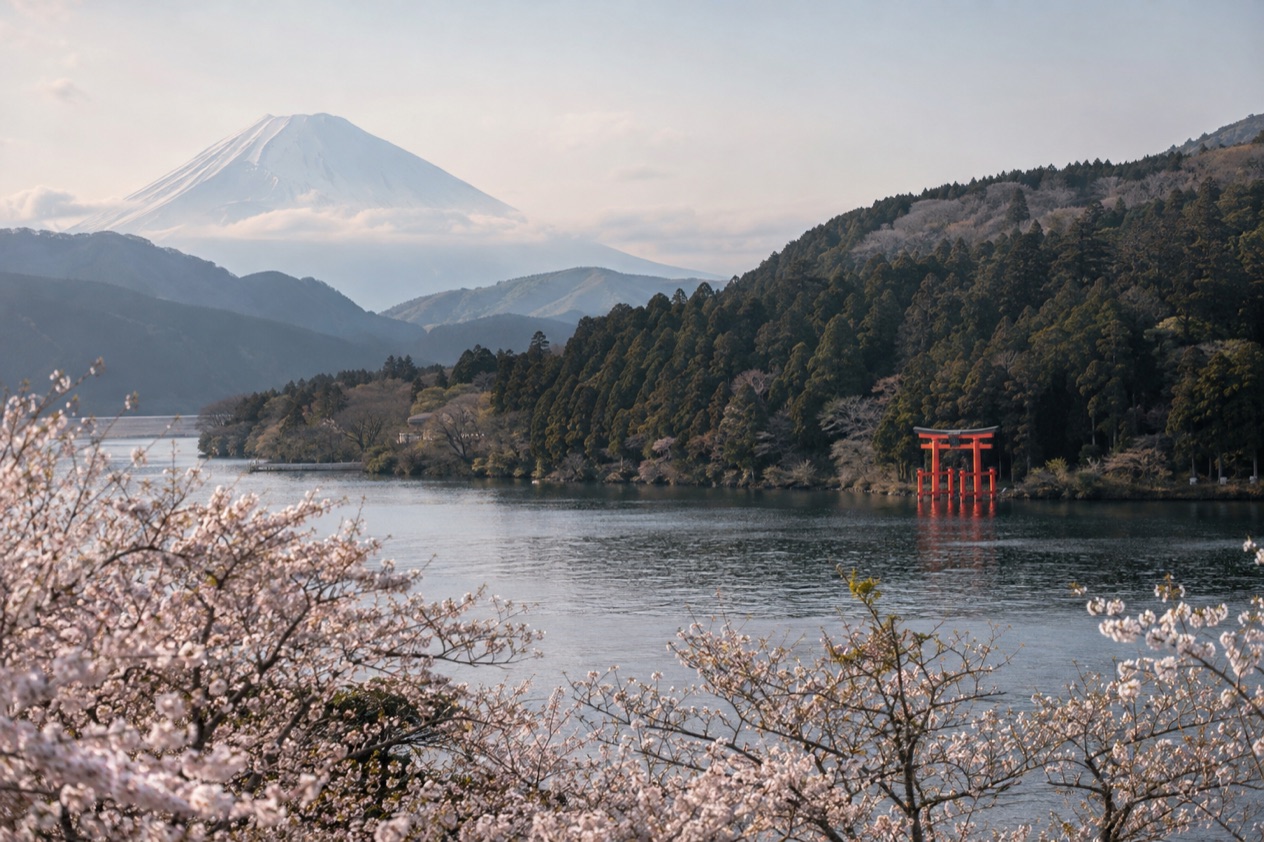
Lake Ashi is a crater lake at the heart of Fuji-Hakone-Izu National Park, and you can explore it by boat on the Hakone Sightseeing Cruise. On the water you sit with a cold breeze on your face and the forested slopes around you, and when the clouds part you may see Mount Fuji above the ridge.
The Hakone Ropeway links Sounzan and Togendai by way of Owakudani, so one ride brings you over steaming ground and down to the lake. Owakudani itself is a volcanic valley with active sulphur vents and hot springs.
Here you can taste the black eggs, boiled in the hot water, which are said to prolong life. In a wet or cloudy March the views can vanish, so keep the ride flexible and treat the eggs as the sure pleasure. This loop suits anyone who likes a day of moving between scenes, and it pairs well with the Hakone Freepass, which offers unlimited rides on eight kinds of transportation, including the Hakone Tozan Train, the ropeway and the cruise.
Museums for a gray day
The Hakone Open-Air Museum opened in 1969 and is Japan’s first open-air museum. Sculptures stand on the hillside, and in March the cool air makes the walk between them brisk and clear. If a shower comes, the indoor galleries are close at hand.
Sengokuhara is filled with art museums, which makes it a fine base for a rainy day. You can move from gallery to gallery without ever committing to the weather, then finish with a hot bath. The Hakone Freepass Hako Ticket Plus adds unlimited use of applicable art museums, hot springs and activity facilities to the transport pass, and it is valid for two or three days.
Onsen and the ryokan evening
A night in a ryokan, the traditional inn, is the classic Hakone experience. You arrive in the afternoon, change into a yukata, soak in the bath and then sit down to a multicourse dinner. March suits this, since the cold outside makes the hot water feel better.
Dinner and curfew matter at a traditional ryokan, so plan to arrive at least one day after landing in Tokyo to avoid missing the meal or being locked out. After the bath, the best plan is to do very little.
A two-day itinerary for Hakone in March
Day 1 begins in Hakone-Yumoto, with a slow morning among the restaurants and gift shops of the town and a first coffee or bowl of noodles. Go up the mountain by the Hakone Tozan Train, then use the middle of the day for the museums of Sengokuhara, which keep you warm and dry whatever the sky does.
In the afternoon, with almost twelve hours of daylight in the month, there is still time for the Hakone Open-Air Museum while the light is good. Return to your ryokan for the bath and a long dinner. Rain card: stay with the galleries and spend more time in the bath.
Day 2 is for the lake loop. Start at Sounzan and ride the ropeway across Owakudani, stopping to taste a black egg among the vents. Continue to Togendai on Lake Ashi.
In the afternoon take the Hakone Sightseeing Cruise on the lake and look for Mount Fuji over the ridge, with no promise that the clouds will cooperate. Lunch can be a simple meal by the water, and the evening is for one last soak. If the ropeway is not running or the weather is poor, spend the day by the lakeshore and in a hot spring instead.
Is Hakone busy in March?
Hakone is extremely popular with tourists for its closeness to Tokyo and its views of Mount Fuji, so you should expect company in any month, including March.
March is not the cherry blossom season here, since the Somei-Yoshino reach the Kanto region in late March, and so it sits between the winter soaking trade and the spring flower crowds. That means the pace is that of a working spa town rather than a festival, with visitors drifting between the lake, the ropeway and the museums.
The places that draw people are the same through the year: the ropeway, the cruise, Owakudani and the open-air museum. If you want a quieter rhythm, the museums of Sengokuhara and the baths of your ryokan give you somewhere to go when the lines gather elsewhere. The details of rooms and tables are not something to promise, so plan the day around the places themselves.
What to pack for Hakone in March
A light jacket or a simple sweater is what Japan’s spring calls for, and in Hakone you add a few things for the mountain and the water.
- A light jacket and a sweater, for chilly mornings and cool evenings.
- A compact rain jacket or umbrella, since the mountain side is wet.
- Comfortable walking shoes for the museum grounds and the lakeshore.
- Warm socks, which are welcome when shoes come off at a ryokan.
- A small day pack for layers you take off on the ropeway.
Good to know before you go
March is a transition month, so the weather can swing from a bright afternoon to a wet mountain day. Rain falls more heavily on the mountain side than at the base, so keep your plans flexible and use the museums as a back-up.
At a traditional ryokan, arrive in good time for dinner. The Hakone Freepass can cover the train, ropeway and cruise in one pass, and the Hako Ticket Plus adds the museums and hot springs.
Hakone in March vs February and April
Moving earlier to February means colder days and less rain, with plum blossoms usually flowering until late in the month. It is the deepest hot spring weather, with the shorter days of the year. If a long soak in cold air is the goal, February is the month to look at.
Moving later to April brings warmer afternoons, longer days and more sunshine, though the mountain gets wetter still. By then the cherry trees are more likely to be in flower across much of the Kanto region, which suits anyone who wants spring color alongside the lake.
March sits between the two. Choose it if you want mild afternoons without giving up the cool air that makes a bath feel good, and shift to April if flowers matter more to you than quiet baths.
Is March a good time to visit Hakone?
Yes, for travelers who like a soak after a cool day and are happy to let the weather set the plan. March suits people who enjoy museums, the lake and the ropeway more than a fixed list of views.
It is less right for anyone who has come only for a clear view of Mount Fuji or for cherry blossoms, since neither can be promised. On arrival, start with a hot spring and the lake, then fit the ropeway and museums around the sky. What is special about March in Hakone is the mix of steam and cool air, a sulphur-scented valley, a black egg in your hand and a hot bath waiting at the end of the day.
Sources
- Japan Meteorological Agency (JMA), Normal values 1991-2020, monthly (https://www.data.jma.go.jp/stats/etrn/view/nml_amd_ym.php?prec_no=46&block_no=1008), station Odawara, elevation 14 m, checked October 11, 2026
- Computed from the date and the latitude of the place (sunrise equation, solar elevation -0.833 degrees), October 11, 2026
- Japan Meteorological Agency, cherry blossom first-bloom dates 2021-2026 and 1991-2020 normal (https://www.data.jma.go.jp/sakura/data/sakura003_07.html), checked October 11, 2026
- Japan Meteorological Agency, cherry blossom full-bloom dates 2021-2026 and 1991-2020 normal (https://www.data.jma.go.jp/sakura/data/sakura004_07.html), checked October 11, 2026
- Japan Meteorological Agency, sakura2020.pdf (https://www.data.jma.go.jp/sakura/data/sakura2020.pdf), checked October 11, 2026
- Japan National Tourism Organization, flowers by season: cherry blossom, plum, wisteria, hydrangea, where and when (https://www.japan.travel/en/see-and-do/flowers/), checked October 11, 2026
- Wikipedia, Prunus mume (https://en.wikipedia.org/wiki/Prunus_mume), checked October 11, 2026
- Japan National Tourism Organization, spring in Japan (https://www.japan.travel/en/guide/spring-guide/), checked October 11, 2026
- Japan National Tourism Organization, autumn in Japan (https://www.japan.travel/en/guide/autumn-guide/), checked October 11, 2026
- Japan National Tourism Organization, summer in Japan (https://www.japan.travel/en/guide/summer-guide/), checked October 11, 2026
- Japan National Tourism Organization, Hakone (https://www.japan.travel/en/destinations/kanto/kanagawa/hakone-and-around/), checked October 11, 2026
- Hakone Tourist Information (https://www.hakonenavi.jp/international/en/), checked October 11, 2026
- Wikipedia, Hakone, Kanagawa (https://en.wikipedia.org/wiki/Hakone,_Kanagawa), checked October 11, 2026
- Wikivoyage, Hakone (https://en.wikivoyage.org/wiki/Hakone), checked October 11, 2026
- Wikipedia, Hakone Open-Air Museum (https://en.wikipedia.org/wiki/Hakone_Open-Air_Museum), checked October 11, 2026
- Wikipedia, Hakone Ropeway (https://en.wikipedia.org/wiki/Hakone_Ropeway), checked October 11, 2026
- Wikipedia, Ōwakudani (https://en.wikipedia.org/wiki/%C5%8Cwakudani), checked October 11, 2026
- Wikipedia, Lake Ashi (https://en.wikipedia.org/wiki/Lake_Ashi), checked October 11, 2026
To plan your stay
- Things to Do in Hakone: Lake Ashi, Owakudani, Open-Air Museum and Hot Springs
- Where to Stay in Hakone: Hakone-Yumoto, Lake Ashi, Sengokuhara and Ryokan Stays
- Hakone from Tokyo: Romancecar, Shinkansen, Local Trains and the Hakone Freepass
- Know Before You Go to Hakone: Getting There, the Freepass, Weather and Etiquette