
The loop starts with a mountain train climbing out of Hakone-Yumoto, and soon the day turns into a chain of changes: a cable car, a ropeway lifting over a steaming valley, a pirate-style ship crossing a lake. Sulfur drifts across the slopes at Owakudani, and Lake Ashi opens up with views of Mount Fuji. This is a day of riding and stopping across the Hakone mountains, built for travelers who like a trip where the transportation is part of the scenery.
Is visiting the Hakone loop worth it?
Yes, if you like to see a landscape change as you travel and you are happy to spend a day moving between a mountain train, a cable car, a ropeway, a cruise ship and a bus. It suits first-time visitors to Hakone, couples, families with children and anyone who wants steam vents, a lake and art museums in the same outing without planning a separate trip for each.
What sets the loop apart from other day trips from Tokyo is that the getting around is the main attraction. Nearby hot spring towns give you one place to settle into.
Here the pleasure is in the sequence: the station at Hakone-Yumoto with its restaurants and gift shops, the volcanic ground at Owakudani where black eggs are cooked in the hot springs, and the water of Lake Ashinoko, which you cross by boat. Hakone sits in the western part of Kanagawa Prefecture, inside Fuji-Hakone-Izu National Park, and that setting is part of what you are looking at the whole day.
It also leaves room to slow down. Sengokuhara is filled with art museums, the hot springs the area is known for are a reason to stay longer, and the open-air art installations at Japan’s first open-air museum give the loop a cultural stop between the rides. If you only want one thing from Hakone, the loop is the version that shows you the most of it.
What to see at the Hakone loop
Hakone-Yumoto and the mountain train
Hakone-Yumoto is where people begin, and it is known for its many restaurants and gift shops. It is a good place to look around before the climb, with the sort of lanes where you can browse sweets, local crafts and wooden souvenirs. Hot spring inns are part of the town’s character as well.
From here the Hakone Tozan Train carries you up into the hills. Look out of the window at how the vegetation thickens around the line, because the mountain side of Hakone gets noticeably more rain than the lowland town of Odawara. In wet months the forest feels full and green, and clouds can sit low on the slopes.
Owakudani and the black eggs
Owakudani is the volcanic valley at the heart of the loop, where steam rises from the ground and the air carries the smell of sulfur. A new tourist spot has opened here, with the Earth Valley observation area and the new Owakudani Station, and OWAKUDANI KITCHEN has opened at the Earth Valley observation area.
The local snack is the black egg, boiled in the hot spring water until the shell turns dark. Visitors to Hakone taste them because they are said to prolong life, and eating one is as much a ritual as a snack. You reach the valley by the Hakone Ropeway, which lifts you over the steaming ground. During scheduled maintenance, a replacement bus service operates on sections of the ropeway.
Lake Ashi and the cruise
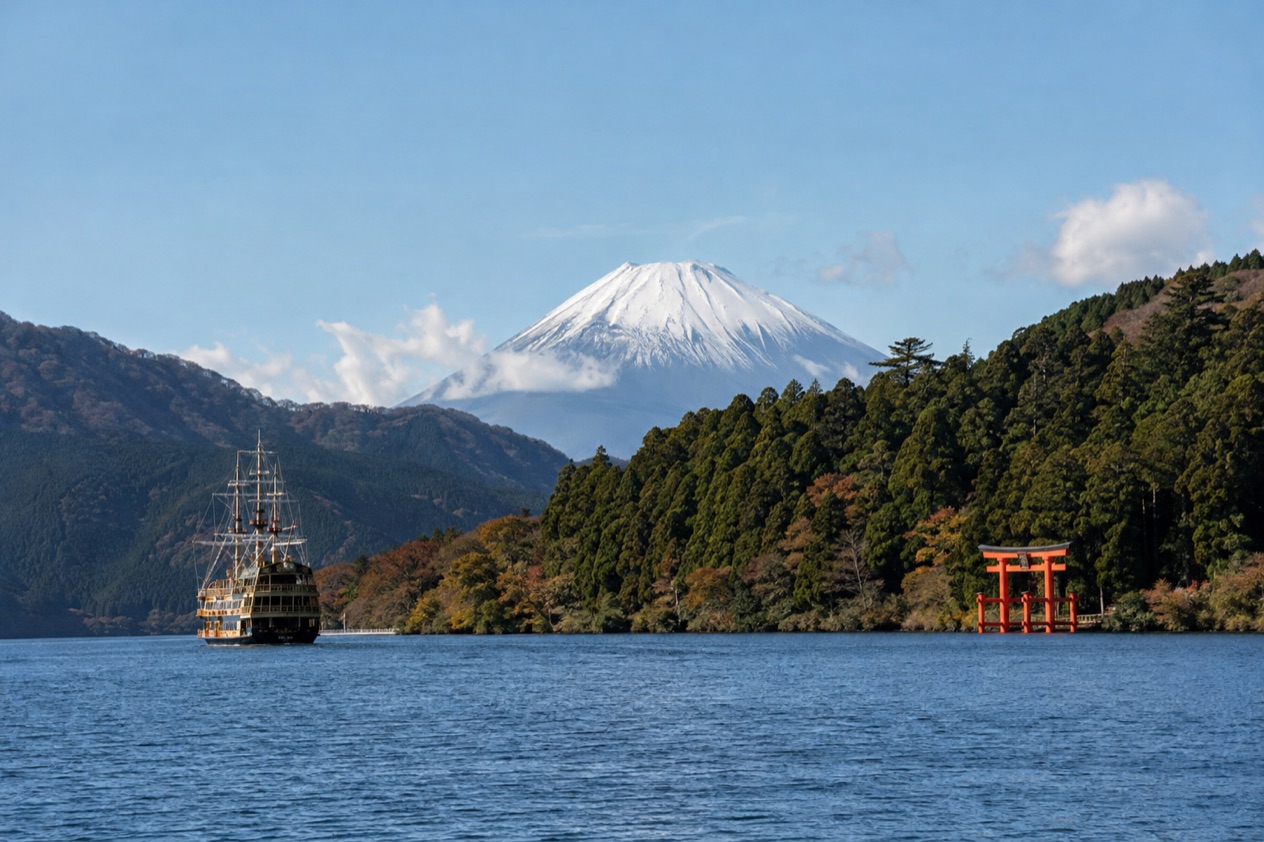
Lake Ashi is where the loop slows down. The Hakone Sightseeing Cruise crosses the lake on ships that look like old sailing vessels, and Lake Ashi offers views of Mount Fuji. Whether the mountain shows itself depends on the weather that day, so treat the view as a chance and not a promise.
The Royal II has been newly renovated, and the Victory and Moto-Hakone Port have been remodeled and updated to offer an elegant cruise on Lake Ashi. Stand on deck for the open air, or sit inside if the wind off the water is cool.
Sengokuhara and the art museums
Sengokuhara is filled with art museums, which makes it the place on the loop where you can trade scenery for galleries. If the weather turns gray, this is where a rainy afternoon becomes a good one, since the day no longer depends on a clear sky.
The Hako Ticket included in the Hakone Freepass “Hako Ticket” Plus gives unlimited visits to applicable art museums, hot springs and activity facilities. The open-air museum, with its sculptures set among the hills, suits those who like to wander outdoors between exhibits.
Hours, tickets and rules
The loop does not have a single gate or opening time, because it is a chain of trains, cable cars, ropeways, buses and ships, each run by its own operator. The Hakone Freepass is the ticket that ties them together. It includes unlimited rides on eight modes of transportation in the Hakone area, and the official times for trains and buses are provided by the Odakyu Hakone Group.
The pass covers the Hakone Tozan Line, the Hakone Tozan Bus in designated areas, the Hakone Tozan Cable Car, the Hakone Ropeway, the Hakone Sightseeing Cruise, the Odakyu Highway Bus in designated areas, the Tokai Bus in designated areas and the KANKO SHISETSU-MEGURI Bus. It also offers discounts at approximately 70 facilities, including hot springs, museums and restaurants.
| Hakone Freepass | Adults | Children (ages 6 to 11) |
|---|---|---|
| 2 days, from Shinjuku | 7,100 yen | 1,600 yen |
| 3 days, from Shinjuku | 7,500 yen | 1,850 yen |
| 2 days, from Odawara (Hakone area only) | 6,000 yen | 1,500 yen |
| 3 days, from Odawara (Hakone area only) | 6,400 yen | 1,750 yen |
Children under 6 do not require a ticket. Digital tickets are for smartphones only, and only one Digital Hakone Freepass can be used at the same time on the same smartphone, so each traveler, including children, uses their own on their own phone.
For a group, up to 4 tickets, adults and children combined, can be purchased on a single device. The Romancecar needs its own separate ticket even with the pass, and travel outside the designated areas is paid for separately.
How to get to the Hakone loop
The two bases in the pass prices are Shinjuku in Tokyo and Odawara, and each has its own version of the Freepass. From Shinjuku, the Odakyu Limited Express Romancecar reaches Hakone-Yumoto in approximately 80 minutes. From Odawara, the Romancecar also runs to Hakone-Yumoto, and the pass for that departure covers the Hakone area only.
To ride the Romancecar, passengers need both a limited express ticket and a regular fare ticket. Even with the Hakone Freepass, a separate Romancecar ticket is required. Children aged 6 to 11 need a child limited express ticket and regular ticket, which are half the adult fares, and children under 6 do not need tickets if they do not occupy a seat.
| Romancecar reserved seat ticket with the Freepass | Adults | Children |
|---|---|---|
| Shinjuku to Hakone-Yumoto | 1,200 yen | 600 yen |
| Odawara to Hakone-Yumoto | 200 yen | 100 yen |
Limited express tickets go on sale at 10 a.m. Japan time one month before the departure date. On the newer GSE trains there are panorama seats at the front and at the rear, with no extra charge beyond ordinary fares. The GSE also has space for large luggage, and the EXEα has a luggage area designed for suitcases.
The Odakyu Highway Bus is another way up, though passengers with reserved tickets are given priority, so it may be full for holders of the Hako Ticket Plus. Route and timetable searches on the official Hakone website work only for transfers within Hakone or to the Odakyu Line or the Odakyu Highway Bus.
When to visit the Hakone loop
The loop runs through the seasons, and the weather decides what the day feels like. Air figures here are for Odawara, at the foot of Hakone. The mountain side gets far more rain, so expect the upper stretches to be wetter and often cloudier than the town at the bottom.
| Month | Odawara high (°F) | Odawara low (°F) | Odawara rain (in) | Odawara sunshine (hours) | Mountain side of Hakone rain (in) |
|---|---|---|---|---|---|
| January | 51.1 | 33.1 | 3.30 | 180 | 5.03 |
| April | 66.0 | 48.6 | 7.15 | 177 | 12.67 |
| July | 84.2 | 71.6 | 8.50 | 163 | 16.74 |
| October | 72.0 | 57.4 | 9.40 | 131 | 15.90 |
January is cold at the base and the driest of the four months on the mountain, with the most sunshine, which suits anyone who wants to pair the loop with a hot spring soak. April is mild, and the rain starts to build. July is warm and wet, and the lake and valley can sit in cloud, so museums and baths make good fallback stops.
October is pleasant at the base, with the fewest sunshine hours of the four and plenty of rain on the mountain. If a gray day arrives, the art museums of Sengokuhara and the hot springs give the day shape. Whether Fuji appears over Lake Ashi is a matter of luck in any month.
Tips for your visit
Keep your phone charged, because the Digital Hakone Freepass lives on it, and each traveler needs their own phone with their own pass.
For a bigger day, look at the Hakone Freepass “Hako Ticket” Plus, which combines the Digital Hakone Freepass with the Hako Ticket for unlimited use of applicable art museums, hot springs and activity facilities. It is valid for 2 days or 3 days, and its discounts reach around 70 tourist spots. The version with an Odakyu Line ticket includes one return trip between the departure station and Odawara Station, with no limits on getting on and off partway.
Pair the loop with a soak in a hot spring, a long museum afternoon at Sengokuhara, or a meal back in Hakone-Yumoto among its restaurants. Families can bring children aged 6 to 11 on child fares, and children under 6 need no pass. If the ropeway is under maintenance, plan on the replacement bus for that stretch. Check the official Odakyu Hakone Group times for trains and buses on the day.
Good to know before you go
All prices are in yen. The Hako Ticket Plus is a set that includes the Digital Hakone Freepass and the Hako Ticket, so individual tickets cannot be refunded.
A refund is made without charge upon request to the call center only if the means of transport in question have not been used during the valid period and the suspension is due to inclement weather. Typhoon and rainy seasons can change a day on the mountain, so keep a second plan for the museums and hot springs.
Sources
- Odakyu Electric Railway, Hakone Freepass (https://www.odakyu.jp/english/passes/hakone/), checked October 11, 2026
- Odakyu Electric Railway, Romancecar (https://www.odakyu.jp/english/romancecar/), checked October 11, 2026
- Hakone Tourist Information (https://www.hakonenavi.jp/international/en/), checked October 11, 2026
- Japan National Tourism Organization, Hakone (https://www.japan.travel/en/destinations/kanto/kanagawa/hakone-and-around/), checked October 11, 2026
- Japan Meteorological Agency (JMA), Normal values 1991-2020, monthly (https://www.data.jma.go.jp/stats/etrn/view/nml_amd_ym.php?prec_no=46&block_no=1008), station Odawara, elevation 14 m, checked October 11, 2026
To plan your stay
- Best Time to Visit Hakone: Autumn Leaves, Rainy Season, Weather by Month and Festivals
- Where to Stay in Hakone: Hakone-Yumoto, Lake Ashi, Sengokuhara and Ryokan Stays
- Hakone from Tokyo: Romancecar, Shinkansen, Local Trains and the Hakone Freepass
- Know Before You Go to Hakone: Getting There, the Freepass, Weather and Etiquette