
In October, the steam rising from the vents at Owakudani smells of sulfur, and a hot spring bath tastes better once the evening air has a chill in it. The black eggs boiled in the volcanic pools are passed around, boats cross Lake Ashinoko, and ryokan guests walk to dinner in their yukata. This is Hakone in the month when summer’s warmth has gone and the mountain town turns to soaking, eating and looking at art.
What is the weather like in Hakone in October?
October in Hakone is cool and drying out, with pleasant afternoons at the foot of the mountain and a good deal of rain still falling on the higher side.
| Month | Average high (°F) | Average low (°F) | Precipitation (in) | Hours of sunshine | Daylight on the 15th |
|---|---|---|---|---|---|
| September | 81.0 | 67.3 | 9.79 | 138 | 12 h 27 min |
| October | 72.0 | 57.4 | 9.40 | 131 | 11 h 21 min |
| November | 63.3 | 46.9 | 4.70 | 149 | 10 h 21 min |
Up on the mountain side, the rain gauge tells a wetter story, with 15.90 inches falling in October.
Layers are the answer to this month. A T-shirt under a light sweater and a jacket you can slip on and off covers a stroll through Hakone-Yumoto, a ropeway ride and an evening walk between ryokan and bath house. The summer sweat of September is gone, and the deep cold of November has not yet arrived.
The light is shorter than in early autumn. Days close earlier, which suits the rhythm of the place: sightseeing fills the daylight, and the hours after dark belong to dinner and the hot spring. Sunshine is still part of most weeks, and it gives Mount Fuji its chance to appear from the viewpoints around the lake.
What to do in Hakone in October
What October asks of Hakone is simple: get warm, get fed and look at the landscape. With the air cooling, the hot spring is the main event of the month, and everything else is arranged around it.
The loop travelers follow links several kinds of transport. The Hakone Freepass offers unlimited rides on eight different means of transport in Hakone, among them the Hakone Tozan Train, the Hakone Ropeway and the Hakone Sightseeing Cruise.
The version sold with an Odakyu Line ticket includes one return trip on the Odakyu Line between the departure station and Odawara Station.
Lake Ashinoko by boat
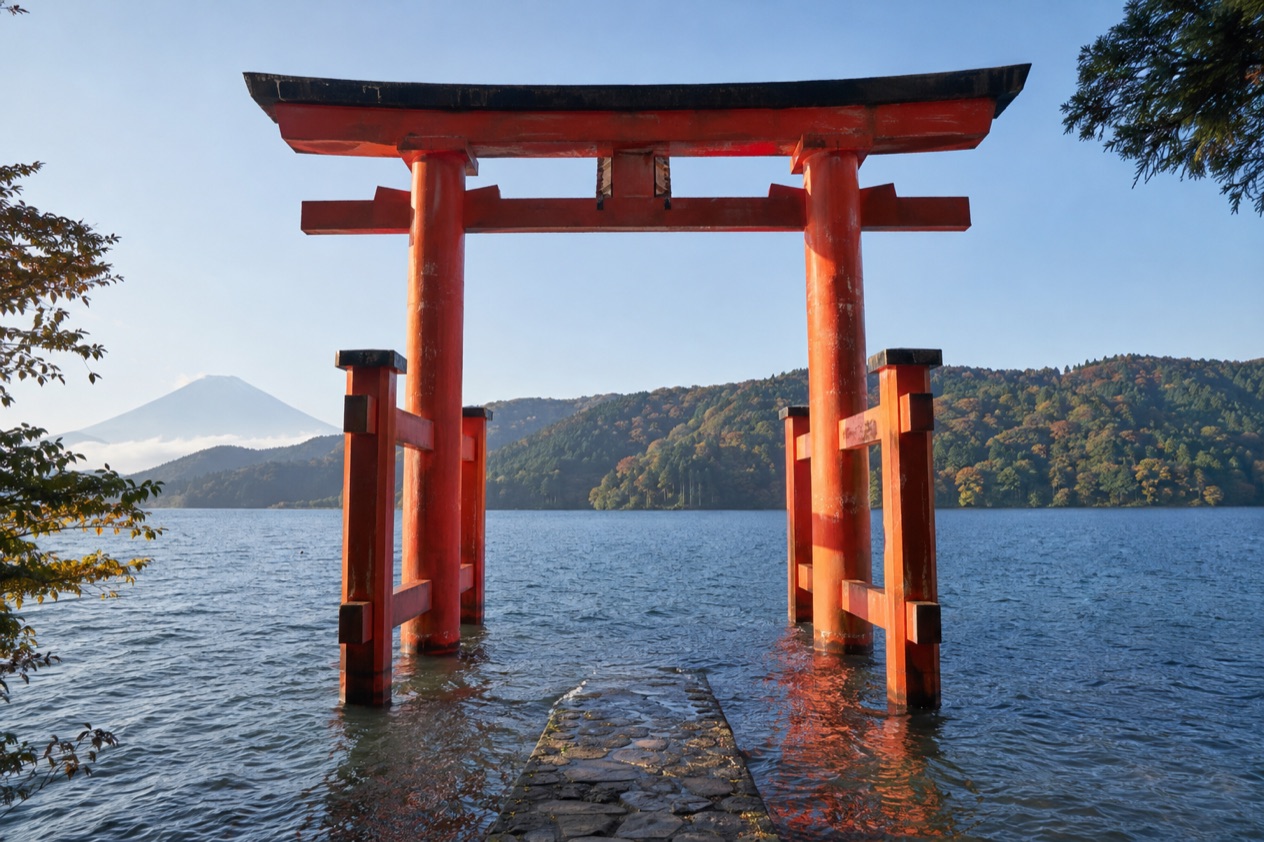
You cross the water on a boat that makes the lake feel like part of the route rather than a destination, with wooded slopes around you and, on a clear day, Mount Fuji on the skyline.
October suits the crossing because the heat of September has gone and a jacket makes the deck comfortable. If cloud sits on the mountain, the lake still has its own mood, with mist around the ridges and the shore blurred. Bring the layers, since the open deck is exposed to the weather.
Owakudani and its black eggs
Owakudani is the volcanic valley where the ground steams and the air smells of sulfur. You eat them there, standing among the vents, and the cool October air makes the steam all the more visible.
The Hakone Ropeway is part of the Freepass, and it gives a view of the valley from above. Because the mountain side of Hakone collects so much of the month’s rain, a wet day here means low cloud and damp paths. The sulfur and steam do not need sunshine to impress.
Art museums and the open-air museum
On a dry day you walk among them in cool air, and on a wet one the indoor galleries take over.
With a Hako Ticket Plus, applicable art museums and activity facilities are covered by the same ticket. That turns the rainy half of the month into a reason to go inside rather than a problem to solve.
Hot springs and the ryokan evening
Hakone is a notable spa town, and its hot springs lie within view of Mount Fuji. In October the bath is most welcome. After a day of boats and ropeways in cool air, the soak in mineral water is the part of the trip people remember.
A traditional ryokan adds a routine of its own. Shoes come off at the entrance, yukata are worn through the building, and dinner is served at a set hour.
Seasonal food here means warm bowls and small sweets from shop counters, and the cool air makes both taste better.
A two-day itinerary for Hakone in October
Day 1 starts in Hakone-Yumoto, with a walk past its restaurants and gift shops and a late-morning meal at a noodle or tempura counter. Then the Hakone Tozan Train carries you into the hills. From there the ropeway rises to Owakudani, where the black eggs and the smell of sulfur wait among the steam vents. Wear the layers, because the mountain side catches more rain than the lowlands.
The days are shorter in October, so the boat ride closes out the sightseeing while light remains. Evening belongs to the ryokan: a hot spring bath, then a seasonal dinner at the set hour, in yukata.
Day 2 turns to art. Spend the morning in Sengokuhara, going through its museums, and the afternoon at the open-air museum, where the sculptures stand among the trees. If rain moves in, the indoor galleries carry most of the day. A Hako Ticket Plus also covers applicable hot springs, so a second soak is the rain card for a damp afternoon. Finish with dinner at a restaurant in town before heading home.
Is Hakone busy in October?
Hakone is a busy destination in any month, and October is no exception, given how close it is to Tokyo and how well it is known for its views of Mount Fuji.
The town is described as extremely popular among tourists, and the pull of hot springs grows as the air cools. The month sits between the humid weeks of September and the cold of November, which makes a bath and a mountain view more appealing than they were a few weeks earlier. The pace is that of a spa town on the edge of a national park, with day visitors and overnight guests moving along the same loop of train, ropeway and boat.
Sengokuhara, with its museums, has a different rhythm, built around slow gallery visits. The Freepass ties the places together, so travelers move through the same stops in similar order.
What to pack for Hakone in October
Pack for cool air, wet mountains and a lot of getting in and out of baths and shoes.
- A light sweater and a jacket, because lowland afternoons are mild and the evenings cool.
- A rain jacket, since the mountain side collects heavy rain in October.
- Shoes that slip on and off, since shoes come off at a ryokan entrance.
- A warm layer for the cruise on Lake Ashinoko, where the deck is open.
- A small bag for a towel and toiletries on the way to a hot spring.
Good to know before you go
September is the wettest month in Hakone, and October still carries a lot of rain on the mountain side. Plan an indoor option for each day, such as an art museum or a hot spring.
The Japan Meteorological Agency runs an Emergency Warning System, launched on 30 August 2013, to alert people to the likelihood of catastrophes from natural phenomena of extraordinary magnitude. The Japan National Tourism Organization also provides a Japan Safe Travel Information page, with safety tips and government information for travelers.
Hakone in October vs September and November
Going four weeks earlier brings warmer air and more rain. September is the wettest month in Hakone, and the mountain side receives 17.67 inches of it. Days are longer, which gives the lake and the ropeway more hours, but a hot spring bath is less of a draw in the humid heat.
Going four weeks later brings cooler air, a drier mountain and more sunshine. The mountain side drops to 7.76 inches of rain, and the days shorten further, so sightseeing ends sooner. The hot spring becomes more welcome, and Lake Ashinoko and Owakudani are cooler to walk around.
Travelers who want warm afternoons and long light should lean toward September. Those who want a hot spring in cool air, with less rain on the mountain, will lean toward November. October sits in the middle, with mild lowland days, a wet mountain side and the bath at its most appealing.
Is October a good time to visit Hakone?
Yes, October is a good time for travelers who come for hot springs, art museums and a ride on the lake, and who do not mind carrying a rain jacket.
It suits couples and solo travelers who want a slow stay in a spa town. It is less ideal for anyone who needs a dry, clear day for a single view of Mount Fuji, since the mountain side is wet this month.
On arrival, start with the Hakone Freepass, since it ties the train, ropeway and boat into one route. Then leave room in the schedule for the bath. October in Hakone is the month when steam, sulfur and warm mineral water make the most sense, and the black egg tastes best in the cool air.
Sources
- Japan Meteorological Agency (JMA), Normal values 1991-2020, monthly (https://www.data.jma.go.jp/stats/etrn/view/nml_amd_ym.php?prec_no=46&block_no=1008), station Odawara, elevation 14 m, checked October 11, 2026
- Computed from the date and the latitude of the place (sunrise equation, solar elevation -0.833 degrees), October 11, 2026
- Japan Meteorological Agency, Emergency Warnings (https://www.jma.go.jp/jma/en/Emergency_Warning/ew_index.html), checked October 11, 2026
- Japan National Tourism Organization, safety information (https://www.japan.travel/en/japan-safe-travel-information/), checked October 11, 2026
- Japan National Tourism Organization, weather and seasons in Japan (https://www.japan.travel/en/plan/weather/), checked October 11, 2026
- Japan Meteorological Agency, maple color-change dates 2025-2026 with difference from the 1991-2020 normal (https://www.data.jma.go.jp/sakura/data/phn_014.html), checked October 11, 2026
- Japan Meteorological Agency, kaede2020.pdf (https://www.data.jma.go.jp/sakura/data/kaede2020.pdf), checked October 11, 2026
- Japan National Tourism Organization, festivals and events (https://www.japan.travel/en/see-and-do/festivals-and-events/), checked October 11, 2026
- Wikipedia, Matsuri (https://en.wikipedia.org/wiki/Matsuri), checked October 11, 2026
- Wikipedia, Takayama Festival (https://en.wikipedia.org/wiki/Takayama_Festival), checked October 11, 2026
- Japan National Tourism Organization, Hakone (https://www.japan.travel/en/destinations/kanto/kanagawa/hakone-and-around/), checked October 11, 2026
- Hakone Tourist Information (https://www.hakonenavi.jp/international/en/), checked October 11, 2026
- Wikipedia, Hakone, Kanagawa (https://en.wikipedia.org/wiki/Hakone,_Kanagawa), checked October 11, 2026
- Wikivoyage, Hakone (https://en.wikivoyage.org/wiki/Hakone), checked October 11, 2026
To plan your stay
- Things to Do in Hakone: Lake Ashi, Owakudani, Open-Air Museum and Hot Springs
- Where to Stay in Hakone: Hakone-Yumoto, Lake Ashi, Sengokuhara and Ryokan Stays
- Hakone from Tokyo: Romancecar, Shinkansen, Local Trains and the Hakone Freepass
- Know Before You Go to Hakone: Getting There, the Freepass, Weather and Etiquette