
On the first mornings of the year, steam rises from the outdoor baths of Hakone while the cool air settles over the valley, and the New Year dishes called osechi arrive at the table in lacquered boxes. The restaurants of Hakone-Yumoto and the ryokan up the mountain settle into a winter rhythm built around hot water, warm food and long evenings. January suits travelers who come for the onsen, the art museums and the lake, and who are happy to dress in layers for it.
What is the weather like in Hakone in January?
January in Hakone is cold but often bright, with cool afternoons at the foot of the mountains and a wetter, colder climb toward the lake and the volcanic valley.
| Month | Average high (°F) | Average low (°F) | Precipitation (in) | Hours of sunshine | Daylight on the 15th |
|---|---|---|---|---|---|
| December | 55.4 | 37.6 | 2.94 | 171 | 9 h 48 min |
| January | 51.1 | 33.1 | 3.30 | 180 | 10 h 01 min |
| February | 52.3 | 34.3 | 3.52 | 160 | 10 h 54 min |
These air figures belong to Odawara, at the foot of Hakone. Afternoons there stay near the low 50s, which is jacket weather for a walk through town, and nights drop close to freezing.
January is one of the sunnier months of the year here, so a day of blue sky is a real possibility, and a pair of sunglasses is useful on the lake. Still, the climb brings cooler air and cloud, so what feels mild in Odawara can feel properly wintry at the ropeway stations. A warm coat, a hat and gloves earn their place in the bag.
Daylight lasts a little over ten hours in mid-January, so the afternoon light fades early. Plan the lake and the viewpoints for the middle of the day and keep the evening for a hot bath and dinner.
What to do in Hakone in January
The great pleasure of January in Hakone is the hot spring. Hakone is a spa town, and bathing outdoors in cold air is what the season is for.
Many ryokan serve a multi-course dinner and a breakfast of grilled fish, rice and miso soup, and the hours between the two are spent soaking, resting in a yukata (a light cotton robe) and walking the corridors in slippers. In the first days of the year, the Japanese New Year brings osechi dishes, and during the New Year holidays many restaurants and attractions are closed, so the first days of the month can be quiet in a different way.
Prunus mume, the Japanese plum, typically flowers from January until late February in East Asia, so you may see early plum blossoms in gardens as the month goes on. They are a small sign of spring in a landscape that is otherwise bare and brown.
Lake Ashi, Owakudani and the ropeway
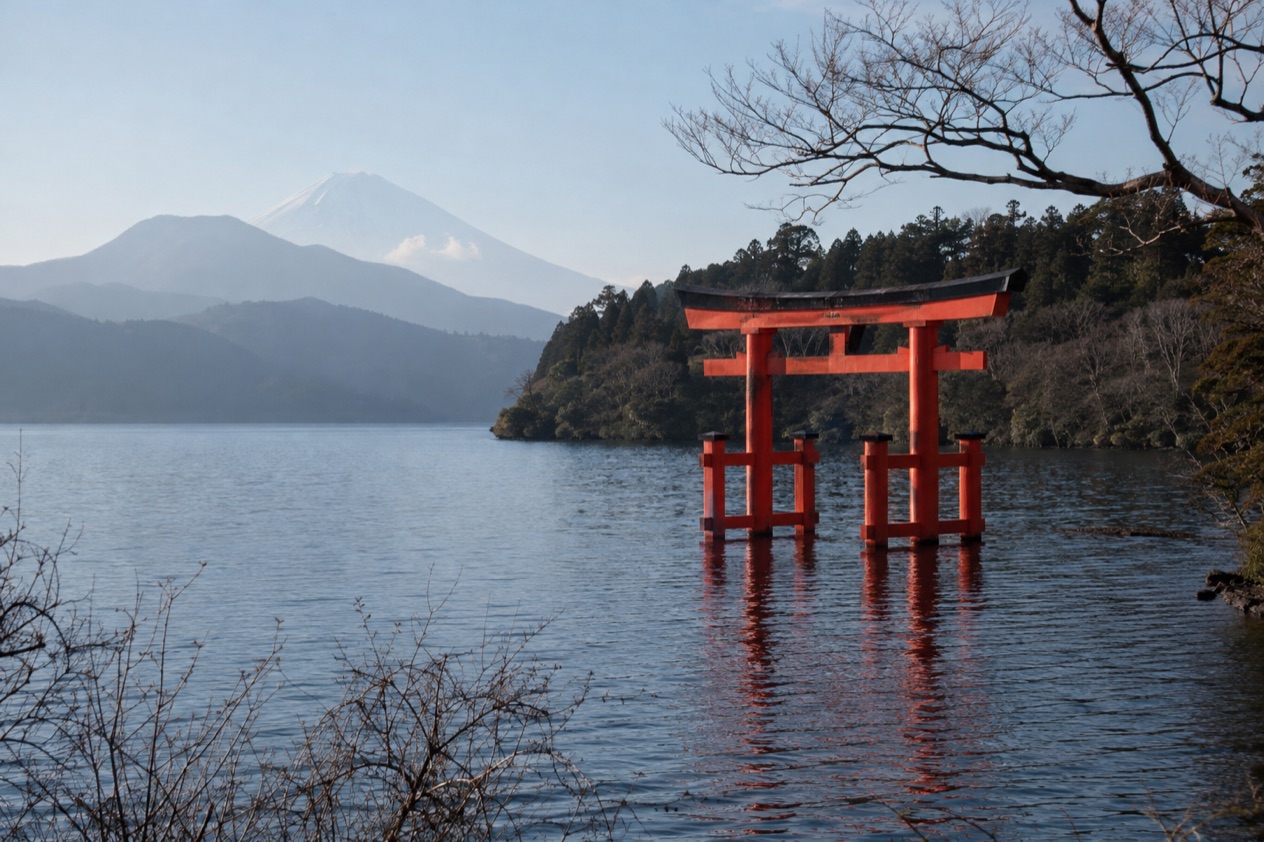
Lake Ashi is a crater lake at the heart of the national park, and visitors explore it by boat on the Hakone Sightseeing Cruise. In winter the air over the water is sharp, and on a clear day the views of Mount Fuji can open up across the lake. It is worth dressing for wind on deck.
The Hakone Ropeway links Sounzan and Togendai by way of Owakudani, a volcanic valley with active sulphur vents and hot springs. Steam drifts from the hillside, and the smell of sulphur is part of the experience.
Owakudani is where you taste the black eggs, boiled in the hot springs and said to prolong life. Pair the ropeway with the lake cruise for a loop across the mountains, and carry a warm layer, since the upper stations are colder than the town below.
Art museums in Sengokuhara and the Open-Air Museum
Sengokuhara is filled with art museums, which makes it a natural base for a cold or wet day. The Hakone Open-Air Museum, Japan’s first open-air museum, opened in 1969 and mixes sculpture in the landscape with indoor galleries, so it works in both clear and gray weather. Seeing sculpture against winter hills, with a cool breeze and bare trees, is a different experience from a summer visit.
Walk outdoors when the sun is out, then step inside to warm up. A museum visit followed by a soak at your ryokan makes a complete day, and a bowl of hot noodles in between fits naturally.
Hakone-Yumoto and getting around
Hakone-Yumoto is known for its many restaurants and gift shops, and it is the gateway to the mountain. The Hakone Tozan Train, the ropeway and the cruise are among the eight modes of transport covered by the Hakone Freepass, which gives unlimited rides. The Freepass Hako Ticket Plus adds art museums, hot springs and activity facilities, and is valid for 2 days or 3 days.
A ryokan stay shapes the schedule. Visitors staying at a traditional ryokan should plan to arrive at least one day after landing in Tokyo to avoid missing dinner or being locked out at curfew time. Shops in rural areas often close earlier, sometimes as early as 6:00 p.m., so plan your errands for the afternoon.
A two-day itinerary for Hakone in January
Day 1 begins in Hakone-Yumoto, the gateway to the mountains, with a hot breakfast and a look at the gift shops. From there the Hakone Tozan Train carries you uphill into colder air, and the late morning is for the ropeway over Owakudani, where steam rises from the valley and the black eggs wait. Dress warmly, because the upper stations are noticeably chillier than the town.
Around midday, ride down to Lake Ashi and take the Hakone Sightseeing Cruise while the light is best, since daylight is short in January. Lunch can be noodles or a set meal in a lakeside restaurant. By late afternoon, check in at your ryokan, soak in the outdoor bath and settle in for the kaiseki-style dinner.
Day 2 is for Sengokuhara and its art museums, ending at the Hakone Open-Air Museum, where sculptures stand in the winter landscape. Walk outdoors if the sky is clear. If rain or cloud arrives, spend longer in the galleries and finish with one more soak.
In the afternoon, return to Hakone-Yumoto for a last meal among its restaurants and a stop for gifts before the shops close. Since the sun sets early, the town feels cozy by dinnertime, and a warm bowl of soup is a fine way to end the trip.
Is Hakone busy in January?
Hakone is extremely popular with tourists because of its closeness to Tokyo and its views of Mount Fuji, and January keeps that draw alive, with a rhythm shaped by the New Year holidays.
In the first days of the month, many restaurants and attractions are closed during the New Year holidays, so the pace changes. Some places pause, and the town can feel slower before it picks up again. When a national holiday falls on a Sunday, the next working day becomes a public holiday, so a long weekend can change the feel of a given week.
January is not the season of cherry blossoms or autumn leaves, so the draw here is the hot spring, the lake and the cold, clear air. That gives the month its own character: visitors come to soak and to see Fuji, not to chase a bloom. Rooms and tables are a matter for your own dates, and with the New Year closures it helps to look at the holiday calendar before settling on a day.
What to pack for Hakone in January
Nights near freezing and a colder mountain mean layers, with a few extras for wet or windy days.
- A warm coat, because the ropeway and the lake deck are colder than the town.
- A hat and gloves for the cruise and the mountain stations.
- Waterproof shoes with grip, since the mountain side gets more precipitation.
- Easy-to-remove layers, for stepping between cold air and warm museums.
- Sunglasses, as January brings plenty of sunshine.
- A small bag for a change of clothes at the ryokan.
Good to know before you go
January falls in the cold season, so the main thing to plan around is the cold and the New Year closures. During the New Year holidays, many restaurants and attractions are closed, so the first days of the month need extra planning. Rural shops often close earlier, sometimes as early as 6:00 p.m. The Hakone Freepass is valid on eight modes of transport, including the Hakone Tozan Train, the ropeway and the cruise, which fits a loop of the mountain.
Hakone in January vs December and February
Moving the trip to December brings slightly milder air, with afternoons a few degrees warmer and a little less precipitation up on the mountain. The days are the shortest of the year, so the light fades even earlier. December also comes with its own holiday rhythm leading up to the New Year closures.
February is a little wetter on the mountain side, with the most precipitation of the three months, and it has the least sunshine. The days are longer than in January, so there is more light for the lake and the museums. The Japanese plum continues to flower until late February, so early blossoms linger.
If you want more sun and don’t mind the New Year closures, January fits well. If you prefer longer evenings of light, February gives them. Travelers who want the mildest air should look to December.
Is January a good time to visit Hakone?
Yes, January is a good time to visit Hakone for travelers who want hot springs, bright winter days and a calm mountain landscape, and who are willing to dress warmly. It is less suited to anyone who wants mild weather or full opening of every restaurant in the first days of the year.
Soaking in an outdoor bath, taking a cruise on Lake Ashi and walking among sculptures all suit the season, and the sun-filled days help. Travelers set on a particular bloom or on hiking in warm air would do better in another month.
On arrival, settle into your ryokan, take the first soak and leave the mountain loop for the sunniest hours. What is special about January here is the contrast: cold air on the face, hot water on the shoulders, and steam rising from the valley.
Sources
- Japan Meteorological Agency (JMA), Normal values 1991-2020, monthly (https://www.data.jma.go.jp/stats/etrn/view/nml_amd_ym.php?prec_no=46&block_no=1008), station Odawara, elevation 14 m, checked October 11, 2026
- Computed from the date and the latitude of the place (sunrise equation, solar elevation -0.833 degrees), October 11, 2026
- Japan National Tourism Organization, shop and attraction hours, national holidays (https://www.japan.travel/en/plan/business-hours-and-holidays/), checked October 11, 2026
- Wikipedia, Japanese New Year (https://en.wikipedia.org/wiki/Japanese_New_Year), checked October 11, 2026
- Wikipedia, Public holidays in Japan (https://en.wikipedia.org/wiki/Public_holidays_in_Japan), checked October 11, 2026
- Japan National Tourism Organization, winter in Japan (https://www.japan.travel/en/guide/winter-guide/), checked October 11, 2026
- Japan National Tourism Organization, skiing and snowboarding in Japan: regions, resorts, seasons (https://www.japan.travel/en/sports/snow/), checked October 11, 2026
- Wikipedia, Climate of Japan (https://en.wikipedia.org/wiki/Climate_of_Japan), checked October 11, 2026
- Japan National Tourism Organization, weather and seasons in Japan (https://www.japan.travel/en/plan/weather/), checked October 11, 2026
- Japan National Tourism Organization, skiing guide (https://www.japan.travel/en/guide/skiing/), checked October 11, 2026
- Wikipedia, List of ski areas and resorts in Japan (https://en.wikipedia.org/wiki/List_of_ski_areas_and_resorts_in_Japan), checked October 11, 2026
- Japan National Tourism Organization, flowers by season: cherry blossom, plum, wisteria, hydrangea, where and when (https://www.japan.travel/en/see-and-do/flowers/), checked October 11, 2026
- Wikipedia, Prunus mume (https://en.wikipedia.org/wiki/Prunus_mume), checked October 11, 2026
- Japan National Tourism Organization, Hakone (https://www.japan.travel/en/destinations/kanto/kanagawa/hakone-and-around/), checked October 11, 2026
- Hakone Tourist Information (https://www.hakonenavi.jp/international/en/), checked October 11, 2026
- Wikipedia, Hakone, Kanagawa (https://en.wikipedia.org/wiki/Hakone,_Kanagawa), checked October 11, 2026
- Wikivoyage, Hakone (https://en.wikivoyage.org/wiki/Hakone), checked October 11, 2026
- Wikipedia, Hakone Open-Air Museum (https://en.wikipedia.org/wiki/Hakone_Open-Air_Museum), checked October 11, 2026
- Wikipedia, Hakone Ropeway (https://en.wikipedia.org/wiki/Hakone_Ropeway), checked October 11, 2026
- Wikipedia, Ōwakudani (https://en.wikipedia.org/wiki/%C5%8Cwakudani), checked October 11, 2026
- Wikipedia, Lake Ashi (https://en.wikipedia.org/wiki/Lake_Ashi), checked October 11, 2026
To plan your stay
- Things to Do in Hakone: Lake Ashi, Owakudani, Open-Air Museum and Hot Springs
- Where to Stay in Hakone: Hakone-Yumoto, Lake Ashi, Sengokuhara and Ryokan Stays
- Hakone from Tokyo: Romancecar, Shinkansen, Local Trains and the Hakone Freepass
- Know Before You Go to Hakone: Getting There, the Freepass, Weather and Etiquette