
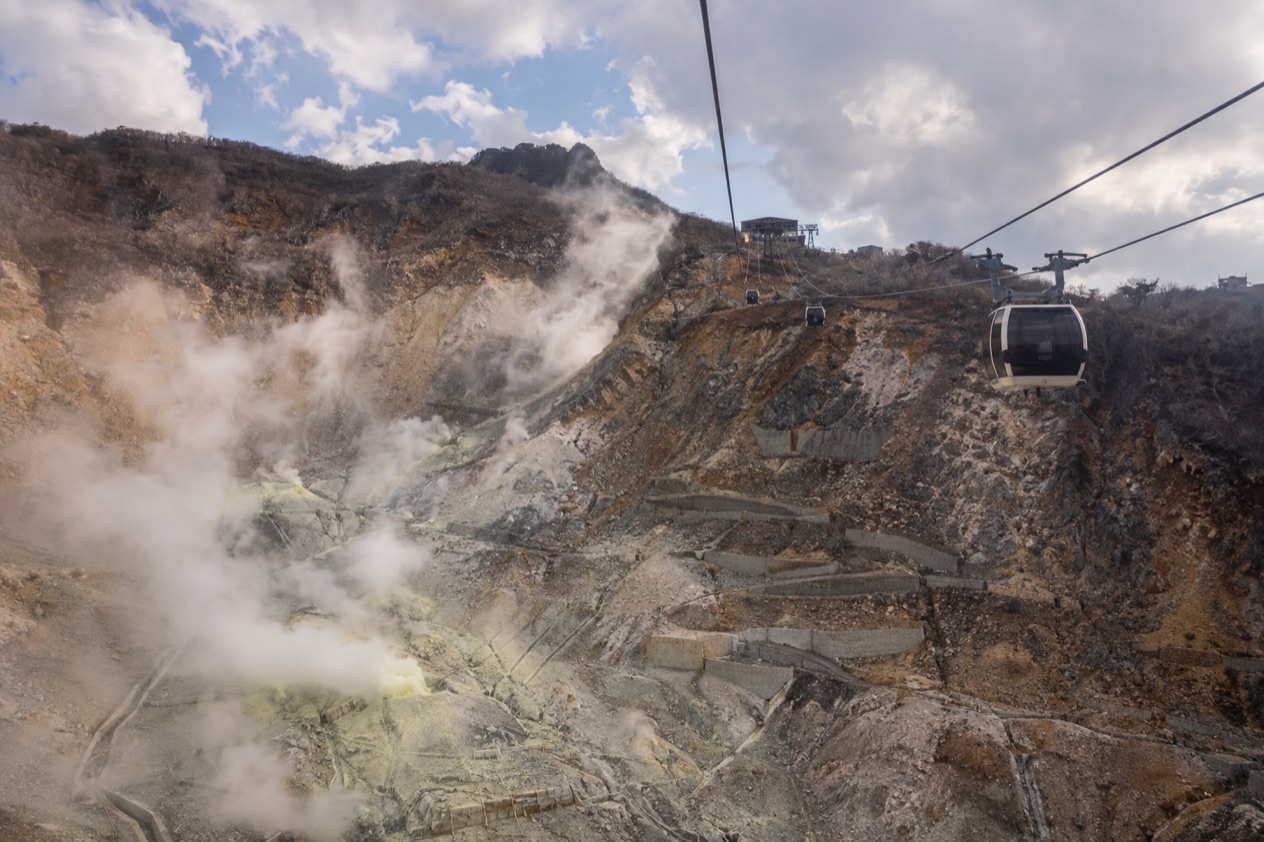
The cabin swings out over a forested ridge, and then the slope changes color. Pale, scarred ground opens up below, white-yellow vents hiss, and the smell of sulfur reaches you before the station does. This is Owakudani, the steaming valley that sits at the middle of the Hakone Ropeway, and a ride here is as much about the landscape under your feet as about the lift itself.
Is visiting the Hakone Ropeway and Owakudani worth it?
Yes, if you want to see Hakone as a working volcano rather than only as a string of hot spring towns and lakeside views. The ropeway is the way many travelers reach Owakudani, and the ride itself is part of the point: you glide above the valley, look down on active sulfur vents, and on clear days look out toward Mount Fuji. It suits anyone who likes landscapes with a bit of drama, and it pairs well with a day that also includes Lake Ashi.
What sets it apart from the other things to do around Hakone is that nothing else on the route shows the volcano so directly. The art museums of Sengokuhara are indoors and quiet in spirit, the restaurants and gift shops of Hakone-Yumoto are a town pleasure, and the cruise on Lake Ashi is about open water and the shoreline. Owakudani is the stop with steam, mineral smell and a bare, rocky slope, created around 3,000 years ago by the explosion of the Hakone volcano.
It also comes with a small ritual. Owakudani is known for kuro-tamago, eggs boiled in the sulfur-rich hot spring water until the shells turn black, and eating one is said to add seven years to your life. People take the saying lightly, and the black egg has become the souvenir you eat on the spot. Anime fans may also recognize the valley, which appears in Neon Genesis Evangelion and its manga adaptation.
The visit has limits worth knowing before you plan around it. The hiking trail at the valley has been closed since 2015, and people with certain health conditions are advised not to enter the valley at all. Those points are laid out in the rules section, and they shape the visit more than any schedule does.
What to see at the Hakone Ropeway and Owakudani
The ropeway runs between Sounzan and Togendai, with Owakudani in the middle and Ubako as another station along the line. Each station sits at a different height, and the climb and descent are what give the ride its changing views.
| Station | Elevation (m) |
|---|---|
| Sounzan | 757 |
| Owakudani | 1,044 |
| Ubako | 878 |
| Togendai | 741 |
The ropeway ride
The Hakone Ropeway opened on December 6, 1959, and it has been operated by the Odakyu Group. In 2002 it became a funitel, a type of cabin lift hung from a pair of cables, the second of its kind in Japan. Each cabin holds 18 passengers, so you ride in a roomy glass box with a view out on every side rather than in a small gondola.
The line is 2.5 miles long in all, split into a section of 0.9 miles between Sounzan and Owakudani and a longer one of 1.6 miles between Owakudani and Togendai. The cabins move at about 11 mph, a pace that leaves time to look.
Watch the vegetation thin out as you approach the valley, then pick out the vents below. It is part of the sightseeing route between Odawara and Lake Ashi, which is why many people ride the whole line instead of getting off at the midpoint.
Owakudani Station and the Earth Valley observation area
A new tourist spot has opened at Owakudani, built around the Earth Valley Observation Area and the new Owakudani Station. This is where you step out of the cabin and onto the rim of the valley, and where the view is widest. On clear days the station looks out to Mount Fuji, and below the visitor center you can see the sulfur vents working away on the slope.
OWAKUDANI KITCHEN has opened at the Earth Valley observation area, giving you a place to eat with the valley in front of you. Treat the observation area as the main event of the stop: you look, you breathe the sulfur air, you take photos, and then you decide whether to go on to the next station or back the way you came.
The valley and its vents
Owakudani is a volcanic valley with active sulfur vents and hot springs. The ground is bare in places and stained in yellows and whites, and plumes of steam rise from cracks in the slope. The valley is a reminder that Hakone’s hot springs, the ones the region is known for far beyond Japan, come from the same volcanic heat.
What you see is seen from the station and the observation area. A trail of about 0.6 miles (0.62 miles) once led through the valley, but it has been closed since 2015 because of increased volcanic activity. The tourist site closed in May 2015 and reopened on April 27, 2016, though not fully, which is why the views from the platform and the cabins matter so much here.
Kuro-tamago, the black eggs
The eggs are simply hard-boiled, but they are boiled in the sulfur-rich hot spring water of the valley, and that is what turns the shells black. Inside, they look like any hard-boiled egg. They are sold in small bags and eaten on the spot, often peeled in the open air with steam drifting past.
The tradition says one egg adds seven years to your life, and it is common to hear visitors count out how many they would need. The Japan National Tourism Organization lists tasting Owakudani’s black eggs among the pleasures of Hakone, next to the hot springs, boat trips on Lake Ashinoko and the open-air art installations of Japan’s first open-air museum.
Hours, tickets and rules
The ropeway is run by the Odakyu Group, and the official times for trains and buses around Hakone come from the Odakyu Hakone Group. Fares and operating hours are theirs to set, and they change with maintenance periods, when a replacement bus service runs on sections of the line. The pass most visitors to Hakone know is the Hakone Freepass, which gives unlimited rides on eight kinds of transport, including the Hakone Tozan Train, the Hakone Ropeway and the Hakone Sightseeing Cruise.
A newer version, the Hakone Freepass Hako Ticket Plus, combines the Digital Hakone Freepass with the Hako Ticket, which covers applicable art museums, hot springs and activity facilities. It is valid for 2 days or 3 days, and a version with an Odakyu Line ticket includes one return trip on the Odakyu Line between your departure station and Odawara Station.
The rules that matter here come from the volcano. The hiking trail at Owakudani has been closed since 2015 due to increased volcanic activity.
People with asthma, bronchitis, heart disease or a heart pacemaker, and pregnant women, are advised not to enter the Owakudani valley because of high volcanic activity. On the route-planning side, the route search and timetable search on the official Hakone website work only for transfers within Hakone or to the Odakyu Line or the Odakyu Highway Bus.
How to get to the Hakone Ropeway and Owakudani
You can reach Owakudani by the Hakone Ropeway itself, getting off at Owakudani Station. The line links Sounzan and Togendai via Owakudani, all within Hakone in Kanagawa Prefecture, and it forms part of the sightseeing route between Odawara and Lake Ashi. Start at Sounzan and you ride up to the valley, then on to Togendai. Start at Togendai and you do the same in the other direction.
The other way in is by road. A bus line, the Izuhakone Bus, runs from Odawara Station, Hakone-Yumoto Station and Kowakidani Station and Kojiri, and it serves the Owakudani Bus Stop. That gives you a way to reach the valley without riding the cable line, and a way to leave it too if the cabins are under maintenance.
During scheduled maintenance, a replacement bus service operates on sections of the ropeway, so the day you travel may mix cabin and bus. The Hakone Freepass is built around exactly this kind of mixed day, since it covers the ropeway along with the Hakone Tozan Train and the Hakone Sightseeing Cruise. For the timing of any leg, the Odakyu Hakone Group provides the official times for trains and buses in the Hakone area.
Hakone itself lies in the western part of Kanagawa Prefecture and is part of the Fuji-Hakone-Izu National Park. Hakone-Yumoto, known for its restaurants and gift shops, is one of the bases you can start from, and Odawara is another.
When to visit the Hakone Ropeway and Owakudani
Any month gives you the valley, but the weather decides what you see from the cabin. Clear days bring the view of Mount Fuji, and gray or wet days take it away while the steam and the smell remain. The rain figure for the mountain side of Hakone, at 855 m, is given alongside.
| Month | Average high (°F) | Average low (°F) | Rain at Odawara (in) | Rain on the mountain side (in) | Sunshine at Odawara (hours) |
|---|---|---|---|---|---|
| January | 51.1 | 33.1 | 3.30 | 5.03 | 180 |
| April | 66.0 | 48.6 | 7.15 | 12.67 | 177 |
| July | 84.2 | 71.6 | 8.50 | 16.74 | 163 |
| October | 72.0 | 57.4 | 9.40 | 15.90 | 131 |
January brings the most sunshine of the four months and the least rain, with cold lows at the foot of the mountain. That suits anyone who wants the best chance of a view and does not mind winter air. April is milder, though the mountain side gets a lot of rain, so a showery day is possible.
July is warm and wet at both levels, with the lowest sunshine figure of the summer months here. October, the month of this writing, is pleasant at the foot of the mountain, with highs in the low 70s, but it is also one of the wetter months on the mountain side and the least sunny of the four. If a clear sky matters to you, January is the month of the four with the stronger case.
No festival or fixed date in this material ties the visit to a particular day. The seasons shape it instead: the cold bright days of winter, the showers of spring, the humid heat of July and the cooler, grayer feel of October.
Tips for your visit
Plan the ropeway as part of a larger Hakone day rather than a stand-alone outing. The line is part of the route between Odawara and Lake Ashi, so it fits naturally into a loop that also includes a cruise. The Hakone Sightseeing Cruise Ship Royal II has been newly renovated, and the Victory and Moto-Hakone Port have been remodeled and updated for an elegant cruise on Lake Ashi, which offers views of Mount Fuji.
If art appeals more than volcanoes, Sengokuhara is filled with art museums, and the Hako Ticket side of the Freepass Plus covers applicable art museums, hot springs and activity facilities. A hot spring bath is the traditional end to a day here, since Hakone is renowned for its natural hot springs. Hakone-Yumoto, with its many restaurants and gift shops, is a place to eat and browse once you come back down.
At Owakudani, give yourself time on the observation area and a stop for kuro-tamago. Bring what you would for any mountain day in the weather of the month you choose, and remember that the valley air smells of sulfur. That smell is part of the place and comes with the vents you came to see.
Families and travelers with health concerns should read the advisory first: people with asthma, bronchitis, heart disease or a pacemaker, and pregnant women, are advised not to enter the valley.
Because the trail is closed, do not plan a walk through the valley. The visit is a ride, a look from the platform, a meal or an egg, and a ride onward. For fans of anime, a pause at the observation area is a chance to see the landscape that appears in Neon Genesis Evangelion.
Good to know before you go
The volcano is active, and the arrangements around it have changed before: the tourist site closed in May 2015 and reopened in 2016 only in part. Scheduled maintenance on the ropeway brings replacement buses on some sections, so the cabin ride may not run the full line on every day. Official times come from the Odakyu Hakone Group.
Rain is heavier on the mountain side than at the foot of Hakone, most of all in July and October, so a waterproof layer belongs in the bag. The sulfur smell and the steam are part of the stop, and the health advisory for the valley is worth taking seriously before you step off the cabin.
Sources
- Hakone Tourist Information (https://www.hakonenavi.jp/international/en/), checked October 11, 2026
- Wikipedia, Hakone Ropeway (https://en.wikipedia.org/wiki/Hakone_Ropeway), checked October 11, 2026
- Wikipedia, Ōwakudani (https://en.wikipedia.org/wiki/%C5%8Cwakudani), checked October 11, 2026
- Japan National Tourism Organization, Hakone (https://www.japan.travel/en/destinations/kanto/kanagawa/hakone-and-around/), checked October 11, 2026
- Japan Meteorological Agency (JMA), Normal values 1991-2020, monthly (https://www.data.jma.go.jp/stats/etrn/view/nml_amd_ym.php?prec_no=46&block_no=1008), station Odawara, elevation 14 m, checked October 11, 2026
To plan your stay
- Best Time to Visit Hakone: Autumn Leaves, Rainy Season, Weather by Month and Festivals
- Where to Stay in Hakone: Hakone-Yumoto, Lake Ashi, Sengokuhara and Ryokan Stays
- Hakone from Tokyo: Romancecar, Shinkansen, Local Trains and the Hakone Freepass
- Know Before You Go to Hakone: Getting There, the Freepass, Weather and Etiquette