
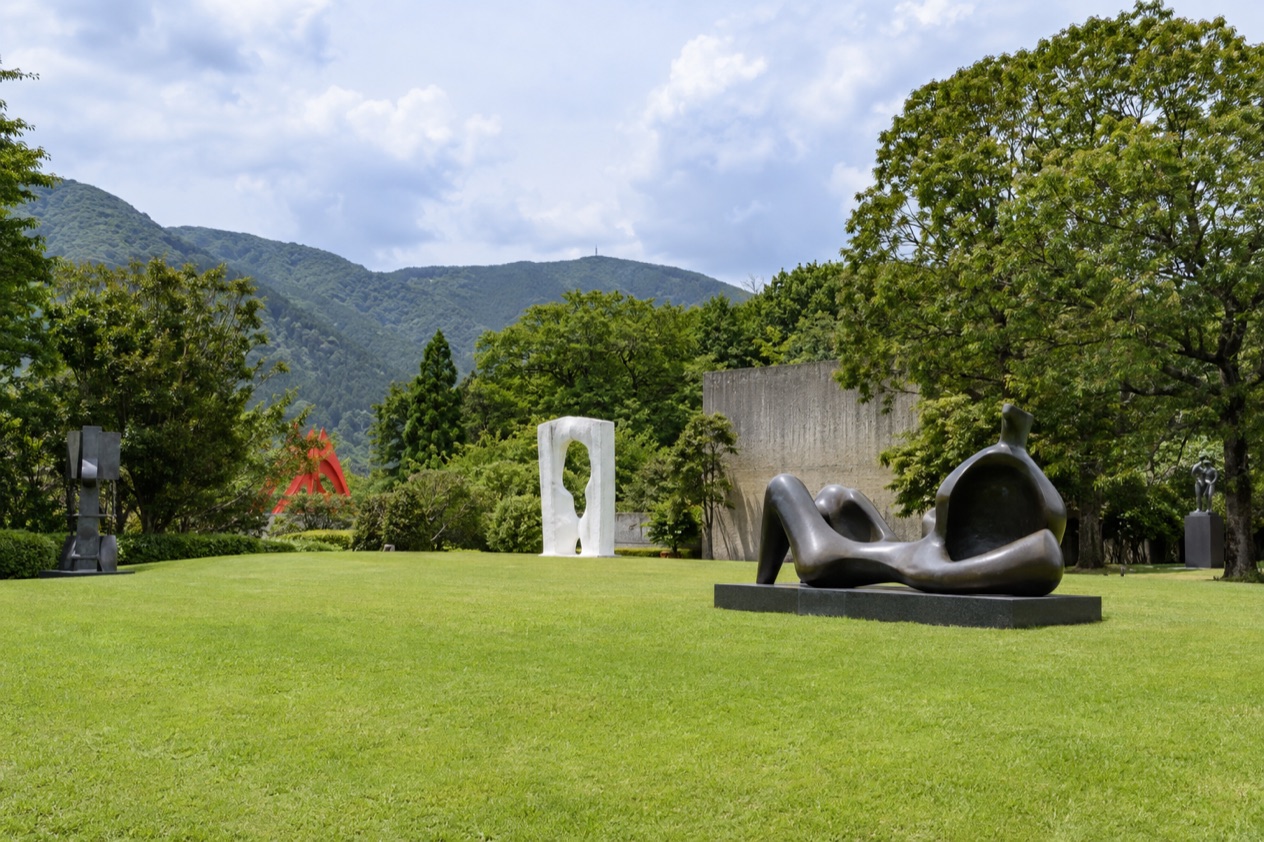
Bronze figures stand out on the lawns with the Hakone hills rising behind them, and visitors drift between the pieces as if strolling through a garden that happens to be full of art. Henry Moore’s rounded forms catch the daylight, children climb into sculptures built for exactly that, and now and then a steaming footbath draws people to sit down. This is Japan’s first open-air museum, and it makes a full outing for anyone spending time in the mountains of Hakone.
Is visiting the Hakone Open-Air Museum worth it?
Yes, if you like art you can walk through rather than file past, and it suits couples, friends and families with children alike. The museum opened in 1969, and its idea has stayed the same since then: sculpture is placed in the landscape, so the weather, the slope of the ground and the hills beyond become part of how you see each piece.
The collection is large. It holds over 1,000 pieces, with works by Pablo Picasso, Henry Moore and Taro Okamoto among others, and about 120 sculptural works are on permanent display across the park.
You do not need to know modern art to enjoy it. A bronze figure on a lawn, a form you can walk around, a piece you are invited to climb into: these work as well for a ten-year-old as for a collector.
What sets it apart from the other art stops in the area is the mix. Sengokuhara, the part of Hakone filled with art museums, offers many places to spend an hour among paintings and objects.
Here the sculpture stays outdoors, a Picasso collection and indoor galleries sit under roofs, and a footbath fed by natural hot spring water lets you rest your feet between the two. Art, open air and onsen culture meet in a single visit, which is very much a Hakone combination.
It is also a good counterweight to the more scenic days in the area. Lake Ashi offers views of Mount Fuji, and Owakudani is known for its black eggs, but both are about the landscape. The open-air museum asks you to slow down and look at things made by people, set in that same landscape.
What to see at the Hakone Open-Air Museum
The museum is built around the idea that you move from one kind of experience to another: sculptures in the open, a dedicated hall for Picasso, galleries indoors, and areas made for play and rest. Start wherever the path pulls you, because the layout is meant for wandering.
The outdoor sculpture park
This is the heart of the museum. Around 120 sculptural works are on permanent display across the park, and works by Henry Moore and Taro Okamoto sit among them. Moore’s pieces, with their smooth hollows and reclining shapes, look different at each turn of the path, and Okamoto’s work brings a more exuberant, almost playful energy to the same grass.
Look at how each piece meets its surroundings. A figure against open sky reads differently from one framed by trees, and the hills around Hakone give every view a backdrop. Walk around the large works instead of stopping at the first angle, and notice how the light and the weather change their surface.
The Picasso Pavilion
Indoors, a hall holds around 300 of Pablo Picasso’s works. It is the part of the visit that rewards a slower pace, and it follows the outdoor park well because the change of scale is striking, from monumental bronze in the open to works made to be seen at arm’s length.
Picasso worked in many materials and styles, and a collection of this size gives you room to see that range.
The five indoor exhibitions
The museum is split into five indoor exhibitions, so the visit is not only a walk outside. They give you somewhere to go when you want a change of pace, and they widen the collection beyond what stands on the lawns.
Think of the galleries as the quiet counterpart to the park. After an hour of fresh air and wide views, a room with works to examine up close is a welcome shift, and it also gives the day a rhythm of outside, inside, outside again.
Play sculptures and the onsen footbath
The museum offers outdoor interactive sculptures for children, which turns an art visit into something young visitors take part in rather than endure. Adults often find themselves drawn to these pieces too, because they change how you think about a sculpture: something to be inside of, not only beside.
The naturally fed onsen footbath is the small Hakone ritual folded into the visit. Sitting with your feet in warm spring water, looking out over the grounds, is a very local way to pause, and it connects the museum to the hot spring culture the region is known for.
Hours, tickets and rules
The Hakone Freepass “Hako Ticket” Plus combines the Digital Hakone Freepass, which allows unlimited use of 8 modes of transport, with the Hako Ticket, which grants unlimited use of applicable art museums, hot springs and activity facilities. It is valid for 2 days or 3 days.
A version of the pass comes with an Odakyu Line ticket and includes 1 return trip on the Odakyu Line between the departure station and Odawara Station. That makes it a pass that covers both the journey into the mountains and the days spent in them, with art museums among the places it opens.
The museum itself is one of several art stops in Hakone, and the way to think about a visit is as part of a day or two in the area rather than an isolated trip. Whether you arrive on a pass or with a separate ticket, the entry and the hours are set by the museum, and the official Hakone website is where the area’s transport and facility information is gathered.
The museum’s identity helps you picture what you are paying for: a park filled with sculpture, a Picasso hall, five indoor exhibitions, play pieces for children and a footbath. Together they make a visit that fills a good part of a day without needing anything else added to it.
How to get to the Hakone Open-Air Museum
The museum is in Hakone, in Ashigarashimo District, Kanagawa Prefecture, and Hakone itself lies in the western part of the prefecture, inside the Fuji-Hakone-Izu National Park. Visitors reach it as part of a wider trip through the area, using the public transport network that Hakone is built around.
The Hakone Freepass offers unlimited rides on eight different transportation means in Hakone, including the Hakone Tozan Train, the Hakone Ropeway and the Hakone Sightseeing Cruise. Hakone-Yumoto, known for its many restaurants and gift shops, is one of the bases in the area. Odawara, at the foot of Hakone, is where the Odakyu Line meets the mountain network.
For times, rely on the official sources. Official times for trains and buses in the Hakone area are provided by the Odakyu Hakone Group. The route search and the timetable search on the official Hakone website work only for transfers within Hakone or to the Odakyu Line or the Odakyu Highway Bus, so they are the tools for planning movement inside the area and the connection back to the line.
Some pieces of the network are being updated. During scheduled maintenance, a replacement bus service operates on sections of the Hakone Ropeway. The Hakone Sightseeing Cruise Ship Royal II has been newly renovated, and the Victory and Moto-Hakone Port have been remodeled and updated. These matter if your day mixes the museum with a ropeway ride or a lake cruise, since the pieces of the loop connect.
When to visit the Hakone Open-Air Museum
Because the sculptures stand outdoors, the season shapes the visit more than it would in a gallery.
| Month | Odawara average high (°F) | Odawara average low (°F) | Odawara rain (in) | Hakone mountain side rain (in) | Odawara sunshine (hours) |
|---|---|---|---|---|---|
| January | 51.1 | 33.1 | 3.30 | 5.03 | 180 |
| April | 66.0 | 48.6 | 7.15 | 12.67 | 177 |
| July | 84.2 | 71.6 | 8.50 | 16.74 | 163 |
| October | 72.0 | 57.4 | 9.40 | 15.90 | 131 |
In January, days at the foot of the mountain are cool and bright, with the most sunshine of the four months, which suits a walk among sculptures if you dress warmly. The mountain side gets more precipitation than the foothills, so expect it to feel colder and damper up in Hakone itself.
April brings mild afternoons and cool mornings, a comfortable temperature for walking outdoors, though the mountain side is already wet. July is warm and humid, and the rain is heavy on the mountain, so the indoor exhibitions and the Picasso Pavilion become the part of the day you lean on.
Rain does not cancel the visit, it changes its order: the galleries and the Picasso hall first, the park between showers. Lake Ashi offers views of Mount Fuji on clear days, which is a reason to keep the schedule flexible if you are pairing the museum with the lake.
Tips for your visit
Plan on a visit that mixes outdoors and indoors, and dress for both. Because the park is open to the sky and the mountain side of Hakone is wetter than the foothills, bring a layer you can add or remove and something for a shower. Comfortable shoes matter in a place where you spend the visit walking between sculptures.
Bring a curious attitude toward the interactive pieces. The outdoor sculptures made for children are a draw for families, and they give older visitors a reason to stop and try something. The onsen footbath is worth keeping time for, since sitting with warm water around your feet is one of the most characteristic Hakone pauses you can take.
The museum fits well into a day of other Hakone stops. Sengokuhara is filled with art museums, so an art-focused day can continue there.
Owakudani now has the Earth Valley Observation Area and the new Owakudani Station, and OWAKUDANI KITCHEN has opened at the observation area, which gives you a meal stop and the place to taste the black eggs said to prolong life. Lake Ashi offers a cruise, and Hakone-Yumoto has restaurants and gift shops for the end of the day.
If you plan several of these stops over two or three days, the Hakone Freepass is built for it, with unlimited rides on its eight kinds of transport. The Hako Ticket Plus adds applicable art museums, hot springs and activity facilities, so a mountain loop of ropeway, cruise, train and museum can sit under a single pass.
Good to know before you go
Weather turns quickly on the mountain, and the rain is heavier there than at the foot of Hakone, so a flexible plan serves better than a fixed one. As in much of Japan, carry your litter with you and keep your voice low in the galleries, as you would in any museum.
Sources
- Hakone Tourist Information (https://www.hakonenavi.jp/international/en/), checked October 11, 2026
- Wikipedia, Hakone Open-Air Museum (https://en.wikipedia.org/wiki/Hakone_Open-Air_Museum), checked October 11, 2026
- Japan National Tourism Organization, Hakone (https://www.japan.travel/en/destinations/kanto/kanagawa/hakone-and-around/), checked October 11, 2026
- Japan Meteorological Agency (JMA), Normal values 1991-2020, monthly (https://www.data.jma.go.jp/stats/etrn/view/nml_amd_ym.php?prec_no=46&block_no=1008), station Odawara, elevation 14 m, checked October 11, 2026
To plan your stay
- Best Time to Visit Hakone: Autumn Leaves, Rainy Season, Weather by Month and Festivals
- Where to Stay in Hakone: Hakone-Yumoto, Lake Ashi, Sengokuhara and Ryokan Stays
- Hakone from Tokyo: Romancecar, Shinkansen, Local Trains and the Hakone Freepass
- Know Before You Go to Hakone: Getting There, the Freepass, Weather and Etiquette