
In May the hillsides above Hakone-Yumoto turn a deep, fresh green, and the smell of sulphur drifts over Owakudani while visitors in light jackets wait for the ropeway cabins. Golden Week has just ended, the lake is dotted with sightseeing boats, and the evenings are mild enough for a slow soak in an outdoor hot spring bath. May is a month for hot springs, art museums and Lake Ashi in warm, spring-like weather.
What is the weather like in Hakone in May?
May is warm and green at the foot of Hakone, with pleasant afternoons and cool nights, but rain is a real part of the month, especially up on the mountain.
| Month | Average high (°F) | Average low (°F) | Precipitation (in) | Hours of sunshine | Daylight on the 15th |
|---|---|---|---|---|---|
| April | 66.0 | 48.6 | 7.15 | 177 | 13 h 03 min |
| May | 73.0 | 56.8 | 7.17 | 182 | 14 h 00 min |
| June | 77.4 | 64.4 | 8.63 | 130 | 14 h 31 min |
At Odawara, at the foot of Hakone, May afternoons reach the low 70s and nights settle in the mid-50s. That means short sleeves at midday in the sun and a sweater or light jacket once the light fades. The spring guide of Japan’s national tourism organization notes that a light jacket or a simple sweater is enough for spring travel, and that fits the evenings here.
The mountain side of Hakone is much wetter than the town below. A compact rain jacket earns its place in the bag, and the museums and bathhouses give you somewhere to go when the clouds close in.
Sunshine builds through April and May and drops off in June as the rainy season approaches, which makes May a bright spot in the spring calendar.
What to do in Hakone in May
May in Hakone begins in the wake of Golden Week, the holiday stretch from late April to early May that includes Showa Day, Constitution Memorial Day, Greenery Day and Children’s Day. The name of Greenery Day suits the mountains well. The slopes are leafing out, and the valleys and lakeshore look their freshest.
The region sits within Fuji-Hakone-Izu National Park, and its hot springs and views of Mount Fuji are what bring people here. Cooler nights make the baths especially pleasant, whether in a ryokan (a traditional inn) or in one of the public bathhouses. Dinner at a ryokan is part of the experience, and visitors staying at one are advised to arrive at least a day after landing in Tokyo so they do not miss the meal or the evening curfew.
Lake Ashi and the sightseeing cruise
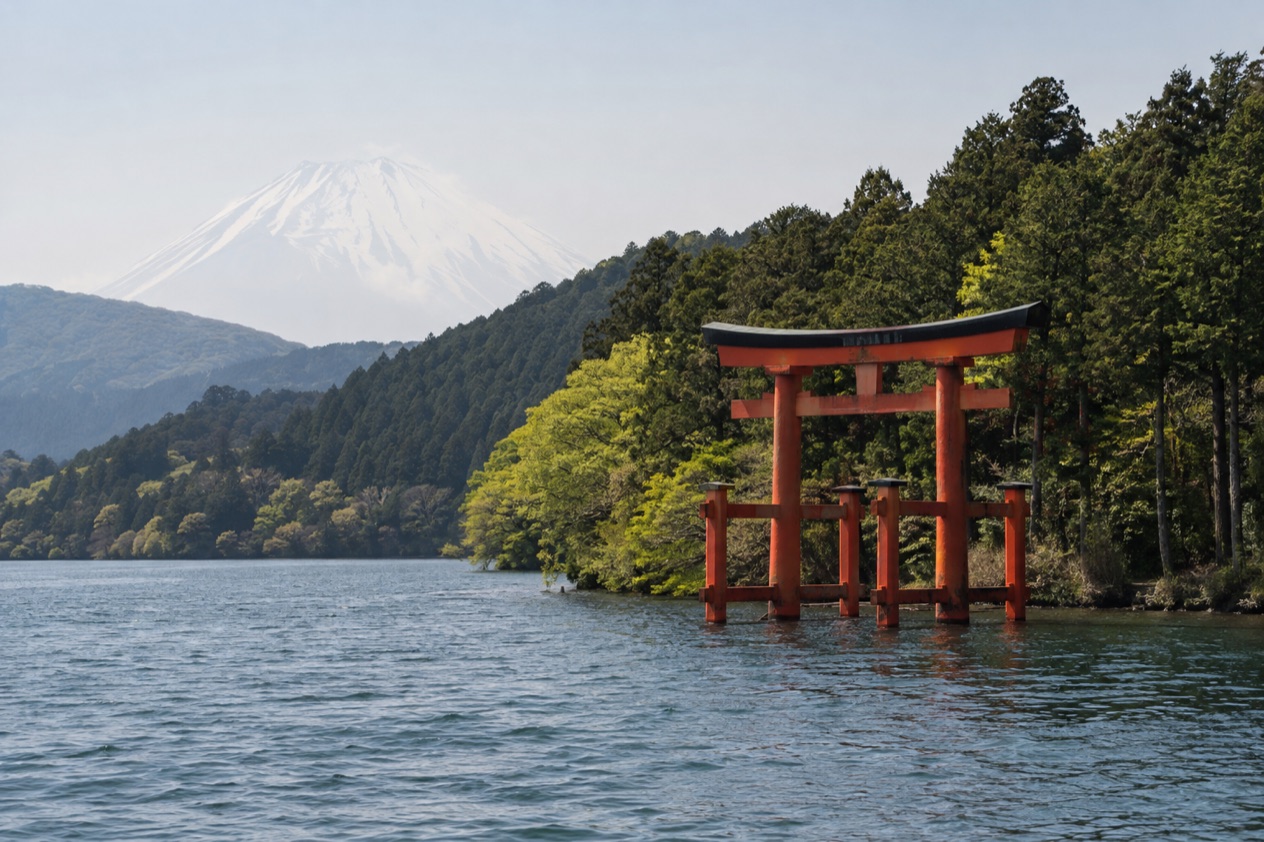
Lake Ashi is a crater lake at the heart of the national park, and the Hakone Sightseeing Cruise is one of the eight modes of transport covered by the Hakone Freepass. Out on the water you look across to forested shores, and when the sky is clear Mount Fuji may appear above the ridge. Clouds are common in the mountains, so treat a Fuji view as a bonus rather than a certainty.
The lakeshore is pleasant for a stroll once the boat ride ends, with May greenery framing the water. If rain sets in, the lake takes on a misty look that many photographers like, and you can retreat to a café or a museum nearby.
Owakudani and the ropeway
The Hakone Ropeway links Sounzan and Togendai via Owakudani, a volcanic valley of active sulphur vents and hot springs. From the cabins you look down on steaming ground and yellow-stained rock, and the smell tells you when you are close. At Owakudani you can taste the black eggs, boiled in the hot spring water and said to prolong life.
Because the mountain side is the wettest part of Hakone, clouds can hide the views in May. A day that starts clear at the bottom may be foggy at the top, so keep the plan flexible and pair the ropeway with indoor stops if the weather is poor.
Art museums and Sengokuhara
Hakone is known for its art, and the Hakone Open-Air Museum, which opened in 1969 as Japan’s first open-air museum, sets sculpture among the hills. May’s greenery is a natural backdrop for the outdoor pieces. Sengokuhara is filled with art museums, so it suits a day that moves between galleries and shelter from the rain.
Hakone-Yumoto, the gateway town, is known for its many restaurants and gift shops. It makes a good place for a meal and for picking up small souvenirs before or after the mountain stops.
The Hakone Freepass offers unlimited rides on eight different modes of transport, including the Hakone Tozan Train, the ropeway and the cruise. A Hako Ticket Plus version adds access to applicable art museums, hot springs and activity facilities, and is valid for 2 days or 3 days, which matches a typical two-day visit.
A two-day itinerary for Hakone in May
Day 1 starts in Hakone-Yumoto, where the restaurants and gift shops make a natural place for a first meal. From there ride the Hakone Tozan Train up into the hills, with the green of May outside the window. Head for the Sounzan end of the ropeway by late morning and glide over Owakudani, tasting the black eggs when you get there.
Continue to Togendai on Lake Ashi and board the sightseeing cruise in the afternoon. Daylight lasts past seven in the evening in mid-May, so there is no need to hurry. Finish at your ryokan with a bath and the evening meal. If rain closes in on the mountain, swap the ropeway for museum time and keep the lake for a clearer hour.
Day 2 belongs to art and slow time. Spend the morning in Sengokuhara among its museums, then go to the Hakone Open-Air Museum for sculpture in the open air, where the May weather suits wandering between the pieces. Take lunch in a local restaurant before the afternoon visit.
Use the rest of the day for one more hot spring soak or a browse among the shops before heading back down the mountain. On a wet day the galleries and the baths carry the plan without any change at all.
Is Hakone busy in May?
May starts busy and then settles, because Golden Week, the holiday period from April 29 to May 5, falls at the very start of the month.
Four of those days are official public holidays: Showa Day on April 29, Constitution Memorial Day on May 3, Greenery Day on May 4 and Children’s Day on May 5. When a national holiday falls on a Sunday, the next working day becomes a holiday too, so the break can stretch a little longer in some years. Hakone is popular with visitors from Tokyo because of its closeness to the capital and its views of Mount Fuji, so the holiday days are the ones when the trains, the ropeway and the lakeside feel the most movement.
After the holiday stretch the pace of the town eases, and weekdays in the middle and later part of the month have the feel of a regular spring season. The calendar is a good guide here. Choose dates after May 5 if you would rather avoid the national holiday rush. Shops in rural areas often close earlier than those in cities, sometimes as early as 6:00 p.m., so in the quieter parts of Hakone it pays to plan your shopping for the afternoon and leave the evening for the bath and dinner.
What to pack for Hakone in May
May calls for layers, since the afternoons are warm and the nights and the mountain are cooler and wetter.
- A light jacket or sweater, for cool evenings and the mountain.
- A compact rain jacket, because the mountain side gets far more rain than the town below.
- Short sleeves for warm afternoons at the foot of Hakone.
- Comfortable walking shoes for the lakeshore and the museum grounds.
- A small day bag for the ropeway and cruise days.
Good to know before you go
May comes before the rainy season of early summer, but the mountain side of Hakone is already wet, so the weather can change from the bottom of the hill to the top. Golden Week ends on May 5, and the public holidays within it affect how busy things are early in the month.
In urban areas, shops are generally open from 10:00 a.m. to 8:00 p.m. every day, while rural shops often close earlier. A ryokan stay carries its own rhythm of arrival, dinner and curfew, so plan to reach it well before the evening.
Hakone in May vs April and June
April is cooler, with afternoons in the mid-60s and nights closer to 49°F, and it opens with the end of Golden Week still ahead. Moving earlier gives you a sharper chill in the evening and a shorter day, a little over thirteen hours of daylight in mid-April. It suits travelers who like cool air for walking and do not mind a heavier layer.
June is warmer and much damper. Sunshine drops sharply, and the mountain side receives its heaviest rain of the three months, so views from the ropeway and the lake are less certain. Days are longer, just over fourteen and a half hours, and the nights are mild, which suits those who like the warmth and the soft light of the early rainy season.
May sits between the two, with the most sunshine of the three months and comfortable temperatures. Choose May if you want bright days for the lake and the ropeway, April if you prefer cooler air, and June if you accept more cloud in exchange for warmer evenings.
Is May a good time to visit Hakone?
Yes, May is a good time to visit Hakone, especially for travelers who want hot springs, art and lake views in mild weather with plenty of sunshine.
It suits those who enjoy outdoor days broken up by museums and baths, and it works for anyone who can plan around a damp mountain. Travelers who need dry, clear skies on every stop, or who want to avoid holiday crowds in the first days of the month, may prefer to arrive after Golden Week ends.
On arrival, start at Lake Ashi or the ropeway if the sky is bright, and keep the museums and the baths for the gray hours. May in Hakone is green hills, steaming vents and an evening soak after the day’s walking.
Sources
- Japan Meteorological Agency (JMA), Normal values 1991-2020, monthly (https://www.data.jma.go.jp/stats/etrn/view/nml_amd_ym.php?prec_no=46&block_no=1008), station Odawara, elevation 14 m, checked October 11, 2026
- Computed from the date and the latitude of the place (sunrise equation, solar elevation -0.833 degrees), October 11, 2026
- Japan National Tourism Organization, shop and attraction hours, national holidays (https://www.japan.travel/en/plan/business-hours-and-holidays/), checked October 11, 2026
- Wikipedia, Golden Week (Japan) (https://en.wikipedia.org/wiki/Golden_Week_(Japan)), checked October 11, 2026
- Wikipedia, Public holidays in Japan (https://en.wikipedia.org/wiki/Public_holidays_in_Japan), checked October 11, 2026
- Japan National Tourism Organization, flowers by season: cherry blossom, plum, wisteria, hydrangea, where and when (https://www.japan.travel/en/see-and-do/flowers/), checked October 11, 2026
- Wikipedia, Wisteria (https://en.wikipedia.org/wiki/Wisteria), checked October 11, 2026
- Japan Meteorological Agency, sakura2020.pdf (https://www.data.jma.go.jp/sakura/data/sakura2020.pdf), checked October 11, 2026
- Japan National Tourism Organization, spring in Japan (https://www.japan.travel/en/guide/spring-guide/), checked October 11, 2026
- Wikipedia, Kanda Matsuri (https://en.wikipedia.org/wiki/Kanda_Matsuri), checked October 11, 2026
- Wikipedia, Sanja Matsuri (https://en.wikipedia.org/wiki/Sanja_Matsuri), checked October 11, 2026
- Japan National Tourism Organization, festivals and events (https://www.japan.travel/en/see-and-do/festivals-and-events/), checked October 11, 2026
- Wikipedia, Gion Matsuri (https://en.wikipedia.org/wiki/Gion_Matsuri), checked October 11, 2026
- Japan National Tourism Organization, Hakone (https://www.japan.travel/en/destinations/kanto/kanagawa/hakone-and-around/), checked October 11, 2026
- Hakone Tourist Information (https://www.hakonenavi.jp/international/en/), checked October 11, 2026
- Wikipedia, Hakone, Kanagawa (https://en.wikipedia.org/wiki/Hakone,_Kanagawa), checked October 11, 2026
- Wikivoyage, Hakone (https://en.wikivoyage.org/wiki/Hakone), checked October 11, 2026
- Wikipedia, Hakone Open-Air Museum (https://en.wikipedia.org/wiki/Hakone_Open-Air_Museum), checked October 11, 2026
- Wikipedia, Hakone Ropeway (https://en.wikipedia.org/wiki/Hakone_Ropeway), checked October 11, 2026
- Wikipedia, Ōwakudani (https://en.wikipedia.org/wiki/%C5%8Cwakudani), checked October 11, 2026
- Wikipedia, Lake Ashi (https://en.wikipedia.org/wiki/Lake_Ashi), checked October 11, 2026
To plan your stay
- Things to Do in Hakone: Lake Ashi, Owakudani, Open-Air Museum and Hot Springs
- Where to Stay in Hakone: Hakone-Yumoto, Lake Ashi, Sengokuhara and Ryokan Stays
- Hakone from Tokyo: Romancecar, Shinkansen, Local Trains and the Hakone Freepass
- Know Before You Go to Hakone: Getting There, the Freepass, Weather and Etiquette