
In Hakone the year turns on the steam. It rises from the vents of Owakudani, from the baths of Hakone-Yumoto, and from your own shoulders as you sink into an open-air tub on a cold evening.
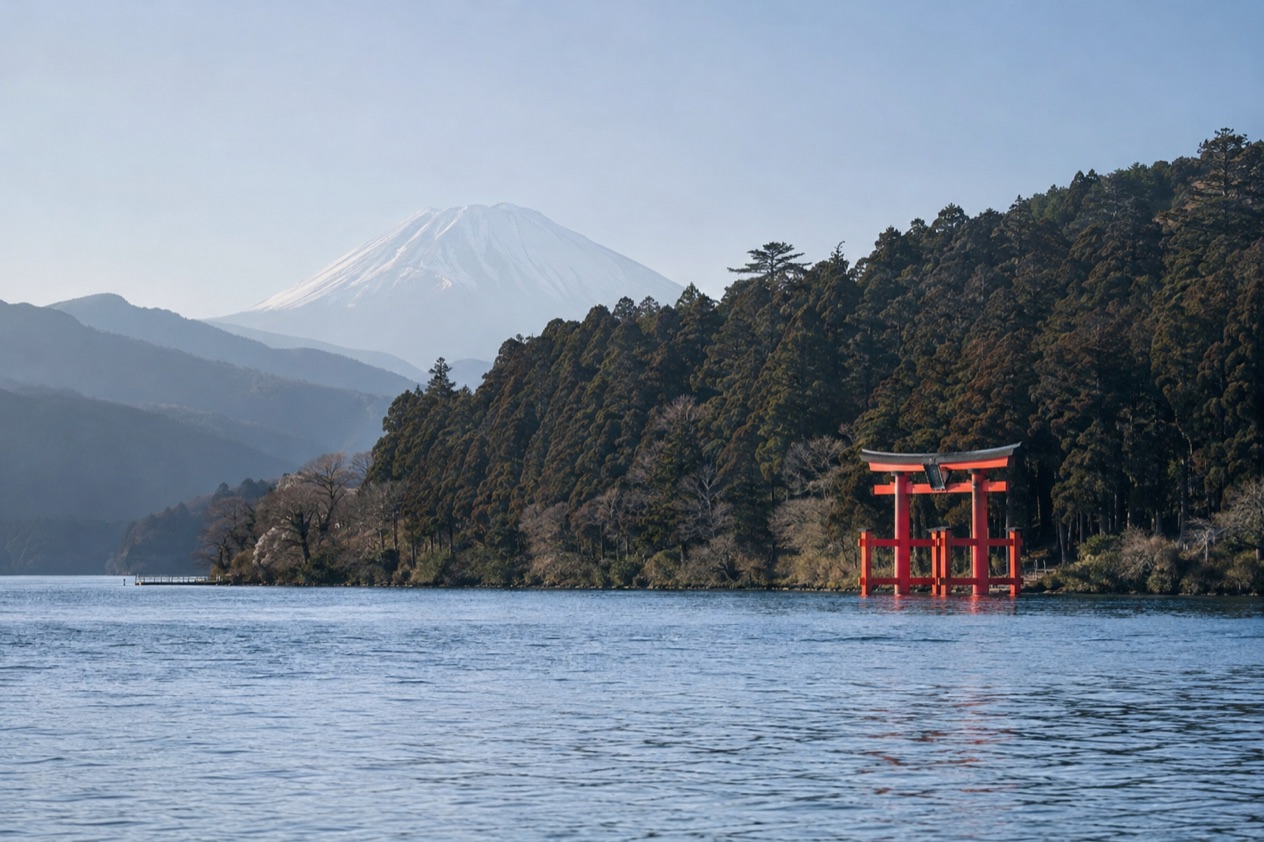
Spring brings pale blossoms to the slopes and summer brings rain and hydrangeas. Autumn paints the mountains red and orange, and winter turns the air crisp. Every season in this hot spring town within sight of Mount Fuji has its own reason to come.
When is the best time to visit Hakone?
Late autumn, from mid-November into early December, is the strongest answer for travelers, with spring a close second. In autumn the trees turn red, yellow and orange, and the air is cool enough to make a hot spring feel like a reward. Spring has mild days that suit a light jacket or a simple sweater, and the mountain slopes come back to life after the cold.
For sightseeing, the autumn and spring weeks are the ones that fit the Hakone loop best: the Hakone Tozan Train climbing the hills, the ropeway over the volcanic valley at Owakudani, a cruise on Lake Ashinoko, and the open-air art installations at Japan’s first open-air museum. Moderate temperatures are ideal for walking, and the Sengokuhara area, filled with art museums, gives you something to do under a roof if the clouds close in.
For soaking, winter has its own appeal. Cold air makes the baths feel better, and the sunshine at the foot of the mountain stays generous in December and January. Mount Fuji views are part of Hakone’s reputation, so a clear winter day with a long outlook is what people hope for, though no season promises it.
Summer is hot and humid at the base and cooler up by the lake. It suits travelers who want the full green of the hills and the lake cruises, and who accept some rain.
The rainy season, from about June into July, is the wettest and grayest stretch, and it rewards those who like misty mountains and hydrangeas over wide views. For travelers who want quiet over color, the cold months outside the New Year holidays are an option, since many restaurants and attractions close around the New Year.
Families with children do well in spring and autumn, when the transport options (the Hakone Freepass covers eight kinds of vehicle, from the train to the ropeway to the sightseeing cruise) make a varied day out of rides alone. Food lovers can pair any month with Owakudani’s black eggs, said to prolong life, and with the restaurants of Hakone-Yumoto.
Hakone weather by month
At Odawara, at the foot of Hakone, winters are cool and bright, summers hot and humid, and the rain peaks in the early summer and early autumn months.
| Month | Average high (°F) | Average low (°F) | Precipitation (in) | Hours of sunshine | Daylight on the 15th |
|---|---|---|---|---|---|
| January | 51.1 | 33.1 | 3.30 | 180 | 10 h 01 min |
| February | 52.3 | 34.3 | 3.52 | 160 | 10 h 54 min |
| March | 57.4 | 39.9 | 6.91 | 161 | 11 h 54 min |
| April | 66.0 | 48.6 | 7.15 | 177 | 13 h 03 min |
| May | 73.0 | 56.8 | 7.17 | 182 | 14 h 00 min |
| June | 77.4 | 64.4 | 8.63 | 130 | 14 h 31 min |
| July | 84.2 | 71.6 | 8.50 | 163 | 14 h 20 min |
| August | 87.1 | 73.4 | 6.58 | 202 | 13 h 32 min |
| September | 81.0 | 67.3 | 9.79 | 138 | 12 h 27 min |
| October | 72.0 | 57.4 | 9.40 | 131 | 11 h 21 min |
| November | 63.3 | 46.9 | 4.70 | 149 | 10 h 21 min |
| December | 55.4 | 37.6 | 2.94 | 171 | 9 h 48 min |
The year runs in three clear stages. December to February is cool and dry, with plenty of sun and the shortest days, so layers and a warm coat are the right call for evenings. From March the rain increases, and from June to October it stays heavy. September is the wettest month for Hakone as a whole, and the grayest stretch runs from June through October.
The mountain side of Hakone, higher up around the lake and Sengokuhara, gets far more rain than the foot of the hills. A day in Hakone-Yumoto can be soft and gray while the ridge is wrapped in fog, so a rain jacket and shoes with some grip belong in the bag for most of the year. Daylight stretches long in early summer and shrinks sharply by December, which changes how many outings fit into a day.
What is there to do in Hakone in each season?
Spring: blossoms and the first warm days
Spring is when Hakone comes back to life, with cherry blossoms along the slopes and roadsides and a comfortable temperature for a morning walk.
The cruise on Lake Ashinoko makes a good midday break, and the lakeside inside Fuji-Hakone-Izu National Park offers the sort of views people come for. March rain at higher elevations can still be heavy, so April and May feel more settled. Bring a light jacket for the lake, where the air always feels cooler than in town.
The rainy season and summer
Rain defines the early summer. Hydrangeas bloom along the train line and the paths, and the clouds drift low across the hills. This is a season for indoor Hakone: the art museums of Sengokuhara, a long soak in a hot spring while the rain taps the roof, lunch among the restaurants and gift shops of Hakone-Yumoto.
From July into August it gets hot and humid at the foot of the mountain, and August brings the most sunshine of the year. The lake and the higher ground feel cooler, so boat rides and the ropeway fit the heat. Plan activities for the morning, keep the afternoon for a bath or a museum, and leave long hikes for another season.
Autumn leaves and winter baths
Autumn is gentle after the summer, with temperatures that are ideal for walking. From mid-November to early December the trees show red, yellow and orange, and the Hakone Tozan Train, the ropeway and the lake cruise become a three-way tour of color. Silver grass in the fields near Sengokuhara adds a softer tone as the season deepens.
Winter is for the baths. Days are short, nights are cold, and an outdoor hot spring bath feels at its warmest against frosty air. Sunshine hours stay generous, and on a clear day Mount Fuji can show itself above the hills. Plan around the New Year, when many restaurants and attractions are closed.
When is Hakone least crowded?
The calmest stretches are the wet and cold ones that fall outside the Japanese holiday weeks. Hakone is extremely popular because of its closeness to Tokyo, and national holidays such as Golden Week in spring, Obon in midsummer and the New Year period are the times when people across Japan travel. Those weeks are the ones to treat with care if you prefer space around you.
The early summer rains give the town a slower mood. Gray skies keep some day-trippers at home, and the hillsides turn a deep green. If you accept a few wet hours, the rainy season gives you a different, quieter Hakone, with mist on the lake and steam rising from the baths. Weekdays always feel looser than weekends in a place that sits so close to a huge city.
Deep winter, outside the New Year period, is another gap. The days are short and the air is cold, but the town runs normally and the baths are most appealing. The foliage and cherry blossom seasons draw viewers from far away, so if your priority is room to breathe rather than color, avoid peak bloom weeks and the height of the leaf season.
At the New Year, the closures matter as much as the visitors. Many restaurants and attractions shut for the holiday, which changes what a day in town looks like. A ryokan stay, with meals and a bath on site, makes the most of those days.
Which months should you avoid in Hakone?
No month is off limits, but June, September and October ask for patience because they are the wettest and grayest, and the New Year holiday needs planning because of closures. Which of them matters depends on what you want from the trip.
The rainy season in June and July brings steady rain and low clouds, and the mountain side gets far more of it than the foot of the hills. Views of Mount Fuji are harder to count on, and ropeway and lake outings can feel muted. If you travel then, think of it as a season for baths, museums and hydrangeas, not for panoramas.
September is the wettest month overall, and the rain carries into October, when sunshine hours are among the lowest of the year. Late summer is also hot and humid at the base, so midday walking can feel heavy. Autumn leaves arrive later, from mid-November, so early autumn is the in-between time with neither summer’s long days nor the full colors.
Winter asks for warm layers, and the days are short. The New Year holidays close many restaurants and attractions. The blossom and leaf seasons bring the best scenery, though their exact timing shifts from one year to the next, so treat the dates as usual rather than guaranteed.
Festivals and events in Hakone through the year
Winter: New Year and the Hakone Ekiden
New Year is the biggest holiday in Japan. Families visit shrines for the first prayers of the year, eat osechi, the traditional dishes packed in lacquered boxes, and slow down. In Hakone, the holiday means a ryokan stay with a long soak and a quiet meal, while many restaurants and attractions close for the break.
On January 2 and 3 the Tokyo-Hakone collegiate relay, the Hakone Ekiden, sends university runners along the roads and up toward the mountain. It is one of the most watched sporting events of the Japanese New Year, and the roadsides in Hakone fill with spectators cheering the runners on. Plan your movements carefully on those days.
Spring and early summer: blossoms and hydrangeas
Hanami, the custom of gathering under cherry trees, defines spring across Japan. In Hakone, you find the blossoms along the slopes, near the lake and in town, and the mood is one of picnics, photographs and slow walks. Golden Week, at the turn of April and May, brings a run of national holidays and a lively spirit to the whole region.
As the rainy season sets in, hydrangeas bloom along the paths and beside the Hakone Tozan Train line. The flowers look best in soft, wet light, so a gray day suits them. It is a season of umbrellas, steaming baths and tea in a warm room.
Summer and autumn: fireworks, silver grass and leaves
Summer is matsuri season across Japan, and Hakone has its own summer festival on Lake Ashinoko, with lantern lights and fireworks over the water. Obon in mid-August, when families return to their hometowns to honor their ancestors, adds a travel rush and dancing in many communities.
In autumn the pace changes. Silver grass sways in the fields near Sengokuhara, and from mid-November to early December the trees show red, yellow and orange. A procession in period costume sometimes marks the season in the old post-town spirit, and the baths feel best when the first cold air comes in. Autumn is the time to walk, to ride the train and to end the day in hot water.
Sources
- Japan Meteorological Agency (JMA), Normal values 1991-2020, monthly (https://www.data.jma.go.jp/stats/etrn/view/nml_amd_ym.php?prec_no=46&block_no=1008), station Odawara, elevation 14 m, checked October 11, 2026
- Computed from the date and the latitude of the place (sunrise equation, solar elevation -0.833 degrees), October 11, 2026
- Japan National Tourism Organization, Hakone (https://www.japan.travel/en/destinations/kanto/kanagawa/hakone-and-around/), checked October 11, 2026
- Hakone Tourist Information (https://www.hakonenavi.jp/international/en/), checked October 11, 2026
- Wikipedia, Hakone, Kanagawa (https://en.wikipedia.org/wiki/Hakone,_Kanagawa), checked October 11, 2026
- Wikivoyage, Hakone (https://en.wikivoyage.org/wiki/Hakone), checked October 11, 2026
- Japan National Tourism Organization, autumn in Japan (https://www.japan.travel/en/guide/autumn-guide/), checked October 11, 2026
- Japan National Tourism Organization, spring in Japan (https://www.japan.travel/en/guide/spring-guide/), checked October 11, 2026
- Japan National Tourism Organization, skiing guide (https://www.japan.travel/en/guide/skiing/), checked October 11, 2026
- Japan National Tourism Organization, winter in Japan (https://www.japan.travel/en/guide/winter-guide/), checked October 11, 2026
To plan your stay
- Things to Do in Hakone: Lake Ashi, Owakudani, Open-Air Museum and Hot Springs
- Where to Stay in Hakone: Hakone-Yumoto, Lake Ashi, Sengokuhara and Ryokan Stays
- Hakone from Tokyo: Romancecar, Shinkansen, Local Trains and the Hakone Freepass
- Know Before You Go to Hakone: Getting There, the Freepass, Weather and Etiquette