
In February, steam rises off the outdoor hot spring baths of Hakone into cold air, and a soak feels like the whole point of the trip. Roasted soybeans get tossed at Setsubun, the plum trees begin to open, and the mountain side of town stays damp and cool. This is a month for onsen, art museums, a boat on Lake Ashinoko and a bowl of something hot in Hakone-Yumoto, for travelers who like winter with a warm bath at the end of it.
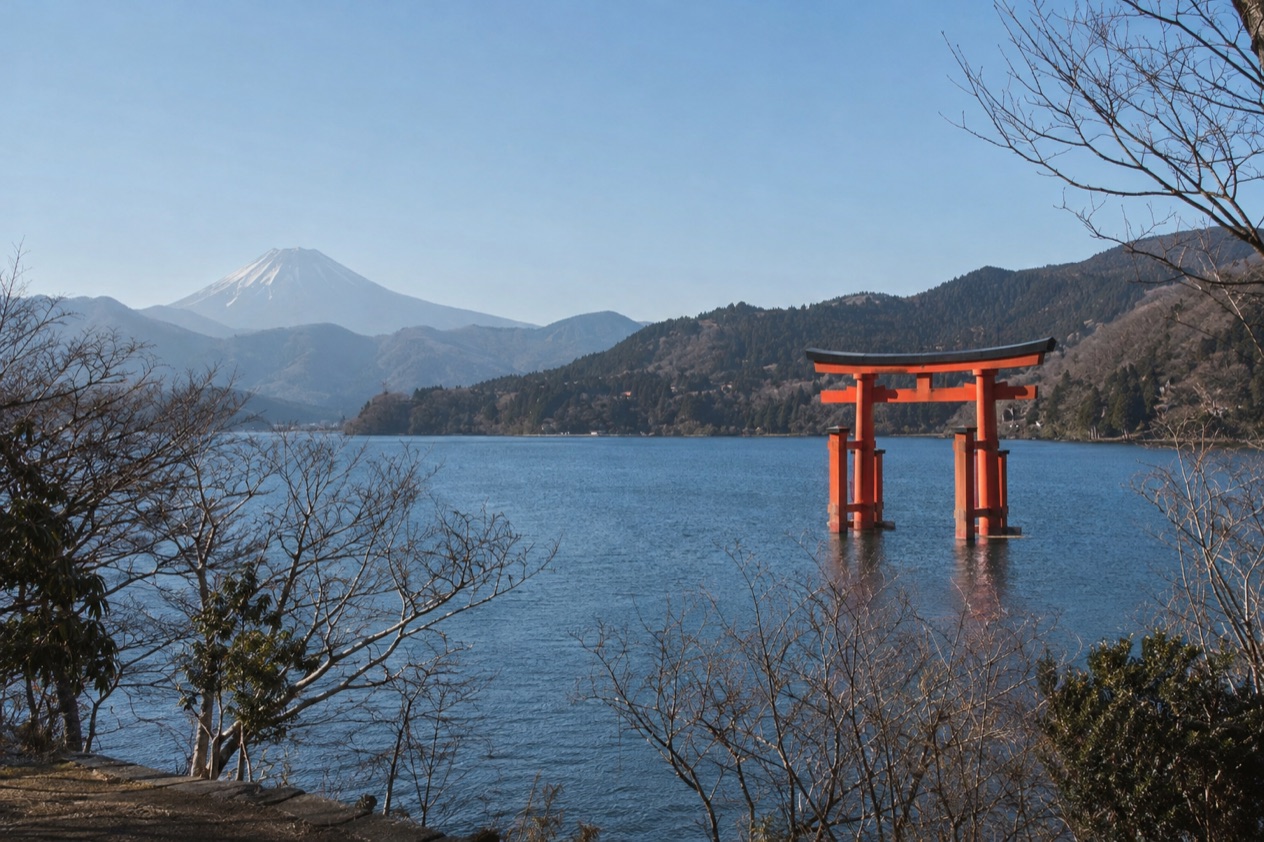
What is the weather like in Hakone in February?
February in Hakone is cold and fairly dry down at the foot of the mountain, and wetter and colder as you climb.
| Month | Average high (°F) | Average low (°F) | Precipitation (in) | Hours of sunshine | Daylight on the 15th |
|---|---|---|---|---|---|
| January | 51.1 | 33.1 | 3.30 | 180 | 10 h 01 min |
| February | 52.3 | 34.3 | 3.52 | 160 | 10 h 54 min |
| March | 57.4 | 39.9 | 6.91 | 161 | 11 h 54 min |
Afternoons at Odawara reach the low 50s, which is a coat-and-scarf temperature rather than a freezing one, while nights drop to just above freezing. Hakone sits higher up. The mountain side of Hakone, around the 855 m mark, receives 5.96 inches of precipitation in an average February, noticeably more than the lowland, so rain gear matters more once you head up toward the lake and the volcanic valley.
Layers are the answer. A warm base, a sweater and a windproof shell let you step in and out of trains, ropeway cabins, museums and bathhouses without suffering at either end. Evenings are the time for the ryokan, where a yukata (a light cotton robe) and a hot bath do the rest.
The light is noticeably longer than in January, with the days stretching toward spring. That gives you a little more room at the end of an afternoon for a last museum or a walk around the lake before dinner.
What to do in Hakone in February
The hot springs are the reason to come in February. Hakone is known for its natural hot springs and for views of Mount Fuji, and a cold month is when the combination makes the most sense.
You can bathe in one of the town’s springs, then step out into cool air with your skin pink and your shoulders loose. Views of Fuji depend on the sky, so treat them as a bonus rather than a plan.
February also brings Setsubun, the festival that marks the turn toward spring, usually in early February. The main ritual is mamemaki, in which roasted soybeans called fukumame are thrown out the front door or at someone wearing an oni (demon) mask, with the shout of ‘Oni wa soto! Fuku wa uchi!’ (Devils out! Fortune in!).
Afterward people eat one soybean for each year of their age plus one more for luck in the coming year. Even if you only watch from a ryokan dining room or a shop doorway, it is a small, funny, very Japanese way to mark winter’s end.
Prunus mume typically flowers from January until late February in East Asia, but the timing in Hakone varies from year to year.
Hot springs and Hakone-Yumoto
Hakone-Yumoto is known for its many restaurants and gift shops, which makes it a natural place to start a day of wandering and warming up. You can browse the shops for local sweets and wooden crafts, then sit down to a hot lunch of noodles or a set meal. In a cold month the steam from a bowl of soba is half the pleasure.
The onsen itself is the main event. , and a ryokan stay adds the rest of the ritual, with a multi-course dinner served in the room or a dining hall and futons laid out on the tatami afterward. Guests staying at a ryokan should plan to arrive at least one day after landing in Tokyo, so that dinner is not missed and the curfew does not lock anyone out.
Owakudani and Lake Ashinoko
At Owakudani you can taste the black eggs that are said to prolong life. They are boiled in the volcanic hot springs and turn black from the minerals, and eating one in a cold month, standing in the steam, is one of the most Hakone things you can do. The valley is part of Fuji-Hakone-Izu National Park, which is volcanically active and centered on Lake Ashi.
Lake Ashinoko can be explored by boat, and the Hakone Sightseeing Cruise is one of the eight modes of transport on the Hakone Freepass, along with the Hakone Tozan Train and the Hakone Ropeway. Bring your windproof layer for the deck, and keep the interior seats in mind if the wind picks up.
Art museums and the open-air museum
February’s cold and damp make Hakone’s indoor art a good use of the day. Sengokuhara is filled with art museums, and the open-air installations at Japan’s first open-air museum let you pair sculpture with a walk in cold air, then warm up inside. If the mountain weather turns gray, the museums are where a rainy afternoon goes best.
The Hakone Freepass ‘Hako Ticket’ Plus combines the Digital Hakone Freepass, which allows unlimited use of eight modes of transport, with the Hako Ticket, which grants unlimited use of applicable art museums, hot springs and activity facilities. It is valid for two days or three days, which matches a short winter stay well.
A two-day itinerary for Hakone in February
Day 1 starts in Hakone-Yumoto, with its restaurants and gift shops. Spend the morning there, browse the shops, and have a hot lunch in a noodle or set-meal restaurant before moving up the mountain. February’s cold makes the first stop the right place to warm up before the day’s climb.
In the afternoon, go to Owakudani for the black eggs and the steam. Keep your outer shell on, because the mountain side is wetter than the lowland. If the weather turns, switch to an indoor stop at one of the art museums in Sengokuhara. Finish the day at your ryokan, with an onsen bath before dinner and another one after.
Day 2 belongs to Lake Ashinoko. Start with the Hakone Sightseeing Cruise, and look for Mount Fuji if the sky is clear. Then spend the middle of the day at the open-air museum, where sculptures stand in the cold air and you can retreat indoors when you need to.
In the afternoon, visit the other museums of Sengokuhara, keeping the Freepass in mind. Have a late lunch in a local restaurant, and spend the end of the day on a last soak. If rain sets in, the museums and the baths carry the whole day.
Is Hakone busy in February?
Hakone is a destination that draws visitors in every month, because of its closeness to Tokyo and its views of Mount Fuji, and February is no exception. What changes in February is the mood. The pleasures are indoor ones, such as baths, museums and hot meals, and the visits tend to be organized around warmth rather than around views.
The “Hako Ticket” Plus combines the Digital Hakone Freepass with access to participating museums, hot springs and activity facilities. Two to three days are enough to cover the places that matter most. The surrounding festivals and blooms also give the month a small calendar of its own, with Setsubun at the start and the end of the plum season at the close.
February is also the time of year when winter sports are in full swing elsewhere in Japan. Skiing generally runs from December to April, with a peak in January and February in places such as Hokkaido and the high mountains of Nagano. Hakone is not the ski destination, so travelers who split their trip between onsen and snow will find February suits both.
What to pack for Hakone in February
Pack for cold mornings, wet mountain air and long stretches of walking between baths, museums and boat decks.
- A warm sweater or fleece, because the lowland is cold and the mountain side is colder.
- A windproof, water-resistant shell, for the lake deck and the mountain rain.
- A scarf and gloves for the boat and the volcanic valley.
- Comfortable shoes you can slip off, since shoes come off at the entrance of a ryokan.
- A small bag for a towel and toiletries, for onsen visits during the day.
Good to know before you go
February is outside the main rainy season, but the mountain side of Hakone still receives a good amount of precipitation, so rain gear is useful. Ryokan guests should plan to arrive at least one day after landing in Tokyo, so they do not miss dinner or get locked out at curfew time.
Hakone in February vs January and March
Moving the trip four weeks earlier brings you to January, which is slightly colder and sunnier, with the shortest days of the three months. The plum blossom season is also underway, since Prunus mume typically flowers from January until late February. Travelers who want the longest stretch of bare-branched winter and the coldest baths will like it.
Moving four weeks later brings you to March, which is milder and noticeably wetter, with 11.20 inches of precipitation on the mountain side of Hakone. The days are longer, but the plum blossoms are finished and the cherry blossoms are the next flowers to wait for. Travelers who want softer air and a longer evening will prefer March, but they should bring stronger rain gear.
February sits between the two. It is the month for Setsubun, for the last plum blossoms and for baths in cold air, with less rain than March. Stay in February if the festival and the winter mood matter, and shift to March if warmth matters more.
Is February a good time to visit Hakone?
Yes, February is a good time to visit Hakone for travelers who want hot springs, museums and a cold-weather trip with a warm place to land. It suits couples, solo travelers and anyone who likes a slow day built around baths and meals. It does not suit travelers who want warmer days outdoors, and no month guarantees a view of Mount Fuji.
On arrival, drop your bags and head straight for a hot lunch in Hakone-Yumoto, then ride up the mountain with the Freepass in your pocket. A first soak in the evening sets the tone for the rest of the stay.
What is special about February in Hakone is the contrast between the cold outside and the heat of the water. Steam rising off the baths, a black egg eaten in the volcanic valley, soybeans thrown out the door at Setsubun and the last plum blossoms on the branch make the month feel like a small, warm secret.
Sources
- Japan Meteorological Agency (JMA), Normal values 1991-2020, monthly (https://www.data.jma.go.jp/stats/etrn/view/nml_amd_ym.php?prec_no=46&block_no=1008), station Odawara, elevation 14 m, checked October 11, 2026
- Computed from the date and the latitude of the place (sunrise equation, solar elevation -0.833 degrees), October 11, 2026
- Wikipedia, Setsubun (https://en.wikipedia.org/wiki/Setsubun), checked October 11, 2026
- Japan National Tourism Organization, festivals and events (https://www.japan.travel/en/see-and-do/festivals-and-events/), checked October 11, 2026
- Sapporo Snow Festival official website (https://www.snowfes.com/english/), checked October 11, 2026
- Wikipedia, Sapporo Snow Festival (https://en.wikipedia.org/wiki/Sapporo_Snow_Festival), checked October 11, 2026
- Japan National Tourism Organization, winter in Japan (https://www.japan.travel/en/guide/winter-guide/), checked October 11, 2026
- Japan National Tourism Organization, skiing and snowboarding in Japan: regions, resorts, seasons (https://www.japan.travel/en/sports/snow/), checked October 11, 2026
- Wikipedia, Climate of Japan (https://en.wikipedia.org/wiki/Climate_of_Japan), checked October 11, 2026
- Japan National Tourism Organization, flowers by season: cherry blossom, plum, wisteria, hydrangea, where and when (https://www.japan.travel/en/see-and-do/flowers/), checked October 11, 2026
- Wikipedia, Prunus mume (https://en.wikipedia.org/wiki/Prunus_mume), checked October 11, 2026
- Japan National Tourism Organization, skiing guide (https://www.japan.travel/en/guide/skiing/), checked October 11, 2026
- Wikipedia, List of ski areas and resorts in Japan (https://en.wikipedia.org/wiki/List_of_ski_areas_and_resorts_in_Japan), checked October 11, 2026
- Japan National Tourism Organization, weather and seasons in Japan (https://www.japan.travel/en/plan/weather/), checked October 11, 2026
- Japan National Tourism Organization, Hakone (https://www.japan.travel/en/destinations/kanto/kanagawa/hakone-and-around/), checked October 11, 2026
- Hakone Tourist Information (https://www.hakonenavi.jp/international/en/), checked October 11, 2026
- Wikipedia, Hakone, Kanagawa (https://en.wikipedia.org/wiki/Hakone,_Kanagawa), checked October 11, 2026
- Wikivoyage, Hakone (https://en.wikivoyage.org/wiki/Hakone), checked October 11, 2026
To plan your stay
- Things to Do in Hakone: Lake Ashi, Owakudani, Open-Air Museum and Hot Springs
- Where to Stay in Hakone: Hakone-Yumoto, Lake Ashi, Sengokuhara and Ryokan Stays
- Hakone from Tokyo: Romancecar, Shinkansen, Local Trains and the Hakone Freepass
- Know Before You Go to Hakone: Getting There, the Freepass, Weather and Etiquette