
Under a tangle of oversized signs, a mechanical crab waves its claws, a blowfish lantern swells above a doorway, and the smell of hot frying oil drifts out of a skewer shop. Above it all, Tsutenkaku Tower rises over the rooftops like a lighthouse for the hungry. Shinsekai is the Osaka neighborhood where old-fashioned amusements, cheap food and loud signage meet, and it suits travelers who like their sightseeing with a bit of grit.
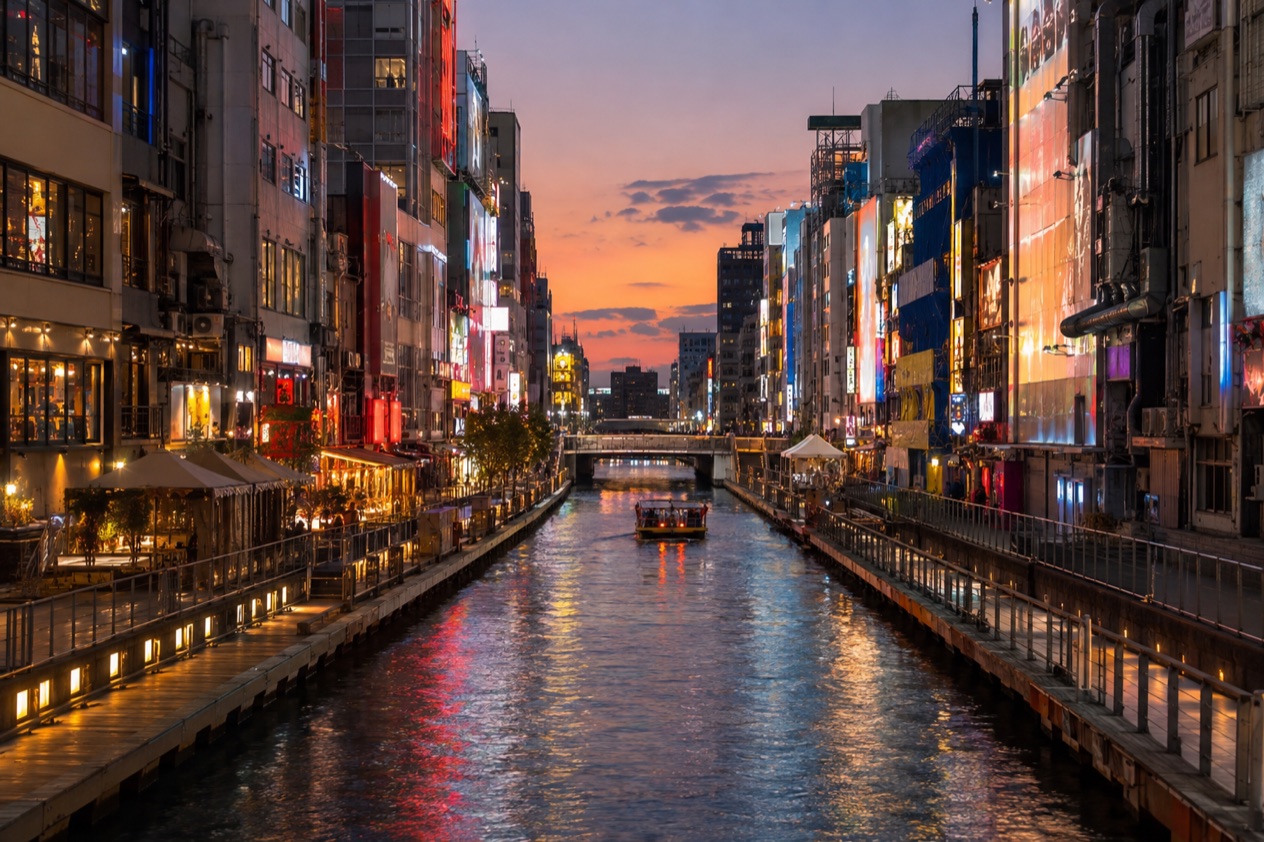
What is Shinsekai like?
Shinsekai is a rowdy, nostalgic, slightly shabby entertainment district, and it wears all three qualities proudly. It sits next to the Minami downtown area in the south of Osaka, yet it feels like a separate town, with its own tower, its own food habits and its own sense of humor.
Streets are lined with skewer restaurants, small theaters, game parlors and shops selling lucky charms and souvenirs. Locals come to eat and to drink, and visitors come for the show the street itself puts on.
The name means New World, and it was a bold idea when the district was created in 1912. The planners borrowed from abroad, using New York’s Coney Island as the model for the southern half and Paris for the northern half.
A Luna Park amusement park ran here until it closed in 1923, and the district has been tied to fun and spectacle ever since. Today it has gentrified into a tourist area, though it keeps a rougher edge than most of Osaka. It is also described as one of the poorest neighborhoods in Japan, and that mix of faded glamour and everyday hardship gives it its character.
Shinsekai rewards people who enjoy wandering without a plan, eating standing up and photographing neon at dusk. It is less suited to anyone looking for polished boutiques or hushed temple gardens. Osaka as a whole is known for its food, entertainment and nightlife, and Shinsekai concentrates that reputation into a few blocks.
Things to do in Shinsekai
Tsutenkaku Tower
Tsutenkaku, the name meaning tower reaching to heaven, is the centerpiece of Shinsekai and the landmark you spot from the end of nearly every street. The current tower was designed by Tachū Naitō, who is also known for Tokyo Tower, and was built in 1956. It stands 338 feet tall, with a lit crown that dominates the skyline of the neighborhood.
From the top, the view over Osaka is panoramic and unobstructed, so it is a good way to understand how the city spreads out around you. Inside, the tower leans into its mascot culture.
Billiken, the smiling god of luck with a pointed head, is the figure to look for, and rubbing his feet is the local custom for good fortune. Treat the tower as a short pause between meals and wandering, and look back at it from the street afterward to see how the signs below pick up its glow.
The lantern streets
The real draw of Shinsekai is at street level, in the lanes that fan out from the tower base. Restaurants compete with giant three-dimensional signs, a puffer fish here, a chef there, a moving crab over a seafood counter. Small shogi and mahjong parlors, old movie theaters and arcades fill the gaps between food stalls, and some of the faded storefronts date from an earlier era of Osaka entertainment.
Walk the streets once to take in the scale of the signs, then go back for a slower loop when you are hungry. Evenings bring the lights and the crowds of diners together, which suits people who want atmosphere. Sit down at a counter, order a drink and watch the street from the doorway.
Spa World
To the south of the neighborhood is Spa World, a large bathing and spa complex that gives you a different kind of afternoon after hours on your feet. People with tattoos, permanent or temporary, are barred from using the facilities, so anyone with body art should plan around that before arriving.
If bathing is not for you, you can still enjoy the walk to the edge of the district, where the dense signage loosens and the streets open up. It makes a useful contrast to the packed lanes around the tower, and it fits the idea of ending a day of eating with a soak.
Tennoji Park, the zoo and the art museum
Shinsekai lies west of Tennoji Zoo, Tennoji Park and the Osaka Municipal Museum of Art, so the green space and the galleries are a natural counterweight to the neon. A morning in the park or among the museum’s collections leaves you fresh for an evening of skewers. The contrast is part of the pleasure, since you move from a landscaped city park to an old amusement quarter within a short stretch of Osaka.
Tennoji also holds Shitennoji Temple, built by Emperor Suiko in 593 AD, and the free view from Abeno Harukas, where elevators and escalators take you to the 17th floor and a business elevator continues to the 30th. Both sit in the neighboring district of Tennoji rather than in Shinsekai itself, but they round out a day in the area.
Eating and drinking in Shinsekai
Shinsekai is above all a place to eat fried food on a stick. Kushikatsu, skewers of meat, seafood and vegetables dipped in batter and breadcrumbs and fried until crisp, is the dish that defines the neighborhood, and shops devoted to it crowd nearly every block. You order a few at a time, they arrive hot, and you dip them in a shared pot of sauce.
The one custom to remember is that the sauce is communal. At Kushikatsu Daruma in Osaka, diners are admonished not to double-dip their skewers, and the same habit is the polite way to eat at skewer counters generally. If you want more sauce on a bite, use the cabbage provided to scoop it over. Pair the skewers with a cold beer or a highball, which is how people drink here.
Fugu, takoyaki and other street food
The giant blowfish lanterns hanging over restaurant doors point to fugu, the pufferfish served in hot pots and as thin sashimi, a specialty Osaka has long celebrated. Even if you skip a full fugu meal, the lanterns make good photographs and tell you which doors lead to a serious sit-down dinner.
For lighter bites, look for takoyaki, the round octopus dumplings cooked on dimpled iron griddles and eaten piping hot, and for okonomiyaki, the savory pancake cooked at the table or counter. Traditional noodle shops serving udon in warm broth are another pleasure when you want something gentler than frying.
A walk after dinner under the signs, a coffee at an old-style kissaten and a last snack from a stand makes a full evening.
Staying in Shinsekai
Shinsekai suits travelers who want to sleep in the middle of the spectacle and do not mind a lively neighborhood after dark. It is a base for people who would rather step out of the door into skewer shops and neon than into a quiet residential street. Lodging here tends toward practical, no-frills places rather than resort-style comfort, which fits the character of the district.
The area is described as one of the poorest in Japan, with a large homeless population, and visitors are advised to be cautious after dark. That does not mean avoiding the neighborhood, but it does mean choosing a room with the evening in mind and taking the usual habits of care when you walk back late. Anyone who wants a hushed, polished stay may be happier elsewhere.
The neighboring areas offer different moods. Dotonbori and Shinsaibashi, reached by the Midosuji Line, are the districts of shopping arcades and bright canal-side dining, and they suit travelers who want a big-city setting. Tennoji, a district on the southeast side of Osaka, puts you beside the temple, the park and the museums.
Osaka Bay, reached from Osaka or Umeda stations by the JR Loop Line and the Chuo subway line, is where Universal Studios Japan stands, and it fits families heading there for the theme park. Shinsekai itself is for people who put food and atmosphere first.
Getting to Shinsekai
Exit 3 leaves you a short step from the neighborhood. Shin-Imamiya Station is the other gateway, served by JR West’s Osaka Loop Line and by two Nankai Railway lines, and its East Exit is where you leave for Shinsekai on foot.
| Station | Line | Exit | Walk (minutes) |
|---|---|---|---|
| Ebisucho | Osaka Municipal Subway Sakaisuji Line | Exit 3 | 3 |
| Shin-Imamiya | JR West Osaka Loop Line | East Exit | 10 |
| Shin-Imamiya | Nankai Line and Koya Line | East Exit | 10 |
From Kansai International Airport, the fastest trains to Tennoji Station are the Haruka limited express run by JR West, taking approximately 32 minutes. From Tennoji you are in the district next door to Shinsekai, and the neighborhood sits beside Tennoji Zoo and the park.
If you arrive from Tokyo, the Tokaido-Sanyo shinkansen runs to Shin-Osaka Station, a journey of about two and a half hours. From there, a JR local line goes on to Osaka Station, and you continue by the lines above. Coming from Dotonbori or Shinsaibashi, the Midosuji Line from Osaka or Umeda stations reaches Shinsaibashi, and staying aboard takes you to Namba Station for Dotonbori.
Good to know before you go
Shinsekai is a place to see in the evening, when the signs are lit and the skewer shops are busy, but the neighborhood asks for the ordinary habits of care after dark. Carry yen for the small shops and counters, keep your belongings close in the busy lanes, and plan your route back to the station before you settle in for a long meal. Pair Shinsekai with a daytime visit to Tennoji so the park, the temple and the museums balance out the night.
Sources
- Wikipedia, Shinsekai (https://en.wikipedia.org/wiki/Shinsekai), checked October 11, 2026
- Wikivoyage, Osaka/Tennoji (https://en.wikivoyage.org/wiki/Osaka/Tennoji), checked October 11, 2026
- Japan National Tourism Organization, Osaka (https://www.japan.travel/en/destinations/kansai/osaka/), checked October 11, 2026
To plan your stay
- Best Time to Visit Japan: Cherry Blossoms, Autumn Colors, Weather and Festivals
- Where to Stay in Japan: Ryokan, Temple Stays, Capsule Hotels and the Best Cities to Base In
- Sending Luggage from the Airport in Japan: Hands-Free Travel, Hotel Delivery and Coin Lockers
- Know Before You Go to Japan: Entry, Money, Etiquette and Getting Around