
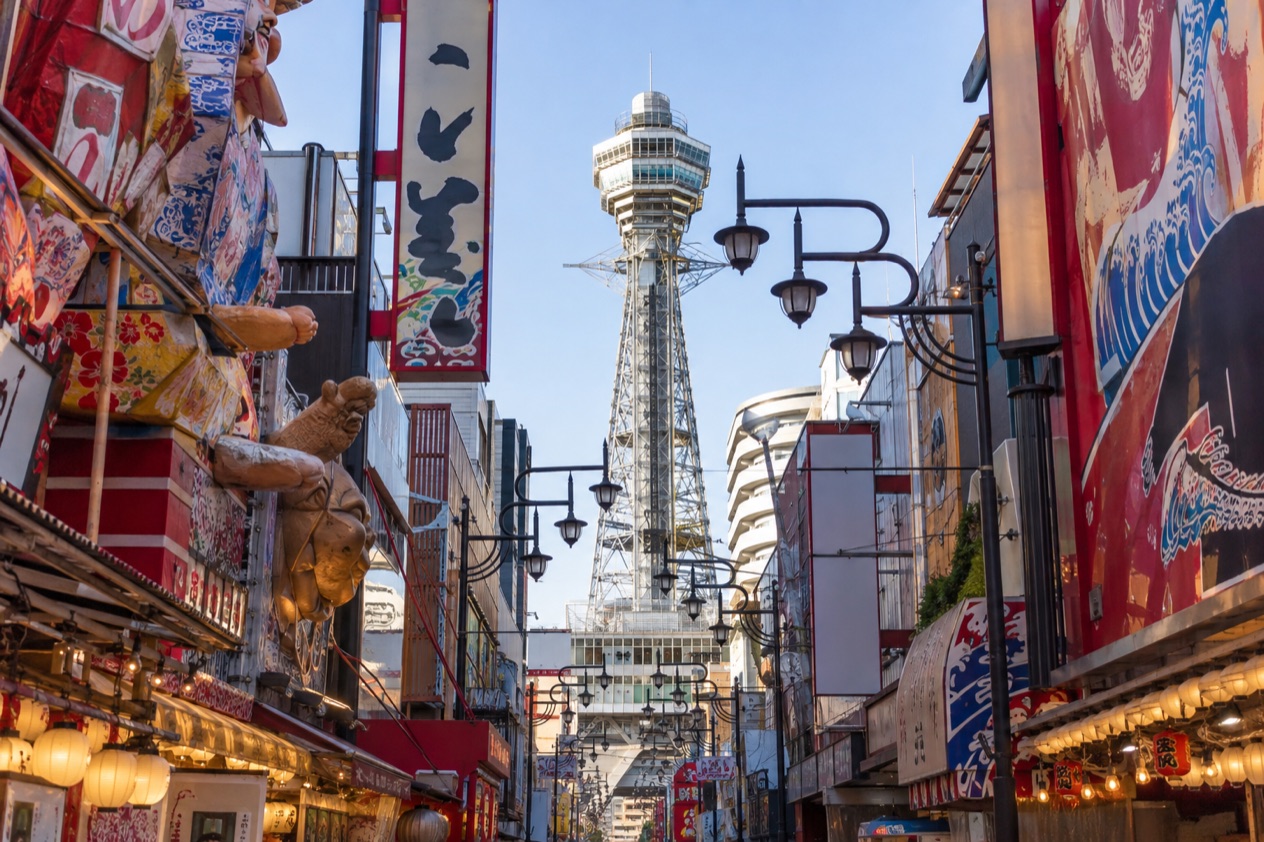
The first thing you see coming up from the streets of Shinsekai is the tower, a lattice of steel with a glowing sign at its crown, rising over rows of signboards, fried-food counters and pachinko parlors. Under the lanterns and giant painted signs, grills sizzle and the smell of hot oil drifts along the lanes. This is a visit for wandering, eating skewers and taking in an old-fashioned corner of Osaka, with a trip to the top of Tsutenkaku for the view.
Is visiting Shinsekai and Tsutenkaku worth it?
Yes, if you like neighborhoods with a strong personality, street food and a bit of nostalgia, and it suits anyone who wants to see a side of Osaka that is not about shopping malls or neon canals. It works well for food lovers, for travelers curious about how a district can be built around a dream of foreign cities, and for anyone who wants a wide look over Osaka from above.
Shinsekai means “new world,” and the name fits its origin. The district was created in 1912 with New York’s Coney Island as the model for its southern half and Paris for its northern half. You will not find Paris or Brooklyn today, but the idea of a made-up, slightly theatrical place still shapes the streets, with a tower as its centerpiece.
What sets it apart from the other Osaka districts visitors tend to line up, such as Dotonbori and Shinsaibashi, is its mood. Those are places of department stores and glowing canal-side billboards.
Shinsekai sits beside the Minami area of south Osaka and feels like a retro neighborhood with its own tower, its own food habits and a lived-in, working-class character. It gives you the city’s love of eating and entertainment in a plainer, more nostalgic form.
It also pairs naturally with other parts of a day in Osaka. Tennoji Zoo, Tennoji Park and the Osaka Municipal Museum of Art lie nearby, and Spa World is to the south, so Shinsekai can be the lively midpoint of a longer outing rather than a stop on its own.
What to see at Shinsekai and Tsutenkaku
Tsutenkaku Tower
Tsutenkaku means “tower reaching to heaven,” and it is the centerpiece of Shinsekai. The tower you see today was designed by Tachū Naitō, who is also known for Tokyo Tower, and was built in 1956. It stands 338 feet tall, which in this low-rise neighborhood is enough to make it visible from many lanes, so it works as a landmark when you lose your bearings among the signs.
From the top you get a panoramic, unobstructed view of Osaka. Look for the way the city spreads out in every direction, with the dense roofs of Shinsekai directly below and the larger towers of the center beyond them. The tower is also a good place to understand how the district sits against the rest of the city.
Around the base, expect souvenir shops and the tower’s cheerful mascot culture. The figure of Billiken, a smiling character often associated with good luck, is closely tied to the tower, and rubbing the feet of his statue is a habit visitors follow.
The streets and food of Shinsekai
The real draw of Shinsekai is walking its covered lanes and side streets. Giant three-dimensional signs hang over the counters, among them blowfish lanterns and oversized crabs, and the old-style storefronts give the place a look of an earlier Osaka. A Luna Park amusement park once operated here until it closed in 1923, and the district’s showman spirit has outlasted it.
The food to look for is kushikatsu: skewers of meat, seafood and vegetables coated in breadcrumbs and fried. Many counters pair the skewers with cold beer, and a standing-room stop is part of the fun.
Beyond skewers, you will see fugu (blowfish) restaurants, small shops selling snacks, game halls and shogi and mahjong parlors. Walk without a plan, turn into the narrow lanes and let the signs steer you.
Tennoji and Spa World nearby
Spa World lies to the south, a bathing and leisure complex that gives you a different way to end a day on your feet.
Think of these as extensions of the visit. The park and the museum give a calmer contrast to the lanes, while the zoo adds a stop for travelers with children. Choose one or two rather than trying to fit them all, and let the streets of Shinsekai remain the core of the outing.
Hours, tickets and rules
Tsutenkaku Tower is the one part of Shinsekai built around an entry to the top, where the observation view over Osaka is the reward. The surrounding streets are an ordinary neighborhood, so you move through them as you would any lively district, stopping where a counter or a doorway pulls you in.
The tower is a 1956 rebuild by Tachū Naitō, and the climb to its viewpoint is part of what a visit means. The view is described as panoramic and unobstructed, which is the reason to go up rather than simply admire the tower from the lanes below.
At the food counters, the habits are the ones you meet across Osaka: eat where the cook points you, take your skewers one at a time, and use the sauce pot as a shared dish. Restaurants and small shops set their own routines, and each has its own way of handling orders, so follow what the person next to you is doing.
Around the tower and in the lanes, look at the signs and displays rather than treating them as props. Many are hand-painted or built by the businesses themselves, and they are part of what makes Shinsekai look the way it does.
How to get to Shinsekai and Tsutenkaku
Shinsekai has several stations around it, on JR, private railways, the Osaka Municipal Subway and a tramway. Which one you choose depends on where you are staying in Osaka and which line is closest.
| Station | Line | Walk to Shinsekai (minutes) |
|---|---|---|
| Ebisucho Station, Exit 3 | Osaka Municipal Subway Sakaisuji Line (brown line) | 3 |
| Ebisucho Station | Hankai Tramway Hankai Line | 3 |
| Dobutsuen-mae Station, Exit 5 | Osaka Municipal Subway Midosuji Line (red line) | 10 |
| Shin-Imamiya Station, East Exit | JR West Osaka Loop Line | 10 |
| Shin-Imamiya Station, East Exit | Nankai Railway Nankai Line and Koya Line | 10 |
If you are coming from the Dotonbori and Shinsaibashi area, the Midosuji Line is the subway that runs through those districts, and the same red line serves Dobutsuen-mae Station for Shinsekai. From Osaka or Umeda Station, the Midosuji Line carries you to Shinsaibashi, and you can stay on it to Namba Station for Dotonbori.
Travelers arriving from Tokyo take the Tokaido-Sanyo shinkansen to Shin-Osaka Station, a journey of about two and a half hours. From Shin-Osaka Station, the JR local line goes to Osaka Station, where you can pick up the subway or the JR Osaka Loop Line toward the Shinsekai area.
The Osaka Loop Line is also the line that reaches Shin-Imamiya Station, so a loop-line ride and the walk from its East Exit is one way in. The Nankai Line and Koya Line stop at the same station, which makes it a meeting point for several railways.
When to visit Shinsekai and Tsutenkaku
The tower view is the part that depends most on the sky, so clear weather matters if the panorama is your goal.
| Month | Average high (°F) | Average low (°F) | Days with rain | Sunshine (hours) |
|---|---|---|---|---|
| January | 49.5 | 37.4 | 5.6 | 146 |
| April | 67.8 | 51.6 | 9.2 | 193 |
| July | 89.2 | 76.3 | 10.0 | 184 |
| October | 74.7 | 60.8 | 8.3 | 166 |
Spring and autumn are the gentlest seasons for walking between the lanes. April is mild and offers comfortable conditions for exploring the neighborhood on foot. October is generally mild, with some rainy days.
July is hot and humid, so a lot of time outdoors can feel heavy, and the covered lanes and the food counters offer a break from the heat. January is cold, with the occasional day of snow or sleet, and hot skewers taste especially good then.
Rainy days still work for Shinsekai, since much of the pleasure is in the food stops and the signs. If the sky is gray, you may prefer the museum or the covered lanes first, and keep the tower for a clearer hour.
Tips for your visit
Come hungry and travel light. Shinsekai rewards grazing, a skewer here and a snack there, so a small bag and comfortable shoes serve you better than a full itinerary. Bring a layer in winter and something for the sun in summer, since the lanes mix covered and open stretches.
Plan the visit as part of a larger loop. Tennoji Zoo, Tennoji Park and the Osaka Municipal Museum of Art make a natural green and cultural pairing with the lanes, and Spa World to the south gives a bathing stop at the end of the day. Families can mix the zoo with the tower and the food counters, and anyone who wants a quieter hour can head for the park.
If you want the wider Osaka picture, Dotonbori and Shinsaibashi are on the same Midosuji Line, and Osaka Bay offers a very different day out, including Universal Studios Japan and its Wizarding World of Harry Potter. Each makes a different day from the nostalgia of Shinsekai.
For photos, the signs are the subject. Look up at the oversized figures, and step back for a shot that includes the tower rising over the rooftops. Keep your skewer orders simple, taste a few things, and let one stop lead to the next.
Good to know before you go
Osaka is known for its food, entertainment and nightlife, and Shinsekai fits that picture in a nostalgic form. Summer is humid and wet spells come through in other months, so a compact umbrella is worth tucking in your bag.
Sources
- Wikipedia, Shinsekai (https://en.wikipedia.org/wiki/Shinsekai), checked October 11, 2026
- Japan National Tourism Organization, Osaka (https://www.japan.travel/en/destinations/kansai/osaka/), checked October 11, 2026
- Japan Meteorological Agency (JMA), Normal values 1991-2020, monthly (https://www.data.jma.go.jp/stats/etrn/view/nml_sfc_ym.php?prec_no=62&block_no=47772), station Osaka, elevation 23 m, checked October 11, 2026
To plan your stay
- Best Time to Visit Japan: Cherry Blossoms, Autumn Colors, Weather and Festivals
- Where to Stay in Japan: Ryokan, Temple Stays, Capsule Hotels and the Best Cities to Base In
- Sending Luggage from the Airport in Japan: Hands-Free Travel, Hotel Delivery and Coin Lockers
- Know Before You Go to Japan: Entry, Money, Etiquette and Getting Around