
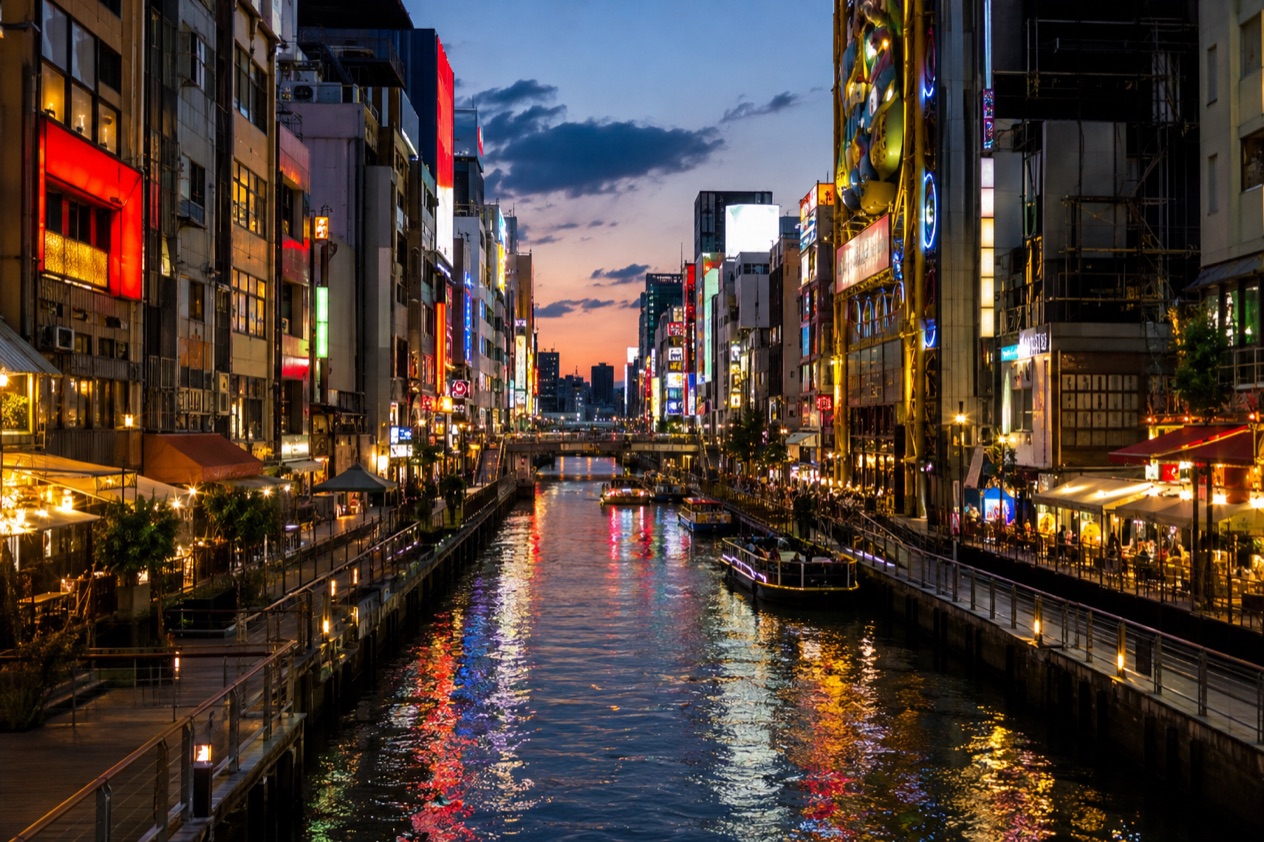
Steam rises off a tray of takoyaki, the octopus dumplings flipped by hand in Dotonbori, and the neon on the canal glows brighter as the evening cools. Osaka runs on appetite all year, but the weather decides how you spend the hours between meals. Spring brings blossoms to the castle parks, summer turns the city hot and sticky, and autumn and winter bring cool air, colored leaves and lights along the boulevards.
When is the best time to visit Osaka?
The best time to visit Osaka is late March through April for cherry blossoms, and October through early December for cool, comfortable days and autumn color. Both stretches suit nearly every kind of traveler. They give you temperatures that invite a full day on foot, and each has a seasonal event to build a trip around.
For sightseeing, spring and autumn are the two seasons that fit the city’s mix of castle grounds, waterfront promenades and covered shopping arcades. In autumn Japan grows milder after the summer, with moderate temperatures that suit walking. In spring a light jacket or a simple sweater is usually enough. Both seasons let you cross from Kita to Nakanoshima to Dotonbori on foot without wilting.
For food, Osaka rewards every month, because the city is known for its cooking, entertainment and nightlife. Osaka’s okonomiyaki and kushikatsu are year-round pleasures, while a steaming bowl of udon feels especially welcome in winter. Summer favors cold noodles, shaved ice and a cold beer at an outdoor table once the sun drops. If eating is the point of your trip, pick the season whose weather you enjoy and the menu will follow.
For budget travelers and anyone who prefers open space, the stretches between the big seasons are worth a look. January and February are cold but bright, and the cold-weather dishes taste even better then. The wet weeks of early summer can also work if you plan around museums, aquariums and covered arcades.
Families will find the Bay Area, with its theme parks, aquariums and Ferris wheels, easiest to enjoy in the mild months of spring and autumn. Summer’s heat and humidity make long outdoor days at the theme park hard going. Winter is cold, so layers matter.
Osaka weather by month
Osaka has four distinct seasons, with a hot, humid summer and a cool winter.
| Month | Average high (°F) | Average low (°F) | Precipitation (in) | Days with 1 mm or more of precipitation | Hours of sunshine | Daylight on the 15th |
|---|---|---|---|---|---|---|
| January | 49.5 | 37.4 | 1.85 | 5.6 | 146 | 10 h 04 min |
| February | 50.9 | 37.8 | 2.38 | 6.3 | 141 | 10 h 55 min |
| March | 57.6 | 42.8 | 4.06 | 9.1 | 172 | 11 h 55 min |
| April | 67.8 | 51.6 | 4.01 | 9.2 | 193 | 13 h 01 min |
| May | 76.8 | 60.8 | 5.37 | 9.5 | 204 | 13 h 57 min |
| June | 82.4 | 68.5 | 7.29 | 11.3 | 154 | 14 h 28 min |
| July | 89.2 | 76.3 | 6.87 | 10.0 | 184 | 14 h 17 min |
| August | 92.7 | 78.4 | 4.45 | 7.2 | 222 | 13 h 30 min |
| September | 85.1 | 71.4 | 6.02 | 9.5 | 162 | 12 h 27 min |
| October | 74.7 | 60.8 | 5.35 | 8.3 | 166 | 11 h 22 min |
| November | 64.0 | 50.4 | 2.85 | 6.2 | 153 | 10 h 23 min |
| December | 54.1 | 41.5 | 2.19 | 6.1 | 152 | 9 h 51 min |
The year builds from a cold winter to a hot, sticky summer and back again. January and February are chilly, with snow or sleet on several days each month, though total precipitation is relatively low. Winter calls for a coat, a scarf and gloves for evenings. From March the city warms quickly, and the spring months need only a light layer by day.
Early summer is the wettest stretch, with June bringing the most rain days of the year and long, gray, humid spells. July and August turn hot and heavy, with nights that barely cool down. August is the sunniest month of the year, so sun protection and a hat matter more than an umbrella. September stays warm and is still wet. October brings relief, with warm afternoons and cooler evenings that suit a light jacket.
Daylight shapes how much you can fit in. In December the light fades early and evening plans start under lamps. In early summer the days run long, so you can wander the city well into the evening, though the heat may push you indoors at midday.
What is there to do in Osaka in each season?
Spring: cherry blossoms and the first warm days
Spring is for hanami, picnics beneath the cherry trees, and the parks around Osaka Castle are where people spread their blankets. The first flowers usually open around March 27. Full bloom usually falls around April 4. In recent years the first blossoms have opened anywhere from the third week of March to the end of that month, and full bloom has landed between the end of March and the first week of April, so the exact weekend shifts from one spring to the next.
The castle was first built by Toyotomi Hideyoshi, and the grounds are a good place to see the blossoms against the stone walls and moat.
Early summer rain and the heat of July and August
June is the rainy month, and it suits indoor Osaka. The covered shopping arcades of Shinsaibashi keep you dry. Pack a compact umbrella and quick-drying clothes, and plan on a slow pace.
July and August bring real heat. Nights stay warm, and the city’s rhythm shifts toward the evening, when the neon returns to the canals and summer festivals fill the streets. Shaved ice and cold noodles come out, and the Bay Area’s rides and Universal Studios Japan, with its Wizarding World of Harry Potter, draw families who can handle the sun. Leave long walks across the city for another season.
Autumn color and winter lights
October is warm by day and cool at night, and it is a good month for walking the city from one district to another. Across Japan the leaves turn red, yellow and orange from mid-November into early December. In the city itself, maple leaves usually change color around the start of December. In 2025 the change was recorded on December 4, so the last weeks of autumn are the ones to count on.
Winter is cold but not harsh, with short days and long evenings made for hot food. This is the season for steaming bowls of udon, grilled skewers and the lights that dress the city’s main avenues before the New Year. Museums, department stores and underground malls give you places to warm up between outings.
When is Osaka least crowded?
The calmest stretches tend to fall in the weeks that have no holiday or seasonal hook, which means January and February after the New Year, and the wet weeks of June. Those are the months when fewer people are building a trip around a blossom, a leaf or a long break.
The weeks to expect more movement are the ones tied to Japan’s holiday calendar. Golden Week runs from the end of April into early May, Obon falls in mid-August, and the New Year days bring the busiest stretch of family travel across the country.
Many Japanese travelers are on the move then, and some shops and restaurants close for the New Year days. Osaka tends to feel those weeks in its trains, its parks and its main sights.
The blossom and leaf seasons pull visitors toward the same places. Late March and early April turn the grounds of Osaka Castle into a gathering spot, and the first days of December do the same for the best maple trees.
For a visit that feels more relaxed, aim for early March before the first blossoms, May after Golden Week, or the weeks of October before the leaves turn. Weekdays tend to feel looser than weekends in any season, and the Dotonbori area stays lively in the evening whatever the month.
Which months should you avoid in Osaka?
No month is off-limits, but June, July and August are the hardest on the traveler, and January and February are the coldest. The rest comes down to what you want to do in the city.
June is the wettest month, with gray skies and humid air for long stretches. It does not ruin a trip, since much of Osaka’s best eating and shopping is indoors, but outdoor plans such as a day at the castle grounds or a walk along Nakanoshima will need a backup. Rain gear belongs in the bag.
July and August are hot and sticky, with warm nights that give little relief. September stays warm and wet before the weather turns in October.
January and February are cold, and snow or sleet falls on several days. , but the days are short and a warm coat helps. In exchange you get the city’s cold-weather food and a calmer rhythm.
The blossom and leaf seasons carry their own caution, since the first flowers and the colored leaves arrive on dates that shift from year to year.
Festivals and events in Osaka through the year
Winter: New Year, shrines and sumo
The year opens with the New Year days. On the last night of December, temple bells ring out across Japan, and in the first days of January families visit shrines for hatsumode, the first prayers of the year.
In early January the Ebisu shrines hold their own celebration for the god of business, a festival with an Osaka flavor.
Setsubun, in early February, marks the turn toward spring with bean-throwing at temples and shrines. March brings sumo’s spring tournament to Osaka, a week or two of bouts that draw fans from across the country. The mood in the city lifts as the first warm days arrive and the blossom forecast becomes the talk of the season.
Spring and summer: blossoms and the river festival
Late March into early April is hanami season, with groups of friends, families and office workers gathering under the trees at Osaka Castle Park and other green spaces. Picnic blankets and lively crowds gather beneath the trees in Osaka Castle Park. Golden Week follows at the end of April, a string of public holidays when the whole country travels.
Summer belongs to the matsuri, the festivals that run through the season. Tanabata, the star festival, falls on July 7, with paper strips of wishes hung on bamboo. The Tenjin Matsuri, held in late July, is the one most closely tied to Osaka, with processions, boats on the river in the evening and fireworks. In mid-August, Obon brings the return of ancestral spirits, with lanterns and dances in many neighborhoods.
Autumn: harvest festivals and colored leaves
Autumn is a season of harvest festivals, and in September the danjiri festival sends teams hauling heavy wooden floats through the streets of the Osaka area at a run. It is loud, fast and proudly local. The cool weather of October makes it a good month for neighborhood fairs and open-air events.
From mid-November into early December the leaves turn red, yellow and orange, and the city adds its own color with winter illuminations along its main avenues. As December draws to a close, Osaka turns from autumn color and winter lights toward the New Year holiday.
Sources
- Japan Meteorological Agency (JMA), Normal values 1991-2020, monthly (https://www.data.jma.go.jp/stats/etrn/view/nml_sfc_ym.php?prec_no=62&block_no=47772), station Osaka, elevation 23 m, checked October 11, 2026
- Computed from the date and the latitude of the place (sunrise equation, solar elevation -0.833 degrees), October 11, 2026
- Japan National Tourism Organization, Osaka (https://www.japan.travel/en/destinations/kansai/osaka/), checked October 11, 2026
- Osaka official tourism guide, basic guide (https://www.osaka-info.jp/en/osaka/basic/), checked October 11, 2026
- Japan National Tourism Organization, autumn in Japan (https://www.japan.travel/en/guide/autumn-guide/), checked October 11, 2026
- Japan National Tourism Organization, spring in Japan (https://www.japan.travel/en/guide/spring-guide/), checked October 11, 2026
- Japan Meteorological Agency, cherry blossom first-bloom dates 2021-2026 and 1991-2020 normal (https://www.data.jma.go.jp/sakura/data/sakura003_07.html), checked October 11, 2026
- Japan Meteorological Agency, cherry blossom full-bloom dates 2021-2026 and 1991-2020 normal (https://www.data.jma.go.jp/sakura/data/sakura004_07.html), checked October 11, 2026
- Japan Meteorological Agency, maple color-change dates 2025-2026 with difference from the 1991-2020 normal (https://www.data.jma.go.jp/sakura/data/phn_014.html), checked October 11, 2026
To plan your stay
- Things to Do in Osaka: Osaka Castle, Dotonbori Street Food, Universal Studios Japan and Day Trips
- Where to Stay in Osaka: Kita, Minami, Tennoji, the Castle Area and the Bay
- Osaka from Tokyo: Shinkansen Services, Shin-Osaka Station and Where to Go on Arrival
- Know Before You Go to Osaka: Entry, Money, Getting Around, Weather and Etiquette