
You step through the gate and the first thing that stops you is the Taiko bashi, a bridge so steeply arched that crossing it feels like climbing a small hill. Beyond it, the shrine’s red-and-white halls sit under tall trees, and the city seems to fall away. Sumiyoshi Taisha, which Osaka residents call Sumiyoshi-san, is a Shinto shrine with deep roots, and a visit here is a slow, quiet-minded walk through one of Japan’s oldest shrine layouts.
Is visiting Sumiyoshi Taisha worth it?
Yes, if you like shrines for their buildings and their stories more than for spectacle, and if you want a side of Osaka that has nothing to do with neon and street food. Sumiyoshi Taisha is the main shrine of all the Sumiyoshi shrines across Japan, and it gave its name to an entire style of shrine architecture, Sumiyoshi-zukuri. Architecture fans, history lovers and anyone who enjoys photographing a curved wooden bridge will find plenty to hold their attention.
What sets it apart from other Osaka sights is the sense of age and purpose. The shrine was founded by Tamomi no Sukune in the year 211, and its main hall is a national treasure, designated as the oldest example of its style.
Here, the pleasure is in the details: the way the halls are arranged, the stone torii with their square edges, the worn paving and the scent of old trees.
The shrine also carries a maritime story. Today it is completely landlocked, yet until the Edo period its riding grounds, now Sumiyoshi Park, faced the sea. That explains why the deities enshrined here, the three Sumiyoshi sanjin and Okinagatarashi-hime no Mikoto, are tied to travel and the water in Japanese tradition. Standing among the trees, it is worth picturing the shoreline that once lay just beyond.
It also works well as a contrast within a longer Osaka stay. Osaka is known for its food, entertainment and nightlife, and a morning at Sumiyoshi Taisha gives the trip a calmer, more historical counterweight. Travelers who only want big-ticket attractions, like a theme park, may find it understated. Those who like to wander, look closely and read a place through its buildings will leave glad they came.
What to see at Sumiyoshi Taisha
The Taiko bashi
The arched bridge is the image people carry away from Sumiyoshi Taisha. Its name means drum bridge, a nod to the rounded curve, and the span rises so sharply that the far side is hidden until you reach the top. It crosses a pond, and the reflection of the curve in the water completes a near-perfect circle when the surface is still.
Take your time on it. The steep rise and descent make for a small ritual of crossing, a threshold between the outside world and the shrine grounds. It is also a favorite spot for photographs, so you may share it with others trying to frame the same view. Look at the stonework and the railings as well, since the details reward a second glance.
The honden and the Sumiyoshi-zukuri style
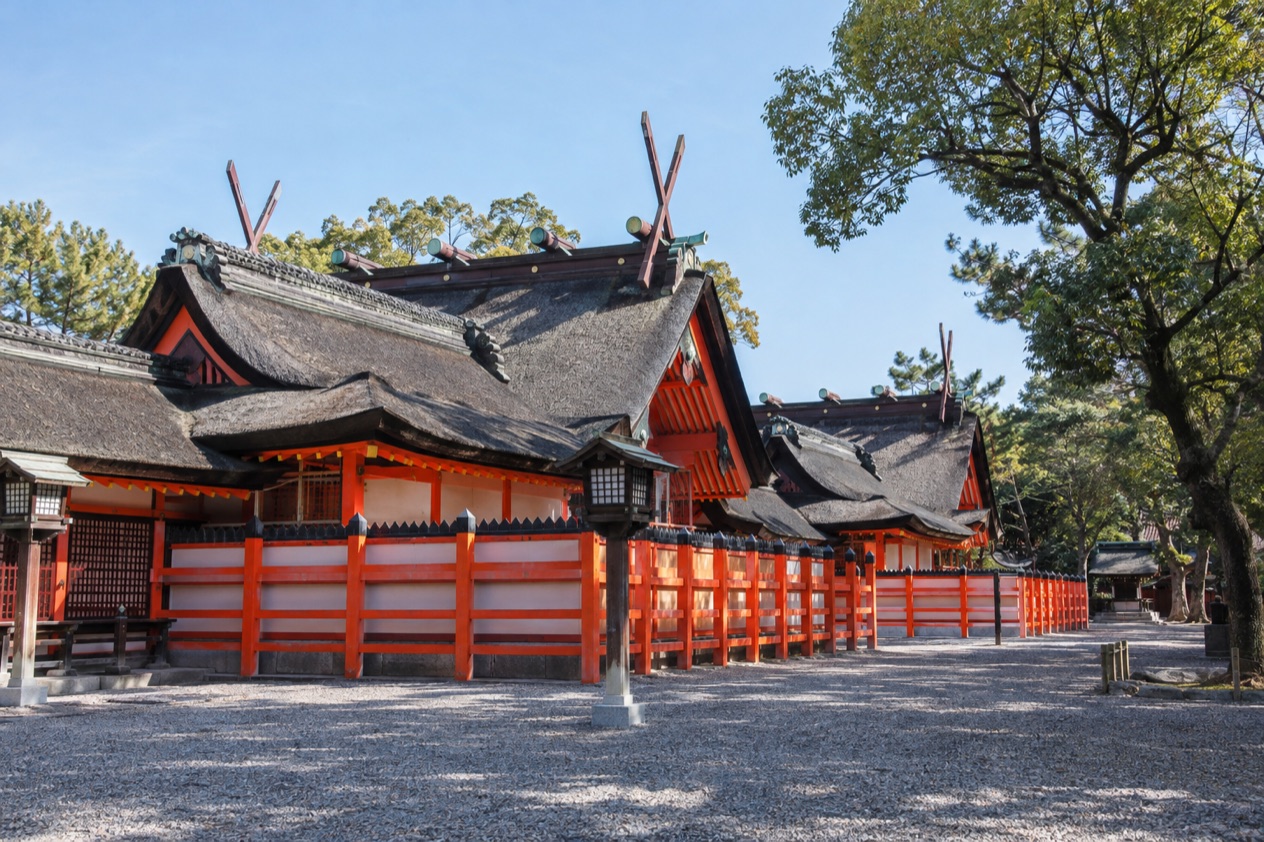
The honden, the main hall, is the heart of the shrine and the reason architects come. It is built in the Sumiyoshi-zukuri style, the form that takes its name from this very place, and it has been designated a national treasure as the oldest example of that style. The lines are straight and plain, with the gabled roof, the red-lacquered posts and the white walls typical of the type.
Look at how the halls are positioned in relation to each other, and at how restrained the decoration is. This is Shinto architecture before later temple influences added flourish. The shrine enshrines the three Sumiyoshi sanjin, Sokotsutsu no Ono-mikoto, Nakatsutsu no Ono-mikoto and Uwatsutsu no Ono-mikoto, together with Okinagatarashi-hime no Mikoto, and each is honored in its own hall. Stand quietly at the offering area, bow, and watch how visitors pray.
The Kakutorii and the stone gates
Just south of the honden stands a stone torii known as the Kakutorii. It is a gate with a clean, geometric character: its middle bar does not extend beyond the vertical posts, and all the pieces have square edges. People picture a torii with sweeping, upturned ends, so this one looks almost severe by comparison.
It rewards a close look. Walk up to it and run your eye along the joints and corners, then step back and compare it with the other gates on the grounds. For anyone curious about how Shinto gates differ in form, it is a small lesson in a few minutes of looking, and a good reason to linger rather than rush toward the main hall.
Sumiyoshi Park and the old shoreline
The shrine’s former riding grounds are now Sumiyoshi Park, and they once faced open water. That fact changes how you read the place. The tall trees and the quiet of the grounds feel like an inland garden, yet the shrine began as a guardian of the sea and of those who traveled by it.
As you walk, think about the lost coastline. Osaka Bay still exists, but it lies elsewhere in the city today. The park is a pleasant place to slow down after the halls, with paths under the trees and room to sit and take in what you have seen before heading back toward the station.
When to visit Sumiyoshi Taisha
The date that defines the shrine’s year is New Year’s Day. Sumiyoshi Taisha is famous for very large crowds at hatsumode, the first shrine visit of the year, when families and friends come to pray for the months ahead.
If you want to feel that energy, January is the moment, though you should expect to move at the pace of the crowd. If you prefer to see the buildings and the bridge without a crush, choose another time.
Rain falls on around five or six days, and sunshine is fairly generous for winter. Dress in layers and a warm coat if you come then, because the shrine is an outdoor visit.
Spring brings milder air, with April highs in the high 60s and lows in the low 50s. Showers appear on roughly nine days, so a light rain jacket is sensible. It is a comfortable month for walking the grounds and crossing the bridge, and the longer sunshine hours help if you want to photograph the halls.
Summer is hot and humid. July highs reach the high 80s and the nights stay in the mid-70s, with humidity high and rain on about ten days. A visit then is best taken at a leisurely pace, with water at hand and a pause in the shade of the trees. The grounds are green and full, but the heat shapes how long you will want to stay out.
October is a pleasant choice. Highs sit in the mid-70s and lows around 60, which makes for easy walking weather in a long-sleeved shirt or a light layer. Rain falls on about eight days, so a compact umbrella is useful. Whatever the month, a morning on the grounds is a good way to start a day that you can then continue elsewhere in the city.
| Month | Average high (°F) | Average low (°F) | Precipitation (in) | Days with rain | Sunshine (hours) |
|---|---|---|---|---|---|
| January | 49.5 | 37.4 | 1.85 | 5.6 | 146 |
| April | 67.8 | 51.6 | 4.01 | 9.2 | 193 |
| July | 89.2 | 76.3 | 6.87 | 10.0 | 184 |
| October | 74.7 | 60.8 | 5.35 | 8.3 | 166 |
Tips for your visit
Wear comfortable shoes. The grounds are outdoors, the paving can be uneven, and the Taiko bashi is steep enough that a good grip helps on the way up and down. If rain is forecast, bring a compact umbrella, since the halls are best seen from the paths and the open areas rather than from inside.
Bring a camera and some patience. The bridge, the Kakutorii and the honden each ask for a pause, and the light under the trees changes the look of the red and white buildings. Take a moment to observe how others approach the halls, with a bow and a quiet prayer, and follow the same gestures if you wish to take part.
As for combining it with other stops, the shrine sits in Sumiyoshi-ku in Osaka, so it fits into a wider day in the city. Dotonbori and Shinsaibashi are districts in Osaka, reached by taking the Midosuji Line from Osaka or Umeda Station to Shinsaibashi, and you can stay on the same line to Namba for Dotonbori.
If you want a different kind of outing, Osaka Bay is reachable from Osaka or Umeda stations via the JR Loop Line and the Chuo subway line. Universal Studios Japan, which opened in 2001, features attractions like the Wizarding World of Harry Potter. Pairing a historic shrine with a theme park is an unusual contrast, but it shows how many sides the city has.
Families and anyone with limited mobility should keep the bridge in mind, as its steep arch is part of the experience and also its main physical challenge. You can still enjoy the shrine’s atmosphere and the buildings from the grounds. If you are coming from Tokyo, the Tokaido-Sanyo shinkansen runs to Shin-Osaka Station, a journey of about two and a half hours, and from there the JR local line leads to Osaka Station.
Good to know before you go
Sumiyoshi Taisha is a working Shinto shrine, so the habits of the place are the habits of worship: a bow at the gate, a quiet voice, and a pause before the offering area. Locals simply call it Sumiyoshi-san, and you will hear that name often when asking around town.
Weather shapes the visit more than anything else. Summer is hot and humid with regular rain, and the year has its wet spells, so a light layer, a hat or an umbrella is worth having depending on the month. Keep some yen in your wallet for small purchases around the grounds, and take your time, since the best part of the shrine is the unhurried looking.
Sources
- Wikipedia, Sumiyoshi-taisha (https://en.wikipedia.org/wiki/Sumiyoshi-taisha), checked October 11, 2026
- Japan National Tourism Organization, Osaka (https://www.japan.travel/en/destinations/kansai/osaka/), checked October 11, 2026
- Japan Meteorological Agency (JMA), Normal values 1991-2020, monthly (https://www.data.jma.go.jp/stats/etrn/view/nml_sfc_ym.php?prec_no=62&block_no=47772), station Osaka, elevation 23 m, checked October 11, 2026
To plan your stay
- Best Time to Visit Japan: Cherry Blossoms, Autumn Colors, Weather and Festivals
- Where to Stay in Japan: Ryokan, Temple Stays, Capsule Hotels and the Best Cities to Base In
- Sending Luggage from the Airport in Japan: Hands-Free Travel, Hotel Delivery and Coin Lockers
- Know Before You Go to Japan: Entry, Money, Etiquette and Getting Around