
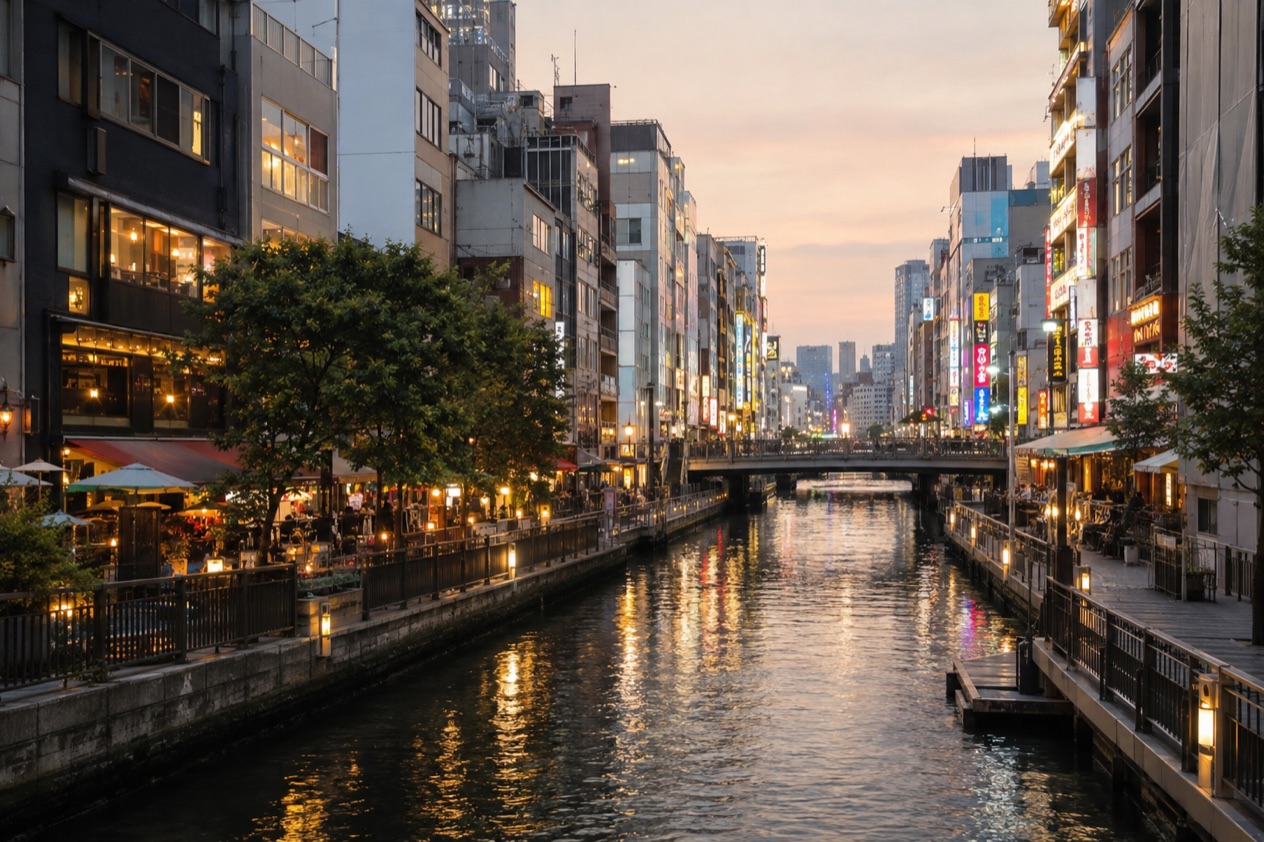
In July, Osaka smells of grilled octopus batter and sweet soy, and the canal at Dotonbori throws back a wall of neon after dark. Paper fans circulate, shaved ice comes out in bright syrups, and drums and boats gather for the river festival of late summer. This is Osaka at its hottest and most humid, a month for eating outdoors at night, ducking into cool arcades and department stores by day, and spending the evenings by the water.
What is the weather like in Osaka in July?
July in Osaka is hot, humid and gray-and-bright by turns, with the rainy stretch of early summer fading and the full heat of August on its way.
| Month | Average high (°F) | Average low (°F) | Precipitation (in) | Days with 1 mm or more of precipitation | Hours of sunshine | Daylight on the 15th |
|---|---|---|---|---|---|---|
| June | 82.4 | 68.5 | 7.29 | 11.3 | 154 | 14 h 28 min |
| July | 89.2 | 76.3 | 6.87 | 10.0 | 184 | 14 h 17 min |
| August | 92.7 | 78.4 | 4.45 | 7.2 | 222 | 13 h 30 min |
Afternoons run well into the upper 80s, and nights barely cool off, so the city feels warm even after dark. Humidity sits around 70 percent, which makes the air heavy and clothes cling. Japan’s JNTO describes the summers of Honshu as very humid, hot and sultry, and Osaka fits that picture.
Rain still comes in a good share of the days, often as a shower or a gray, damp spell rather than a single downpour. A compact umbrella earns its place in the bag, and it doubles as shade when the sun comes back. Sunshine hours climb from June, so clear spells can feel strong.
Light, breathable clothes in cotton or linen suit the month, with something dry to change into after a soaking. Daylight stretches well into the evening, which leaves plenty of time for a walk along the canal or the river once the day has loosened its grip. Indoor spaces, from shopping arcades to museums, are a useful break between outdoor stops.
What to do in Osaka in July
The big event of the month is the Tenjin Matsuri, a river festival that usually lands in the last week of July. Processions wind through the streets, and decorated boats glide along the river in the evening, often with fireworks.
The Japanese word for fireworks is hanabi, and summer in the Kansai region is full of them. Elsewhere in the region, Kyoto holds its Gion Matsuri throughout July, with float processions that begin on July 17 and run again later in the month.
Food in July leans cold and refreshing. Shaved ice (kakigori) with fruit syrup, chilled soba and somen noodles, iced barley tea and draft beer all show up on tables, next to the city’s year-round street food of takoyaki (octopus balls), okonomiyaki (savory pancakes) and kushikatsu (breaded skewers). The city’s reputation for eating well is easy to test on any street at dinnertime.
Osaka Castle and its park
Osaka Castle is one of the landmarks of the city, and the original was built between 1583 and 1598 by Toyotomi Hideyoshi. The surrounding parks give you lawns, moats and stone walls to walk around, with the keep rising above the trees.
In July the green is at its fullest, and the cicadas buzz through the trees. Plan for slow walking, plenty of water and a pause in any shaded corner. The stone walls and moats are good for photographs even when the sky is overcast.
Kita and the Nakanoshima waterfront
Kita is a modern area lined with shopping malls, department stores and office buildings, and a short walk leads to Nakanoshima, with retro architecture and waterfront scenery. In July this is an easy mix of indoor and outdoor time: you can browse the stores when the humidity wins and walk the river’s edge when it relents.
The department stores and malls are a handy refuge on rainy days, and their lower floors are full of prepared foods and sweets. The water in Nakanoshima is the draw for an evening stroll, with the old buildings facing the river.
Dotonbori after dark
Dotonbori is a district running along its canal from Dotonboribashi Bridge to Nipponbashi Bridge, in the Namba area of Chuo ward. The signs, the lanterns and the stalls cluster along the water, and the whole stretch is built for eating on your feet.
A July evening here means takoyaki steaming in paper boats, bowls of okonomiyaki on griddles at the table, and a cold drink to wash it down. The neon reflecting in the canal is the picture visitors bring home. Walk it slowly, stop where the smell pulls you in, and finish at the bridge for the view along the canal.
The Bay Area
The Bay Area of Osaka is a beachfront entertainment hub with theme parks, aquariums, Ferris wheels and sports facilities. Osaka Bay can be reached from Osaka or Umeda stations via the JR Loop Line and the Chuo subway line. Universal Studios Japan, which opened in 2001, sits here with attractions such as the Wizarding World of Harry Potter.
In July the aquarium is a natural escape from the humid air, while the Ferris wheel and waterfront give a look back across the bay. Theme-park days in the summer heat call for water, hats and a plan for indoor shows.
A two-day itinerary for Osaka in July
Day 1 belongs to the old and the new city center. Start at Osaka Castle park by taking the JR Loop Line to Morinomiya, and walk the moats and the stone walls while the day is fresh. At midday, move indoors: Kita’s department stores and food halls make an easy lunch of noodles, tempura or a set meal in an air-conditioned dining floor.
In the afternoon, cross to Nakanoshima and follow the river past the retro architecture. With daylight lasting more than fourteen hours, there is no rush. Come evening, head to Dotonbori for the canal, the lights and a street-food dinner of takoyaki, okonomiyaki and kushikatsu, followed by a cold drink.
If rain turns the plan, shift Kita’s malls and department stores to the morning and treat the castle as a short stop between showers. Dotonbori’s covered arcades nearby keep dinner going whatever the sky does.
Day 2 goes to the Bay Area. Aquariums are cool refuges in July, and a Ferris wheel gives a view over the bay in the evening light.
For lunch, look for a casual spot near the waterfront or in the park’s food courts. After the sun lowers, return to the city for a last dinner, perhaps at an izakaya, a Japanese pub with small shared dishes, in Namba or Umeda. If it rains, the aquarium and the theme park’s indoor shows carry the day.
Is Osaka busy in July?
July in Osaka is a festival month in a hot, humid season, so the city’s pace turns toward the evenings, when the river and the streets come alive.
The Tenjin Matsuri gives the last week of the month a particular energy, with processions, boats and fireworks near the river. In Kyoto, the Gion Matsuri runs through July, with its two float processions, and the festival is one of the largest in Japan. These events add to the sense of a city in full summer mode.
Beyond Osaka, the Mount Fuji climbing season typically begins at the start of July and runs to about the first week of September, which gives the month a feeling of the summer outdoor season opening across Honshu. In the city itself, the heat shapes how people move: shade, air conditioning and cold drinks set the rhythm, and evenings become the main social hours.
With a metropolitan area of over 17 million people, Osaka is a big place whatever the month. In July the pace is easier to read from the weather than from any calendar: when the sun and humidity are strong, the arcades, malls and canalside restaurants fill, and when the heat eases toward dusk the streets spill outdoors again.
What to pack for Osaka in July
Pack for heat, humidity and the occasional shower, with light layers for the chill of air-conditioned interiors.
- Lightweight cotton or linen clothes, because the air stays humid and warm well after dark.
- A compact umbrella, for showers and for shade at the castle grounds.
- A hat and sunscreen, since sunshine hours climb through the month.
- Comfortable walking shoes that dry quickly, for the park paths and canal streets.
- A thin cardigan or scarf, for strongly air-conditioned malls and aquariums.
- A refillable bottle and a small towel, for the walks between stops.
Good to know before you go
July in Osaka means a month of humidity and a share of rainy days, so build slack into outdoor plans and keep indoor options ready. Tanabata, the Star Festival, falls on the 7th day of the 7th lunar month, and festival evenings in the region can change the feel of a neighborhood. Wear shoes that handle wet pavement, and keep your pace slow in the heat.
Osaka in July vs June and August
Moving the trip four weeks earlier brings you to June, which is cooler by several degrees and has slightly more rainy days. Evenings are mild rather than sticky, and daylight is a bit longer. You miss the Tenjin Matsuri, which belongs to the end of July, and the summer festival mood is only starting to build.
Moving four weeks later brings August, which is hotter, sunnier and drier on paper, with fewer rainy days. The heat is at its fullest, and the daylight is shorter. The Mount Fuji climbing season, which begins in July, runs on to about the first week of September, and the Sendai Tanabata Festival, held from August 6 to 8, belongs to that month in northern Honshu.
Travelers who want festivals and a full summer atmosphere do well to stay with July, while those who prefer milder evenings might lean to June. If you can handle intense heat and want the sunniest days, August is the choice.
Is July a good time to visit Osaka?
Yes, for travelers who like summer festivals, night-time eating and a city that comes alive after dark, and who are comfortable with heat and humidity.
Food lovers will find the season suits them: cold noodles, shaved ice and street food in the evening along the canal. Families and groups who plan around a water-and-air-conditioning rhythm, with indoor stops at midday, will do fine. Those who struggle with sticky heat, or who want crisp air for long walks, should choose another month.
On arrival, start with Osaka Castle park while you adjust to the climate, then save Dotonbori for the first evening. The river festival at the end of the month, with its boats and fireworks, is what sets July apart in Osaka.
Sources
- Japan Meteorological Agency (JMA), Normal values 1991-2020, monthly (https://www.data.jma.go.jp/stats/etrn/view/nml_sfc_ym.php?prec_no=62&block_no=47772), station Osaka, elevation 23 m, checked October 11, 2026
- Computed from the date and the latitude of the place (sunrise equation, solar elevation -0.833 degrees), October 11, 2026
- Japan National Tourism Organization, weather and seasons in Japan (https://www.japan.travel/en/plan/weather/), checked October 11, 2026
- Wikipedia, Climate of Japan (https://en.wikipedia.org/wiki/Climate_of_Japan), checked October 11, 2026
- Japan National Tourism Organization, summer in Japan (https://www.japan.travel/en/guide/summer-guide/), checked October 11, 2026
- Japan National Tourism Organization, festivals and events (https://www.japan.travel/en/see-and-do/festivals-and-events/), checked October 11, 2026
- Wikipedia, Hanabi (https://en.wikipedia.org/wiki/Hanabi), checked October 11, 2026
- Wikipedia, Gion Matsuri (https://en.wikipedia.org/wiki/Gion_Matsuri), checked October 11, 2026
- Japan National Tourism Organization, Mount Fuji guide (https://www.japan.travel/en/fuji-guide/), checked October 11, 2026
- Official website for Mt. Fuji climbing, about the climb (https://www.fujisan-climb.jp/en/about/), checked October 11, 2026
- Wikipedia, Tanabata (https://en.wikipedia.org/wiki/Tanabata), checked October 11, 2026
- Wikipedia, Osaka (https://en.wikipedia.org/wiki/Osaka), checked October 11, 2026
- Wikivoyage, Osaka (https://en.wikivoyage.org/wiki/Osaka), checked October 11, 2026
- Japan National Tourism Organization, Osaka (https://www.japan.travel/en/destinations/kansai/osaka/osaka-bay-area/), checked October 11, 2026
- Osaka official tourism guide, basic guide (https://www.osaka-info.jp/en/osaka/basic/), checked October 11, 2026
- Wikipedia, Dōtonbori (https://en.wikipedia.org/wiki/D%C5%8Dtonbori), checked October 11, 2026
- Wikipedia, Universal Studios Japan (https://en.wikipedia.org/wiki/Universal_Studios_Japan), checked October 11, 2026
To plan your stay
- Things to Do in Osaka: Osaka Castle, Dotonbori Street Food, Universal Studios Japan and Day Trips
- Where to Stay in Osaka: Kita, Minami, Tennoji, the Castle Area and the Bay
- Osaka from Tokyo: Shinkansen Services, Shin-Osaka Station and Where to Go on Arrival
- Know Before You Go to Osaka: Entry, Money, Getting Around, Weather and Etiquette