
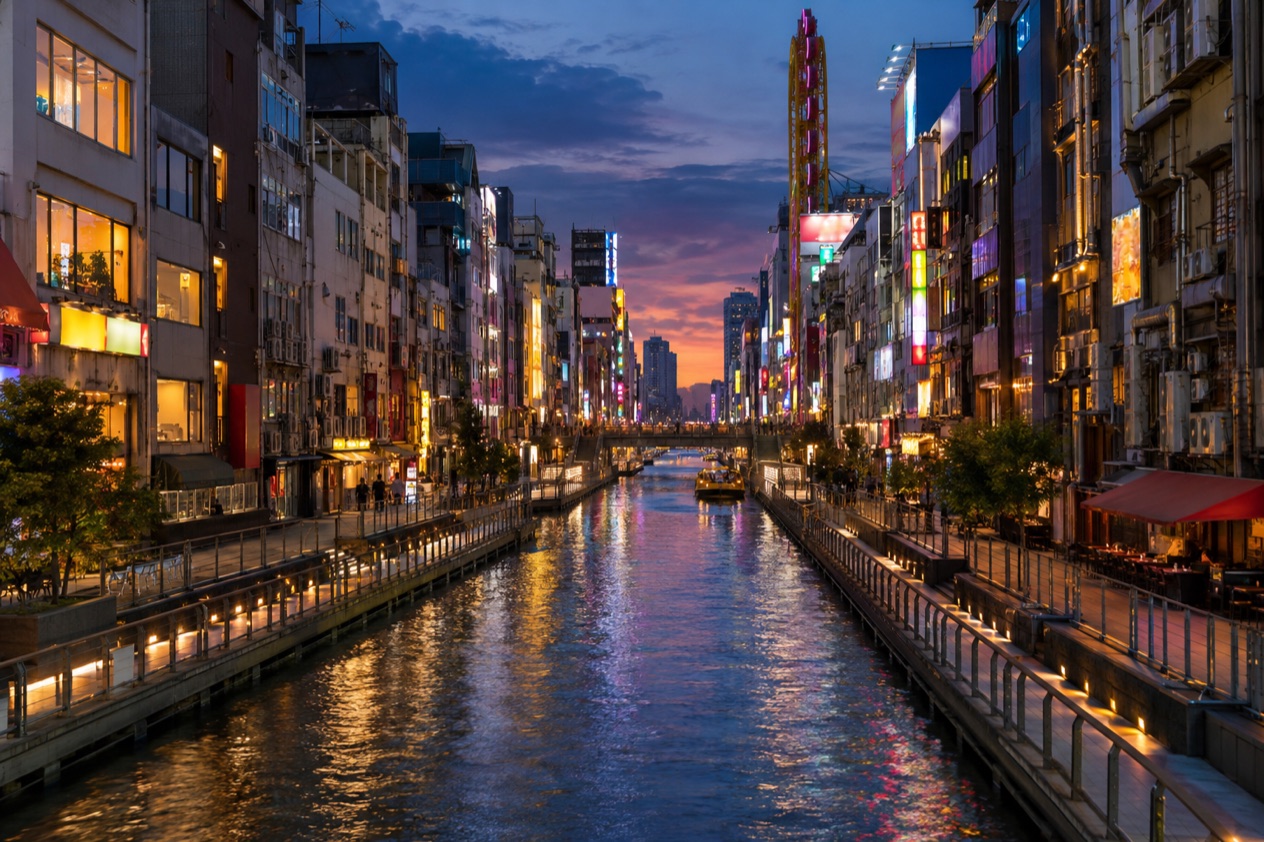
Late in the evening in Namba, the canal turns into a ribbon of neon, the smell of takoyaki drifts out of the stalls, and someone is always lining up for a plate of kushikatsu. A few streets away, the morning starts quietly with shutters rolling up on the arcades and commuters pouring into the station. Staying here means choosing which of those two moods you want outside your window, and which part of Minami, Osaka’s southern entertainment district, you want to wake up in.
What is the best area to stay in Namba?
For a first visit, the streets around Namba Station are the best base, because the trains, the food streets and the neon of Dotonbori all start at your door. Travelers who care most about shopping and an evening stroll will like Shinsaibashi, nightlife seekers will want to be in or beside Dotonbori, and families heading to the theme park may prefer the Osaka Bay side. Those watching their budget tend to look at the business-style and guesthouse lodging that clusters near the stations.
The areas differ less in distance than in mood. Namba is regarded as the center of Minami, the largest commercial area in Osaka, which stretches from Semba to Namba Station. Inside that zone, the station neighborhood is about movement and connections, Dotonbori is about eating and lights, and Shinsaibashi is about shopping streets and a slightly more polished feel. Osaka Bay sits apart, with its own rhythm built around the waterfront and Universal Studios Japan.
First-timers who want everything within reach should think about the station. Namba Station is really a group of connected stations: Namba, JR Namba and Osaka-Namba.
Between them they carry the Nankai Line and Koya Line, the Midosuji, Yotsubashi and Sennichimae subway lines, and the JR Kansai Main Line (Yamatoji Line). That tangle of rails is the reason the area works as a base for a whole stay in Kansai, not only for Osaka itself.
Sightseers who plan to spend their days in Nara, Kobe or elsewhere in the region also benefit from sleeping here. Kintetsu runs from Osaka-Namba Station to Nara, Ise, Shima, Yokkaichi and Nagoya, Hanshin goes toward Sannomiya in Kobe, and JR-West links JR Namba to Tennoji, Nara and Horyuji. You can leave Osaka in the morning and come back to the same bed without moving your luggage.
If food and nightlife are the point of your trip, Dotonbori is the obvious address. Osaka is known for its food, entertainment and nightlife, and this is where all three meet along the canal.
Light sleepers should keep in mind that a room facing the main strip is a room facing the evening. Shinsaibashi, a stop away on the Midosuji Line, gives you the same access to the food streets with a calmer return at night.
Families with a theme-park day on the agenda have a different question to answer. Universal Studios Japan, which opened in 2001 and counts the Wizarding World of Harry Potter among its attractions, sits in the Osaka Bay area. Staying there shortens the morning, but you give up the Minami evenings. Many families split the difference, sleeping in Namba for the food and the rail links and making the bay a single day out.
Budget travelers should look at what kind of room they actually need. A compact business hotel or a guesthouse beside a station often serves a visitor who spends the day outside and only comes back to sleep. Namba has plenty of both kinds of lodging, along with larger hotels and apartment-style stays for longer visits.
The best areas to stay in Namba
Around Namba Station
This is the practical heart of Minami, a district spread across Chuo and Naniwa wards. Its name comes from a variation of Naniwa, the old name for Osaka, and the streets still feel like the working core of the old merchant city. Below ground, passages link the three stations, and above ground the arcades lead you to the food lanes within a few minutes of leaving the platform.
Lodging here runs from large city hotels to business hotels, capsule-style stays, guesthouses and apartments. It suits first-time visitors, rail-minded travelers and anyone planning day trips, because the Nankai, Kintetsu, Hanshin and JR lines all start from the complex. Three subway lines run through as well, including the Midosuji Line, which also connects Shin-Osaka and Umeda to the city center.
A useful tip: the station complex is large and its parts have different names, so note which of the three stations your hotel is nearest to. A property by Osaka-Namba is a better fit for Kintetsu and Hanshin trips, while one by JR Namba suits Nara and Tennoji, and one by Namba Station itself suits the Nankai and Koya lines.
Dotonbori
Dotonbori is the canal-side strip that most visitors picture when they think of Osaka at night: giant signs, restaurant fronts with mechanical crabs and pufferfish, and boats gliding under the bridges. You reach it by staying on the Midosuji Line until Namba Station, so a hotel here is effectively a hotel in Namba with the neon at the doorstep.
The lodging tends toward business hotels, boutique-style stays and guesthouses tucked into the side streets, along with some apartments. It suits couples, groups of friends and solo travelers who want to step out for a late bowl of ramen or a plate of okonomiyaki without planning a route. The mood is lively until late, so it is less suited to those who go to bed early.
A tip: ask for a room that faces a side street or a higher floor if you want a quieter night. The main canal frontage is the place to eat and wander, but the streets just behind it give a calmer place to close the door.
Shinsaibashi
Shinsaibashi pairs with Dotonbori in the way the guidebooks tell it, and the Midosuji Line serves both. From Osaka or Umeda Station you ride to Shinsaibashi Station to reach the covered shopping arcade, the department stores and the boutiques, then continue on foot to the canal for dinner.
Lodging here leans toward hotels with a design focus, business hotels and apartment-style stays, which suit couples, shoppers and travelers on a longer visit. It feels a little more composed than the canal strip, with shopping during the day and restaurants in the evening. You are one subway stop from Namba Station, so the Nankai and Kintetsu trains are still within reach.
One tip: because the Midosuji Line also runs to Umeda and Shin-Osaka, Shinsaibashi is a sensible choice if your trip mixes the southern entertainment district with the northern side of the city.
Osaka Bay area
Osaka Bay lies on the waterfront of this major port city. It is reached from Osaka or Umeda stations by the JR Loop Line and the Chuo subway line, so it is a rail ride from the center rather than a walk. This is where Universal Studios Japan stands, and the area feels more like a resort district than a city neighborhood.
Hotels here are geared to visitors who come for the park, and they suit families with children who want to wake up near the gates. The trade-off is that the food streets and nightlife of Minami are a train ride away, and so are the rail lines toward Nara, Kobe and Nagoya. It works as a one- or two-night add-on rather than a base for a long Kansai stay.
Namba areas compared
| Area | Best for | Feel | Getting around |
|---|---|---|---|
| Around Namba Station | First visit, day trips, rail links | Busy transport hub at the heart of Minami | Nankai Line, Koya Line, Midosuji, Yotsubashi and Sennichimae subway lines, JR Kansai Main Line (Yamatoji Line) |
| Dotonbori | Food, nightlife, evening strolls | Neon, canal and restaurant fronts | Midosuji Line to Namba Station |
| Shinsaibashi | Shopping, couples, longer stays | Shopping arcades and boutiques | Midosuji Line to Shinsaibashi Station |
| Osaka Bay area | Families, theme-park days | Waterfront and resort | JR Loop Line and Chuo subway line from Osaka or Umeda stations |
The first trade-off is between sleeping right on the station and sleeping on a quieter street. A hotel beside the complex puts every platform within a few steps of the lobby, which matters when you are carrying luggage or heading to Nara for the day.
In exchange, the surroundings are busier and the streets keep moving long after dark. A room a few blocks away in the Shinsaibashi direction gives you calmer evenings for a short walk back.
The second trade-off is between the old town and the new. Namba and Dotonbori carry the feel of old Osaka, where the name itself comes from Naniwa and the food culture grew up around the canal.
Shinsaibashi is the shopping side, with department stores and arcades. Osaka Bay is the modern waterfront, built around a theme park. Each is a different Osaka, and the right one depends on whether you want to eat, shop or ride.
There is also the question of how often you will use the trains. If your plans take you out of the city regularly, the station area wins because Kintetsu, Hanshin and JR-West all leave from the complex. If you mostly stay in Osaka and spend your evenings eating, Dotonbori or Shinsaibashi will serve you just as well, and the Midosuji Line keeps you connected to Umeda and Shin-Osaka whenever you need them.
Finally, think about the length of your stay. A short visit rewards a single base close to the food and the main line. A longer one can be split, for example a few nights in Minami and one night near the bay for the park. Moving once is usually a smaller price than commuting to the bay every morning from the other side of the city.
How to choose your hotel in Namba
Start by choosing the kind of lodging, because Namba offers several. A standard hotel gives you a private room with a bathroom, a front desk and often a restaurant, and it suits most visitors. A business hotel is the compact Japanese version, with a small room, a narrow bed and a unit bath, built for people who spend their days outside. Both are found in large numbers around the stations.
A capsule hotel is a different experience, with a sleeping pod in a shared space and shared bathing facilities. It appeals to solo travelers who want a bed near the station and are curious about the format. A guesthouse, by contrast, usually offers simple rooms or dorm beds and a common area where travelers swap tips, which suits people on a long trip who like company.
A ryokan, the traditional Japanese inn, is the one to consider if you want to sleep on a futon laid over tatami and perhaps eat a multi-course dinner in your room. Such stays are more often associated with onsen towns and Kyoto than with the dense commercial streets of Minami, so if the ryokan experience matters to you, it may be worth giving it a night elsewhere in the trip.
Apartment-style stays suit families, groups and longer visits. They usually give you a small kitchen and more floor space, which counts when you are traveling with children. Their locations spread across the streets around Namba and Shinsaibashi, so it is worth checking which station each is closest to rather than relying on the neighborhood name alone.
Next, look at the station, not just the area name. Namba Station is three connected stations, Namba, JR Namba and Osaka-Namba, and each opens onto different lines. A hotel close to Osaka-Namba gives you the Kintetsu lines toward Nara, Ise, Shima, Yokkaichi and Nagoya, plus Hanshin toward Amagasaki, Ashiya, Nishinomiya and Sannomiya. JR Namba has the JR-West services to Tennoji, Nara and Horyuji.
If you arrive by shinkansen from Tokyo, the ride to Shin-Osaka Station takes about two and a half hours. From there the Midosuji Line, which links Shin-Osaka and Umeda to the city center, leads you toward Minami, so a hotel on that line keeps the first day simple. A hotel near the Midosuji stops is also a good fit if you plan to go out to the bay later.
Families should weigh the evening scene. The streets around Dotonbori are at their liveliest after dark, which children may enjoy for a stroll but which can make a room on the main strip less restful. A hotel a few streets back, or in the Shinsaibashi direction, gives a calmer base while keeping the canal close. For a day at the theme park, the Osaka Bay area is a separate option.
Travelers who think about stairs and long walks should look at how the hotel connects to the stations. The Namba complex joins several stations and lines in one place, so a hotel near it means fewer changes between neighborhoods. When comparing listings, favor those that name the station they sit beside and the line you will use most, since that tells you more about a day in Osaka than a map pin does.
Finally, match the lodging to the trip. A visitor spending every day on day trips needs a bed and a station. A visitor eating and shopping through the evening may prefer a room with space to unwind. Someone coming for the park and little else can sleep by the bay. The right Namba hotel is the one that fits the shape of your days rather than the one with the longest list of amenities.
Good to know before you go
If you come from Tokyo, the Tokaido-Sanyo shinkansen reaches Shin-Osaka Station, and the Midosuji Line then connects Shin-Osaka and Umeda to the city center and on toward Namba. From Osaka or Umeda Station the same line runs to Shinsaibashi, and you can stay aboard to Namba Station. Osaka has a relaxed, food-loving character, so plan for evenings out near the canal.
Sources
- Wikipedia, Namba (https://en.wikipedia.org/wiki/Namba), checked October 11, 2026
- Wikivoyage, Osaka/Minami (https://en.wikivoyage.org/wiki/Osaka/Minami), checked October 11, 2026
- Japan National Tourism Organization, Osaka (https://www.japan.travel/en/destinations/kansai/osaka/), checked October 11, 2026
To plan your stay
- Best Time to Visit Osaka: Cherry Blossoms, Autumn Color, Weather and Festivals
- Things to Do in Osaka: Osaka Castle, Dotonbori Street Food, Universal Studios Japan and Day Trips
- Osaka from Tokyo: Shinkansen Services, Shin-Osaka Station and Where to Go on Arrival
- Know Before You Go to Osaka: Entry, Money, Getting Around, Weather and Etiquette