
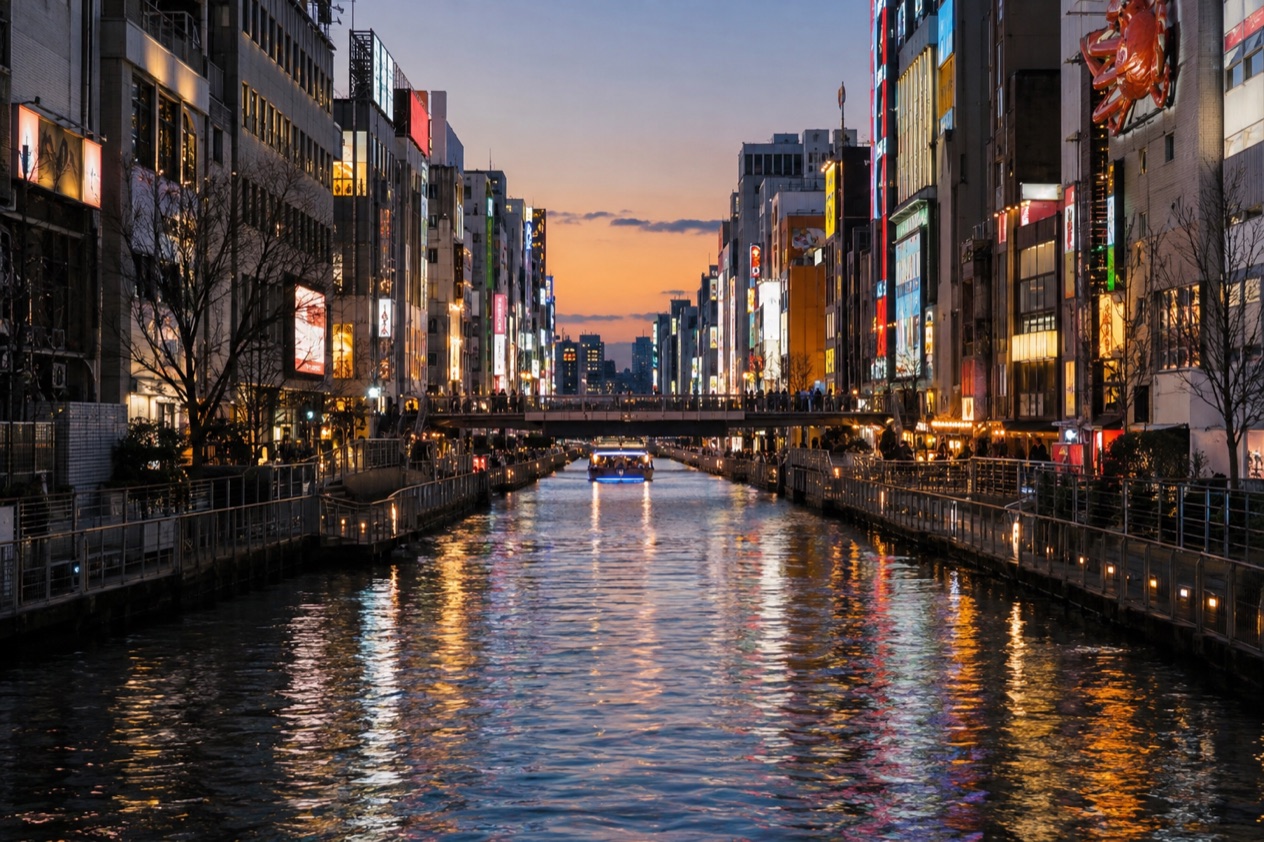
In the first days of January, Osaka slows down in a way it rarely does. Shutters stay down on side streets while families eat osechi, the lacquered boxes of New Year dishes, and then the city switches back on, with the lights of Dotonbori reflected in the canal and steam rising from takoyaki stands.
The air is cold and often bright, a good match for hot food and long walks between warm interiors. This is Osaka in the heart of winter, for travelers who like their sightseeing with a scarf on.
What is the weather like in Osaka in January?
January in Osaka is cold but rarely brutal: crisp days with a fair amount of sun, chilly nights, and only a handful of wet days.
| Month | Average high (°F) | Average low (°F) | Precipitation (in) | Days with 1 mm or more of precipitation | Hours of sunshine | Daylight on the 15th |
|---|---|---|---|---|---|---|
| December | 54.1 | 41.5 | 2.19 | 6.1 | 152 | 9 h 51 min |
| January | 49.5 | 37.4 | 1.85 | 5.6 | 146 | 10 h 04 min |
| February | 50.9 | 37.8 | 2.38 | 6.3 | 141 | 10 h 55 min |
Afternoons sit in the upper 40s, so you can walk outdoors between stops if you are dressed in layers: a sweater, a warm coat, a scarf. Nights drop to just above freezing, and the cold is felt most when you stand on a bridge over the canal or wait on an open train platform. Humidity is moderate, so the cold is not damp the way a winter on the coast can be.
Rain is the lightest of the three months, and when it comes it is usually a cold, gray drizzle rather than a downpour. An umbrella is more useful than boots.
Daylight is short, with the sun setting early in the evening, so the lit-up part of the city begins soon after the afternoon fades. Plan outdoor sights for the middle of the day and keep the evenings for neon, food halls and warm interiors.
What to do in Osaka in January
The month opens with Japanese New Year, celebrated on January 1 under the Gregorian calendar. Families eat osechi, a selection of small dishes packed in tiered boxes, and many restaurants and attractions close during the New Year holidays.
That makes the first days of the month a time to wander the streets, see the shrines and eat what is open rather than to tick off a long list of sights. After the holidays, the city returns to its usual pace.
Shops in urban areas are generally open from 10:00 a.m. to 8:00 p.m. every day, which leaves long evenings for department stores, arcades and the food halls in the basements of the big stores. Winter is a season for hot, comforting food, and Osaka is a city that takes eating seriously.
Dotonbori after dark
Dotonbori is a district running along the canal of the same name, from Dotonboribashi Bridge to Nipponbashi Bridge in the Namba area of Chuo ward. In January the cold brings people closer to the food stalls, and the glow of the signs on the water is the reason to come. You eat standing up or in tiny counters: takoyaki (octopus balls) piping hot from the griddle, okonomiyaki (savory pancakes) cooked in front of you, kushikatsu (breaded skewers) and a bowl of ramen.
The street is lively once darkness falls early, and a stroll along the canal with a hot snack in hand is the classic winter ritual. Dress warmly for the walk, because the wind off the water can be sharp, and keep an umbrella in your bag for the drizzly evenings.
Osaka Castle and its parks
Osaka Castle and its surrounding parks sit in the middle of the city. The original castle was built between 1583 and 1598 by Toyotomi Hideyoshi, and today the main keep houses a museum that stands 55 meters above ground. From Osaka or Umeda Station you take the JR Osaka Loop Line to Morinomiya Station, which is right next to Osaka Castle Park.
January is a good time for the grounds: the air is cold and clear, the bare branches show the stone walls and moats, and the plum trees are the ones to look for. Prunus mume, the Japanese plum, typically flowers from January until late February in East Asia, so you may catch the first buds in parks and gardens as winter turns toward spring.
Kita, Nakanoshima and the Bay Area
The Kita area is a modern district lined with shopping malls, department stores and office buildings, and a short walk leads to Nakanoshima with its retro architecture and waterfront scenery. On a gray winter day, the covered malls and basement food floors are an easy place to spend the afternoon, and Nakanoshima is a place for a few minutes of river air between indoor stops.
The Bay Area is a beachfront entertainment hub with theme parks, aquariums, Ferris wheels and sports facilities, reached from Osaka or Umeda stations via the JR Loop Line and the Chuo subway line. Universal Studios Japan, which features the Wizarding World of Harry Potter, and Super Nintendo World belong to the same family of big-ticket days out. The aquariums and indoor attractions suit the colder, shorter days.
If the cold calls for something more dramatic, Japan’s ski season generally opens in December and lasts until April, with peak season in January and February in Hokkaido and the high mountains of Nagano. Osaka itself has no slopes, but the winter sports regions are a different trip altogether from a city stay.
A two-day itinerary for Osaka in January
Day 1 starts at Osaka Castle, when the grounds are cold and the air is clear. Take the JR Loop Line to Morinomiya and walk the moats and the stone walls, then go up into the castle museum. With the sun setting early, this is the day for the outdoors while there is light. At midday, find a casual lunch of udon or a set meal near the park or back in the center.
In the afternoon, cross to Kita for the department stores and the food halls underneath them, and take a short stretch of Nakanoshima if the sky is dry. As evening arrives, head south to Dotonbori for the lights, with takoyaki and okonomiyaki as dinner. If rain sets in, the covered shopping streets and arcades stand in for the canal walk.
Day 2 is for the Bay Area, with its theme parks, aquariums and Ferris wheels reached by the JR Loop Line and the Chuo subway line. Pick the aquarium or Universal Studios Japan depending on who is with you, and expect to spend most of the day there. Indoor attractions make this a rain-proof day, which suits a month with a few gray, drizzly spells.
Return toward the center for the evening and choose an izakaya (a casual Japanese pub) for a late meal of grilled skewers, hot pot or kushikatsu. A last drink or dessert in Namba finishes the trip warm and fed.
Is Osaka busy in January?
January starts with a pause and then settles into winter: the New Year holidays close many restaurants and attractions, and the city is quieter in character until things reopen. Shops in urban areas are generally open from 10:00 a.m. to 8:00 p.m. every day, so ordinary shopping goes on once the holidays end.
There is no cherry blossom or autumn leaf season to draw crowds in this month. What January offers instead is the plum blossom, which typically starts around now, and the food and lights of a big city in winter. National holidays follow their own rules: when one falls on a Sunday, the next working day becomes a public holiday, and a day between two holidays becomes one too, which can shift when places are shut.
For the pace of the city, that means the first days are calm and shuttered, the following weeks return to a normal urban rhythm, and the big attractions work as they do the rest of the year. The cold makes indoor places, such as food halls, aquariums and department stores, the natural gathering points.
What to pack for Osaka in January
Think in layers, since you will move between cold streets and heated interiors all day.
- A warm coat, for afternoons in the upper 40s and colder nights.
- Sweaters or thermal layers, to peel off in heated malls and trains.
- A scarf and gloves, for the wind along the canal and on open platforms.
- A compact umbrella, for the drizzly days and the occasional sleet.
- Comfortable walking shoes, for the castle grounds and long evenings in Dotonbori.
Good to know before you go
The New Year holidays are the main thing to plan around: many restaurants and attractions are closed in the first days of the month, so keep that in mind for the start of a trip. Shops in urban areas are generally open from 10:00 a.m. to 8:00 p.m. every day, which helps once the holidays are over. If a public holiday lands on a Sunday, the following working day is also a holiday, and that can affect closures.
January is a winter month with a few days of sleet or light snow, though major cities rarely see snow. Carry an umbrella and dress for the cold rather than for deep snow.
Osaka in January vs December and February
Going four weeks earlier puts you in December, a little milder, with afternoons in the mid-50s and slightly more sun. The days are the shortest of the three months, and the city is in the run-up to the New Year rather than inside it. Skiers will find the season opening in December, though January and February are the peak.
Going four weeks later means February, with a touch more rain and the longest days of the three, so the light lasts well into the afternoon. Prunus mume typically flowers from January until late February, so the plum blossoms are still around, and there is a bit more sleet in the air.
Choose January if you want the New Year atmosphere and the lightest rain of the three. Shift to December for slightly milder days, or to February for longer evenings and plum blossom, with the ski season still in full swing.
Is January a good time to visit Osaka?
Yes, for travelers who like a food city in winter: hot street snacks, lit-up canals and indoor attractions that suit the cold. It is a good fit for people who enjoy walking in crisp air and then ducking into warmth, and for those curious about New Year customs such as osechi.
It suits less well anyone hoping for blossoms in full bloom or warm evenings outdoors, and anyone who needs every restaurant and attraction open during the first days of the month. If that is you, a later month will work better.
On arrival, start with a hot meal in Dotonbori or a loop of Osaka Castle park, depending on the hour. What is special about Osaka in January is how its warmth is made of food and light: steaming takoyaki, a bowl of noodles, and the signs glowing on the canal after an early dusk.
Sources
- Japan Meteorological Agency (JMA), Normal values 1991-2020, monthly (https://www.data.jma.go.jp/stats/etrn/view/nml_sfc_ym.php?prec_no=62&block_no=47772), station Osaka, elevation 23 m, checked October 11, 2026
- Computed from the date and the latitude of the place (sunrise equation, solar elevation -0.833 degrees), October 11, 2026
- Japan National Tourism Organization, shop and attraction hours, national holidays (https://www.japan.travel/en/plan/business-hours-and-holidays/), checked October 11, 2026
- Wikipedia, Japanese New Year (https://en.wikipedia.org/wiki/Japanese_New_Year), checked October 11, 2026
- Wikipedia, Public holidays in Japan (https://en.wikipedia.org/wiki/Public_holidays_in_Japan), checked October 11, 2026
- Japan National Tourism Organization, winter in Japan (https://www.japan.travel/en/guide/winter-guide/), checked October 11, 2026
- Japan National Tourism Organization, skiing and snowboarding in Japan: regions, resorts, seasons (https://www.japan.travel/en/sports/snow/), checked October 11, 2026
- Wikipedia, Climate of Japan (https://en.wikipedia.org/wiki/Climate_of_Japan), checked October 11, 2026
- Japan National Tourism Organization, weather and seasons in Japan (https://www.japan.travel/en/plan/weather/), checked October 11, 2026
- Japan National Tourism Organization, skiing guide (https://www.japan.travel/en/guide/skiing/), checked October 11, 2026
- Wikipedia, List of ski areas and resorts in Japan (https://en.wikipedia.org/wiki/List_of_ski_areas_and_resorts_in_Japan), checked October 11, 2026
- Japan National Tourism Organization, flowers by season: cherry blossom, plum, wisteria, hydrangea, where and when (https://www.japan.travel/en/see-and-do/flowers/), checked October 11, 2026
- Wikipedia, Prunus mume (https://en.wikipedia.org/wiki/Prunus_mume), checked October 11, 2026
- Japan National Tourism Organization, Osaka (https://www.japan.travel/en/destinations/kansai/osaka/osaka-bay-area/), checked October 11, 2026
- Osaka official tourism guide, basic guide (https://www.osaka-info.jp/en/osaka/basic/), checked October 11, 2026
- Osaka official tourism guide, FAQ (https://www.osaka-info.jp/en/information/osaka-faq/), checked October 11, 2026
- Wikipedia, Osaka Castle (https://en.wikipedia.org/wiki/Osaka_Castle), checked October 11, 2026
- Wikipedia, Dōtonbori (https://en.wikipedia.org/wiki/D%C5%8Dtonbori), checked October 11, 2026
- Wikipedia, Universal Studios Japan (https://en.wikipedia.org/wiki/Universal_Studios_Japan), checked October 11, 2026
To plan your stay
- Things to Do in Osaka: Osaka Castle, Dotonbori Street Food, Universal Studios Japan and Day Trips
- Where to Stay in Osaka: Kita, Minami, Tennoji, the Castle Area and the Bay
- Osaka from Tokyo: Shinkansen Services, Shin-Osaka Station and Where to Go on Arrival
- Know Before You Go to Osaka: Entry, Money, Getting Around, Weather and Etiquette