
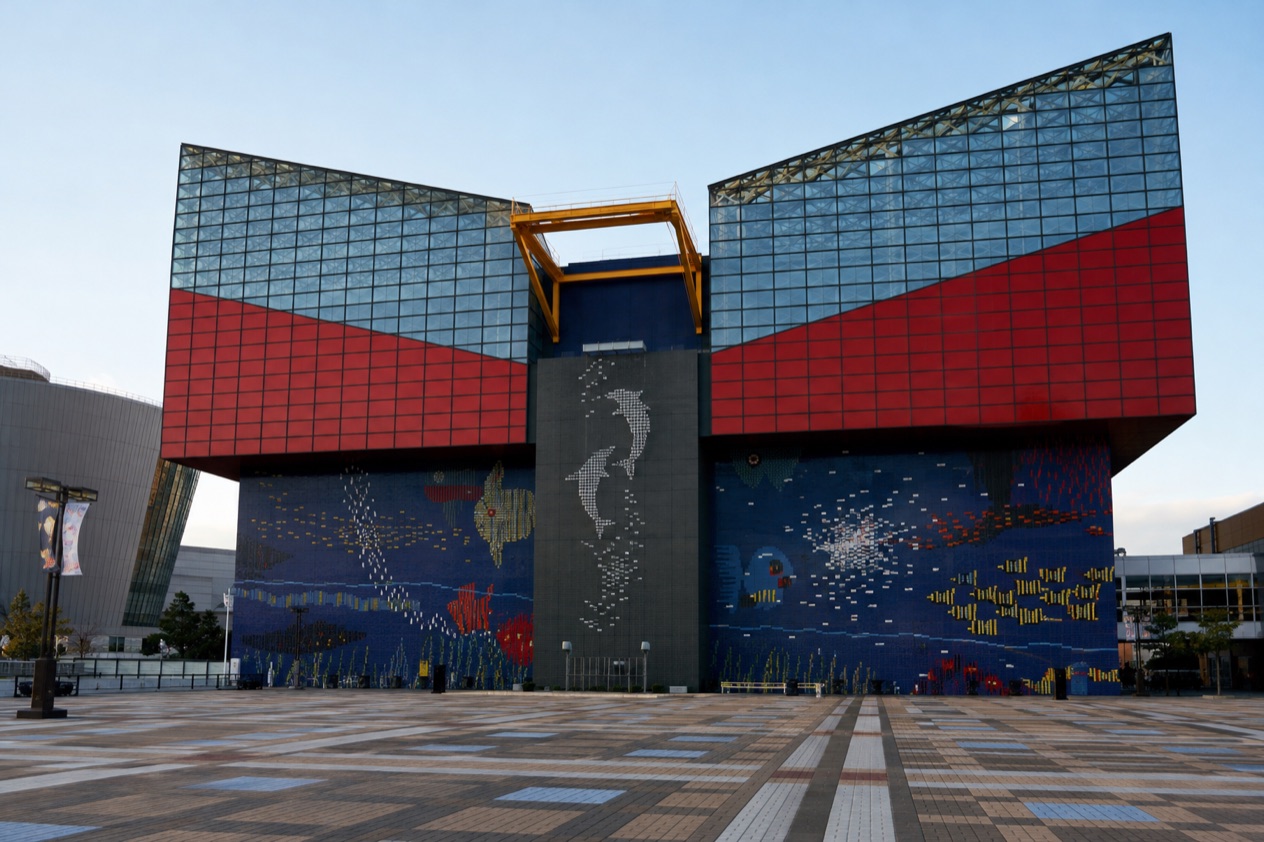
Near Osaka Bay, the Tempozan Ferris Wheel turns slowly above the waterfront while visitors drift toward a building that looks like a ship’s hull. Inside, an escalator carries them high, and the first glimpse of blue water comes before they have even started walking. The Kaiyukan is the aquarium of Osaka’s Minato ward, and the visit it offers is one long, slow descent through the Pacific, suited to anyone who likes to wander and look.
Is visiting the Kaiyukan aquarium worth it?
Yes, for anyone who enjoys watching large animals glide past glass, and especially for families, couples and travelers who want a few unhurried hours indoors in a city better known for its food and nightlife. Osaka is a relaxed city of street snacks, neon and entertainment, and the Kaiyukan gives a different rhythm to a day there: dim light, the hum of filtration, and the slow movement of animals that never hurry.
What sets it apart is the way it is built as a single journey rather than a set of rooms. You ride up first, then walk down a continuous corridor that circles around one enormous central tank, so the same water appears again and again from a new angle.
Each stretch of the route stands for a different corner of the Pacific, from cold northern coasts to tropical reefs, and the animals change with the scenery. That sense of travelling around an ocean, rather than stopping at a row of display cases, is what people tend to remember.
The setting helps too. The aquarium stands next to the Tempozan Ferris Wheel on the bay, so the outing has a waterfront feel, and the whole area works as a half-day or a full day away from the busier districts.
Over 2.5 million people come through each year, a measure of how much the place draws. If you only have time for a handful of sights in Osaka, this is the one where you stop, sit on a bench in front of the glass, and simply watch.
What to see at the Kaiyukan aquarium
The visit follows one clear path, and the tanks are arranged along it like chapters. The theme is the Pacific Rim, the ring of coastlines, volcanoes and ocean basins around that vast body of water, and each habitat is meant to feel like a real place rather than a display.
The ride up and the long walk down
You begin by taking an escalator up to the 8th floor, then walk down a corridor to the 4th floor. The route is a gentle spiral around the central tank, so you spend the visit moving slowly downward while the water stays beside you. It is a clever way to organize a building, because there is no backtracking and no map to puzzle over. The path simply leads you on.
On the way down, the tank walls change from small, glass-fronted habitats to wide windows that let you look straight into the big water. Pay attention to where the corridor opens up and where it narrows. The wide stretches are where people stand still, and the narrow ones are the places to look closely at smaller animals.
The Pacific Ocean tank and its whale sharks
The heart of the Kaiyukan is the Pacific Ocean tank, which holds about 1,427,000 US gallons of water and houses two whale sharks. They are the largest fish in the sea, and seen through the glass they move with a calm, unbothered pace, mouths slightly open, spotted backs catching the light from above. Smaller fish and rays move around them, and you may see a manta ray sweep past in one smooth turn.
Because the corridor circles the tank, you meet the whale sharks several times at different depths. At the top they pass near the surface, and lower down you look up at their pale undersides against the blue. Visitors pick one spot at the lowest level and stay for a while, letting the animals come to them.
Habitats around the Pacific
Around the central tank, the smaller habitats recreate places along the Pacific Rim. Along the route you may find a Japanese forest with a stream, cold northern waters, a kelp forest, a tropical rainforest and a polar coast. Each is dressed with plants, rock and light that fit the region, and the animals match, from river fish to seals and penguins.
These are the stretches where it pays to slow down. The cold-water habitats often hold the animals that move the most, such as otters or seals, while the reef and tropical tanks reward a long look at the color and detail. The whole set adds up to a tour of the Ring of Fire without leaving the building.
Jellyfish, rays and the small tanks
Between the big habitats, the smaller tanks hold some of the most absorbing animals in the building. Jellyfish drift in lit, rounded tanks, pulsing in slow motion, and rays, crabs and odd-shaped bottom dwellers fill the quieter corners. They are easy to walk past on the way to something bigger, but they are often what people photograph and talk about afterward.
Together, the tanks hold about 2,906,000 US gallons of water, which gives a sense of how much of the building is simply water. Treat the small tanks as a pause between the large ones, and take your time with the glass, because the animals are often more interesting up close than they look from a distance.
How to get to the Kaiyukan aquarium
The aquarium is a five-minute walk from Osakako Station on the Osaka Municipal Subway Chuo Line, and that station is the way in that travelers will use. Osaka Bay can also be reached from Osaka or Umeda stations via the JR Loop Line and the Chuo subway line, so both of Osaka’s big hubs lead toward the waterfront.
The Kaiyukan stands in the Minato ward, near Osaka Bay, and the Tempozan Ferris Wheel next door is a landmark to steer by as you leave the station. Once you can see the wheel, you are close.
From Osaka and Umeda stations
If you are staying near Osaka Station or Umeda, the Osaka Bay area is reached by the JR Loop Line and the Chuo subway line. The subway line is the one that stops at Osakako Station, so that is where you get off. From there, the walk to the aquarium is about five minutes.
Travelers coming from Tokyo arrive at Shin-Osaka Station on the Tokaido-Sanyo shinkansen, a ride of about two and a half hours. From Shin-Osaka, a JR local line goes to Osaka Station, which puts you at one of the starting points above.
From Dotonbori and Shinsaibashi
Visitors sleep near the food and shopping districts of Dotonbori and Shinsaibashi, both in Osaka. These are reached from Osaka or Umeda Station by the Midosuji Line to Shinsaibashi Station, and you can also stay on the Midosuji Line to Namba Station for Dotonbori.
From those districts, the route to the aquarium follows the same logic as from anywhere else in the city: you are heading for Osakako Station on the Chuo Line. Plan the day so that you arrive at the waterfront with the aquarium as your main stop, and then let the rest of the outing unfold around it.
When to visit the Kaiyukan aquarium
Because the tanks are indoors, the aquarium can be part of a trip in any month, and the weather mostly shapes the walk from the station and the time you spend near the bay. The season you choose changes the mood of the waterfront more than the visit itself.
Spring is mild, summer is hot and humid, and October brings a pleasant middle ground, though it has its share of wet days.
| Month | Average high (°F) | Average low (°F) | Rain (inches) | Days with rain | Sunshine (hours) |
|---|---|---|---|---|---|
| January | 49.5 | 37.4 | 1.85 | 5.6 | 146 |
| April | 67.8 | 51.6 | 4.01 | 9.2 | 193 |
| July | 89.2 | 76.3 | 6.87 | 10.0 | 184 |
| October | 74.7 | 60.8 | 5.35 | 8.3 | 166 |
Cool months and the bay in winter
In January the air is cold, so the walk between the station and the aquarium is the part where you will feel the season. Inside, the tanks keep the same blue light whatever the weather, which makes the building a natural place to spend a chilly day.
The cold-water habitats feel especially fitting then, and a warm drink afterward near the waterfront rounds off the outing. The city has some sunshine in winter, so the bay can look bright even when the air is sharp.
Spring and October
April and October are mild and comfortable for walking, which suits a day that combines the aquarium with time outdoors by the Ferris wheel and along the bay. Rain does come, with a good number of wet days in both months, so the aquarium is a sensible fallback if the sky turns gray.
In October, the evenings cool down and the bay area feels relaxed. It is a good month to pair the indoor tanks with an outdoor stroll, since the heat of summer has eased.
Summer heat
July is hot and humid, with the most rain of the four months, often in showers or a stormy afternoon. The air-conditioned aquarium becomes a refuge, and the day works best if you treat the outdoor parts, such as the walk and the Ferris wheel, as short interludes. A hot day is also a good reason to linger over the cold-water tanks and to take a long break in the cafe area before heading back out.
Tips for your visit
Think of the Kaiyukan as the center of a waterfront day, with the Ferris wheel next door and the bay beyond. The route inside is a single path, so you can set your own pace, stopping at the tanks that hold your attention and moving quickly through the ones that do not.
Pacing the route
Because you go up to the 8th floor first and then walk down to the 4th, the visit has a clear beginning and end, and there is no need to plan a route. Look at the central tank on the way down each time you pass it, because the animals have moved and the light has shifted.
Families will find that the spiral corridor gives children something new to spot around each bend, from the whale sharks to the smaller tanks. A good approach is to let them lead for a while, pausing wherever they want to watch, and to save the central tank for a longer stop.
Pairing it with the rest of the bay
The bay area has more to offer, and Universal Studios Japan, which opened in 2001 and features attractions like the Wizarding World of Harry Potter, is part of the same Osaka Bay area.
For a change of pace in the evening, the food and entertainment districts of Dotonbori and Shinsaibashi are reached by the Midosuji Line. After the quiet of the tanks, the neon and the street food make a lively contrast, and they are part of what Osaka is known for.
Mobility and comfort
The route is a long, continuous walk downhill along a corridor, which means a lot of standing and strolling. Wear shoes you are comfortable walking in, and give yourself room to sit when you want to, since the big windows invite you to stop and watch for a while.
If you are traveling with someone who tires quickly, the downward slope is a help, and you can break the visit into stretches. Treat the aquarium as a slow outing rather than a rush, and let the animals set the pace.
Good to know before you go
The Kaiyukan is an indoor visit in a large city, so the usual habits of urban sightseeing apply: keep your belongings close, move with the flow in the corridors, and keep an eye on the weather for the walk between the station and the building. On a wet day, a rain jacket or umbrella is useful for the stretch outside, and the sky in Osaka can change between showers and sunshine, especially in summer. The rest of the visit unfolds in dim light beside the glass, and the Ferris wheel next door is waiting when you step back out onto the waterfront.
Sources
- Wikipedia, Osaka Aquarium Kaiyukan (https://en.wikipedia.org/wiki/Osaka_Aquarium_Kaiyukan), checked October 11, 2026
- Japan National Tourism Organization, Osaka (https://www.japan.travel/en/destinations/kansai/osaka/), checked October 11, 2026
- Japan Meteorological Agency (JMA), Normal values 1991-2020, monthly (https://www.data.jma.go.jp/stats/etrn/view/nml_sfc_ym.php?prec_no=62&block_no=47772), station Osaka, elevation 23 m, checked October 11, 2026
To plan your stay
- Best Time to Visit Osaka: Cherry Blossoms, Autumn Color, Weather and Festivals
- Where to Stay in Osaka: Kita, Minami, Tennoji, the Castle Area and the Bay
- Osaka from Tokyo: Shinkansen Services, Shin-Osaka Station and Where to Go on Arrival
- Know Before You Go to Osaka: Entry, Money, Getting Around, Weather and Etiquette