
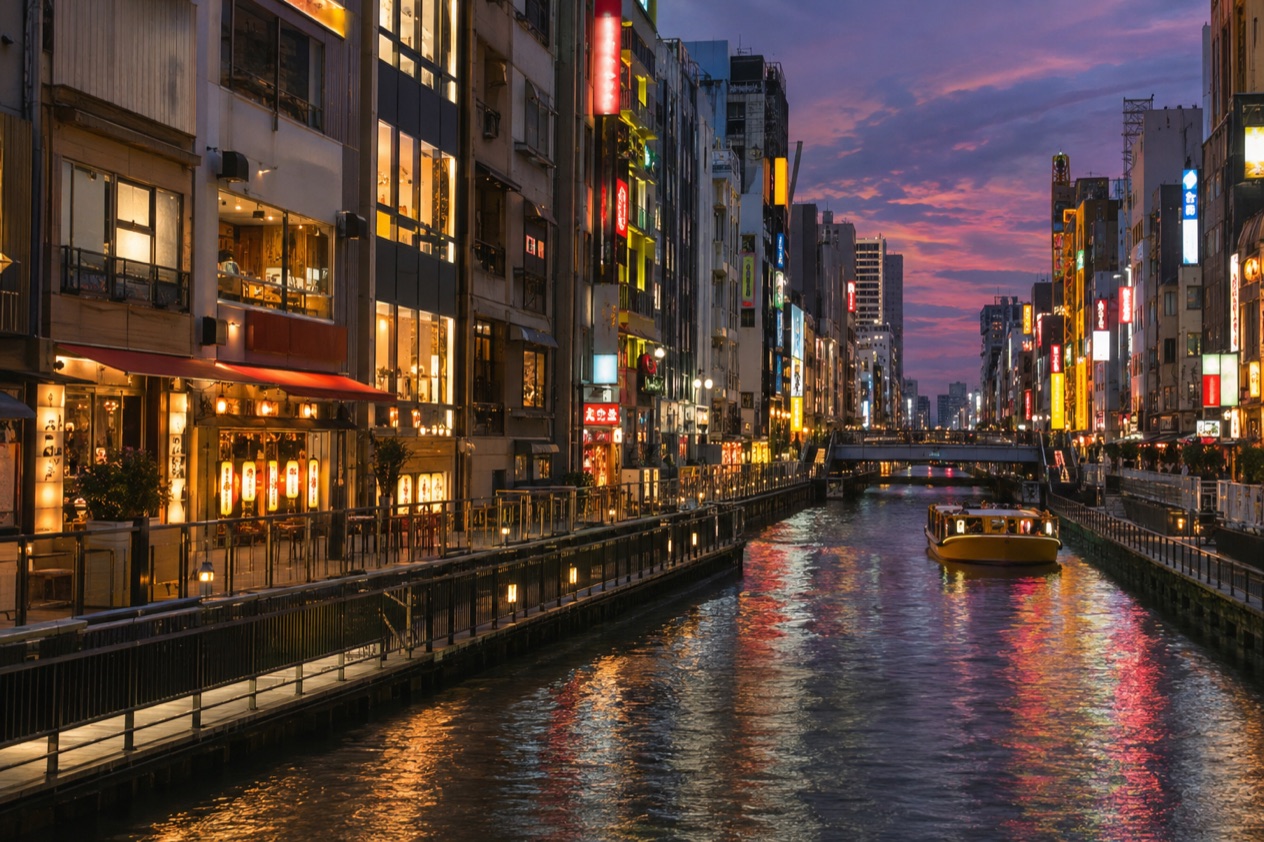
The first thing that hits you in Osaka is often the smell: batter and grilled octopus drifting out of the stalls near Dotonbori, with neon reflected in the canal and a city that seems to be mid-conversation. Osaka is relaxed, funny and built around eating well, and a handful of practical details make the first day run more smoothly.
What should you know before visiting Osaka?
Before visiting Osaka, plan your rail arrival, check card acceptance at the register, pack for the season and observe everyday customs around shoes, public transit and trash.
What tends to surprise first-time visitors is how many different cities seem to sit inside one. Kita, around Osaka and Umeda stations, is modern, lined with shopping malls, department stores and office buildings, and a short walk leads to Nakanoshima, where retro architecture faces the water. Minami is the energetic downtown, where tradition and fashion cross paths, from traditional culture to gourmet food and trendy clothes.
The Bay Area is a beachfront entertainment hub with theme parks, an aquarium, Ferris wheels and sports facilities. Osaka sits in the center of Honshu, Japan’s main island, and each of these districts has its own mood, so a day spent in one feels very different from a day in another.
Visitors also expect a single historic core and find instead a city that mixes a rebuilt castle, shopping arcades and a harbor with big attractions. That mix is part of the appeal, and it is why a loose plan, a district at a time, works well here.
Entry, customs and paperwork
According to the U.S. State Department, U.S. citizens coming to Japan as tourists or on business can stay visa free for up to 90 days. They need a valid passport, and should have proof of a return or onward ticket. The passport has to remain valid for the entire time of the stay, so it is worth looking at its expiration date well before packing.
A visa-free stay does not include the right to work on the local economy. It is a visit for sightseeing, meetings and the like, and the State Department is clear that earning money locally is outside what that status allows.
Once you are in the country, the State Department also notes that you must always carry your U.S. passport (or a Japanese Residence Card for residents). You may be questioned or detained if you cannot show proof of identity and status, so the passport travels with you in Osaka just as it did on arrival.
One more item concerns what you bring in. The State Department points out that CBD may be illegal in Japan depending on the amount of THC it contains, which makes it a product better left at home than carried in a bag through customs.
Money, cards and tipping
International credit, debit and prepaid cards are generally accepted throughout Japan, but acceptance varies by business.
There is one small catch. Some stores do not display the symbols of the cards they accept, so the simple habit is to ask the person at the register whether your card will work. In a city of tiny food stalls and narrow side streets, that question is useful, and it is usually met with a smile or a quick gesture.
As for tipping, it is not part of daily life in Japan. People pay the price on the bill, say thank you, and leave. Service in a Dotonbori restaurant or a hotel lobby is meant to be gracious as a matter of course, so there is nothing to add at the end of a meal or a ride.
Getting around and staying connected
Osaka is built around its train stations, and most arrivals begin with one. From Tokyo, the Tokaido-Sanyo shinkansen runs to Shin-Osaka Station, and the journey takes about two and a half hours. From Shin-Osaka, a JR local line continues to Osaka Station, in the heart of Kita.
Travelers landing at Kansai International Airport (KIX) can take the Nankai or JR lines to Tennoji or Namba stations. Namba is next to Dotonbori, which makes it a familiar first stop for the Minami area.
Reaching the main districts by rail
For Shinsaibashi and Dotonbori, take the Midosuji Line from Osaka or Umeda Station to Shinsaibashi Station. You can also stay on the Midosuji Line until Namba Station and walk into Dotonbori from there. The Shinsaibashi shopping arcade is nearly 1.2 miles long and extends from Shinsaibashi Station to Dotonbori, so the two districts run into one another along a covered street.
For Osaka Castle, the JR Osaka Loop Line from Osaka or Umeda Station goes to Morinomiya Station, right next to Osaka Castle Park. From Osaka or Umeda, the Osaka Bay area is accessible via the JR Loop Line and the Chuo subway line.
Health, water and the weather
Weather is the part of health most worth planning around. Osaka changes character through the year, and a few seasons show it clearly. In January, highs are in the upper 40s and lows in the upper 30s, with some days of snow or sleet and fairly sunny skies. Spring arrives gently, and April warms into the high 60s by day with a few more showery days.
July is hot and humid, with highs near 89°F and nights that stay warm in the mid-70s. Rain falls on about ten days, and the air feels heavy, so light clothing and a pace that leaves room for air-conditioned stops make sense. October is milder, with highs in the mid-70s, cooler evenings and showers on a handful of days.
| Month | Average high (°F) | Average low (°F) | Rain days | Sunshine (hours) |
|---|---|---|---|---|
| January | 49.5 | 37.4 | 5.6 | 146 |
| April | 67.8 | 51.6 | 9.2 | 193 |
| July | 89.2 | 76.3 | 10.0 | 184 |
| October | 74.7 | 60.8 | 8.3 | 166 |
Local customs and etiquette
Shoes come off at the entrance of a building in many settings. The habit is to step out of them, put on indoor slippers, and leave the shoes in a shoe box or neatly to one side. Inside a home or ryokan, slippers come off again on tatami mats, and a separate pair of toilet slippers is often waiting by the bathroom door.
Public life in Japanese cities tends to be considerate. People speak quietly on trains, generally avoid phone calls, and line up at platforms and food counters. In Osaka the mood is a little more talkative and jokey than the stereotype of reserve suggests, but the small courtesies stay: a nod of thanks, a light bow, a word of apology when you brush past someone.
Street food is part of the pleasure of Dotonbori and Shinsaibashi, and the usual habit is to eat near the stall instead of walking through the crowd with a skewer. Bins are not always easy to find, so people keep their trash with them until they reach one. These small habits are what locals tend to notice, and they are easy to adopt once you see them around you.
Good to know before you go
The U.S. State Department rates Japan Level 1: Exercise Normal Precautions.
Keep your passport and your onward or return ticket in an easy-to-reach place, since they are the documents you are expected to show. One last habit worth keeping: carry a small bag for your own trash, so a skewer stick or a wrapper never becomes a problem on a busy street.
Sources
- Japan National Tourism Organization, Osaka (https://www.japan.travel/en/destinations/kansai/osaka/), checked October 11, 2026
- Osaka official tourism guide, basic guide (https://www.osaka-info.jp/en/osaka/basic/), checked October 11, 2026
- U.S. Department of State, Japan travel information, local laws and special circumstances (https://travel.state.gov/content/travel/en/international-travel/International-Travel-Country-Information-Pages/Japan.html), checked October 11, 2026
- Japan National Tourism Organization, manners, etiquette, shoes, bowing, chopsticks, public behavior (https://www.japan.travel/en/guide/understanding-and-mastering-japanese-manners-and-etiquette/), checked October 11, 2026
- Japan National Tourism Organization, credit cards and cash, where cards are accepted (https://www.japan.travel/en/plan/credit-cards/), checked October 11, 2026
- U.S. Department of State, Japan travel advisory (https://travel.state.gov/content/travel/en/international-travel/International-Travel-Country-Information-Pages/Japan.html), checked October 11, 2026
- U.S. Department of State, Japan travel information, entry and exit requirements (https://travel.state.gov/content/travel/en/international-travel/International-Travel-Country-Information-Pages/Japan.html), checked October 11, 2026
- Japan Meteorological Agency (JMA), Normal values 1991-2020, monthly (https://www.data.jma.go.jp/stats/etrn/view/nml_sfc_ym.php?prec_no=62&block_no=47772), station Osaka, elevation 23 m, checked October 11, 2026
To plan your stay
- Best Time to Visit Osaka: Cherry Blossoms, Autumn Color, Weather and Festivals
- Things to Do in Osaka: Osaka Castle, Dotonbori Street Food, Universal Studios Japan and Day Trips
- Where to Stay in Osaka: Kita, Minami, Tennoji, the Castle Area and the Bay
- Osaka from Tokyo: Shinkansen Services, Shin-Osaka Station and Where to Go on Arrival