
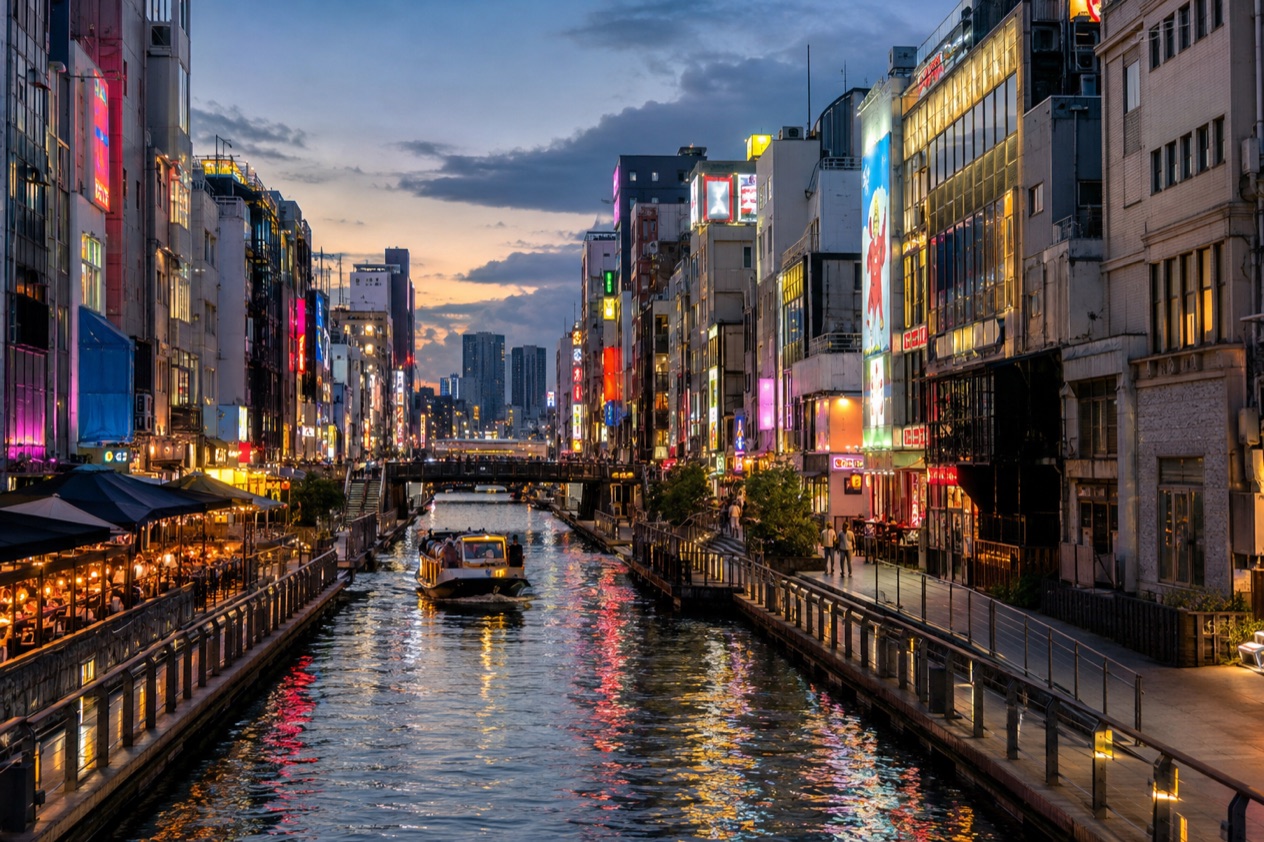
In September, cicadas are still buzzing in the castle trees, and the steam rising from takoyaki griddles feels thicker in the humid air. Neon from the Dotonbori signs shakes on the canal while people carry paper trays of octopus dumplings along the water.
Summer has not let go of Osaka yet, but the first cooler evenings begin to arrive, and the city’s appetite for food and noise carries on regardless. It is a month for travelers who like their sightseeing hot, their meals long and their evenings out late.
What is the weather like in Osaka in September?
September in Osaka is still hot and humid, a little softer than August, with more rain and noticeably less sun. The first table sets it beside the months on either side.
| Month | Average high (°F) | Average low (°F) | Precipitation (in) | Days with 1 mm or more of precipitation | Hours of sunshine | Daylight on the 15th |
|---|---|---|---|---|---|---|
| August | 92.7 | 78.4 | 4.45 | 7.2 | 222 | 13 h 30 min |
| September | 85.1 | 71.4 | 6.02 | 9.5 | 162 | 12 h 27 min |
| October | 74.7 | 60.8 | 5.35 | 8.3 | 166 | 11 h 22 min |
Afternoons are still warm enough that you want a hat, a small towel and a cold drink from one of the vending machines that stand on nearly every corner. Honshu summers are humid and sultry, and Osaka carries that stickiness into the first weeks of the month. Evenings are mild, warm enough to eat at an outdoor counter or walk along the canal in short sleeves.
Rain comes in spells, sometimes as a gray, drizzly day, sometimes as a heavy shower that empties the streets for a while and then passes. Humidity hardly changes from August, so a shower rarely cools things for long. Sunshine drops off sharply from the summer peak, which means more cloud in the sky and softer light on the castle walls and the river.
Days are shorter than in August, and dusk arrives earlier, so the neon districts light up sooner. Pack for heat, but keep a compact umbrella or a light rain jacket within reach, and wear shoes that cope with wet pavement.
What to do in Osaka in September
September in Osaka is for eating, wandering and ducking between air-conditioned stops. Food is the city’s main attraction, and the late-summer heat makes cold noodles, shaved ice and cold beer taste especially good. As the month goes on, autumn flavors begin to appear on menus: chestnuts, sweet potato and grilled fish such as sanma, the Pacific saury that belongs to the new season.
The calendar also adds a few pauses. Respect for the Aged Day falls on a Monday in the middle of the month and the autumnal equinox follows around the 23rd, both public holidays, and families often use the long weekends to travel. Around then, shops put out moon-viewing dumplings and pampas grass for tsukimi, the custom of watching the autumn moon.
Osaka Castle and its parks
Osaka Castle stands in a wide stretch of parkland, with moats, stone walls and big trees that give some shade on a hot day. From Osaka or Umeda Station, the JR Osaka Loop Line runs to Morinomiya Station, right next to Osaka Castle Park. The original castle was built by Toyotomi Hideyoshi between 1583 and 1598, and the keep you see today houses the Osaka Castle Museum, a symbol of the city.
In September, the lawns are green, and the cicadas are loud in the trees along the paths. Walk the outer moat first, then climb toward the keep, where the upper floors look out over a city of glass towers. A cold drink and a rest on a park bench make the loop more pleasant in this weather.
Dotonbori and the Namba food streets
Dotonbori runs along its canal from Dotonboribashi Bridge to Nipponbashi Bridge, in the Namba district of Chuo ward. This is the stretch where Osaka eats: takoyaki stands, okonomiyaki griddles, kushikatsu counters serving skewers of deep-fried vegetables and meat, and gyoza shops with open kitchens. The big mechanical signs, a crab, a runner, a giant octopus, are part of the show.
In September, the humid evening air makes the street feel like one long open-air kitchen. Order a few small things at several places instead of one big meal, and finish with something sweet or a cold drink by the water. A walk along the canal as the lights come on is part of the evening.
The Bay Area: Universal Studios Japan and the waterfront
The Bay Area is Osaka’s beachfront entertainment hub, with theme parks, aquariums, Ferris wheels and sports facilities. Osaka Bay can be reached from Osaka or Umeda stations via the JR Loop Line and the Chuo subway line. Universal Studios Japan opened in 2001, and it has attractions like the Wizarding World of Harry Potter, plus Super Nintendo World, which recreates the worlds of Nintendo games on a large scale.
This part of the city suits September because many of the attractions have indoor sections, rides and shows that give a break from the heat and the showers. Aquariums and covered attractions help when rain sets in. The Ferris wheel gives a view over the bay once the evening light softens.
Kita and Nakanoshima
Kita is the modern face of Osaka, lined with shopping malls, department stores and office buildings. A short walk leads to Nakanoshima, where retro architecture and waterfront scenery make a different kind of afternoon. The department stores have food halls in their basements, full of seasonal sweets and bento boxes.
On a wet day, this is where Osaka goes indoors: you can wander from mall to department store without much exposure to the weather. When the rain stops, step out to the river for a stroll among the old stone buildings. Kita is also the area around Osaka and Umeda stations, so it makes a natural base for a rainy afternoon.
A two-day itinerary for Osaka in September
Day 1 starts with the history of the city. Begin early at Osaka Castle, riding the JR Osaka Loop Line to Morinomiya, so that you walk the moats and the stone walls while the day is still cooler. Climb to the keep and the museum inside, then rest in the shade of the park trees. At midday, head to a restaurant for noodles or a set lunch, away from the sun.
In the afternoon, cross to Kita and Nakanoshima for the waterfront and the department stores, which also work as a rain shelter. As the light fades, move on to Dotonbori for dinner: takoyaki, okonomiyaki and kushikatsu, then a walk along the canal under the neon. The days are shorter than in August, so the lights arrive early and you can stay out as long as you like.
Day 2 belongs to the Bay Area. Take the Chuo subway line or the JR Loop Line toward Osaka Bay in the morning and spend the day at Universal Studios Japan, with Super Nintendo World and the Wizarding World of Harry Potter.
Eat in the park or in one of its casual restaurants, and use the indoor attractions when a shower comes. If rain sets in for good, an aquarium in the Bay Area gives you a covered afternoon, and the Ferris wheel is there for the lights in the evening.
Is Osaka busy in September?
September in Osaka feels like a city between seasons, with the summer heat lingering but the autumn color still months away. The leaves in the Kinki region turn from early to mid December, so there is no foliage rush yet. What shapes the pace of the month is the calendar: holiday weekends in the middle and toward the end of the month bring local travelers out to the castle, the shopping streets and the bay.
The theme parks and the Dotonbori canal are places where a crowd gathers at any time of year, and the holiday weekends add to the feeling. Weekdays outside the public holidays have a more ordinary rhythm, with office workers filling the lunch counters around Kita and Namba.
The weather also sets the tempo. On hot afternoons, people drift into malls, cafés and covered arcades, and when a shower comes the streets empty and then refill. Plan outdoor sights for the cooler parts of the day, and keep an indoor option in your pocket for the rest.
What to pack for Osaka in September
Pack for a hot, sticky city with the odd heavy shower, and plan on walking a lot between sights, food streets and stations.
- Lightweight, breathable clothes, because the humidity stays high and shirts dry slowly.
- A compact umbrella or light rain jacket for the showers that pass through the city.
- Comfortable shoes that handle wet pavement, since castle paths and canal streets mean a lot of walking.
- A hat and sunscreen for the open grounds of Osaka Castle Park.
- A small towel or handkerchief to wipe your face while you wait at the takoyaki stands.
- A light layer for strongly air-conditioned malls, aquariums and trains.
Good to know before you go
September is a month of heat, humidity and spells of rain, and Honshu’s summers are described as very humid, hot and sultry. Weather can turn, so keep your plan flexible and have an indoor stop in mind. The Japan Meteorological Agency issues Emergency Warnings to alert people to the likelihood of catastrophes tied to natural phenomena of extraordinary magnitude, and the Japan National Tourism Organization keeps a Japan Safe Travel Information page with safety tips and government information for travelers.
Public holidays fall in the middle and toward the end of the month, so expect some local travel on those weekends. Mount Fuji’s climbing season ends around the first week of September, which matters if you plan to combine Osaka with a trip elsewhere in Japan.
Osaka in September vs August and October
Going four weeks earlier, in August, means the hottest and sunniest weather of the three months, with the longest days. It also means less rain, but the heat is heavier and the evenings stay warm. If you love long summer days and bright skies, August has that, though you will spend more time looking for shade and air conditioning.
Going four weeks later, in October, brings clearly cooler air, shorter days and a gentler pace for walking. The autumn color in the Kinki region still lies ahead, from early to mid December, so October is a pleasant month rather than a foliage one.
Travelers who want to walk long distances and do not mind a bit of humidity can stay with September, especially if they want a blend of summer food and the first touches of autumn. Those who dislike heat should move to October, while people who want the brightest, longest days should choose August.
Is September a good time to visit Osaka?
Yes, September is a good time for travelers who come for food, neon and theme parks and do not mind warm, humid weather. It suits people who plan their days around meals, cold drinks and air-conditioned stops, and who are happy to have a few showers in the mix. Those who want crisp air for long walks, or bright blue skies every day, should look to another month.
On arrival, start with Osaka Castle while the day is fresh, then keep the evenings for the canal and its food stalls. Keep an umbrella in your bag, a plan for the Kita department stores and a free afternoon at the Bay Area in case the weather changes. What makes September in Osaka its own is the overlap: cicadas and cold noodles on one side, the first chestnut sweets and moon-viewing dumplings on the other, with the neon of Dotonbori shining on the water through it all.
Sources
- Japan Meteorological Agency (JMA), Normal values 1991-2020, monthly (https://www.data.jma.go.jp/stats/etrn/view/nml_sfc_ym.php?prec_no=62&block_no=47772), station Osaka, elevation 23 m, checked October 11, 2026
- Computed from the date and the latitude of the place (sunrise equation, solar elevation -0.833 degrees), October 11, 2026
- Japan Meteorological Agency, Emergency Warnings (https://www.jma.go.jp/jma/en/Emergency_Warning/ew_index.html), checked October 11, 2026
- Japan National Tourism Organization, safety information (https://www.japan.travel/en/japan-safe-travel-information/), checked October 11, 2026
- Japan National Tourism Organization, weather and seasons in Japan (https://www.japan.travel/en/plan/weather/), checked October 11, 2026
- Japan National Tourism Organization, summer in Japan (https://www.japan.travel/en/guide/summer-guide/), checked October 11, 2026
- Wikipedia, Climate of Japan (https://en.wikipedia.org/wiki/Climate_of_Japan), checked October 11, 2026
- Japan Meteorological Agency, maple color-change dates 2025-2026 with difference from the 1991-2020 normal (https://www.data.jma.go.jp/sakura/data/phn_014.html), checked October 11, 2026
- Japan Meteorological Agency, kaede2020.pdf (https://www.data.jma.go.jp/sakura/data/kaede2020.pdf), checked October 11, 2026
- Japan National Tourism Organization, autumn in Japan (https://www.japan.travel/en/guide/autumn-guide/), checked October 11, 2026
- Japan National Tourism Organization, spring in Japan (https://www.japan.travel/en/guide/spring-guide/), checked October 11, 2026
- Japan National Tourism Organization, Osaka (https://www.japan.travel/en/destinations/kansai/osaka/osaka-bay-area/), checked October 11, 2026
- Osaka official tourism guide, basic guide (https://www.osaka-info.jp/en/osaka/basic/), checked October 11, 2026
- Osaka official tourism guide, FAQ (https://www.osaka-info.jp/en/information/osaka-faq/), checked October 11, 2026
- Wikipedia, Osaka Castle (https://en.wikipedia.org/wiki/Osaka_Castle), checked October 11, 2026
- Wikipedia, Dōtonbori (https://en.wikipedia.org/wiki/D%C5%8Dtonbori), checked October 11, 2026
- Wikipedia, Universal Studios Japan (https://en.wikipedia.org/wiki/Universal_Studios_Japan), checked October 11, 2026
To plan your stay
- Things to Do in Osaka: Osaka Castle, Dotonbori Street Food, Universal Studios Japan and Day Trips
- Where to Stay in Osaka: Kita, Minami, Tennoji, the Castle Area and the Bay
- Osaka from Tokyo: Shinkansen Services, Shin-Osaka Station and Where to Go on Arrival
- Know Before You Go to Osaka: Entry, Money, Getting Around, Weather and Etiquette