
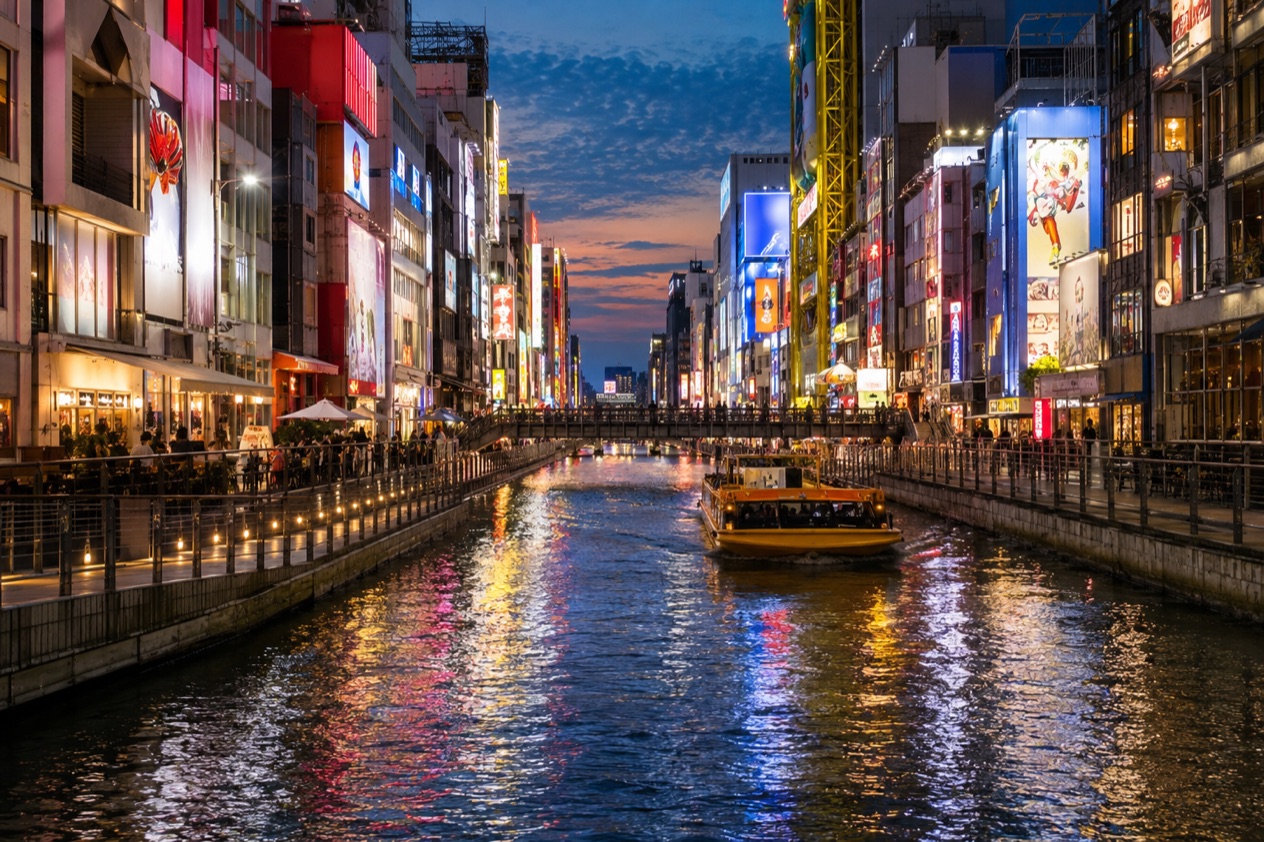
Under the neon of Dotonbori, steam rises from takoyaki griddles and the canal throws back the glow of the giant signs. A few stops north, the glass towers around Osaka Station look like another city altogether, and the waterfront at Nakanoshima has a calmer, more old-fashioned face. Osaka spreads across several districts with very different moods, and choosing where to sleep means choosing which of them you want outside your door.
What is the best area to stay in Osaka?
For a first visit, Minami (around Namba, Shinsaibashi and Dotonbori) is the natural choice for food, nightlife and street life, while Kita (around Osaka and Umeda stations) suits travelers who care most about train connections to the rest of the Kansai region. Families heading to the theme park and the aquarium may prefer the Bay Area, and anyone drawn to history can look at the Osaka Castle area or Tennoji and Abeno.
Think of Osaka as a handful of neighborhoods rather than one center. Minami is the energetic downtown, where tradition and fashion meet and where the shopping arcades, the canal and the restaurants run into each other.
Kita is the modern side of town, lined with malls, department stores and office buildings, with a short walk leading to the retro architecture of Nakanoshima. The two are linked by the Midosuji subway line, so staying in one never cuts you off from the other.
If sightseeing is the goal, the pairing most first-timers follow is Osaka Castle and the Osaka Museum of History, then an evening of dining, shopping and entertainment around Dotonbori. That route fits a stay in either Minami or Kita, with the castle reached by the JR Osaka Loop Line from Osaka or Umeda Station. Staying in Minami puts the evening part of that plan at your doorstep, and you simply ride out to the castle for the day.
Travelers on a tighter budget often look to the areas around the big stations, where business hotels and simple rooms cluster, and to the south around Tennoji. Nightlife seekers will want to be in Minami, where the evenings stretch long and you can walk back to your room. Those who plan to spend days in Kyoto, Nara or Kobe should think about the station they will leave from, since each of those cities lies within one hour by train from central Osaka stations, with Osaka Station in the north and Namba and Tennoji stations in the south.
Osaka is described as a charming and relaxed city known for its food, entertainment and nightlife, with some history and culture to discover. That mix explains why the choice of neighborhood matters more here than the choice of a particular hotel.
Arrival also shapes the decision. Those coming from Tokyo by shinkansen step off at Shin-Osaka Station and continue on a JR local line to Osaka Station, which makes Kita the shortest hop for them. Those flying into Kansai International Airport reach Tennoji or Namba stations on the Nankai or JR lines, which favors the south. Either way, nothing in Osaka is far from a station, and that is the real luxury of staying here.
The best areas to stay in Osaka
Minami: Namba, Shinsaibashi and Dotonbori
Minami is where Osaka puts on its loudest show. Dotonbori sits beside a 400-year-old canal, and above Ebisubashi Bridge the Glico Man runner, one of the most famous symbols of Osaka, lifts his arms over the water.
The Shinsaibashi shopping arcade nearly 1.2 miles long runs from Shinsaibashi Station to Dotonbori, so a single covered walk takes you past fashion shops, snack counters and department stores. You will hear the crowd long after dark.
This is the area for first-time visitors, food lovers and anyone who wants to step out of the hotel straight into dinner. Lodging here runs from business hotels and compact city rooms to apartment-style stays and guesthouses tucked on side streets. Rooms facing the main strips can hear the nightlife, and side streets a few minutes away often feel calmer.
From Osaka or Umeda Station, the Midosuji Line takes you to Shinsaibashi Station, and staying aboard carries you on to Namba Station, another way into Dotonbori. Namba is also one of the stations served from Kansai International Airport by the Nankai line. A tip: pick a hotel close to Namba or Shinsaibashi Station so that the metro and the airport trains are both within a short stretch of your door.
Kita: Osaka Station, Umeda and Nakanoshima
Kita is the modern face of the city, a district of shopping malls, department stores and office buildings clustered around Osaka and Umeda stations. Walk a little farther and the mood shifts to Nakanoshima, where retro architecture stands along the waterfront. Where Minami is loud and crowded with eaters, Kita is polished and built around the rhythm of commuters and shoppers.
It suits travelers who plan many day trips, because Osaka Station is the northern gateway for Kyoto, Nara, Kobe and Wakayama. Anyone arriving from Tokyo can ride the Tokaido-Sanyo shinkansen to Shin-Osaka Station, then a JR local line to Osaka Station, and be at the hotel quickly. The lodging leans toward large city hotels and business hotels, many of them tied closely to the station buildings.
Kita also gives you a different evening: dinner in a mall, a stroll by the river at Nakanoshima, a drink in a quieter bar. The Midosuji Line makes the trip south to Minami simple, so you can eat your fill of street food in Dotonbori and be back in your room afterward. A tip: if you want Osaka Castle on your list, the JR Osaka Loop Line from Osaka or Umeda Station goes to Morinomiya Station, right beside Osaka Castle Park.
Tennoji and Abeno
Tennoji and Abeno hold two silhouettes that define the southern skyline: Abeno Harukas, Japan’s tallest skyscraper, and Tsutenkaku Tower, the symbol of Osaka. Around them you find a zoo, temples and shrines, so the area feels like a place where everyday Osaka and its older layers sit side by side. It has less of the bright-lights frenzy of Dotonbori, which travelers will count as a plus.
Tennoji is one of the two stations where trains from Kansai International Airport arrive, reached on the Nankai or JR lines, and it is one of the southern stations from which Kyoto, Nara, Kobe and Wakayama are all within one hour. That makes it a sensible base for travelers with an early flight or a heavy suitcase who want a direct line from the plane to the bed. Lodging includes business hotels, a few larger hotels near the big towers, and simpler guesthouse-style rooms.
Choose it if you like to pair a city base with a stroll through temple grounds, a morning at the zoo, or a view from the top of a tall building. A tip: look at where your hotel sits relative to Tennoji Station, since the walk to the station will be part of every outing you take from here.
Around Osaka Castle
Osaka Castle and its parks are the historical heart of the city. The original castle was built between 1583 and 1598 by Toyotomi Hideyoshi, set on fire in 1615, and the castle you see now is a reconstruction of the one built by the Tokugawa shogunate. Enormous double moats and stone walls still show why it was such an obstacle to invaders, and the Osaka Museum of History stands close by.
The district suits visitors who care about history, and the setting changes with the seasons, with plum blossoms in winter and cherry blossoms in spring. Morinomiya Station sits right next to Osaka Castle Park, reached by the JR Osaka Loop Line from Osaka or Umeda Station. Lodging nearby is more modest in scale than in the big station districts, so think of a quiet base with a trip into the centers for dinner.
The trade-off is simple. You wake up near the moat and the parks, but your evening entertainment lies a train ride away in Kita or Minami. A tip: use the Loop Line as your lifeline, since it connects you to both main hubs.
The Bay Area
The Bay Area is a beachfront entertainment hub with theme parks, aquariums, Ferris wheels and sports facilities. Universal Studios Japan opened in 2001 and features attractions like the Wizarding World of Harry Potter. The Kaiyukan Aquarium houses whale sharks and penguins in multi-story tanks, and Tempozan Market Place nearby has restaurants and a large Ferris wheel whose ride lasts about 15 minutes, with panoramic views of the city and the bay.
This is the area for travelers whose trip is built around the theme park and the aquarium, and it fits families who want rides and exhibits at the front of the plan. Osaka Bay is reached from Osaka or Umeda stations by the JR Loop Line and the Chuo subway line. Staying here means days of entertainment, but you ride into the city for the food streets and the sightseeing.
A tip: if the park is only one part of your trip, you might base yourself in Kita or Minami and make the bay a day out, since both are on lines that run toward it.
Osaka areas compared
| Area | Best for | Feel | Getting around |
|---|---|---|---|
| Minami (Namba, Shinsaibashi, Dotonbori) | First visit, food, nightlife, shopping | Energetic downtown where tradition and fashion meet | Midosuji Line to Shinsaibashi and Namba stations; Nankai line from Kansai International Airport to Namba |
| Kita (Osaka and Umeda stations, Nakanoshima) | Day trips around Kansai, arrivals by shinkansen | Modern, with malls, department stores and offices, and retro waterfront architecture nearby | JR local line from Shin-Osaka to Osaka Station; JR Loop Line to the castle and the bay |
| Tennoji and Abeno | Airport arrivals, towers, temples and a zoo | Southern district with Abeno Harukas and Tsutenkaku Tower | Nankai or JR lines from Kansai International Airport to Tennoji |
| Osaka Castle area | History, parks and blossoms | Moats, stone walls and parkland | JR Osaka Loop Line to Morinomiya Station |
| Bay Area | Theme park, aquarium, Ferris wheel | Beachfront entertainment hub | JR Loop Line and Chuo subway line from Osaka or Umeda |
The first trade-off is between being next to a big station and being among quiet streets. Kita and the big stations of the south put the trains at your feet, which matters when you plan day trips to Kyoto, Nara or Kobe. Minami gives you the nightlife and the canal, but its main strips stay lively late, and a room on a side street can feel like a different neighborhood.
The second is between the old town and the new. Around the castle you have moats, a museum of history and blossoms in their season. Kita offers glass, malls and polished waterfront architecture, and Minami is the one where old Osaka appetites meet fashion. Tennoji and Abeno stand between them, with a skyscraper, a symbolic tower, temples and a zoo.
The third is between entertainment and sightseeing. The Bay Area gives you a theme park, an aquarium and a Ferris wheel in one stretch, but if your days are about food streets and shopping, you will spend more time on the Loop Line than you would from Minami or Kita. None of these choices is a mistake, since the whole city is tied together by rail, and the best base is the one that matches the first thing you plan to do each morning.
How to choose your hotel in Osaka
Start with the kind of room you want, then match it to the area. Osaka offers large city hotels, business hotels, guesthouses and apartment-style stays, and the big stations of Kita and Minami are where you find the widest spread. A business hotel gives you a compact, practical room. A guesthouse suits those who like a more personal base, and an apartment-style stay gives space for a longer visit.
If you are drawn to a traditional inn, a ryokan is a different experience from a city hotel. Ryokan, traditional Japanese inns, are believed to have emerged in Japan in the 8th century.
They typically feature tatami floors, futons, private baths (sometimes outdoor), yukata (light cotton robes), a kaiseki dinner and a traditional Japanese breakfast. Treat it as a style of stay in its own right, in which dinner and breakfast are part of the evening and the morning.
Another traditional option is Heritage Stays, where visitors can take part in cultural activities such as tea ceremony, calligraphy and wearing traditional Japanese clothing. Reservations for Heritage Stays are required and can often be made through the property’s website or by phone. These stays fit travelers who want the lodging to be part of the cultural program rather than just a place to sleep.
Distance to a station deserves more weight than almost any other detail. A hotel a short step from Osaka, Namba or Tennoji Station turns each day trip into a simple departure, while a room far from a station adds a leg to every outing.
Airport arrivals are worth planning too. Kansai International Airport is served by all major airlines, with many direct flights between KIX and major cities in the United States, Europe and Australia, and the JR Kansai Airport Rapid and Nankai Railways link it to the city, as do limousine buses, with travel time of approximately 40 to 60 minutes.
Osaka’s other airport, Itami, is closer to the city and can be reached in about 30 minutes by monorail, train or limousine bus. Trains from Kansai International Airport reach Tennoji and Namba stations, so a hotel near either keeps the last leg of a long flight short.
Families will think about space and about where the days are spent. For a theme park and aquarium trip, the Bay Area puts rides and exhibits close, while Kita and Minami give more choice of rooms and more places to eat in the evening.
Finally, think about the evening. If you want to be out until late among the signs, stay in Minami. If you prefer to return to a calm room after dinner, look to Kita, Tennoji or the castle area, and ride into Minami for the evening. The Osaka Convention & Tourism Bureau operates three tourist information centers, in Umeda (JR Osaka Station), Namba and Shin-Osaka, with staff who can speak English and other foreign languages.
Good to know before you go
Osaka has two airports, Kansai International and Itami, and from Tokyo the Nozomi shinkansen takes about two and a half hours one way to Shin-Osaka Station, while JAL and ANA frequently fly to Osaka from Haneda and Narita. Pick the district that suits your first morning, and the rest of Osaka is a ride away.
Sources
- Japan National Tourism Organization, Osaka (https://www.japan.travel/en/destinations/kansai/osaka/), checked October 11, 2026
- Osaka official tourism guide, basic guide (https://www.osaka-info.jp/en/osaka/basic/), checked October 11, 2026
- Osaka official tourism guide, FAQ (https://www.osaka-info.jp/en/information/osaka-faq/), checked October 11, 2026
- Japan National Tourism Organization, ryokan stays, what is included, etiquette (https://www.japan.travel/en/guide/japanese-ryokan/), checked October 11, 2026
- Japan National Tourism Organization, heritage stays (https://www.japan.travel/en/heritage-stays/), checked October 11, 2026
To plan your stay
- Best Time to Visit Osaka: Cherry Blossoms, Autumn Color, Weather and Festivals
- Things to Do in Osaka: Osaka Castle, Dotonbori Street Food, Universal Studios Japan and Day Trips
- Osaka from Tokyo: Shinkansen Services, Shin-Osaka Station and Where to Go on Arrival
- Know Before You Go to Osaka: Entry, Money, Getting Around, Weather and Etiquette