
After dark, the grounds of Kanazawa Castle and the paths of Kenroku-en are lit, and the old pines catch the glow while their ropes (laid out like tents of string in winter) throw long shadows on the lawns. Kanazawa is a city of gardens, craft workshops and samurai lanes, set on the Sea of Japan side of Honshu. It suits travelers who like to wander, look closely at handmade things and eat very well, and who would rather linger over a teahouse than tick off a skyline.
Where is Kanazawa and what is it like?
Kanazawa is the capital of Ishikawa Prefecture, on a narrow strip of land along the Sea of Japan on Honshu, Japan’s main island. The city covers just under 181 square miles, yet what visitors come for sits in a cluster of districts rather than spread across the whole of it. Komatsu Airport, in the neighboring city of Komatsu, is the nearest airport, and the Hokuriku Shinkansen stops in Kanazawa on its way from Tokyo.
The character of the place comes from the Edo period, when Kanazawa was one of the most important cultural and artistic centers in Japan. That past still shows in what the city makes and cares about: lacquer, gold leaf, ceramics, silk dyeing, tea and the performing arts. It belongs to the UNESCO Creative Cities Network as a City of Crafts and Folk Art, and you feel it in shop windows, small museums and the way a bowl or a sweet is set on the table.
The pace is that of a town that keeps its traditions in daily use. Mornings might start at a market stall with seafood from the Sea of Japan, afternoons drift through a garden or a gallery, and evenings end in a small restaurant serving the regional cooking. Winter brings snow and gray skies, summer brings heat and damp, and both change the mood of the same streets.
Kanazawa rewards people who enjoy slow looking, craft, gardens and food. It may feel less rewarding to anyone hoping for beaches, mountain trekking or a big nightlife scene, since its pleasures are quieter ones: a tea bowl, a carved gate, a contemporary art installation, a bowl of rice topped with the morning’s fish.
What is there to do in Kanazawa?
The things to do in Kanazawa come down to four big reasons: a famous garden, a craft tradition, the old samurai and teahouse quarters, and a very good table. Together they make the city different from its neighbors on the Hokuriku line, which lean on mountains and rural villages, while Kanazawa leans on art, craft and town life.
Kenroku-en and Kanazawa Castle
Kenroku-en, the Garden of Six Attributes, is a strolling garden and one of the three great gardens of Japan. It stretches over 25 acres, with ponds, stone lanterns, bridges, teahouses and pines trained over many generations. It was opened to the public in 1875 and is still the reason people book a trip here. Kanazawa Castle sits right next to it, so the two make one outing.
Seasons change the garden completely. Snow settles on the pines in winter, blossoms and fresh green arrive in spring, and in October the first maple color can begin to show. Both the castle park and Kenroku-en are illuminated at night, which gives you a second look at the same paths after dinner. Garden culture in Japan has been appreciated for over a thousand years, and here you can see why it lasted.
| Site | Open |
|---|---|
| Kenroku-en Garden, summer hours | 7:00 to 18:00 |
| Kenroku-en Garden, winter hours (mid-October to the end of February) | 8:00 to 17:00 |
Crafts, gold leaf and contemporary art
Craft is the thread running through the city. Gold leaf, Kutani porcelain, lacquerware and Kaga yuzen silk painting are all part of Kanazawa’s identity, and shops and workshops show them in forms from tiny souvenirs to fine tableware. Looking at the work of the artisans is part of the pleasure, as much as buying something.
The 21st Century Museum of Contemporary Art, Kanazawa, gives the city a modern counterweight. After the gardens and the samurai houses, its galleries show another side of a place that takes art seriously in every period. It suits visitors who like to pair old and new in one day, and it is a useful stop when the weather turns wet.
Samurai lanes, teahouse districts and the table
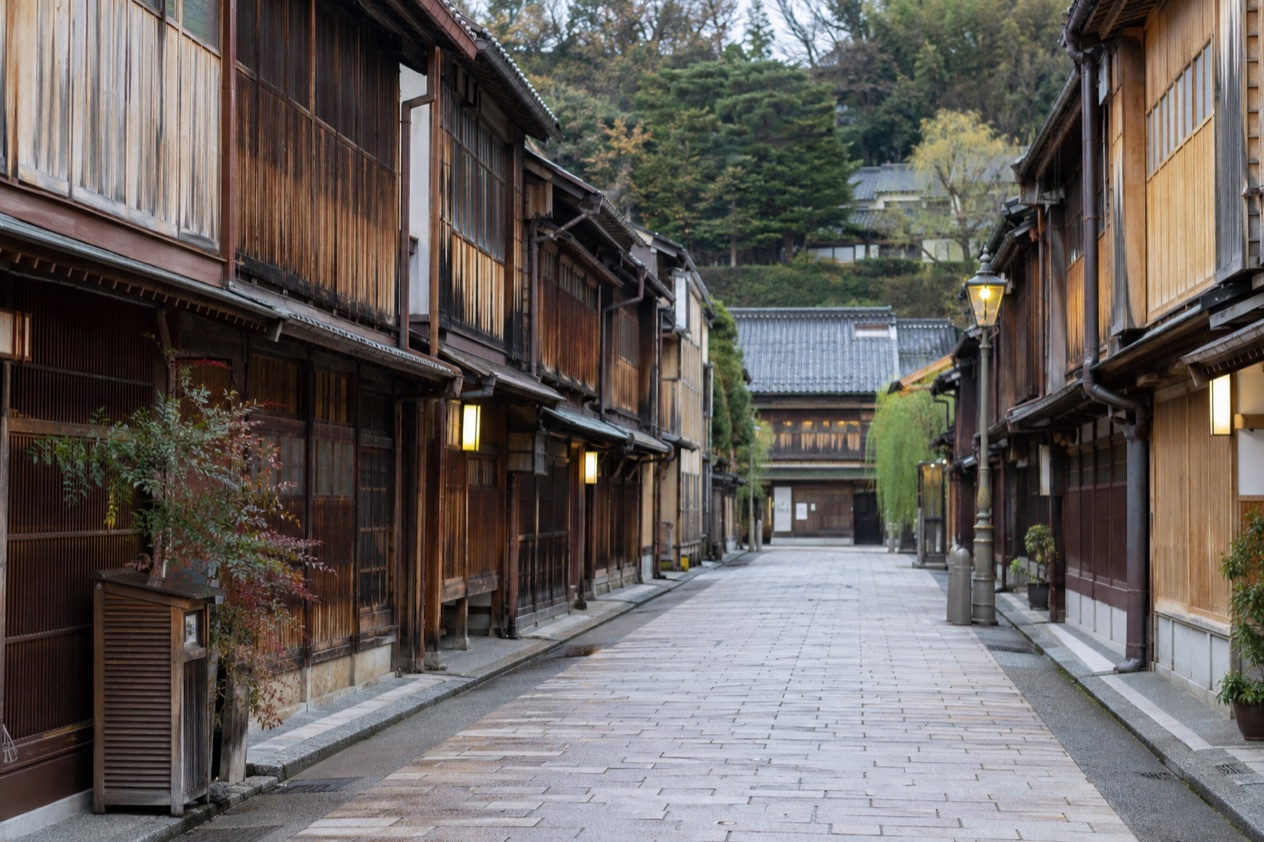
Beyond the garden, Kanazawa keeps quarters where the past still shapes the streets. In the samurai district, earthen walls line narrow lanes and a few former residences open to visitors with tatami rooms and small gardens. The teahouse districts, with wooden latticed facades, are where the city’s tea and entertainment culture took root, and you can drink matcha with a seasonal sweet in a room that has hosted that ritual for generations.
Food finishes the picture. With the Sea of Japan close, seafood has a leading role: sushi, seafood rice bowls from the market stalls and simmered dishes in the local Kaga style. Sweets often come dusted or decorated with gold leaf, which is the most Kanazawa way to end a meal.
How many days do you need in Kanazawa?
A long weekend is enough for Kanazawa’s main sights, and a few more days let you add the mountain villages. With two or three days you can cover Kenroku-en and the castle, a samurai residence, one teahouse district, a craft workshop or two and the contemporary art museum, with enough room left for long meals. Keep one evening free to return to the illuminated castle park and garden.
A shorter stay, one night or a rushed single day, still gives you the garden and the castle, since they sit side by side. But the city is built for browsing, and hurrying past the tea rooms and workshops takes away much of what it offers. If you are on the Hokuriku line between Tokyo and Kyoto or Osaka, a night here is a better use of the route than a pass-through.
With more time, Kanazawa works as a base for the mountain country. The Kanazawa Tourist Information Guide offers sample itineraries for Gokayama, Shirakawa-go and Takayama from the city, which makes each of them a natural addition for travelers who want thatched farmhouses and mountain valleys after the city’s gardens and galleries. Each of these is a larger outing than a stroll across town, and they pair well with an extra night or two.
A good rhythm for a longer stay alternates a day of sights with a looser day. One morning for the garden and castle, one afternoon for the museum and the teahouse streets, another day for a mountain excursion, and a last slow morning at the market and a workshop. That rhythm suits a city where quiet details matter more than a checklist.
Where to stay in Kanazawa
Where you stay in Kanazawa depends on whether you want to be near the garden and castle, near the districts of old streets, or near the point where the Shinkansen arrives.
A stay near the old teahouse and samurai quarters suits travelers who care most about atmosphere. You wake to the lanes and craft shops, and a day of tea, sweets and gold leaf work begins at your door. This approach suits people who like a traditional inn with tatami rooms and a seasonal dinner, where the shoes come off at the entrance and the meal arrives in small courses.
A modern hotel near the rail connections suits those on a tight schedule or heading out to the mountain villages and the next stop on the Hokuriku line. It makes arrival and departure simple, and the city’s sights remain within reach of that base. With the contemporary art museum and the gardens both on your list, either kind of base works, and the choice comes down to whether you value tradition or convenience more.
For a first visit, a few nights in a traditional-style inn or a hotel close to the garden gives the clearest picture of the city. If you split a longer stay, a night in a ryokan followed by a night near the station lets you taste both ways of staying in Japan.
How do you get to Kanazawa and get around?
Travelers reach Kanazawa by train. From Tokyo Station, the Hokuriku Shinkansen takes approximately two and a half hours, with stops at Nagano and Toyama stations. The line has served Kanazawa since March 14, 2015, and that opening changed the city’s place on the map, bringing it within a morning of the capital.
From Osaka or Kyoto, the route runs on the Limited Express Thunderbird to Tsuruga, where you transfer to the Hokuriku Shinkansen. The total journey is about two hours. For travelers linking the big cities, the JR Hokuriku Arch Pass offers unlimited travel between Tokyo, Kyoto and Osaka via Toyama and Kanazawa for seven consecutive days, which makes Kanazawa part of a loop rather than a detour.
The nearest airport is Komatsu Airport (KMQ), in the city of Komatsu. It is the airport that serves Kanazawa, and it is where those flying in will land before continuing to the city.
Once you are in the city, the main sights gather around Kenroku-en and Kanazawa Castle, which sit side by side, so one visit covers both. The contemporary art museum, the teahouse and samurai districts and the market add to the day. For the mountain villages of Gokayama, Shirakawa-go and Takayama, the Kanazawa Tourist Information Guide provides sample itineraries starting from the city, and that is the place to start planning such a trip.
When is the best time to visit Kanazawa?
April and October are the strongest months for visitors. In April the average high reaches the low 60s, there is plenty of sunshine, and spring colors fill the garden, though showers come on a fair number of days.
October is milder still, with highs in the low 70s and cool nights in the upper 50s, and rain falls on about a third of the days, usually in passing spells. Both months suit long days outdoors in Kenroku-en and the old districts.
Summer is hot and damp. July brings highs in the mid-80s, nights that stay warm, humidity around three quarters and a good deal of rain, so museums, tea rooms and shaded gardens carry the day.
Winter looks very different: January highs sit in the mid-40s, rain or snow falls on most days, and sunshine is scarce, with snow measured in feet across the month. It is a gray season, but the snow-laden pines of the garden give it a particular beauty.
The garden’s hours also change with the season. Winter hours begin in mid-October, so evenings come sooner, and the night illumination of the castle park and Kenroku-en gives you a reason to be out after dark. Spring and autumn are the seasons when travelers choose to come, but each month has its own mood, and the city holds up in any of them if you plan around the weather.
Good to know before you go
Kanazawa asks you to plan around its weather more than most cities. The Sea of Japan side brings frequent rain and, in winter, snow, so a waterproof layer helps in many months, and in July the humidity is as noticeable as the heat.
The city’s pleasures are indoor and outdoor in equal measure, which means a wet afternoon can turn into a museum visit or a tea break rather than a lost day. Habits are the usual ones in tea rooms and traditional inns: shoes come off at the entrance, and voices drop in gardens and galleries.
Sources
- Japan National Tourism Organization, Kanazawa (https://www.japan.travel/en/destinations/hokuriku-shinetsu/ishikawa/kanazawa-and-around/), checked October 11, 2026
- Kanazawa Tourist Information Guide (https://www.kanazawa-tourism.com/), checked October 11, 2026
- Wikipedia, Kanazawa, Ishikawa (https://en.wikipedia.org/wiki/Kanazawa,_Ishikawa), checked October 11, 2026
- Wikivoyage, Kanazawa (https://en.wikivoyage.org/wiki/Kanazawa), checked October 11, 2026
- Japan National Tourism Organization, Japanese gardens (https://www.japan.travel/en/see-and-do/japanese-garden/), checked October 11, 2026
- Wikipedia, Kenroku-en (https://en.wikipedia.org/wiki/Kenroku-en), checked October 11, 2026
- Wikipedia, Kanazawa Castle (https://en.wikipedia.org/wiki/Kanazawa_Castle), checked October 11, 2026
- Wikipedia, 21st Century Museum of Contemporary Art, Kanazawa (https://en.wikipedia.org/wiki/21st_Century_Museum_of_Contemporary_Art,_Kanazawa), checked October 11, 2026
- Japan Meteorological Agency (JMA), Normal values 1991-2020, monthly (https://www.data.jma.go.jp/stats/etrn/view/nml_sfc_ym.php?prec_no=56&block_no=47605), station Kanazawa, elevation 6 m, checked October 11, 2026
All our pages
When to go
- Best Time to Visit Kanazawa: Cherry Blossoms, Autumn Color, Winter Snow and Festivals
- Kanazawa in January: Snow on the Pines, Winter Seafood and Garden Walks
- Kanazawa in February: Snow Gardens, Setsubun, Winter Food and What to Do
- Kanazawa in March: Weather, Kenrokuen, Gold Leaf and a Two-Day Plan
- Kanazawa in April: Cherry Blossoms, Kenrokuen and What to Do
- Kanazawa in May: Weather, Kenroku-en in Green, Golden Week and What to Do
- Kanazawa in June: Rainy-Season Gardens, Kenrokuen, Crafts and a Two-Day Plan
- Kanazawa in July: Weather, Kenrokuen After Dark, Gold Leaf Sweets and Sea of Japan Seafood
- Kanazawa in August: Weather, Obon Season, Kenrokuen and a Two-Day Plan
- Kanazawa in September: Weather, Kenrokuen, Higashi Chaya and Where to Eat
- Kanazawa in October: Weather, Kenrokuen, Markets and a Two-Day Plan
- Kanazawa in November: Autumn Leaves, Snow Crab, Weather and a Two-Day Plan
- Kanazawa in December: Winter Weather, Kenrokuen at Night and Seasonal Food
Things to do
- Things to Do in Kanazawa: Kenrokuen, Samurai Streets, Gold Leaf and Day Trips
- Day Trips from Kanazawa: Shirakawa-go, Takayama, Toyama and Gokayama
- 3 Days in Kanazawa: Kenrokuen, Castle Park, Craft Districts and a Day Trip
- Kanazawa Castle: Gates, Turrets, Moats and When to Visit