
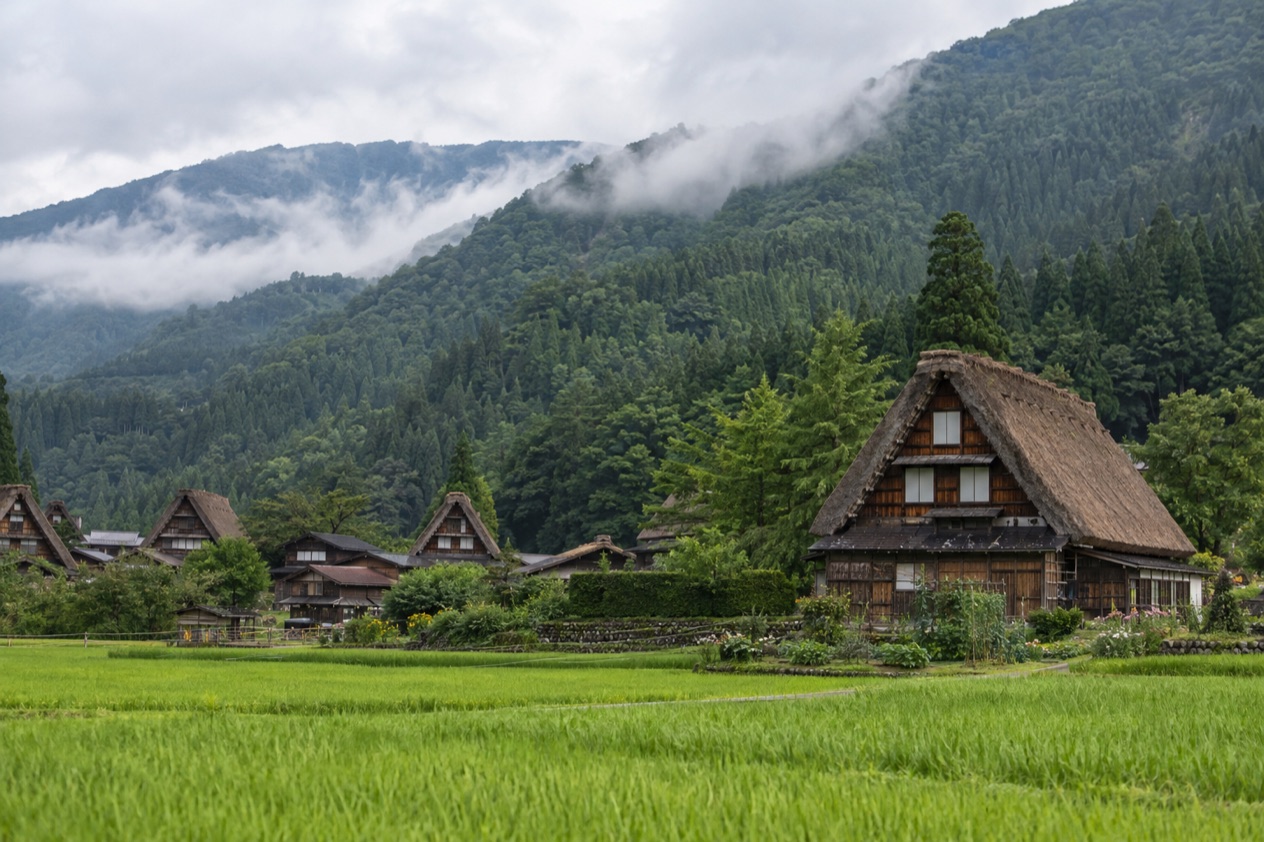
Smoke drifts from the hearth of a farmhouse whose thatched roof rises like two hands pressed together, and the rice fields around it hold either a thin film of water, a green haze or a blanket of white. Shirakawa-go is a mountain village district where people still live inside the houses you came to see. It suits travelers who like to walk slowly, look closely at how a place was built, and let a day run at the pace of the valley.
Where is Shirakawa-go and what is it like?
Shirakawa-go is a valley district of farming hamlets in the mountains, tied by road to Takayama, Kanazawa, Toyama and Nagoya, and sharing its World Heritage listing with Gokayama in Nanto, Toyama. What defines it is the roofs. The farmhouses are built in the gassho style, a word meaning hands together, as in prayer, and the steep thatch is cut at an angle that sheds the heavy snow of the region.
The village does not feel like a resort or a town with a main street of shops. It feels like a working settlement that happens to be known around the world.
Houses stand among small vegetable plots, irrigation channels and rice paddies, and the lanes between them are where you spend most of your time. Some farmhouses are open as small museums, some serve meals or sell local sweets and crafts, and some are simply homes with a curtain drawn across the door.
Shirakawa is also counted among the snowiest places in Japan, with yearly snowfall of more than 390 inches. That figure explains everything you see: the steep pitch of the roofs, the deep eaves, the large attic floors where families once worked.
It also shapes the visit. In winter the village is a world of white shapes and dark timber, while in the warmer months it turns green and open, with the thatch standing out against wooded slopes.
This is a place for people who enjoy architecture, rural life, photography and the idea of a day away from cities. It rewards a visit that is not rushed, with time to look at joinery and roof lines and to stop at a stall for a skewer or a bowl of noodles.
Travelers who want nightlife, a long list of sights or a beach will find it very different. The village is small in scope, and its appeal is the single, well-kept picture it offers.
What is there to do in Shirakawa-go?
Most of what you do in Shirakawa-go is walk among the farmhouses, step inside one or two, and look out over the village from higher ground. What sets it apart from the neighboring cities is that the attraction is a way of life preserved in wood and thatch, not a single temple or castle. It was registered as a UNESCO World Heritage Site together with Gokayama, and the care given to the buildings shows in every roofline.
Walking among the gassho farmhouses
The core of the visit is a slow loop through the hamlet, along narrow paths beside irrigation channels, past woodpiles, persimmons hung to dry in autumn, and vegetable gardens right up against the walls. You will see roofs of different ages, some with fresh golden thatch and others dark and mossy. The proportions are what stay in the mind: huge triangular roofs sitting on modest walls.
Some farmhouses open their interiors, and a few let you climb the ladder-like stairs to the upper floors. Up there, the beams are bound with rope rather than nails, a method that lets the frame flex under heavy snow.
Families once raised silkworms in these attics, which is why they are so tall and open. Take off your shoes at the entrance, as in any Japanese home, and keep voices low, since these are lived-in places.
The village from above
Seeing the whole settlement at once is half the pleasure, and there is higher ground from which the roofs are laid out like a model against the mountains. From there you can read the layout: houses turned in the same direction, fields between them, the river valley beyond. In winter this view is mostly white with chimneys and eaves picked out in brown. In summer it is a patchwork of greens.
It is a good place to understand why the houses face the way they do and how the community fits into a narrow valley. Photographers tend to linger here, and a few minutes of watching the light change over the thatch is enough to make the trip feel complete. Wear shoes with grip if there is snow or rain, because slopes and steps can be slick.
Shiramizu Falls and the surrounding landscape
Shiramizu Falls, near Shiramizu Lake, is a scenic waterfall that is free to visit. It gives the trip a second side beyond the farmhouses, one of water, forest and rock rather than thatch. If you have time beyond the village, it is the kind of stop that adds variety to a day built around architecture.
The surrounding hills and river are part of what made the settlement viable, supplying water, timber and thatching grass. Looking at the landscape helps explain why people chose to stay here despite the snow. Pair the falls with a meal of mountain vegetables, river fish or local soba, and the day gains a rhythm of walking, looking and eating that fits this valley well.
Food and small pleasures
Mountain cooking is the style here: pickled vegetables, tofu, soba noodles, river fish grilled over charcoal and sweets made from rice. Hot dishes taste especially good when there is snow on the ground, and many farmhouse restaurants build meals around seasonal wild plants. Doburoku, a cloudy, unfiltered rice sake, is tied to the village’s autumn festival and to local shrine traditions.
Small shops sell crafts, dried goods, handmade sweets and souvenirs shaped like the gassho roofs. A stop at a stall for something warm to eat while you walk is one of the easiest pleasures in the village. Look at the ingredients, ask what is in season, and the answers will tell you as much about the valley as the architecture does.
How many days do you need in Shirakawa-go?
Shirakawa-go works as a long day trip, and an overnight stay lets you see it in a different light. Because highway buses connect it with Takayama, Kanazawa, Toyama and Nagoya, it slots easily into a route through the region.
With an overnight, the experience changes. You can wander the lanes when the day-trippers have left, eat dinner in a farmhouse inn, and wake to the sound of the valley. Staying also frees you from the clock set by a bus timetable, so you can take your time over photographs, a second walk past the fields or a bath before bed. For travelers, a single night is the right amount.
Adding a second night makes sense mainly if you plan to explore Gokayama, which shares the World Heritage listing and offers a smaller, more spread out collection of gassho villages. It also makes sense if you want to take the falls and surrounding hills at an unhurried pace, or if winter weather might disrupt travel. Snow is a real factor in this region, and a bit of slack in the schedule is welcome.
Visitors build the village into a longer journey through the mountains. Toyama and Nagoya sit at the other ends of the bus links. With a week, a loop that includes Shirakawa-go, Takayama and Kanazawa shows three very different faces of central Japan.
Where to stay in Shirakawa-go
The most memorable place to stay is in the village itself, where some farmhouses operate as small family inns, often called minshuku. You sleep on futons laid over tatami mats, eat a set dinner built around local ingredients and share a home that is also a piece of living heritage. Evenings and early mornings, when the lanes empty, give a very different feel from the daytime village.
A stay like this comes with the habits of a Japanese inn. Shoes come off at the door, slippers are worn indoors, and meals are served at set times in a shared room or at a low table. The rooms are simple, with sliding paper doors and thin walls. It suits travelers who want to be part of the setting and are comfortable with a modest, communal style of lodging.
If the village inns do not fit your plans, there are other ways to organize a visit. Takayama in Gifu has a wide range of hotels and ryokan and is connected to Shirakawa by a route that, since the opening of the Hida Tunnel, can be covered within 50 minutes. Kanazawa and Toyama are also linked by highway bus, and each makes a comfortable base with restaurants, museums and evening life.
Think about what you want from the trip. Choose the village for atmosphere, a slower pace and the chance to see the roofs in the evening and morning. Choose Takayama or Kanazawa for variety, more dining choices and easier combinations with other sights. Travelers heading on to Gokayama may prefer to stay on that side of the mountains, where smaller villages offer a similar experience in a more scattered setting.
How do you get to Shirakawa-go and get around?
Shirakawa-go can be reached by highway bus from Takayama, Kanazawa, Toyama and Nagoya. Each starting city offers a different kind of journey, passing through mountain scenery and tunnels before arriving in the valley.
The ride from Takayama has become much shorter. Since the opening of the Hida Tunnel, Shirakawa can be reached within 50 minutes from Takayama, compared with the long drive it once required. That change is a large reason the village fits so well into a trip through the mountains of central Japan, whether you travel from the Gifu side or continue on toward the coast.
Once you arrive, the village is explored on foot. The houses, shops, paths and fields are spread through the hamlet, and wandering between them is the activity itself. Footwear matters more than you might think. In snow, paths turn slushy and icy, and in wet weather the lanes and field edges can be muddy, so sturdy shoes or boots are a sensible choice for a day among the farmhouses.
Pace yourself around your bus connection if you are visiting for the day, since the village is the kind of place where it is easy to lose track of time. Allow yourself some slack at the end, enough for one more walk through the lanes or a last hot drink. If you stay overnight, you will have the luxury of letting the bus schedule fall away and exploring in the order you like.
When is the best time to visit Shirakawa-go?
Winter and autumn are the two seasons that most clearly show what Shirakawa-go is. In winter the village is one of the snowiest places in Japan, and the steep thatch, deep eaves and heavy white cover explain why the houses look the way they do. Cold days, smoke from chimneys and the glow of windows at dusk give the village its most dramatic picture, though snow can also affect travel, so allow flexibility.
Autumn brings color to the surrounding hills, a harvest atmosphere in the fields and the village’s festival tradition around doburoku, the cloudy rice sake. The air is cooler, the light is softer and the thatch stands out against red and gold slopes. Spring and summer have their own character, with water in the paddies, fresh green on the mountains and a more open, rural feel as the snow disappears.
There is no bad moment to see the roofs, but the season changes what you do. In snow, you spend more time indoors, warming up over meals and hot drinks. In the green months, you walk further, follow the irrigation channels and add the falls to your day. Choose winter for the dramatic white scene, autumn for color and festivals, and the warmer months for easy, open walking through the fields.
Good to know before you go
Shirakawa-go is a place where people live and work, so the usual habits of respect apply. Keep to the paths, avoid stepping into fields, and ask before photographing people or the inside of a home. Shoes come off at the entrance of a farmhouse, and quiet voices are the norm indoors. Bring layers for changing mountain weather, and expect heavy snow in winter, which can slow roads and buses.
Sources
- Wikipedia, Shirakawa-gō (https://en.wikipedia.org/wiki/Shirakawa-g%C5%8D), checked October 11, 2026
- Wikivoyage, Shirakawa-go (https://en.wikivoyage.org/wiki/Shirakawa-go), checked October 11, 2026