
You step off the Hokuriku Shinkansen into a station whose great wooden gate stands over the concourse, and within minutes you are walking toward a city of old craft workshops, gardens and lantern-lit lanes. Kanazawa rewards a little preparation. A few habits at the door, a plan for the weather off the Sea of Japan and a sense of how to get here make the days go smoothly.
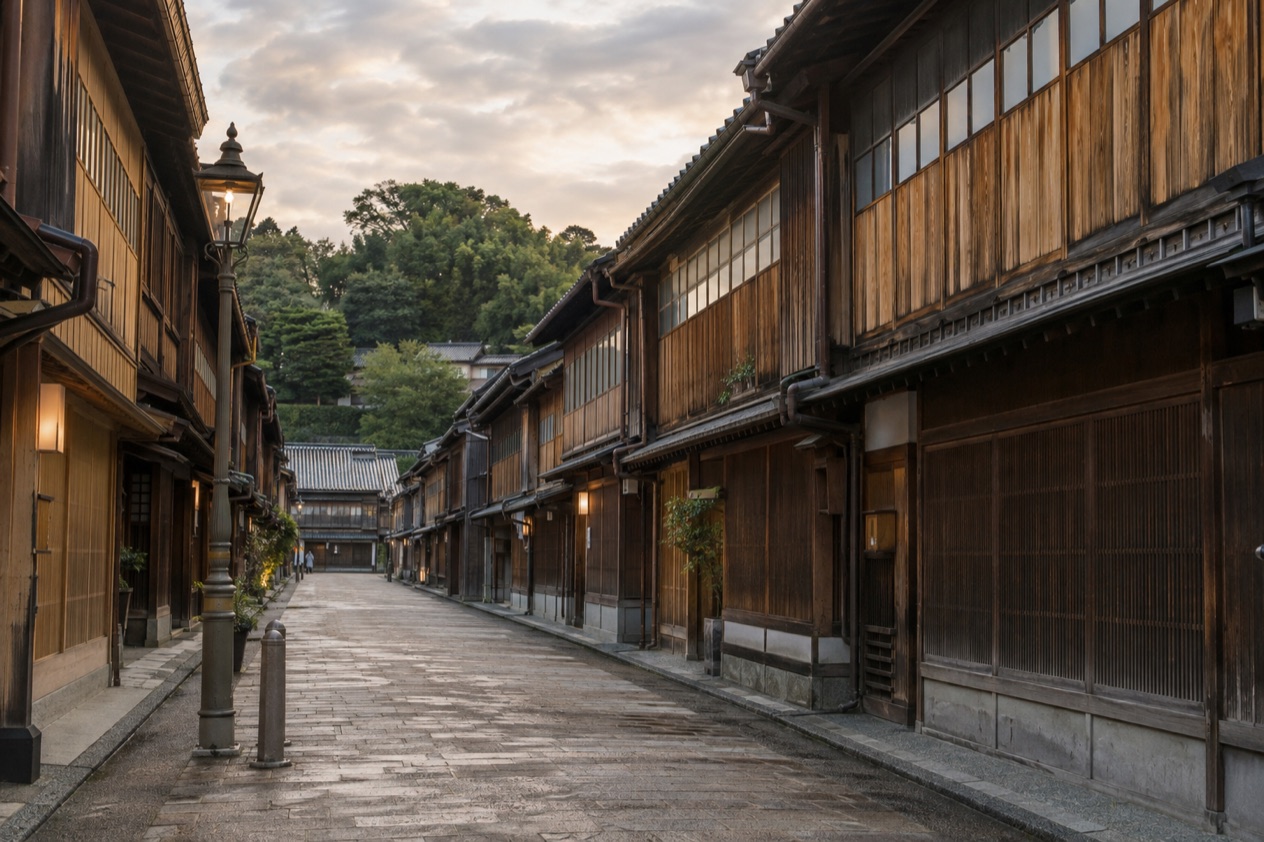
What should you know before visiting Kanazawa?
Four things matter most here: how you reach the city, the weather on the Sea of Japan side, cards and cash, and the small manners of shoes and slippers. Kanazawa is the capital of Ishikawa Prefecture, set on a narrow strip of land along the sea on Honshu, and that position shapes both the climate and the trip in.
Travelers from Tokyo arrive by the Hokuriku Shinkansen, which has served the city since March 2015 and stops at Nagano and Toyama along the way. Those coming by air land at Komatsu Airport, the nearest one. Once in town, you find a place that was one of the most important cultural and artistic centers of Japan in the Edo period, and it still carries that identity through its crafts, which earned it a place in the UNESCO Creative Cities Network as a City of Crafts and Folk Art.
What surprises first-time visitors is often the rain. Kanazawa gets showers in every season, and winter brings heavy, damp snow rather than dry cold.
The second surprise is how much of the city is made for slow looking: gardens, workshops and old merchant streets reward a loose schedule more than a tight list.
Entry, customs and paperwork
According to the U.S. State Department, U.S. citizens on a tourist or business visit can stay visa free for up to 90 days, provided they hold a valid passport and should have proof of a return or onward ticket. The passport has to remain valid for the entire time you are in Japan, so check its date well before you pack.
A visa-free stay does not allow you to work on the local economy. Once you are in the country, the State Department also notes that you must always carry your U.S. passport with you, and that you may be questioned or detained if you cannot show proof of identity and status. Keep it in a secure pocket or bag rather than leaving it at the hotel.
One rule catches travelers who think it harmless: CBD products may be illegal in Japan depending on the amount of THC they contain. Leave them at home rather than testing the line at the border.
Money, cards and tipping
International credit, debit and prepaid cards are generally accepted throughout Japan, and that holds in Kanazawa’s shops, hotels and larger restaurants. It still pays to be a little observant. In some cases stores do not display the symbols of the cards they take, so the simple move is to ask the seller whether yours can be used before the food arrives or the item is wrapped.
Small places such as market stalls, tea houses and tiny workshops are where a question at the counter is most useful. Craft shops in the old districts often sell gold leaf goods, ceramics and lacquerware, and a quick word at the register settles how you will pay without any awkwardness.
As for tipping, it is not part of daily life in Japan. People leave the table without adding anything, and the staff in a ryokan or restaurant simply thank you with a bow. Good service is the baseline, so a polite thank you at the door does the job.
Getting around and staying connected
The Hokuriku Shinkansen is the line that ties Kanazawa to the capital. From Tokyo Station the ride is approximately 2 hours 30 minutes, with stops at Nagano and Toyama stations. Travelers who plan a longer loop can look at the JR Hokuriku Arch Pass, which offers unlimited travel between Tokyo, Kyoto and Osaka via Toyama and Kanazawa for seven consecutive days.
By air, the nearest airport is Komatsu Airport in the city of Komatsu, with the code KMQ. It is the gateway for those who prefer to fly into the region instead of taking the train from Tokyo.
Kanazawa covers a wide area, and its sights are spread across several districts, from the garden and castle park to the old craft quarters. Plan each day around one or two neighborhoods rather than trying to cross the whole city in a morning. The Kanazawa Tourist Information Guide lists the city’s tourist spots and is a handy place to start choosing.
Health, water and the weather
Weather is the health topic that matters most here, and it changes a lot by season. At the Kanazawa station, January brings highs in the mid-40s and lows just above freezing, with rain or snow on most days and very little sun. Snow or sleet falls on more than twenty days that month, so waterproof boots and layers matter more than anything else you pack.
By April the city feels gentler, with highs in the low 60s and lows in the high 40s, and a good deal more sunshine, though showers still come on about a dozen days. Snow has nearly vanished, with only a couple of days of snow or sleet. A light rain jacket stays useful.
July is warm and humid, with highs in the mid-80s and lows in the low 70s, and showers on roughly thirteen days. October is milder, with highs around 71°F and lows near 57°F, and again about a dozen rainy days. In every season, an umbrella earns its place in the bag.
| Month | Average high (°F) | Average low (°F) | Precipitation (in) | Days with precipitation |
|---|---|---|---|---|
| January | 44.8 | 34.2 | 10.08 | 23.4 |
| April | 63.1 | 46.8 | 5.67 | 12.0 |
| July | 85.1 | 73.2 | 9.19 | 12.9 |
| October | 71.2 | 57.0 | 6.97 | 12.7 |
Local customs and etiquette
The habit you will meet first is the shoes. In Japan it is customary to remove your shoes at the entrance of a building, step into indoor slippers and leave your shoes in a shoe box or to the side. You will see it in ryokan, in some restaurants and in traditional houses that open to visitors.
The routine goes a step further inside a Japanese home or ryokan. Slippers come off before you walk onto tatami mats, and a separate pair of toilet slippers is often provided for the bathroom. It is a small ritual, and people quickly pick it up after the first time.
Beyond the doorway, daily manners lean toward quiet and consideration. People tend to speak softly on trains, wait their turn in a line, and carry their trash with them until they find a bin. A slight bow and a thank you go a long way when you buy something or leave a shop, and the same warmth carries over to the craft studios and tea houses where staff are glad to explain what they make.
Good to know before you go
The U.S. State Department rates Japan Level 1: Exercise Normal Precautions.
Plan for rain at any time of year, since every season in Kanazawa has wet days, and keep a flexible plan so a gray morning can become a museum or a craft workshop afternoon. Carry your passport, ask at a shop whether your card is accepted, and finish the day with Kenrokuen or the castle park lit after dark.
Sources
- Japan National Tourism Organization, Kanazawa (https://www.japan.travel/en/destinations/hokuriku-shinetsu/ishikawa/kanazawa-and-around/), checked October 11, 2026
- Kanazawa Tourist Information Guide (https://www.kanazawa-tourism.com/), checked October 11, 2026
- Wikipedia, Kanazawa, Ishikawa (https://en.wikipedia.org/wiki/Kanazawa,_Ishikawa), checked October 11, 2026
- Wikivoyage, Kanazawa (https://en.wikivoyage.org/wiki/Kanazawa), checked October 11, 2026
- U.S. Department of State, Japan travel information, local laws and special circumstances (https://travel.state.gov/content/travel/en/international-travel/International-Travel-Country-Information-Pages/Japan.html), checked October 11, 2026
- Japan National Tourism Organization, manners, etiquette, shoes, bowing, chopsticks, public behavior (https://www.japan.travel/en/guide/understanding-and-mastering-japanese-manners-and-etiquette/), checked October 11, 2026
- Japan National Tourism Organization, credit cards and cash, where cards are accepted (https://www.japan.travel/en/plan/credit-cards/), checked October 11, 2026
- U.S. Department of State, Japan travel advisory (https://travel.state.gov/content/travel/en/international-travel/International-Travel-Country-Information-Pages/Japan.html), checked October 11, 2026
- U.S. Department of State, Japan travel information, entry and exit requirements (https://travel.state.gov/content/travel/en/international-travel/International-Travel-Country-Information-Pages/Japan.html), checked October 11, 2026
- Japan Meteorological Agency (JMA), Normal values 1991-2020, monthly (https://www.data.jma.go.jp/stats/etrn/view/nml_sfc_ym.php?prec_no=56&block_no=47605), station Kanazawa, elevation 6 m, checked October 11, 2026
To plan your stay
- Best Time to Visit Kanazawa: Cherry Blossoms, Autumn Color, Winter Snow and Festivals
- Things to Do in Kanazawa: Kenrokuen, Samurai Streets, Gold Leaf and Day Trips
- Where to Stay in Kanazawa: Station Area, Tea House Streets, Downtown and Ryokan Choices
- Kanazawa from Tokyo: Hokuriku Shinkansen, Komatsu Airport and a Day in the Gardens