
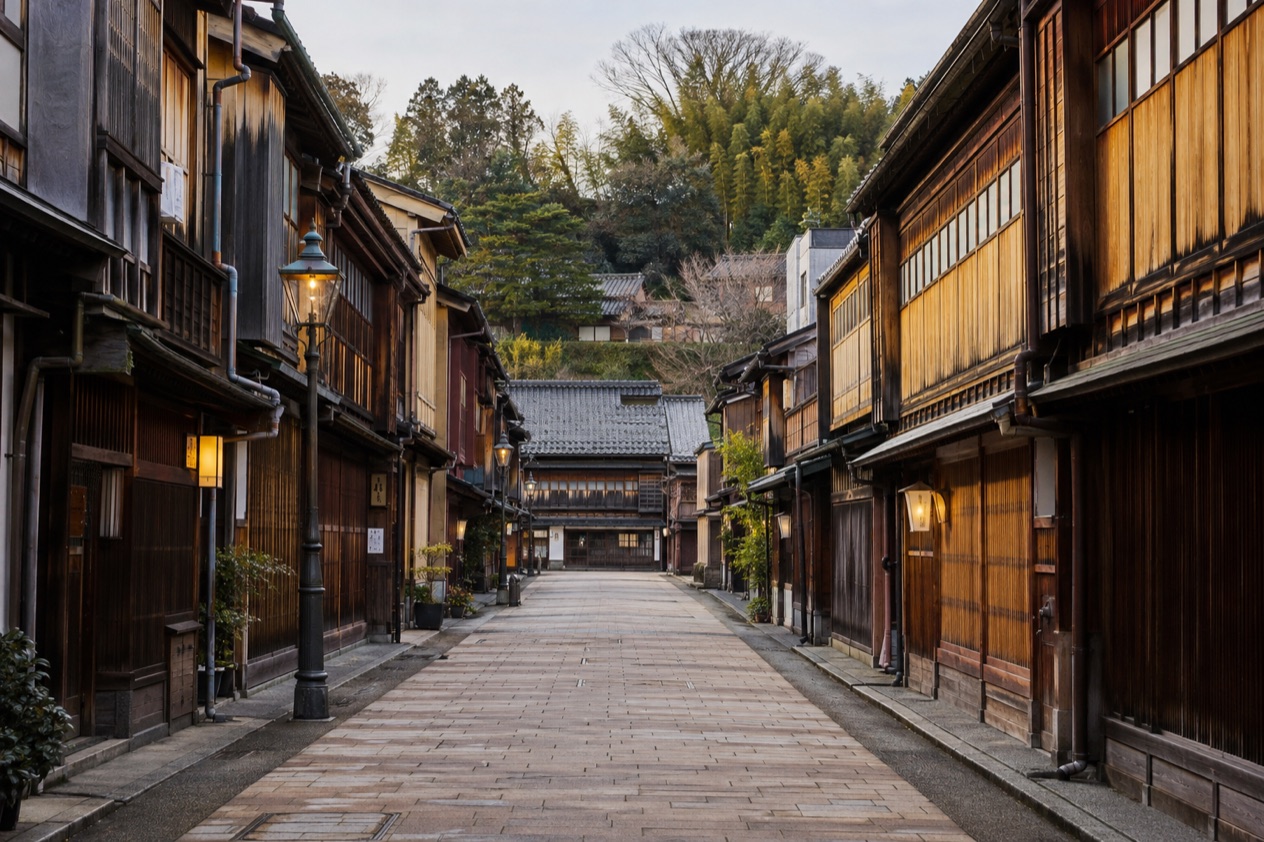
The street opens out in front of you paved in stone, lined with dark wooden houses whose slatted lattice fronts give nothing away about the rooms behind. Somewhere a shop assistant is pressing a sheet of gold leaf onto a soft-serve cone, and a few visitors in rented kimono pause to photograph the doorways. Higashi Chaya District is the old tea house quarter of Kanazawa, a place for slow strolling, sweets and a look at how evenings were once spent in this city of the Edo period.
Is visiting Higashi Chaya District worth it?
Yes, if you like to wander through a preserved street, look at fine woodwork and eat something sweet along the way, and it suits couples, friends and families who enjoy atmosphere more than a checklist of sights. It is a district to be in rather than a monument to tick off. You come for the rhythm of the lane, the lattices, the shop windows and the cafés tucked into old tea houses.
Kanazawa was one of the most important cultural and artistic centers in Japan during the Edo period, and Higashi Chaya is where that refinement is easiest to feel at street level. Tea houses were places of music, dance and conversation, and the architecture still reflects it: a ground floor set back from the street, an upper floor built for entertaining guests, and fronts designed to be seen from the lane. Even if you step into nothing at all, the buildings do a good part of the storytelling.
What sets it apart from other old quarters in the city is its focus on entertainment rather than daily life. The samurai district of Nagamachi, with its earthen walls and narrow canals, speaks of households and rank. Higashi Chaya speaks of evenings, of lanterns, of shamisen music and of the women who performed.
A second tea house district, Nishi Chaya, shares that story on a smaller scale, and Kazue-machi, along the river, adds another. Together they make a pleasing trio, but Higashi Chaya is the one with the longest street, the most shops and the clearest sense of a quarter that has kept its looks.
It is also a good fit for a city that rewards unhurried days. Kanazawa sits on a narrow strip of land along the Sea of Japan, and the district fits naturally into a day that also takes in Kenrokuen Garden and the castle grounds.
If your trip leans toward temples and mountains, you may find the district a modest stop. If it leans toward crafts, food and architecture, it can easily fill a relaxed half day.
What to see at Higashi Chaya District
The main street and its lattice facades
The heart of the district is its main lane, a stone-paved street where the two-story wooden houses stand shoulder to shoulder. The fine vertical lattices on the front are the signature detail.
They let those inside look out while keeping passersby from seeing in, which suited a place built on discretion. Look at the proportions of the upper floors, which were designed with entertaining in mind, and at the way each doorway is framed by a modest noren curtain or a hanging lantern.
The side lanes, narrower and more domestic in feel, are worth a detour too. Here you notice details such as the drainage stones, the sliding doors and the plants set in pots along the walls. The pleasure is in looking closely rather than covering ground, and in turning down each alley to see where it leads.
Tea houses and the world of the evening
A chaya, or tea house, in this sense was not a place for simple tea drinking. It was a house where guests were received in tatami rooms to enjoy food, drink and performances by geisha, who trained in dance, music and conversation.
Kanazawa’s culture of the arts, nurtured under its Edo-period rulers, gave these houses a refined reputation. Today the tradition is carried on in a quieter form, with some buildings still keeping their original purpose and others reborn as museums, cafés and shops.
What to look for inside a converted house is the layout: the entrance, the staircase to the guest rooms, the small garden court, the lacquered or gilded touches in the main room. Even from the street you can often glimpse an interior of deep red walls and a wall-hung scroll through an open sliding door. Treat these buildings with the usual courtesy of a private cultural site, taking photos only where it is clearly welcome.
Gold leaf, sweets and craft shops
Kanazawa is closely tied to gold leaf, and the shops along the street make the most of it. You will find gold leaf sheets pressed onto soft-serve ice cream, floating in tea, laid across cakes and decorating small boxes, mirrors and chopsticks. It is a quick and playful way to taste the city’s craft, even if you buy nothing more than a treat to share.
Beyond gold, look for wagashi, the delicate Japanese sweets made to go with matcha, and for shops selling lacquerware, ceramics and textiles. A cafe in a former tea house, with a bowl of matcha and a seasonal sweet served in a tatami room, is one of the nicest ways to sit down. The pairing of bitter tea and sugary confection is a quiet reminder of what these rooms were built for.
Kenrokuen Garden and the castle grounds nearby
Higashi Chaya pairs naturally with Kenrokuen Garden, which the Japan National Tourism Organization calls one of Japan’s most iconic landscape gardens. Admission to Kenrokuen is free, and the garden and Kanazawa Castle Park are both illuminated at night, which can shape how you plan the end of a day. The garden offers ponds, pines, stone lanterns and winding paths, a contrast to the tight street of the tea houses.
Seeing the garden and the district on the same day gives a fuller sense of what Edo-period Kanazawa valued: refined landscapes for the ruling class and refined entertainment for the city. The two feel like different chapters of the same story, one open and green, the other lined with timber and paper.
When to visit Higashi Chaya District
Any season can work, but the weather shapes the experience more than usual because so much of the pleasure is outdoors, on foot, in the lane. Kanazawa is a rainy city for much of the year, and its winters are snowy. On the other hand, the district’s wood and stone look particularly handsome when wet or dusted with snow, and many cafés offer a warm place to wait out a shower.
| Month | Average high (°F) | Average low (°F) | Precipitation (inches) | Days with 1 mm or more | Hours of sunshine |
|---|---|---|---|---|---|
| January | 44.8 | 34.2 | 10.08 | 23.4 | 62 |
| April | 63.1 | 46.8 | 5.67 | 12.0 | 185 |
| July | 85.1 | 73.2 | 9.19 | 12.9 | 167 |
| October | 71.2 | 57.0 | 6.97 | 12.7 | 152 |
Winter is cold and gray, with snow or sleet on most days of an average January and little sun. It is a season for warm drinks and indoor tea rooms, and for walking in a coat, hat and waterproof shoes. The lanes can feel stark and beautiful in snow, though slippery stone underfoot calls for care.
April brings milder air and much more sunshine, a pleasant month for hours outdoors, though a light rain jacket still earns its place. By October the heat has eased into mild days and cool evenings, with a fair amount of rain in the mix. The garden and the castle grounds are lit at night, so an autumn afternoon in the district can run into an evening nearby.
July is hot and humid, with highs in the mid-80s and warm nights, and showers that come and go. Pace yourself, keep to the shade and treat the cafés and gold leaf ice cream shops as welcome cooling stops. Historically, tea houses did their business in the evening, so an end-of-day visit gives a better feel for the district’s original purpose, but visit hours are set by each shop and house, so take the district as it comes.
Tips for your visit
Wear comfortable shoes with good grip, since the stone paving and side lanes can be slick in rain or snow, and bring a compact umbrella in any season. A small bag is useful for sweets, craft purchases and the light layers that Kanazawa’s changeable weather calls for. If you plan to step into a tea house cafe, shoes may come off at the entrance, so socks in good shape are a sensible choice.
The district pairs well with the rest of the city. Kenrokuen Garden and Kanazawa Castle Park lie nearby, and the samurai quarter of Nagamachi and the second tea house district of Nishi Chaya make a coherent theme day around old Kanazawa. A relaxed plan might begin with the garden, move on to lunch, and finish in the lanes of Higashi Chaya with a sweet and a bowl of tea.
| Site | Admission |
|---|---|
| Kenrokuen Garden | Free |
Getting to Kanazawa is straightforward from Tokyo. The Hokuriku Shinkansen has served the city since March 14, 2015, bringing the trip to around 2 1/2 hours. The nearest airport is Komatsu Airport, in the city of Komatsu.
Families will find plenty to enjoy in the sweets and the visual play of the lanes, and children often like the gold leaf treats. Strollers and wheelchairs need to deal with stone paving and the thresholds of older buildings, so it is wise to expect that some interiors will be hard to enter. A leisurely pace, with a few café breaks, suits the district better than a rush.
Conduct in a living neighborhood matters. Some houses are private homes or working tea houses, so speak softly, avoid blocking doorways and ask before photographing anyone, particularly performers or women in traditional dress.
Good to know before you go
Bring some yen in cash for small purchases at stalls and cafés, and carry a card as well. Keep your belongings in a zipped bag in busy lanes, as you would anywhere, and mind the stone paving when it is wet. Kanazawa’s rainy climate is part of its character, so plan for showers, and in winter, snow, whatever the month on the calendar.
Sources
- Japan National Tourism Organization, Kanazawa (https://www.japan.travel/en/destinations/hokuriku-shinetsu/ishikawa/kanazawa-and-around/), checked October 11, 2026
- Kanazawa Tourist Information Guide (https://www.kanazawa-tourism.com/), checked October 11, 2026
- Wikipedia, Kanazawa, Ishikawa (https://en.wikipedia.org/wiki/Kanazawa,_Ishikawa), checked October 11, 2026
- Japan Meteorological Agency (JMA), Normal values 1991-2020, monthly (https://www.data.jma.go.jp/stats/etrn/view/nml_sfc_ym.php?prec_no=56&block_no=47605), station Kanazawa, elevation 6 m, checked October 11, 2026
To plan your stay
- Best Time to Visit Japan: Cherry Blossoms, Autumn Colors, Weather and Festivals
- Where to Stay in Japan: Ryokan, Temple Stays, Capsule Hotels and the Best Cities to Base In
- Sending Luggage from the Airport in Japan: Hands-Free Travel, Hotel Delivery and Coin Lockers
- Know Before You Go to Japan: Entry, Money, Etiquette and Getting Around