
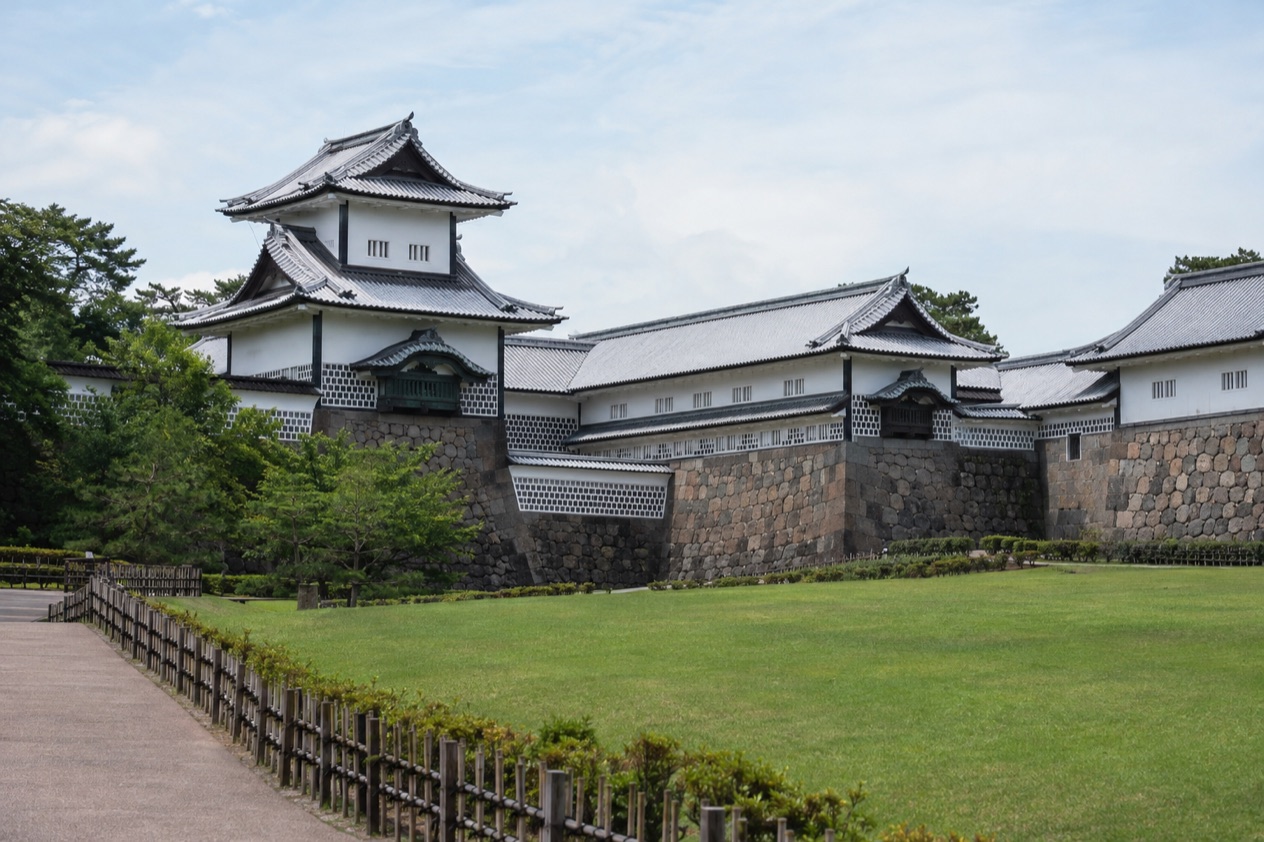
You come up to Kanazawa Castle across a stone-lined moat, and the first thing that catches the eye is the pale shimmer of the roofs, tiled in lead rather than the usual gray clay. Behind the wooden gates, wide lawns open out and long white-walled storehouses line up against the sky. It is a visit about walls, timber and the way a great clan lived, and it sits right beside Kenroku-en Garden, so the two usually share a day.
Is visiting Kanazawa Castle worth it?
Yes, especially for travelers who like to see how a castle is rebuilt and what still stands from the original, and for anyone already heading to Kenroku-en, since the two grounds are neighbors. It suits history lovers, photographers drawn to white walls and black-framed windows, and anyone who enjoys wandering open grounds without a fixed route.
What sets it apart from the keep-and-museum castles elsewhere in Japan is that this one is a flatland castle, spread across the ground rather than stacked on a hilltop, and only partly restored. Kanazawa Castle was the seat of the Kaga Domain, ruled by the Maeda clan for 14 generations until 1871, and the grounds still read as the headquarters of a wealthy domain: gates, storehouses, turrets and a vast palace site. You see original buildings standing beside carefully reconstructed ones, and the contrast is part of the interest.
Kanazawa was one of the most important cultural and artistic centers of Japan during the Edo period, and the castle explains why. A domain this prosperous could afford craftsmen, gardens and ceremony on a grand scale, and you feel that scale in the size of the grounds before you read a single sign. In 2008 the castle was designated a National Historic Site of Japan.
There is also something to watch happening. The restoration, known as the Heisei Castle Construction, is still moving forward, with the groundbreaking for Ninomaru Palace held on March 9, 2025. Coming here means seeing a castle that is slowly being given back its missing pieces, using traditional building methods, rather than a finished monument frozen in place.
If castles are not your thing, the grounds still work as a long, open pause between the garden, the city streets and the nearby museums. If you want to climb to the top of a tall keep for a view, this is a different kind of place, built around low buildings, gates and walls.
What to see at Kanazawa Castle
Ishikawa-mon Gate
The Ishikawa-mon Gate is the face of the castle for many visitors. It is made up of eight separate structures, all designated National Important Cultural Properties, and it faces one entrance of Kenrokuen park. The main gate was built in 1788, and it is among the original buildings that survived rather than a reconstruction.
Look at how the gate is built as a small compound rather than a single doorway, with walls and a defensive layout that force anyone approaching to turn and slow down. Notice the heavy timber, the plaster walls and the lead-gray roofs. The stonework beneath is worth a close look as well, since every block is fitted with a precision that rewards a slow walk along its length.
Because it faces the garden entrance, the gate is where most people start or end a visit. Stand across the moat for the full view, then walk through to see how the space opens up behind it.
Sanjukken Nagaya and the Tsurumaru Storehouse
Two of the surviving original structures sit side by side in spirit if not in function: the Sanjukken Nagaya and the Tsurumaru Storehouse. Both are designated Important Cultural Properties. The nagaya is a long, low warehouse building, the kind of structure that held supplies for a castle that had to be ready for a siege, and its long white walls are some of the most photographed lines on the grounds.
These buildings are quiet in character. There is no grand display, just thick walls, small windows and the simple logic of storage built to last. That is exactly why they are interesting. They show the practical side of a domain headquarters, the part that kept soldiers fed and equipped, and they show how much of the real castle was working infrastructure rather than ceremony.
Since they are original, look closely at the timber, the plaster and the way the roof lines sit. Compare them with the restored buildings nearby and you start to see the small differences in age and finish.
Hishi Yagura, Gojikken Nagaya and the connecting turret
In 2001, the Hishi Yagura turret, the Gojikken Nagaya warehouse and the Hashizume-mon Tsuzuki Yagura turret were restored using traditional construction methods. Together they form the part of the castle that most resembles what the Maeda clan saw. The Hishi Yagura is a watchtower whose roof rises high above its stone wall, and its shape, with a diamond-patterned footprint that gives the building its name, is a striking piece of design.
The Gojikken Nagaya is a long warehouse building that links these structures, and the turret next to it continues the line. Walk the length of them and notice how timber, plaster and tile are joined without modern fixings in the visible parts.
Pay attention to the roof tiles here. They are made of lead, which is fireproof and, in times of siege, could be melted down for bullets. The result is the distinctive whitish sheen that gives Kanazawa Castle its look, especially under gray skies when the roofs seem to glow.
Kahoku-mon, Hashizume-mon and Nezumitamon
Several of the castle gates have been rebuilt in stages. The Kahoku-mon Gate was reconstructed in 2010, the Hashizume-mon Gate in 2015, and the Nezumitamon Gate and Nezumitamon Bridge in 2020. Each one restores a point of entry that existed in the castle’s working days, and together they rebuild the approach routes that once shaped how people moved through the grounds.
The Nezumitamon Bridge adds a different element, a crossing over the water that lets you see the moat and the stone walls from a new angle. Seeing the gates in sequence is a way to follow the restoration itself, from the first buildings to the newest ones.
The newer timber has a fresher color than the old, and that is part of the pleasure. You can read the age of each element if you look, and over the years the wood will weather and blend in.
Ninomaru Palace, the moats and the canals
Ninomaru Palace was the largest building in Kanazawa Castle and served as the administrative center of the Kaga Domain. It is the final stage of the restoration, with the groundbreaking ceremony held on March 9, 2025.
The water system tells another part of the story. The inner moats, built by Maeda Toshinaga, run for well over a mile around the grounds, and the canal system that supplied drinking water to the castle stretched for nearly nine and a half miles. Standing at the edge of a moat, you can see that defense and water supply were planned together on a very large scale.
When to visit Kanazawa Castle
Spring and autumn bring milder temperatures than midsummer or midwinter. October is a good example: pleasantly cool, with highs in the low 70s and enough sun to light up the white walls against the green of the lawns. Rain still falls on a good share of days, in showers rather than anything prolonged, so a light layer and an umbrella fit the month.
April is cooler and fresher, and the grounds feel open and bright. The air is mild enough for long outdoor walks, though evenings cool off, and rain on roughly one day in three means a compact umbrella is useful. Spring is also a natural time to combine the castle with the garden next door.
July is hot and humid, with highs in the mid-80s, and the rain comes in warm showers. A castle with open lawns and little shade asks for a hat, water and a slower pace. The reward is the deep green of the grounds, and the lead roofs against a summer sky can be striking.
January is a different world. Kanazawa sits on the Sea of Japan side of Honshu, and winter brings snow or sleet on most days of the month, along with gray skies and high humidity. Snow on the roofs and walls can be beautiful, but it also means wet footing and cold hands, so this is a visit for those who enjoy winter scenery and dress for it.
| Month | Average high (°F) | Average low (°F) | Rain days | Sunshine (hours) |
|---|---|---|---|---|
| January | 44.8 | 34.2 | 23.4 | 62 |
| April | 63.1 | 46.8 | 12.0 | 185 |
| July | 85.1 | 73.2 | 12.9 | 167 |
| October | 71.2 | 57.0 | 12.7 | 152 |
Kanazawa Castle Park and Kenrokuen Garden are also known for nighttime illuminations.
Because the restoration is ongoing, the grounds change from one trip to the next. A return visit after a few years may show new gates, new walls and, eventually, the rebuilt palace taking shape.
Tips for your visit
Plan the castle and Kenroku-en as one outing, since the Ishikawa-mon Gate faces an entrance of the garden. Start in one and finish in the other, and let the route follow your energy. Comfortable shoes matter, because the grounds are large and much of the visit is on foot over gravel, lawn and stone.
Bring layers that fit the season. In summer, a hat, sunscreen and water are the sensible choices. In winter, waterproof shoes, gloves and a warm coat matter more than anything else. In spring and autumn, a light jacket and a small umbrella cover most days, since showers are common in every season here.
A camera is worth carrying. The white lead roofs, the black-framed timber and the stone walls reflected in the moat make for good pictures in almost any weather, and overcast skies are kind to the pale tiles. Look for angles that include both the original and the restored structures, which makes the history visible in a single frame.
For the wider trip, Kanazawa is the capital of Ishikawa Prefecture, on a narrow strip of land along the Sea of Japan. Since March 14, 2015, the Hokuriku Shinkansen has served the city, shortening the trip from Tokyo to around 2 1/2 hours. The nearest airport is Komatsu Airport, in the city of Komatsu.
With children, the open lawns, the moats and the long white buildings give plenty to look at and room to move, and the story of lead tiles that could become bullets tends to catch young imaginations.
Give the visit a loose frame rather than a tight schedule. Walk to the gates, stand at the moat, follow the long storehouse walls and then stop to read how the pieces fit together. The castle rewards the unhurried, and the stroll into Kenroku-en afterward is a natural next step.
Good to know before you go
Admission to Kenrokuen Garden is free. Weather shifts quickly on this coast, so a compact umbrella earns its place in the bag in any season, and the summer months bring heat and humidity to the open grounds.
Sources
- Wikipedia, Kanazawa Castle (https://en.wikipedia.org/wiki/Kanazawa_Castle), checked October 11, 2026
- Japan National Tourism Organization, Kanazawa (https://www.japan.travel/en/destinations/hokuriku-shinetsu/ishikawa/kanazawa-and-around/), checked October 11, 2026
- Kanazawa Tourist Information Guide (https://www.kanazawa-tourism.com/), checked October 11, 2026
- Wikipedia, Kanazawa, Ishikawa (https://en.wikipedia.org/wiki/Kanazawa,_Ishikawa), checked October 11, 2026
- Japan Meteorological Agency (JMA), Normal values 1991-2020, monthly (https://www.data.jma.go.jp/stats/etrn/view/nml_sfc_ym.php?prec_no=56&block_no=47605), station Kanazawa, elevation 6 m, checked October 11, 2026
To plan your stay
- Best Time to Visit Kanazawa: Cherry Blossoms, Autumn Color, Winter Snow and Festivals
- Where to Stay in Kanazawa: Station Area, Tea House Streets, Downtown and Ryokan Choices
- Kanazawa from Tokyo: Hokuriku Shinkansen, Komatsu Airport and a Day in the Gardens
- Know Before You Go to Kanazawa: Entry, Money, Getting Around and Local Etiquette