
Morning in Kanazawa can mean a slow walk past dark wooden lattice windows in a tea house district, or the clatter of a seafood market where crab and sweet shrimp are laid out on ice. By evening the castle grounds and Kenrokuen Garden are lit, and the streets near the station fill with people looking for dinner.
What is the best area to stay in Kanazawa?
For a first visit, the area around Kanazawa Station is the sound choice, since the Hokuriku Shinkansen arrives there and the rest of the city unfolds from it. Travelers who care most about atmosphere tend to look at the old tea house streets and the samurai quarter, while those who want restaurants and bars after dark look at the downtown district around Korinbo and Katamachi. Anyone drawn mainly by gardens and museums can base themselves near Kenrokuen and the castle grounds.
The areas differ in what they put outside your door. Around the station you find the big modern hotels, the departure point for onward trains and a city that looks like any Japanese regional hub, with the famous wooden gate of the station announcing that you are somewhere particular.
Downtown has the shopping streets, izakaya (casual pubs serving small plates) and late lamps. The old districts are made of narrow lanes, craft shops, tea rooms and small inns, and they feel like a different century. Budget travelers will mostly find business hotels and guesthouses toward the station and downtown, while ryokan, the traditional inns, fit the historic quarters better.
Kanazawa was the fief of the wealthy Kaga clan, the Maeda family, during the Edo period, and its wealth went into gardens, crafts, tea and theater. That legacy is spread across the city, so no single neighborhood holds all of it.
The city is also part of the UNESCO Creative Cities Network as a City of Crafts and Folk Art, which means gold leaf, lacquerware, ceramics and textiles turn up in shops and galleries in every district. Wherever you sleep, you are never far from a craft you can watch, touch or take home.
Think of the choice as three questions. First, how are you arriving: by Shinkansen from Tokyo, by the Thunderbird and Shinkansen route from Osaka or Kyoto, or by air into Komatsu Airport, the nearest one.
Second, how much of the evening do you want to spend in the neighborhood you sleep in. Third, do you want a modern room with a bed, or a tatami room with futons and a kaiseki dinner, the multicourse meal of a traditional inn. Answer those and the map sorts itself.
Families with children often value a hotel with room for luggage and a restaurant downstairs, which points to the station area. Couples after a night of lanterns and wooden façades lean toward the tea house district. Solo travelers on a tight plan can use the station area as a base and still reach every sight by local transport.
Nightlife follows the downtown streets. In every case, the city is spread along a narrow strip of land by the Sea of Japan, so the choice is less about avoiding a bad neighborhood and more about which mood you want to wake up in.
The best areas to stay in Kanazawa
Around Kanazawa Station
The station is where the Hokuriku Shinkansen pulls in, about two and a half hours from Tokyo Station with stops at Nagano and Toyama. From Osaka or Kyoto, the Limited Express Thunderbird runs to Tsuruga, where you change to the Shinkansen for a total journey of about two hours.
The area outside is modern, built around department stores, a huge timber-and-glass gate and a ring of large hotels. It is a place you pass through easily and wake up in comfortably.
Lodging here is mostly business hotels and larger city hotels, with some capsule-style and budget options. It suits first-time visitors, anyone changing trains, and travelers who want a conventional room with a bed.
If you plan a day trip to Gokayama, Shirakawa-go or Takayama, the city’s sample itineraries start from Kanazawa, and a station base keeps those mornings simple. Evening dining is there too, with restaurants inside the station buildings serving local seafood and regional dishes.
A tip: if you also hold the JR Hokuriku Arch Pass, which links Tokyo, Kyoto and Osaka via Toyama and Kanazawa, this area is where the rail side of your trip begins and ends. Tourists with large suitcases often prefer this district for that reason alone.
Korinbo and Katamachi, the downtown core
Downtown Kanazawa is where the city eats and drinks after dark. Shopping streets give way to lanes of izakaya, sushi counters, cafés and small bars, with local specialties such as seafood from the Sea of Japan and the rich stews of the region on many menus. Hotel types here lean toward business hotels and mid-size city hotels, with some guesthouses and apartment-style stays tucked into the side streets.
It suits travelers who plan on late dinners, who like to stroll to a bar and back, and who want department stores and everyday shops on hand. Couples and groups of friends often choose it for the evenings. During the day the district sits between the station and the old castle and garden grounds, so it connects to both without feeling like either.
A tip: if you plan to return late, choose a room on an upper floor facing away from the main shopping street, since the lively lanes below keep going after dinner. Look at the room plan rather than the lobby photos.
Higashi Chaya and the old tea house streets
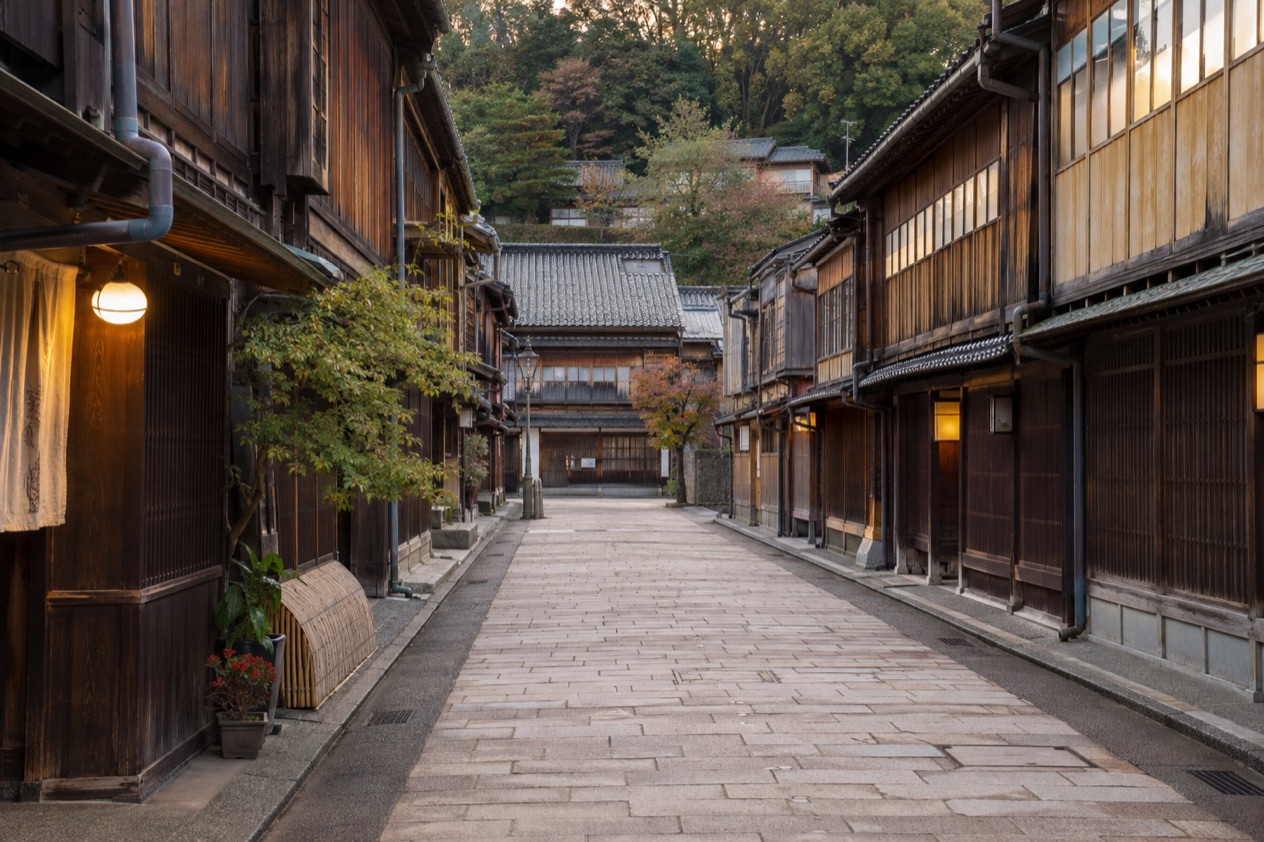
The tea house districts are the picture most people have of historic Kanazawa: wooden façades with fine lattice, stone-paved lanes, small gold leaf shops and tea rooms where you can sit with a sweet and a bowl of matcha. They recall the Edo period, when the Maeda family made Kanazawa one of the most important cultural and artistic centers in Japan. Walking these lanes in the evening, when day visitors have gone and lanterns come on, is a very different experience from passing through in daylight.
Lodging is smaller and more individual here: guesthouses in converted townhouses, boutique inns, a few ryokan, and apartment-style stays. Ryokan typically feature tatami floors, futons, private baths, yukata (a light cotton robe), a kaiseki dinner and a traditional Japanese breakfast. This is the area for couples, for travelers who want atmosphere over amenities and for anyone who wants to feel the city’s craft traditions rather than only see them.
A tip: in a ryokan, staff explain the customs, including removing shoes indoors, bathing in the onsen (hot spring bath) and wearing the yukata, so there is nothing to study beforehand. Accept the guidance and enjoy the slower pace.
Near Kenrokuen and Kanazawa Castle Park
Kenrokuen is one of the three great gardens of Japan, opened to the public in 1875 and spread over 25 acres. Free admission is offered, and the garden and the neighboring Kanazawa Castle Park are illuminated at night. In winter the garden is known for yukitsuri, the ropes arranged in cones over the trees to hold up branches under heavy wet snow, an image that draws photographers from far away.
Staying near the garden suits travelers who care about museums, gardens and the spaces of the old castle town. Lodging nearby ranges from mid-size hotels to small inns and guesthouses. Visiting the garden is a matter of timing your day around its opening hours, which change with the season, so a room close by gives you flexibility in how you shape your morning.
A tip: the samurai quarter and the Ninja Temple, Myoryuji, are among the other sights in this part of Kanazawa. Visitors to the temple must join a tour and are expected to reserve in advance, so plan the day around that visit before anything else.
Kanazawa areas compared
| Area | Best for | Feel | Typical lodging |
|---|---|---|---|
| Around Kanazawa Station | First visit, rail connections, day trips | Modern, busy with trains and shops | Business hotels, city hotels, capsule-style stays |
| Korinbo and Katamachi | Dining, bars, evenings out | Lively lanes after dark | Business hotels, mid-size hotels, guesthouses |
| Higashi Chaya and old districts | Atmosphere, couples, craft lovers | Wooden façades, lattice, lantern light | Ryokan, boutique inns, guesthouses, apartments |
| Near Kenrokuen and the Castle Park | Gardens, museums, a historic setting | Garden grounds and castle town | Mid-size hotels, small inns, guesthouses |
The main trade-off is between the station and the old streets. Near the station you are close to the Hokuriku Shinkansen, the larger hotels and the restaurants of a modern city, and you give up the feel of wooden lanes in the evening. In the old districts the reverse holds: you wake up among tea houses and craft shops, and you accept a smaller room, a smaller choice of restaurants after dark and a little more planning when you travel on.
The second trade-off is between old and new. Downtown gives you restaurants, bars and late lamps, which many travelers want after a day of sightseeing.
The areas by the garden and the castle offer a more historic setting, and their quiet evenings are a matter of the lodging being smaller rather than of anything promised. A reasonable compromise is to stay downtown or at the station and visit the tea house streets and Kenrokuen as day outings, since Kanazawa is a city where the sights are spread through the neighborhoods rather than clustered in one.
Travelers splitting a longer stay sometimes choose two kinds of lodging: a practical hotel for the arrival and departure nights and a ryokan or guesthouse for a night in the old quarter. That way you get the Shinkansen convenience on both ends and the Edo-period mood in the middle, without committing the whole trip to one style.
How to choose your hotel in Kanazawa
A traditional ryokan answers the question of what kind of night you want to have. Tatami floors, futons laid out by staff, a private bath, a yukata to wear and a kaiseki dinner followed by a Japanese breakfast give you a stay that is itself part of the trip.
Ryokan are believed to have emerged in Japan in the 8th century, and staying in one is a way to take part in a tradition rather than only visit one. They suit couples, travelers who like to slow down and anyone curious about Japanese customs.
Heritage Stays are another route, and they are tied to cultural activities such as tea ceremony, calligraphy and wearing traditional Japanese clothing. Reservations are required and can often be made through the property’s website or by phone. This kind of stay appeals to travelers who want an activity attached to the night, and it fits Kanazawa well given the city’s history as a center of art and culture under the Maeda family.
A business hotel is the straightforward choice. You get a private room with a bed, a small bathroom and a location near transport, and you keep your attention for the city outside.
These hotels cluster near the station and downtown, and they work for travelers on a tight schedule, for those arriving late by Shinkansen and for anyone who just wants a reliable base. A capsule hotel pares things down further, with a sleeping pod and shared facilities, and it suits solo travelers who value the location above space.
Guesthouses and apartment-style stays sit between the two. Many occupy converted townhouses in the old districts and give you a room in a historic building, sometimes with a kitchen or shared lounge. They suit longer stays, small groups and travelers who prefer a home-like setting to a front desk. If you want to be in the tea house quarter and a ryokan does not fit your plans, this is where to look.
Families should think about the room itself. A tatami room with futons is a different experience from a hotel room with beds, and some families love sleeping on the floor while others prefer a bed.
Travelers with limited mobility may find a conventional hotel near the station simpler to arrange than a historic building, since older townhouses can include steps and narrow passages. When choosing, read the room description for the bed type, the bath and the meal arrangement, and decide whether you want dinner on site, which is how ryokan work, or the freedom to eat out, which is how business hotels work.
If you plan a day trip to Gokayama, Shirakawa-go or Takayama, as the city’s sample itineraries suggest, a base near the station keeps your departure simple. If your main interests are Kenrokuen, the castle grounds and the old districts, the historic quarters repay you with evening atmosphere. In either case, the choice is between convenience and character, and Kanazawa lets you have a night of each.
Good to know before you go
Komatsu Airport is the nearest airport to Kanazawa. By rail, the Hokuriku Shinkansen has served the city since March 14, 2015, and the JR Hokuriku Arch Pass links Tokyo, Kyoto and Osaka via Toyama and Kanazawa for seven consecutive days.
Kenrokuen Garden has free admission, with hours that change with the season, and the Ninja Temple takes visitors on reserved tours only. The Kanazawa City Tourism Association offers newsletters if you want to follow the city’s events before you arrive.
Sources
- Japan National Tourism Organization, Kanazawa (https://www.japan.travel/en/destinations/hokuriku-shinetsu/ishikawa/kanazawa-and-around/), checked October 11, 2026
- Kanazawa Tourist Information Guide (https://www.kanazawa-tourism.com/), checked October 11, 2026
- Wikipedia, Kanazawa, Ishikawa (https://en.wikipedia.org/wiki/Kanazawa,_Ishikawa), checked October 11, 2026
- Wikivoyage, Kanazawa (https://en.wikivoyage.org/wiki/Kanazawa), checked October 11, 2026
- Japan National Tourism Organization, ryokan stays, what is included, etiquette (https://www.japan.travel/en/guide/japanese-ryokan/), checked October 11, 2026
- Japan National Tourism Organization, heritage stays (https://www.japan.travel/en/heritage-stays/), checked October 11, 2026
- Japan National Tourism Organization, wellness and onsen (https://www.japan.travel/en/guide/wellness-travel-in-japan/), checked October 11, 2026
To plan your stay
- Best Time to Visit Kanazawa: Cherry Blossoms, Autumn Color, Winter Snow and Festivals
- Things to Do in Kanazawa: Kenrokuen, Samurai Streets, Gold Leaf and Day Trips
- Kanazawa from Tokyo: Hokuriku Shinkansen, Komatsu Airport and a Day in the Gardens
- Know Before You Go to Kanazawa: Entry, Money, Getting Around and Local Etiquette