
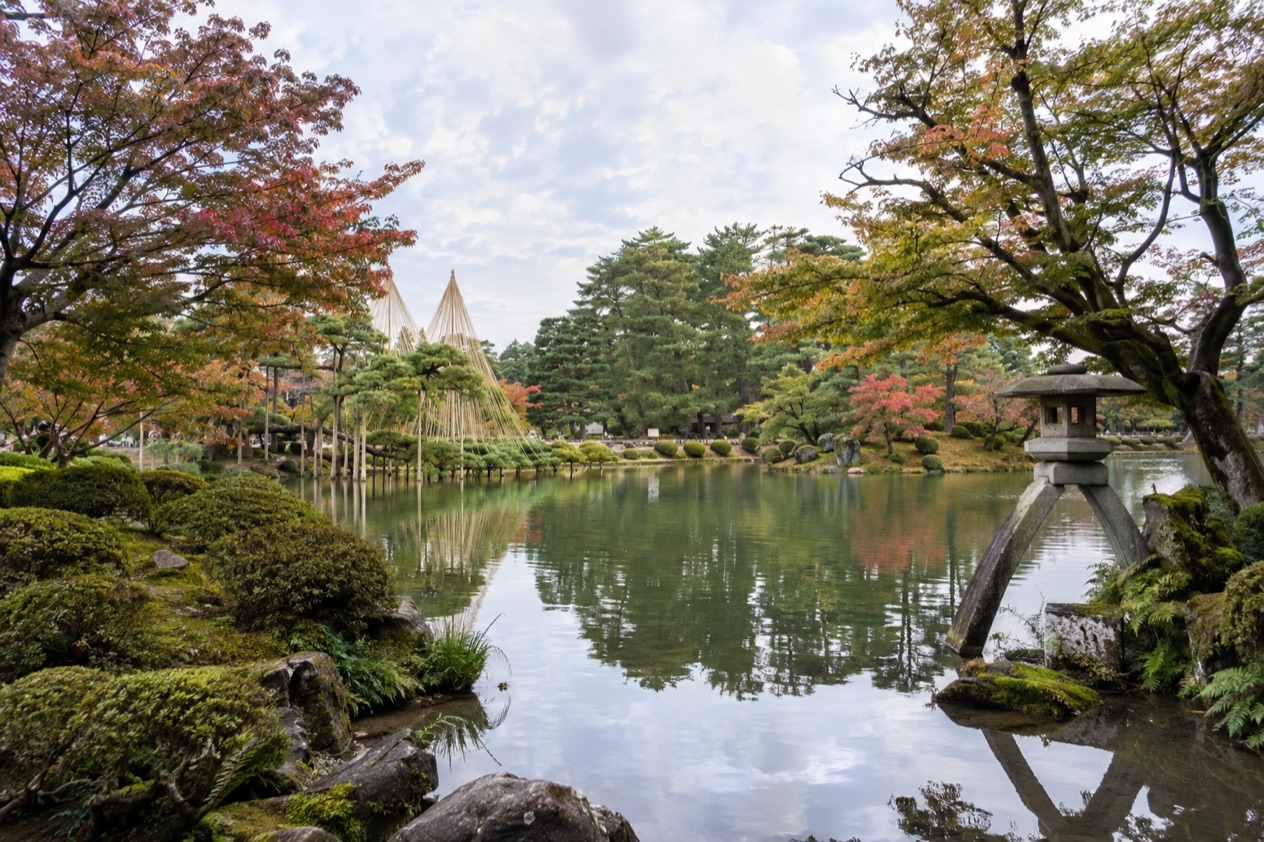
Beyond the gate, the paths slope down toward a wide pond where pines lean over the water and a two-legged stone lantern stands at the edge. Stepping stones, little bridges and teahouse roofs appear one after another, and each turn of the path opens a different scene. Kenrokuen is the great strolling garden of Kanazawa, a place for wandering slowly through every season, and a visit here is about paths, water and old trees rather than a checklist of sights.
Is visiting Kenrokuen worth it?
Yes, for anyone who likes to spend a few unhurried hours among ponds, stone ornaments and carefully shaped trees, and especially for travelers already heading to Kanazawa, where the garden sits at the heart of the city’s cultural story. Kenrokuen is a place to walk and look, with no single monument to tick off, and its rewards come in small details.
The name means Garden of Six Attributes, a reference to six qualities that classical garden makers prized: spaciousness, seclusion, artifice, antiquity, water courses and panoramas. The idea is that a garden rarely offers all six at once, and that Kenrokuen manages to. Whether you notice that or simply enjoy the scenery, the layout keeps you moving from open lawns to shaded corners and back to the water.
It is counted among the Three Great Gardens of Japan, alongside Kairaku-en and Koraku-en, and it was designated a National Site of Scenic Beauty in 1922 and a National Site of Special Scenic Beauty in 1985. It first opened to the public on May 7, 1874, and today its grounds spread over more than 25 acres.
What makes it different from the famous gardens of Kyoto is the kind of garden it is. Ryoanji’s stone garden is a karesansui, a dry landscape where raked sand and rocks suggest the movement of water and invite meditation. Kenrokuen does the opposite.
Real water runs through it, ponds anchor the views, and you walk through the scenery instead of sitting before it. Garden designers also use sudden changes in the width and direction of a path to make a garden feel larger than it is, and Kenrokuen’s winding routes do the same.
What to see at Kenrokuen
The garden rewards looking closely at a handful of things: a lantern, a bridge, a teahouse, the water and the trees. Together they show how a Japanese garden is built from small, deliberate pieces, and none of them asks for more than a few minutes of attention. Take them in any order, because the paths loop back on themselves.
Kotoji-toro, Flying Geese Bridge and the Kaiseki Pagoda
Kotoji-toro is the stone lantern that appears on postcards of Kanazawa. It stands on two legs, and people say it resembles the bridge of a koto, the Japanese zither, over which the strings pass. It is emblematic of both the garden and the city, and the pond and pines around it make it one of the most photographed corners of Kenrokuen.
Nearby, Flying Geese Bridge (Ganko-bashi) is made of eleven red stones laid out so that they resemble geese in a flying formation. Look at the way the stones step across the water at an angle. The Kaiseki Pagoda is said to have been donated to the Maeda family, the lords who ruled Kanazawa, by Toyotomi Hideyoshi, and it adds a touch of history to the stonework.
Yugao-tei teahouse
Yugao-tei is the oldest building in the garden, built in 1774. Like many teahouses in Japanese gardens, it is part of the scenery as much as a building, set so that the pond, the trees and the sky are framed from its rooms. Gardens of this kind were historically places for poetry gatherings and Noh performances, with guests invited to enjoy them, and a teahouse like this one recalls that social side of garden life.
Stop and look at how the roofline, the veranda and the plantings are arranged, because nothing here is accidental. The teahouse shows what the garden was for: not just walking, but sitting, composing a verse and watching the light on the water.
Water, the fountain and the sound of the garden
Water is the structure of Kenrokuen, as it is in many Japanese gardens, with streams, ponds and small falls linking one scene to the next. The garden contains the oldest fountain in Japan, which operates by natural water pressure alone, with no pump. Watching it rise and fall is a small lesson in how the garden’s makers solved problems with the land itself.
Listen as well as look. Flowing water and rustling leaves are part of the design, and stone basins called tsukubai, where guests wash their hands before entering a tea ceremony room, add the sound of trickling water. If you stand still for a minute beside a stream, the garden begins to sound like something composed.
Trees and the yukitsuri ropes
The garden holds roughly 8,750 trees and 183 species of plants, so the scenery changes with the calendar even though the layout stays the same. Pines are shaped branch by branch, and the whole planting is arranged so that each view has a foreground, a middle and a distance.
In winter, Kenrokuen is known for yukitsuri, ropes tied in a conical array from a pole above each tree to support the branches in their chosen arrangement and protect them from the damage heavy snow can cause. The cones look like tents of fine lines over the pines, and they give the winter garden a look found nowhere else on the page of a Japanese travel brochure. They are practical and beautiful at once.
Hours, tickets and rules
Kenrokuen is open to visitors through paid admission all year, during daylight hours. There is no closed season, so the garden is there in snow, in rain and in sun, and the hours follow the light rather than a fixed clock. Free admission is offered on one special event day.
| Site | Open |
|---|---|
| Kenrokuen Garden, Kanazawa | Year-round, during daylight hours |
The rules that apply to a visit are the ones above: admission is paid, the garden is open through the year in daylight, and one event day brings free entry. Kenrokuen is also lit at night during a special event, and the neighboring Kanazawa Castle Park is illuminated in the same way, so evening visits happen only around those occasions.
The Kanazawa Tourist Information Guide website keeps an event calendar divided into four seasons, Spring, Summer, Autumn and Winter, and it is where the illumination and free-admission days are announced. Looking there is how to learn when each one falls.
When to visit Kenrokuen
Kenrokuen is open in every season, and each one gives the garden a different face.
| Month | Average high (°F) | Average low (°F) | Days with rain or snow (1 mm or more) | Hours of sunshine |
|---|---|---|---|---|
| January | 44.8 | 34.2 | 23.4 | 62 |
| April | 63.1 | 46.8 | 12.0 | 185 |
| July | 85.1 | 73.2 | 12.9 | 167 |
| October | 71.2 | 57.0 | 12.7 | 152 |
January is the winter month, cold and wet, with snow or sleet on most days and very little sun. It is also when the yukitsuri ropes are most striking, so the cold has a payoff for anyone ready to dress warmly and walk slowly.
April is mild, with a good deal of sun and noticeably fewer wet days than in winter, which suits a long stroll with the paths and ponds in full view. July is hot and humid, with highs in the mid-80s, so the shade of the trees and the sound of water become part of the appeal.
October brings highs in the low 70s and cool lows, comfortable for walking all afternoon, though about one day in every three still brings rain. A wet day does not ruin the garden, because rain darkens the pines and the stones and makes the ponds ripple.
Beyond the months, there are special dates. The garden is illuminated at night during a special event, as is Kanazawa Castle Park, and Kenrokuen offers free admission on one event day. Both are announced by the Kanazawa Tourist Information Guide, and they are worth knowing if your dates are flexible.
Tips for your visit
Plan for a loose block of time rather than a checklist, because the pleasure of Kenrokuen is in pausing at a bridge, a bench or a teahouse. The paths wind and double back, so there is no single route to follow, and wandering is the point.
Dress for the month. In winter, warm layers matter because the days are cold and wet, and in summer the heat and humidity call for light clothing. In October, a light jacket is enough on most days, with something for a passing shower.
Combining Kenrokuen with Kanazawa Castle Park
Kenrokuen and Kanazawa Castle Park are promoted together by the Kanazawa Tourist Information Guide, which describes both as illuminated at night during special events. The pairing makes sense because the garden was once tied to the castle of the Maeda lords, and the two landmarks tell one story from different angles.
The same website lists Kanazawa tourist spots, and it is a useful place to see what else the city offers. During the Edo period, Kanazawa was one of the most important cultural and artistic centers in Japan, and the city remains a destination for art and culture lovers, so the garden fits easily into a longer stay.
Getting to Kanazawa and going further
Kanazawa is the capital of Ishikawa Prefecture, on a narrow strip of land along the Sea of Japan on Honshu. Since March 14, 2015, the Hokuriku Shinkansen has served the city, shortening the trip from Tokyo to around 2 1/2 hours. The nearest airport is Komatsu Airport, in the city of Komatsu.
If you want to build a trip around the garden, the Kanazawa Tourist Information Guide website provides sample itineraries for Gokayama, Shirakawa-go and Takayama. The Kanazawa City Tourism Association is located at 1-1 Kinoshinbo-machi, Kanazawa, Ishikawa.
Good to know before you go
Admission to Kenrokuen is paid, apart from the one event day when entry is free, and the garden is open year-round during daylight hours. Kanazawa lies on the Sea of Japan side of Honshu, and rain or snow falls on many days in several months, so a wet day is part of the picture, and the garden looks quite different under it. As in any garden, the ordinary habits apply: walk slowly, leave the plants and stones as they are, and give the paths and the pond edges the care they deserve.
Sources
- Japan National Tourism Organization, Japanese gardens (https://www.japan.travel/en/see-and-do/japanese-garden/), checked October 11, 2026
- Kanazawa Tourist Information Guide (https://www.kanazawa-tourism.com/), checked October 11, 2026
- Wikipedia, Kenroku-en (https://en.wikipedia.org/wiki/Kenroku-en), checked October 11, 2026
- Japan National Tourism Organization, Kanazawa (https://www.japan.travel/en/destinations/hokuriku-shinetsu/ishikawa/kanazawa-and-around/), checked October 11, 2026
- Wikipedia, Kanazawa, Ishikawa (https://en.wikipedia.org/wiki/Kanazawa,_Ishikawa), checked October 11, 2026
- Japan Meteorological Agency (JMA), Normal values 1991-2020, monthly (https://www.data.jma.go.jp/stats/etrn/view/nml_sfc_ym.php?prec_no=56&block_no=47605), station Kanazawa, elevation 6 m, checked October 11, 2026
To plan your stay
- Best Time to Visit Japan: Cherry Blossoms, Autumn Colors, Weather and Festivals
- Where to Stay in Japan: Ryokan, Temple Stays, Capsule Hotels and the Best Cities to Base In
- Sending Luggage from the Airport in Japan: Hands-Free Travel, Hotel Delivery and Coin Lockers
- Know Before You Go to Japan: Entry, Money, Etiquette and Getting Around