
In May, the maples along the garden paths of Kanazawa are in fresh, bright leaf, and the moats around the castle reflect that green back at you. The city sits on the Sea of Japan, and its old samurai lanes, tea-house streets and market stalls are all open to long spring days. May is for strolling gardens and canal-side lanes, eating the catch of the Sea of Japan, and looking at craft in a city that has made gold leaf and lacquer for centuries.
What is the weather like in Kanazawa in May?
May in Kanazawa is warm and green, comfortable for walking all day in light clothes, with rain that comes in a modest number of days and a good amount of sunshine between them.
| Month | Average high (°F) | Average low (°F) | Precipitation (in) | Days with 1 mm or more of precipitation | Hours of sunshine | Daylight on the 15th |
|---|---|---|---|---|---|---|
| April | 63.1 | 46.8 | 5.67 | 12.0 | 185 | 13 h 05 min |
| May | 72.1 | 56.5 | 5.43 | 10.4 | 207 | 14 h 05 min |
| June | 78.1 | 65.1 | 6.70 | 10.6 | 162 | 14 h 39 min |
Afternoons reach the low 70s, which is T-shirt weather for most people, while nights settle in the mid-50s. That gap is why a thin layer earns its place in the bag. A cotton cardigan or a light jacket is enough, which matches the general advice for spring in Japan: a light jacket or a simple sweater does the job.
Rain is spread thinly across the month rather than packed into one stretch. Roughly one day in three brings measurable rain, and the Sea of Japan side of the country has a reputation for changeable skies, so a compact umbrella or a packable rain shell belongs in the day bag. The garden paths, the stone lanes of the samurai district and the covered corners of the market all cope fine with a few drops.
Light is the real gift of May. Days are long, so you can fit a garden visit, a late lunch and a tea-house street into the daylight with room to spare. Compared with April, the air has lost its chill, and compared with June it has not yet turned heavy and damp, which makes it a month for sightseeing on foot without constant sweating.
What to do in Kanazawa in May
Cherry blossom has already come and gone by May. In the Hokuriku region, the Somei-Yoshino cherries open around April 10, so the petals belong to the previous month and what you get now is fresh leaf, azalea color and gardens at their greenest. The first days of the month fall inside Golden Week, a string of public holidays, so the mood in the streets shifts from a holiday bustle at the start to a steadier pace as the month moves on.
Kanazawa was one of the most important cultural and artistic centers of Japan during the Edo period, and it is still a place for people who like art and craft. It belongs to the UNESCO Creative Cities Network as a City of Crafts and Folk Art. May weather suits that kind of trip, since you spend your hours moving between gardens, workshops, museums and old streets, with a roof never far away if a shower comes.
Kenroku-en and Kanazawa Castle Park
Kenroku-en, the Garden of Six Attributes, is a strolling garden, meant to be walked slowly with views that change at each bend. It is described as one of the most iconic landscape gardens in Japan. In May the ponds, stone lanterns and pines frame the new green, and the maples are in soft leaf rather than the red of autumn.
Kanazawa Castle sits adjacent to the garden, and the castle park around it is a good place for lawn-side pauses between the garden’s winding paths. The castle park and Kenroku-en are also illuminated at night, so a visit can run into the evening. Give the pair a generous chunk of your day, since they work better when you stop often than when you rush.
Samurai lanes and tea-house streets
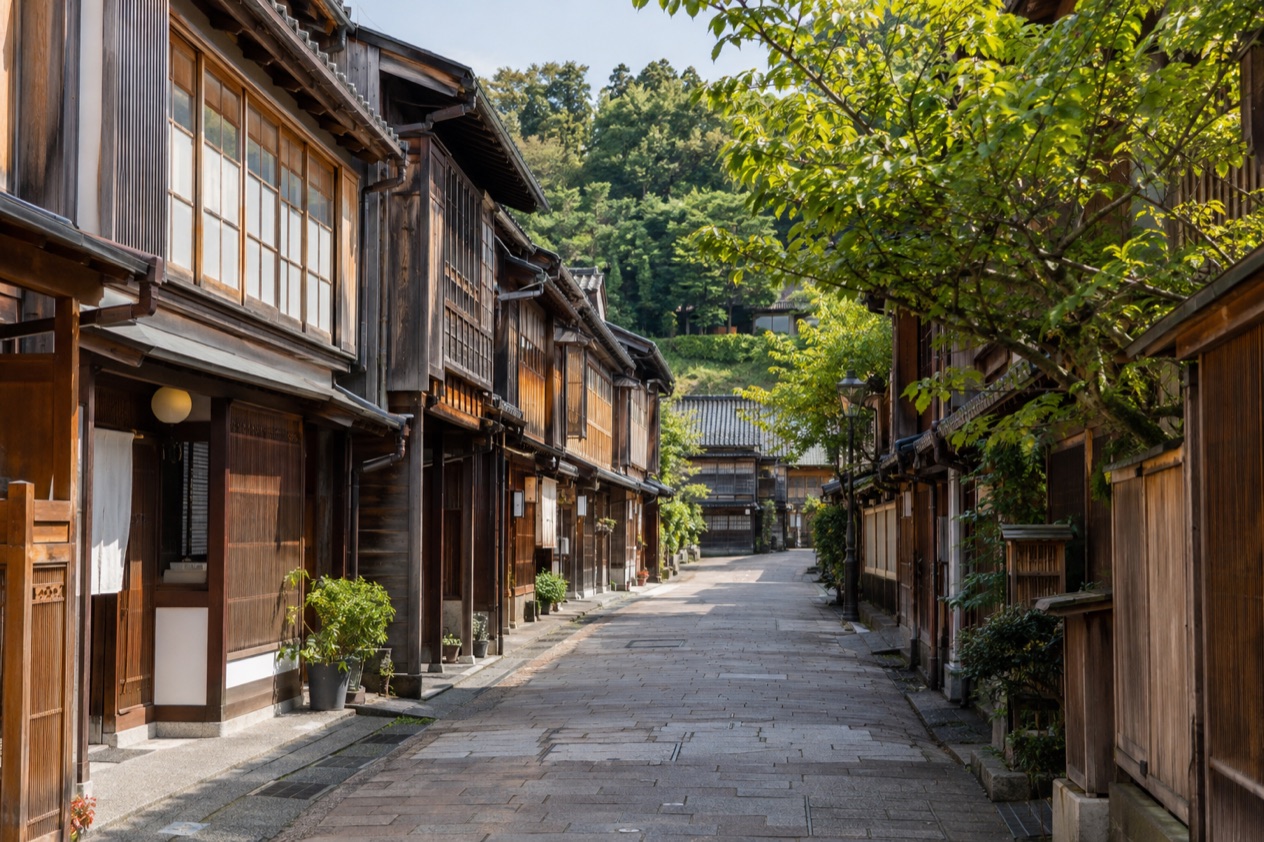
Beyond the garden, Kanazawa keeps old quarters where the Edo past is easy to picture. The samurai district, Nagamachi, has earthen walls and narrow lanes that once separated warrior households, while the tea-house districts are lined with wooden lattice facades where evening entertainment once took place. Some of these buildings now hold small museums, cafés and craft shops.
May’s long daylight lets you wander these districts at an unhurried rhythm, with the wooden facades and stone paving in soft spring light. Stop for matcha with a seasonal sweet, a pairing that goes naturally with a tea-house street. If a shower passes, the shops and cafés inside the old buildings give you somewhere to wait it out.
Gold leaf, lacquer and the craft tradition
Kanazawa is closely associated with gold leaf, and you see it applied to lacquerware, ceramics, small boxes and even food, from sparkling sweets to soft-serve ice cream wrapped in a gold sheet. Other local crafts include Kutani porcelain and silk dyeing. Shops and workshops let you look at the work up close, and some offer hands-on sessions.
A craft stop is a useful rainy-day card, and in May it also fills the gap between two outdoor stretches. The city’s contemporary art museum adds a modern counterpoint to the old crafts, a good choice for travelers who like to alternate between the traditional and the current.
Eating the Sea of Japan in spring
With the Sea of Japan along its edge, Kanazawa eats a lot of seafood, and the central market is a fine place to see it laid out: fresh fish, shellfish, pickles and prepared dishes. Sushi, seafood bowls and grilled fish are the obvious orders. Local Kaga cuisine adds dishes such as jibuni, a simmered duck dish in a gently thick sauce, and vegetables grown in the region.
Spring brings lighter flavors to the table, with tender greens, bamboo shoots and delicate soups appearing on menus. Sake from the area pairs naturally with all of it. For something sweet, look for wagashi, the traditional confections served with tea, and for the gold-leaf treats that make Kanazawa instantly recognizable.
Shops in urban areas of Japan are generally open from 10:00 a.m. to 8:00 p.m. every day, which gives you plenty of room for browsing crafts and food stalls on any given afternoon. Rural areas close earlier, sometimes as early as 6:00 p.m., a point to remember if you wander outside the city.
A two-day itinerary for Kanazawa in May
Day 1 is for the garden and the old quarters. Start at Kenroku-en as soon as you are ready for the day, and take your time along its paths, ponds and lanterns. Cross to Kanazawa Castle Park beside it, where the lawns and moats give you the green view May is known for. Then head to the samurai district for a slow walk past the earthen walls.
Lunch can be a seafood bowl or a plate of local Kaga dishes at a small restaurant near the old lanes. In the afternoon, move to a tea-house street for matcha and a sweet, and look at the wooden facades while the light is long.
Come back to the garden area after dark if you want to see the castle park and Kenroku-en illuminated at night. If the rain arrives, trade the lanes for a craft museum or a tea-house café.
Day 2 is for the market, the crafts and the modern side. Begin at the central market, where fish, produce and prepared foods make a lively breakfast stop. Then spend the middle of the day on craft: a gold-leaf shop, a workshop that lets you try your hand, or a lacquerware gallery. After that, visit the contemporary art museum, a good indoor anchor if the weather turns gray.
Spend the late afternoon in a different tea-house district from the one you saw yesterday, then finish with dinner at an izakaya, a casual pub serving small plates of seafood, tofu and local sake. May’s long daylight stretches the evening comfortably, so you can linger without worrying about the light fading.
Is Kanazawa busy in May?
The start of May is the busiest stretch because Golden Week, running from 29 April to 5 May, packs several public holidays into a single week and puts many Japanese travelers on the move.
Four days of that week are official public holidays: Showa Day on 29 April, Constitution Memorial Day on 3 May, Greenery Day on 4 May and Children’s Day on 5 May. When a national holiday lands on a Sunday, the next working day becomes a holiday too, and a day sandwiched between two national holidays is also a day off. These rules can lengthen the break.
After the holidays end, the cherry blossom season is long over in this part of Japan, which changes the pace of the month. The garden is about green leaf and calm ponds rather than a crowd gathered under pink branches, and the city settles into a steadier rhythm. Shops follow their usual urban hours, generally from 10:00 a.m. to 8:00 p.m., so you can plan your days without special closures in mind.
Planning around Golden Week is the main lever you have. Visit later in the month for a different mood, or arrive in the first days for the holiday atmosphere, knowing that the whole country is traveling at the same time.
What to pack for Kanazawa in May
May calls for light layers and rain protection, plus footwear that suits long days on garden paths and stone lanes.
- A light jacket or a simple sweater, for the cooler end of the day.
- T-shirts or short-sleeved shirts, because afternoons run warm.
- A compact umbrella or packable rain shell, since rain falls on about a third of the days.
- Comfortable walking shoes for gravel paths, castle grounds and old lanes.
- Sunglasses and a hat, as the month brings plenty of sunshine.
- A small day bag for crafts, sweets and market finds.
Good to know before you go
The main thing to keep in mind in May is Golden Week, which runs from 29 April to 5 May and fills the first days of the month with public holidays. Plan around it if you are traveling early in the month. Urban shops are generally open from 10:00 a.m. to 8:00 p.m. every day, while rural shops often close earlier, sometimes as early as 6:00 p.m.
Rain can show up on any day, so keep an indoor option ready for each part of your trip, such as a museum, a craft workshop or a tea-house café.
Kanazawa in May vs April and June
Going four weeks earlier puts you in April, when the air is noticeably cooler, nights are chilly and the days are shorter. That is also when the cherry blossom reaches the Hokuriku region, around April 10, so travelers who want pink branches over the garden ponds should aim for April. The trade-off is more rain days and fewer hours of sun.
Going four weeks later puts you in June, which is warmer and more humid, with the heaviest rainfall of the three months and the least sunshine. Days are longer still, but the air feels thicker, and gray skies are more likely over the garden and the old streets. The green of the landscape is deep, which suits travelers who like lush scenery and do not mind the damp.
May sits in the middle, with the warmth of late spring, more sun than either neighbor and no cherry crowds. Travelers who want blossom should shift earlier, those who prefer lush foliage and do not mind humidity can shift later, and everyone else should stay put.
Is May a good time to visit Kanazawa?
Yes, May is a good time to visit Kanazawa, especially for travelers who like walking, gardens, crafts and food, and who want comfortable temperatures with plenty of daylight.
It suits people who enjoy gardens in fresh green, those who want to browse workshops and museums at a relaxed pace, and anyone who would rather skip the blossom crowds. Travelers set on cherry blossoms should choose April, while those who dislike humid air should avoid the later weeks of the season and stay with May.
On arrival, start with Kenroku-en and the castle park, since the garden sets the tone for the whole stay and shows the city at its greenest. After that, let the days drift between tea-house streets, the market and the craft studios. What is special about May here is the light: long evenings over moats, lanterns and wooden facades, with a city of crafts and gardens in new leaf.
Sources
- Japan Meteorological Agency (JMA), Normal values 1991-2020, monthly (https://www.data.jma.go.jp/stats/etrn/view/nml_sfc_ym.php?prec_no=56&block_no=47605), station Kanazawa, elevation 6 m, checked October 11, 2026
- Computed from the date and the latitude of the place (sunrise equation, solar elevation -0.833 degrees), October 11, 2026
- Japan National Tourism Organization, shop and attraction hours, national holidays (https://www.japan.travel/en/plan/business-hours-and-holidays/), checked October 11, 2026
- Wikipedia, Golden Week (Japan) (https://en.wikipedia.org/wiki/Golden_Week_(Japan)), checked October 11, 2026
- Wikipedia, Public holidays in Japan (https://en.wikipedia.org/wiki/Public_holidays_in_Japan), checked October 11, 2026
- Japan National Tourism Organization, flowers by season: cherry blossom, plum, wisteria, hydrangea, where and when (https://www.japan.travel/en/see-and-do/flowers/), checked October 11, 2026
- Wikipedia, Wisteria (https://en.wikipedia.org/wiki/Wisteria), checked October 11, 2026
- Japan Meteorological Agency, sakura2020.pdf (https://www.data.jma.go.jp/sakura/data/sakura2020.pdf), checked October 11, 2026
- Japan National Tourism Organization, spring in Japan (https://www.japan.travel/en/guide/spring-guide/), checked October 11, 2026
- Wikipedia, Kanda Matsuri (https://en.wikipedia.org/wiki/Kanda_Matsuri), checked October 11, 2026
- Wikipedia, Sanja Matsuri (https://en.wikipedia.org/wiki/Sanja_Matsuri), checked October 11, 2026
- Japan National Tourism Organization, festivals and events (https://www.japan.travel/en/see-and-do/festivals-and-events/), checked October 11, 2026
- Wikipedia, Gion Matsuri (https://en.wikipedia.org/wiki/Gion_Matsuri), checked October 11, 2026
- Japan National Tourism Organization, Kanazawa (https://www.japan.travel/en/destinations/hokuriku-shinetsu/ishikawa/kanazawa-and-around/), checked October 11, 2026
- Kanazawa Tourist Information Guide (https://www.kanazawa-tourism.com/), checked October 11, 2026
- Wikipedia, Kanazawa, Ishikawa (https://en.wikipedia.org/wiki/Kanazawa,_Ishikawa), checked October 11, 2026
- Wikivoyage, Kanazawa (https://en.wikivoyage.org/wiki/Kanazawa), checked October 11, 2026
- Japan National Tourism Organization, Japanese gardens (https://www.japan.travel/en/see-and-do/japanese-garden/), checked October 11, 2026
- Wikipedia, Kenroku-en (https://en.wikipedia.org/wiki/Kenroku-en), checked October 11, 2026
- Wikipedia, Kanazawa Castle (https://en.wikipedia.org/wiki/Kanazawa_Castle), checked October 11, 2026
To plan your stay
- Things to Do in Kanazawa: Kenrokuen, Samurai Streets, Gold Leaf and Day Trips
- Where to Stay in Kanazawa: Station Area, Tea House Streets, Downtown and Ryokan Choices
- Kanazawa from Tokyo: Hokuriku Shinkansen, Komatsu Airport and a Day in the Gardens
- Know Before You Go to Kanazawa: Entry, Money, Getting Around and Local Etiquette