
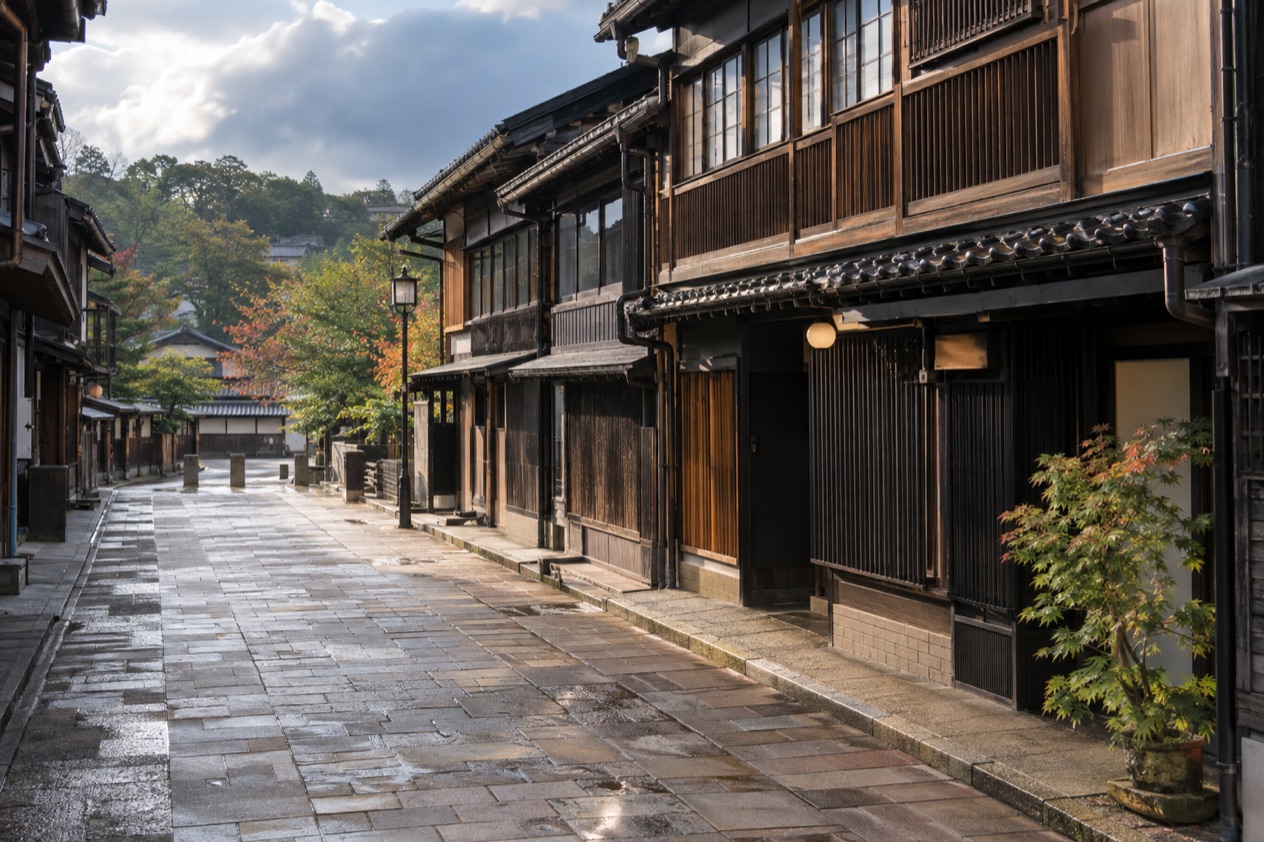
In September, the evening lanes of Higashi Chaya fill with the clack of wooden sandals and the smell of grilled fish drifting from doorways, while cicadas still rasp in the garden trees. The wooden teahouses glow amber behind their lattice screens, and the stone paths stay damp after a passing shower. The heat of high summer loosens its grip on this Sea of Japan city, and it becomes a month for gardens, craft studios and long seafood dinners.
What is the weather like in Kanazawa in September?
September in Kanazawa is warm and humid, with afternoons that still feel like summer and evenings that begin to cool, and it is wetter than the months on either side.
| Month | Average high (°F) | Average low (°F) | Precipitation (in) | Days with 1 mm or more of precipitation | Hours of sunshine | Daylight on the 15th |
|---|---|---|---|---|---|---|
| August | 88.3 | 75.4 | 7.06 | 9.3 | 216 | 13 h 36 min |
| September | 81.0 | 67.8 | 9.13 | 12.0 | 154 | 12 h 28 min |
| October | 71.2 | 57.0 | 6.97 | 12.7 | 152 | 11 h 19 min |
Afternoons are warm enough for a short-sleeved shirt, and the air carries real moisture (relative humidity averages 73 percent), so walking between sights leaves you a little damp even without rain. After dark the temperature eases and a thin layer feels welcome on a terrace or a riverside stroll, though nobody needs a coat.
This is the rainiest of the three months in total. Rain falls on a good share of the days, often as showers that come and go, sometimes as a gray, steady day that suits museums and teahouses better than gardens. Sunshine is clearly thinner than in August, so you will see more soft, filtered light and fewer hard blue skies.
Pack for both. A light rain jacket or a compact umbrella earns its place, and shoes that cope with wet stone and moss are worth more than a fresh pair of sandals. The days are noticeably shorter than in August, which pulls dinner and the evening lantern-lit walk a little earlier.
What to do in Kanazawa in September
Kanazawa was one of the most important cultural and artistic centers in Japan during the Edo period, and that heritage is what you spend a September here on: a great strolling garden, a castle park, old teahouse and samurai districts, craft studios and a market full of Sea of Japan seafood. The city is also part of the UNESCO Creative Cities Network as a City of Crafts and Folk Art. Because most of it is gardens, courtyards and covered lanes, a September day of showers rarely wrecks the plan.
September has no single headline festival to build the trip around. What it offers is the turn of the season at the table, with late-summer pears and grapes appearing in the shops, the first chestnut sweets in the wagashi (traditional confectionery) windows, and richer fish dishes creeping back onto menus as the evenings cool.
Kenrokuen and Kanazawa Castle Park
Kenrokuen, the Garden of Six Attributes, is a strolling garden of ponds, streams, bridges, teahouses and carefully trained pines. In September the green is deep and glossy, the moss is soft after the rain, and the water in the ponds is dark and full. You follow the paths slowly, stopping at the stone lantern by the water and the viewpoints over the pond. After a shower the garden smells of wet earth and cedar.
Kanazawa Castle sits next to the garden, and its park is a wide, open stretch of lawns, stone walls and reconstructed turrets. It is a good counterpoint to the garden, where the paths wind and the views are framed. Both the castle park and Kenrokuen are illuminated at night, which gives you a reason to return after dinner if the day has been gray.
Pair the two in one outing and leave time for a pause at one of the garden teahouses, where a bowl of matcha comes with a seasonal sweet. If rain sets in, a covered pavilion or teahouse veranda lets you watch it fall on the ponds, which is its own pleasure.
Higashi Chaya and the samurai quarter
Higashi Chaya is the old teahouse district, a grid of lanes lined with wooden facades and fine lattice windows. Some houses still host evenings of music and conversation, and others have become small galleries, tea rooms and shops selling gold leaf crafts. Gold leaf is a Kanazawa specialty, and you will see it on cosmetics, chopsticks, lacquerware and even soft-serve ice cream, glittering on top of the cone.
The samurai quarter of Nagamachi is a different mood altogether. Earthen walls run along narrow, winding lanes, and heavy gates hide small gardens and former residences. In wet weather the mud-colored walls darken and the lane stones shine, which makes it a good place for a slow walk under an umbrella. Stop at a craft shop for Kutani porcelain or Kaga yuzen silk painting, two local traditions.
Omicho Market and the Kanazawa table
Omicho Market is the city’s kitchen, a covered market of fishmongers, vegetable sellers and small counters. The fish comes from the nearby Sea of Japan, and bowls of sliced raw seafood over rice are a natural lunch. Look for the local Kaga vegetables, simmered dishes and stalls grilling shellfish. Being under cover, the market is a dependable plan whether the morning is wet or dry.
In the evening, izakaya (casual pubs) serve local sake alongside seasonal small plates. Jibuni, a stew of duck dredged in flour and simmered in a sweet-savory broth, is a Kanazawa classic, and it suits the first cool evenings of the season. Finish with a wagashi and green tea, the kind of sweet that Kanazawa has been refining for centuries.
Between the big sights, the 21st Century Museum of Contemporary Art offers glass-walled galleries and playful installations that work well on a gray afternoon. Small crafts studios let you try your hand at gold leaf decoration, and the narrow lanes behind the main streets reward a wander with tiny shrines, bakeries and sake shops.
A two-day itinerary for Kanazawa in September
Day 1 starts with Omicho Market, a lunch of fresh seafood over rice, and then the garden and castle park while the day is still dry. Take your time along Kenrokuen’s ponds and teahouses, then cross into the castle grounds, where the open lawns give you room to breathe. Gardens come first because shower clouds tend to build later in a humid September day, and wet stone paths are more of a chore than a pleasure.
Late in the afternoon, move to the contemporary art museum or a craft studio, both of which are indoors. For dinner, look for an izakaya serving jibuni and local sake, then return to the illuminated garden or castle grounds if the weather is clear. Rain card: spend the afternoon at the museum and a teahouse, and keep the illuminated walk for the evening only if the showers pass.
Day 2 belongs to the old districts. Begin in Nagamachi’s earthen-walled lanes, with a stop in a restored samurai residence and its small garden. Continue to Higashi Chaya for lunch in a lattice-fronted café, a gold leaf soft-serve and a browse through the craft shops. The teahouse streets are best explored on foot with an umbrella ready.
Spend the afternoon trying a gold leaf workshop or buying Kutani porcelain, then settle into a tea room for wagashi as the light fades. Evenings come earlier than in August, so dinner at a kaiseki (multi-course seasonal) restaurant or a sushi counter fits naturally. In heavy rain, shift the lanes to a shorter walk and give more time to the workshop and tea room.
Is Kanazawa busy in September?
September sits between the heat of summer and the leaf-color season, and Kanazawa does not have a headline festival or bloom to set the pace of the month.
The maple leaves that draw travelers to Japan turn from mid-November to early December, so autumn color is still a couple of months away. What September offers instead is the rhythm of an ordinary working city with its gardens, markets and teahouses in full green.
The weather shapes the pace more than any event. A wet afternoon sends people into museums, cafés and covered markets, while a clear one fills the garden paths. Treat the rain as part of the plan, and keep an indoor option for each day so a shower becomes a change of scene rather than a setback.
In the evenings, the teahouse lanes and the market streets keep their own tempo, with diners drifting from sake bars to late sweets. The cooler air makes an after-dinner stroll more pleasant than in August, and the illuminated castle park and garden give the night a gentle focal point.
What to pack for Kanazawa in September
Pack for warm, humid days with showers and evenings that turn mild, and for lots of walking on wet stone.
- A light rain jacket or compact umbrella, because showers come on many days.
- Breathable short sleeves, since afternoons are warm and sticky.
- A thin layer for evenings, when the air cools after dinner.
- Comfortable shoes with grip for damp garden paths and stone lanes.
- A small towel or handkerchief for the humid walks between sights.
- A day bag with a waterproof pocket for a phone and a guidebook.
Good to know before you go
September brings more rain than August, with showers on many days, so keep a backup indoor plan such as the market, a museum or a teahouse. The air stays humid even on dry days, and the light fades earlier than at the height of summer. Japan’s weather agency runs an Emergency Warning System for extraordinary natural events, a reminder to follow local announcements if the weather turns serious.
Kanazawa in September vs August and October
Going four weeks earlier brings the strongest heat and the most sunshine, with afternoons that are hotter and a little drier. August is the month for long, bright days, though the sticky air makes midday sightseeing heavier. September trades some of that sun for softer light, a bit more rain and the first hints of cool evenings.
Going four weeks later brings clearly cooler air, with light layers needed in the evening and a shorter day. October rainfall in total is lower, though the number of wet days is similar, so showers still need planning. Maple color arrives later still, from mid-November, so October is not yet the leaf season either.
Choose August if you want the brightest weather and do not mind heat. Choose September if you want to walk more comfortably in the garden while the green is still lush and you can accept some rain. Choose October if cooler air matters most and you prefer a sweater to a damp shirt.
Is September a good time to visit Kanazawa?
Yes, for travelers who like gardens, craft studios and food, and who can take a few showers in stride. Kanazawa suits a September visit because most of what it offers works in any weather, from the market and the teahouses to the museums and the garden’s covered pavilions.
It is less suited to anyone who needs reliably bright skies or wants autumn color, which comes later in the year. If you are happy with a flexible plan and a light umbrella, the month works well.
On arrival, begin with Omicho Market for lunch, then walk into Kenrokuen and the castle park while the afternoon allows. What stays with you from September here is the green of the garden after rain, the amber glow of the teahouse lattices and the first cool evening with a bowl of jibuni and a cup of local sake.
Sources
- Japan Meteorological Agency (JMA), Normal values 1991-2020, monthly (https://www.data.jma.go.jp/stats/etrn/view/nml_sfc_ym.php?prec_no=56&block_no=47605), station Kanazawa, elevation 6 m, checked October 11, 2026
- Computed from the date and the latitude of the place (sunrise equation, solar elevation -0.833 degrees), October 11, 2026
- Japan Meteorological Agency, Emergency Warnings (https://www.jma.go.jp/jma/en/Emergency_Warning/ew_index.html), checked October 11, 2026
- Japan National Tourism Organization, safety information (https://www.japan.travel/en/japan-safe-travel-information/), checked October 11, 2026
- Japan National Tourism Organization, weather and seasons in Japan (https://www.japan.travel/en/plan/weather/), checked October 11, 2026
- Japan National Tourism Organization, summer in Japan (https://www.japan.travel/en/guide/summer-guide/), checked October 11, 2026
- Wikipedia, Climate of Japan (https://en.wikipedia.org/wiki/Climate_of_Japan), checked October 11, 2026
- Japan Meteorological Agency, maple color-change dates 2025-2026 with difference from the 1991-2020 normal (https://www.data.jma.go.jp/sakura/data/phn_014.html), checked October 11, 2026
- Japan Meteorological Agency, kaede2020.pdf (https://www.data.jma.go.jp/sakura/data/kaede2020.pdf), checked October 11, 2026
- Japan National Tourism Organization, autumn in Japan (https://www.japan.travel/en/guide/autumn-guide/), checked October 11, 2026
- Japan National Tourism Organization, spring in Japan (https://www.japan.travel/en/guide/spring-guide/), checked October 11, 2026
- Japan National Tourism Organization, Kanazawa (https://www.japan.travel/en/destinations/hokuriku-shinetsu/ishikawa/kanazawa-and-around/), checked October 11, 2026
- Kanazawa Tourist Information Guide (https://www.kanazawa-tourism.com/), checked October 11, 2026
- Wikipedia, Kanazawa, Ishikawa (https://en.wikipedia.org/wiki/Kanazawa,_Ishikawa), checked October 11, 2026
- Wikivoyage, Kanazawa (https://en.wikivoyage.org/wiki/Kanazawa), checked October 11, 2026
- Japan National Tourism Organization, Japanese gardens (https://www.japan.travel/en/see-and-do/japanese-garden/), checked October 11, 2026
- Wikipedia, Kenroku-en (https://en.wikipedia.org/wiki/Kenroku-en), checked October 11, 2026
- Wikipedia, Kanazawa Castle (https://en.wikipedia.org/wiki/Kanazawa_Castle), checked October 11, 2026
To plan your stay
- Things to Do in Kanazawa: Kenrokuen, Samurai Streets, Gold Leaf and Day Trips
- Where to Stay in Kanazawa: Station Area, Tea House Streets, Downtown and Ryokan Choices
- Kanazawa from Tokyo: Hokuriku Shinkansen, Komatsu Airport and a Day in the Gardens
- Know Before You Go to Kanazawa: Entry, Money, Getting Around and Local Etiquette