
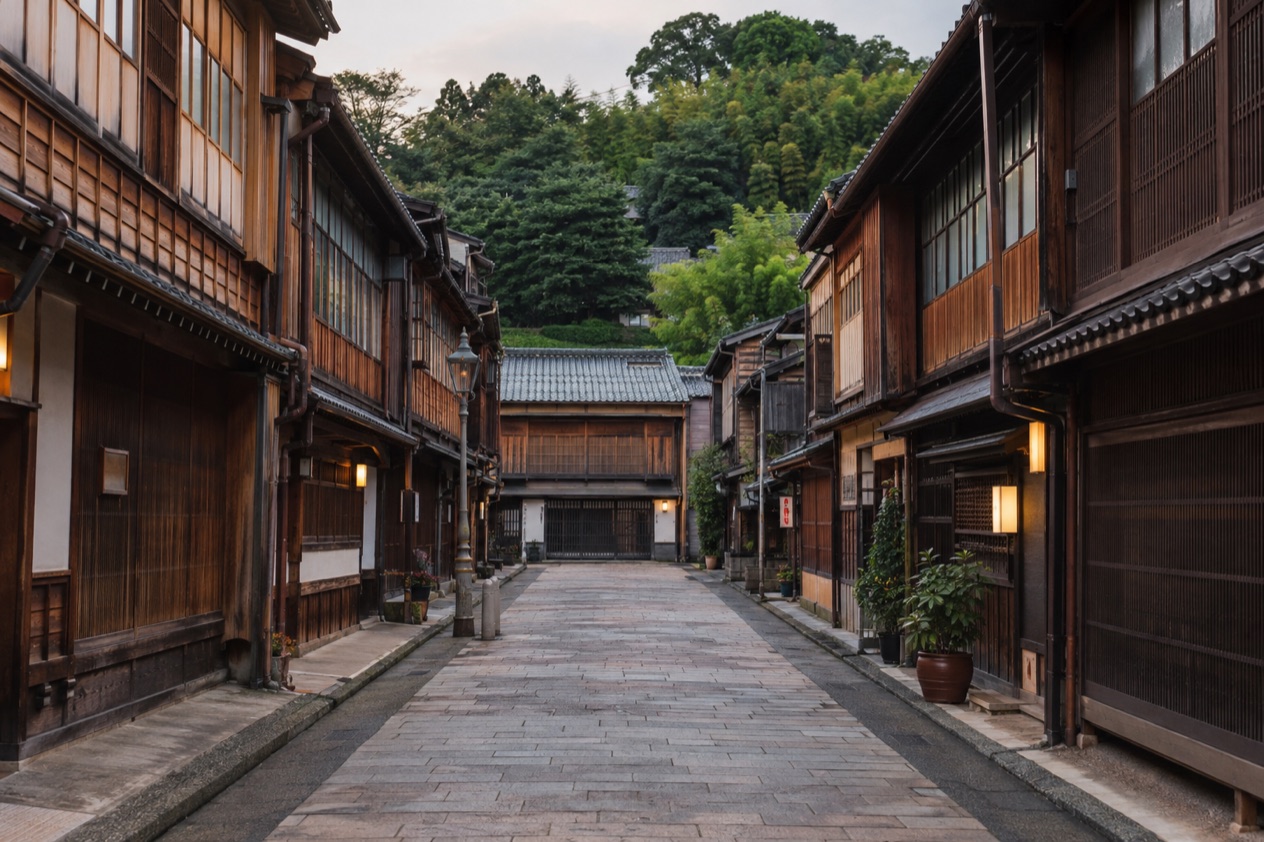
In winter, gardeners in Kanazawa lift ropes in a fan from the top of each pine at Kenrokuen, and the snow settles on them like the ribs of an umbrella. In April the same garden is pink with petals, and in the old geisha quarters the lattice fronts of the teahouses glow after dark. Kanazawa, the castle town on the Sea of Japan coast of Honshu, has a year with four clear moods, and each one suits a different trip.
When is the best time to visit Kanazawa?
Spring from April into May and autumn from October into November suit travelers, while winter suits those who come for snow and seafood. In those shoulder seasons the air is mild, the garden paths are dry enough for long walks, and the city’s main sights are most photogenic. Summer is a good fit only if you can handle heat and humidity.
For sightseeing, aim for the weeks when Kenrokuen Garden and the castle park are doing something: pink blossom around the start of April, fresh green in May, or the turning of the maples in the second half of autumn. Kenrokuen is one of the best known landscape gardens in Japan, and the Higashi Chaya teahouse district and the old samurai lanes of Nagamachi reward a slow day in any of those weeks. A day in the rain is no disaster here either, since the city has plenty of indoor craft and art stops, from gold leaf workshops to museums.
For food, winter is the season people plan around. Kanazawa sits on the Sea of Japan, and from November the tables turn to crab, buri (yellowtail), sweet shrimp and rich hot pots. Spring brings bamboo shoots and wild mountain greens, while autumn has mushrooms, persimmons and new rice. The morning market at Omicho is worth a visit in any month, and the sushi counters do not depend on the weather.
If you want more room to yourself and softer prices, look at the stretches between the big attractions: early June before the humidity peaks, late September, or the first weeks of December. Families with children often like May, when days are long and the temperatures are comfortable, and a gold leaf craft session or a stroll through the castle grounds fits a morning without a long drive. Hot August afternoons and the deep snow of January and February are the months that ask the most of small travelers.
Kanazawa weather by month
Kanazawa swings from snowy, gray winters to hot, humid summers, with a mild spring and a mild autumn in between.
| Month | Average high (°F) | Average low (°F) | Precipitation (in) | Days with 1 mm or more of precipitation | Hours of sunshine | Daylight on the 15th |
|---|---|---|---|---|---|---|
| January | 44.8 | 34.2 | 10.08 | 23.4 | 62 | 9 h 55 min |
| February | 46.0 | 33.8 | 6.40 | 18.6 | 86 | 10 h 50 min |
| March | 52.9 | 38.1 | 6.19 | 15.7 | 145 | 11 h 54 min |
| April | 63.1 | 46.8 | 5.67 | 12.0 | 185 | 13 h 05 min |
| May | 72.1 | 56.5 | 5.43 | 10.4 | 207 | 14 h 05 min |
| June | 78.1 | 65.1 | 6.70 | 10.6 | 162 | 14 h 39 min |
| July | 85.1 | 73.2 | 9.19 | 12.9 | 167 | 14 h 27 min |
| August | 88.3 | 75.4 | 7.06 | 9.3 | 216 | 13 h 36 min |
| September | 81.0 | 67.8 | 9.13 | 12.0 | 154 | 12 h 28 min |
| October | 71.2 | 57.0 | 6.97 | 12.7 | 152 | 11 h 19 min |
| November | 60.6 | 46.6 | 9.87 | 17.0 | 109 | 10 h 15 min |
| December | 50.4 | 38.3 | 11.85 | 22.6 | 69 | 9 h 41 min |
Winter here is not dry. From December to February, rain, sleet and snow fall on most days, the sky stays low and gray, and sunshine is scarce. Pack warm layers, a waterproof coat and boots with a grip, and treat any clear window as a bonus. The snow tapers off through March and is gone from the forecast by April.
Summer rain comes differently, as heavy downpours and stormy spells rather than a steady winter drizzle. July is the wettest month of the warm season, and August, with highs near ninety, is the hottest and sunniest. Light, breathable clothes, a compact umbrella and a hat will serve you better than any jacket from June through September.
Daylight shapes the plan as much as the temperature. Winter days are short, so sights close to the hotel and indoor stops make sense after the afternoon light fades, while in late spring and early summer you have a very long day to stretch across gardens, markets and the teahouse lanes. October and November sit in between, with evenings arriving early enough to make the illuminated castle park and Kenrokuen a natural part of the day.
What is there to do in Kanazawa in each season?
Spring: cherry blossoms and fresh green
The cherry trees of Kanazawa usually begin to open around April 3, and the full bloom usually lands around April 8. In recent years the bloom has come earlier, sometimes in the last days of March, so the dates move from one spring to the next. The castle park and Kenrokuen are the places to see it, with petals on the moats and on the garden ponds.
Once the petals fall, May is a pleasant month for walking. Days are long and mild, the garden is a deep green, and the rest of the city, from the Higashi Chaya lanes to the 21st Century Museum area and the Omicho market stalls, can fill a full itinerary. This is also the time for light layers: a simple sweater or jacket covers most of the spring.
Early summer rain and summer heat
June and July are the wetter part of the summer, with July bringing the heaviest rain. That is a good moment for the interior stops: gold leaf workshops, craft studios, museums and teahouse rooms where you can sit with a bowl of matcha and a sweet while the rain falls on the garden. The city is a UNESCO Creative City for crafts and folk art, so there is always something to see under a roof.
August is hot and humid, with the most sunshine of the year. It suits early starts at the market and long, cool lunches, and it is the month to leave the castle-park circuit to the evening illumination, when the grounds are lit.
Autumn color and winter snow
Autumn arrives gently, and across Japan the leaves turn from mid-November to early December. October is mild and good for walking, and the garden slowly shifts from green to red and gold. November is wetter, so a rain jacket belongs in the bag, but the colors and the first crab of the season reward the effort.
Winter is for snow, hot baths and seafood. Kenrokuen under snow, with its pines wrapped in ropes, is a sight that travelers plan the whole trip around, while the evenings belong to izakaya counters and steaming bowls of seafood stew. Leave the long garden walks for another season, since January snowfall is heavy and the days are short.
When is Kanazawa least crowded?
The calmest months are the ones with no big seasonal hook and no national holiday: early June, late September, and the weeks of early December before the year-end rush. In those weeks Kanazawa feels like a working castle town rather than a destination on a deadline.
The holiday stretches that move people across Japan are well known: Golden Week at the turn of April and May, the Obon holiday in mid-August, and New Year. The cherry blossom weeks in early April and the leaf-color weeks in November are also the moments when travelers choose to come, so the sights, the teahouse lanes and the market are likely to be livelier around those dates.
What that means in practice is simple. If you want the garden at the most photogenic moment, accept that you will share it.
If you prefer room to stroll, choose the shoulder weeks, such as the last days of May, the middle of June or the first part of December. The rain and the snow are the trade-off, so bring the right layers and plan a few indoor stops, such as a museum, a craft workshop or a long lunch of local seafood.
A midweek stay also tends to feel different from a weekend, especially in the old districts. Pick the days that suit your own calendar, and let the seasons set the mood rather than chase an empty street.
Which months should you avoid in Kanazawa?
No month is off limits, but January and February are the hardest if you want to walk outdoors, and August is the toughest for heat. The rest depends on what you want to see, and every month has its own reward.
Winter brings snow, sleet and cold rain on most days, with little sun, so the city asks for warm layers and sturdy boots. December has the most rain of the year, and January the heaviest snowfall. If you love snowy gardens, that is the draw. If you want blue skies and long walks, it is not.
Summer is hot and humid. August has highs near ninety and warm nights, and July brings the heaviest rain of the season, often as stormy downpours. September is also wet, with more than nine inches of rain in an average year, so keep a rain jacket handy through early autumn. No month can promise a dry day, so keep a flexible plan with an indoor option.
Spring and autumn are gentler. The cherry blossoms usually peak around April 8, though recent years have come earlier, so a trip planned for the bloom should leave some room on either side. Autumn leaves across Japan color from mid-November to early December, and November is wetter than October. A rainy day in either season is part of the picture rather than a reason to stay home.
Festivals and events in Kanazawa through the year
Winter: New Year and the snow season
New Year is the biggest family holiday in Japan, and in the first days of January people visit shrines for hatsumode, the first prayer of the year. Kanazawa’s shrines fill with visitors in warm coats, stalls sell hot amazake (a sweet rice drink), and the snow adds to the scene. Many families also eat osechi, the festive boxed dishes, at home.
In early February comes Setsubun, a fixed day on February 3 that marks the turn toward spring. Shrines hold bean-throwing ceremonies to chase away bad luck. Before the snow, in autumn, gardeners at Kenrokuen put up the yukitsuri, the rope supports that protect the pine branches under the weight of snow, and they stay up through the cold months as one of the city’s best-loved winter sights.
Spring and early summer: blossoms and a samurai parade
Hanami, the custom of gathering under the cherry trees, is the heart of April. People spread blue tarps under the branches in the castle park and along the rivers, share bento and sake, and stay until the evening. The park and Kenrokuen are lit after dark, so the blossoms take on another look at night.
In early June Kanazawa holds the Hyakumangoku Matsuri, a festival that recalls the arrival of the Maeda lord in the city. A costumed procession winds through the streets, with traditional music and dance, and the whole center fills with the sound of drums. It takes place usually in the first part of June, in the early days of the humid season, so bring a light rain jacket.
Summer and autumn: Obon, leaves and the first crab
In mid-August, the Obon holiday brings families home to honor their ancestors. Lanterns are lit, local dances are held in neighborhoods, and people travel across the country. In Kanazawa it is a good time to see the city at an evening pace, when the heat eases and the illuminated grounds of the castle park draw walkers.
Autumn is the season of koyo, the turning of the leaves, and in Kanazawa it comes with a food event of its own. When the crab season opens in November, restaurants and market stalls turn to the local catch, and the garden is hung with ropes again in preparation for winter. The mild days of October and the cooler days of November make this a good time to combine the two.
Sources
- Japan Meteorological Agency (JMA), Normal values 1991-2020, monthly (https://www.data.jma.go.jp/stats/etrn/view/nml_sfc_ym.php?prec_no=56&block_no=47605), station Kanazawa, elevation 6 m, checked October 11, 2026
- Computed from the date and the latitude of the place (sunrise equation, solar elevation -0.833 degrees), October 11, 2026
- Japan National Tourism Organization, Kanazawa (https://www.japan.travel/en/destinations/hokuriku-shinetsu/ishikawa/kanazawa-and-around/), checked October 11, 2026
- Kanazawa Tourist Information Guide (https://www.kanazawa-tourism.com/), checked October 11, 2026
- Wikipedia, Kanazawa, Ishikawa (https://en.wikipedia.org/wiki/Kanazawa,_Ishikawa), checked October 11, 2026
- Wikivoyage, Kanazawa (https://en.wikivoyage.org/wiki/Kanazawa), checked October 11, 2026
- Japan National Tourism Organization, autumn in Japan (https://www.japan.travel/en/guide/autumn-guide/), checked October 11, 2026
- Japan National Tourism Organization, spring in Japan (https://www.japan.travel/en/guide/spring-guide/), checked October 11, 2026
- Japan Meteorological Agency, cherry blossom first-bloom dates 2021-2026 and 1991-2020 normal (https://www.data.jma.go.jp/sakura/data/sakura003_07.html), checked October 11, 2026
- Japan Meteorological Agency, cherry blossom full-bloom dates 2021-2026 and 1991-2020 normal (https://www.data.jma.go.jp/sakura/data/sakura004_07.html), checked October 11, 2026
To plan your stay
- Things to Do in Kanazawa: Kenrokuen, Samurai Streets, Gold Leaf and Day Trips
- Where to Stay in Kanazawa: Station Area, Tea House Streets, Downtown and Ryokan Choices
- Kanazawa from Tokyo: Hokuriku Shinkansen, Komatsu Airport and a Day in the Gardens
- Know Before You Go to Kanazawa: Entry, Money, Getting Around and Local Etiquette