
Before sunrise in the cloud forest, hummingbirds already buzz around the feeders and a guide whispers that a quetzal has been spotted in the avocado trees. By afternoon the same traveler might be watching surfers at a Pacific beach while howler monkeys grumble in the palms behind. Costa Rica packs volcanoes, rainforest, two coasts and a relaxed pace into a small country, and it suits anyone who wants to spend a vacation outdoors.
What are the best things to do in Costa Rica?
The best things to do in Costa Rica are almost all outdoors: watching wildlife with a guide, soaking near a volcano, walking through cloud forest and learning to surf.
- Walk the misty trails and hanging bridges of Monteverde, where the forest is thick with orchids, ferns and hummingbirds.
- See Arenal Volcano from the trails around La Fortuna, then end the day in a hot spring.
- Look for monkeys and sloths on the forest paths of Manuel Antonio, then swim from a white-sand cove.
- Take a boat through the canals of Tortuguero, where caimans, herons and monkeys line the banks.
- Learn to surf at Tamarindo, Jaco or Samara, where schools rent boards and the waves are forgiving.
- Watch humpback whales from Uvita, where the whale-tail sandbar appears at low tide.
- Stand at the rim of Poas, where a turquoise acid lake fills the crater on a clear morning.
- Eat a casado at the Central Market in San Jose, the plate that explains everyday Costa Rican cooking.
Some of these stops need advance planning, so check each park’s official page before you go. Many travelers combine a volcano base such as La Fortuna with a cloud-forest stop and a beach town, and the country is small enough that the contrasts arrive within a day of each other.
Guides matter more here than in many places. A trained local guide spots sloths, frogs and birds that a visitor walking alone would pass without noticing, and guided walks are how most people see animals in the wild. Take a guide for at least one forest walk and the whole trip changes.
Sights and landmarks in Costa Rica
Costa Rica’s landmarks are mostly natural ones, with a small cultural core in San Jose. The capital lies in the Central Valley, where the air is mild and spring-like, and most visitors pass through within a day or two. That is enough time for its main buildings and one market.
San Jose: theater, gold and market
Among the city’s most recognizable landmarks, the National Theater is a nineteenth-century hall of marble, painted ceilings and gilded balconies where concerts still take place. Even a short look at the lobby and café gives a sense of how proud the young republic was of its coffee wealth.
Steps away, the Pre-Columbian Gold Museum sits beneath the Plaza de la Cultura. Its cases hold small animal figures, pendants and ornaments made by peoples who lived here long before the Spanish arrived. The Central Market, a covered maze of food stalls, coffee sellers, souvenir shops and lunch counters, is the natural place to eat afterward.
| Site | Notes |
|---|---|
| National Theater | Opened in 1897 |
| Pre-Columbian Gold Museum | Under the Plaza de la Cultura |
| Central Market | Covered market with lunch counters |
Arenal Volcano and La Fortuna
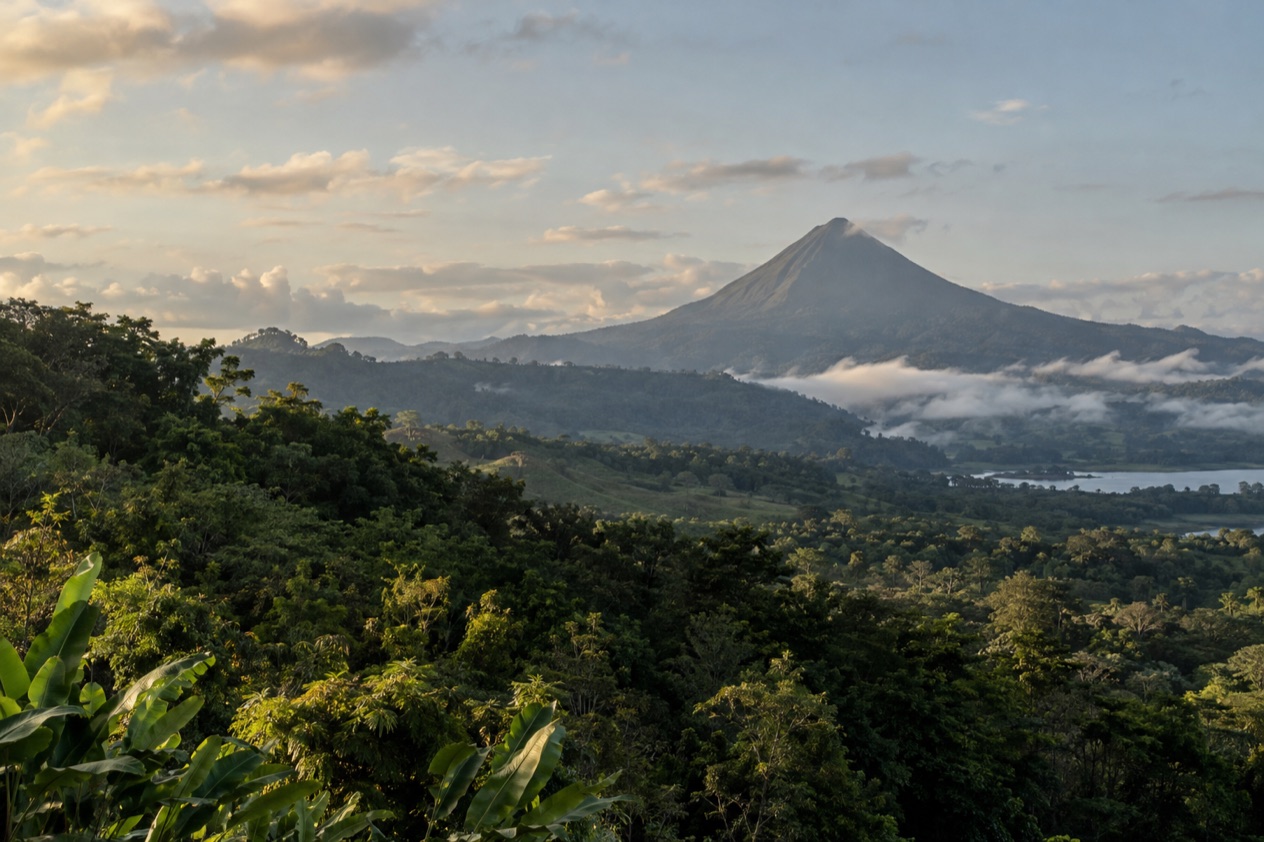
Arenal is a classic cone, the kind a child would draw. From 1968 it was active nearly without pause, and it has stayed calm since 2010, so these days people arrive for the scenery and for brief paths over ancient lava and woods instead of for blasts. On clear mornings the trails give views of the cone and of Lake Arenal.
In La Fortuna, a small town at the volcano’s foot, the waterfall drops into a green basin outside town. A long staircase leads down to it, and swimming in the pool at the bottom is a popular stop. Hot springs, hanging bridges and the lake fill the remaining days.
Poas, Irazu and the other volcanoes
Poas rises above the Central Valley within a couple of hours’ drive of San Jose and holds a large active crater with a turquoise acid lake. The summit is often clearer in the morning before clouds roll in, so an early start pays off. Irazu, the tallest active volcano in the country, sits above Cartago and can be cold and windy, with a green crater lake on clear days.
Every volcano follows its own entry guidelines, and by noon the peak is frequently obscured by clouds. Rincon de la Vieja in Guanacaste offers fumaroles, bubbling mud pots and waterfalls, while Rio Celeste turns a milky turquoise where two streams meet, reached by a trail past a waterfall. Check the park’s official page before heading to any of them.
Monteverde Cloud Forest
The Monteverde reserve protects a misty mountain forest rich in epiphytes, hummingbirds and the resplendent quetzal, a bird that visitors hope to see with a guide in the early morning. Trails wind under moss-draped branches, and the air feels cooler and damper than anywhere on the coast.
In the Santa Elena area, travelers can also walk across suspension bridges in the canopy, ride zip lines above the treetops, and take part in nighttime walks in search of frogs, insects, and birds at rest. The last stretch of road is steep, bumpy and partly unpaved, so the drive is slower than the map suggests. For the truly ambitious, Cerro Chirripo is the highest peak in the country, and climbing it is a multi-day hike with a night at a mountain hut.
Beaches and outdoor things to do in Costa Rica
The Pacific coast is a long chain of beaches from the Nicoya Peninsula in the north to the Osa Peninsula in the south, while the Caribbean coast is a quieter stretch of dark sand, canals and Afro-Caribbean towns. Waves and currents vary a lot from one beach to the next, so look at the flags and ask locally before swimming.
Manuel Antonio
Just south of Quepos, Manuel Antonio takes in hills and beaches near one of Costa Rica’s most popular parks.
Hotels and rentals climb the hill between Quepos and the park entrance along one winding road with sea views, so where you sleep decides whether you walk or take a bus to the beach. Monkeys and sloths are often seen close to the paths in Manuel Antonio.
Surf towns: Tamarindo, Jaco, Santa Teresa and Samara
Along the main street of Tamarindo, a town on the Guanacaste coast, you will find restaurants, shops and nightlife. Beginners will find the break at its beach manageable, surf schools offer board rentals along with instruction, and a brief drive north or south brings you to beaches with larger waves. Jaco, on the central Pacific, has a long dark-sand beach and works for beginners and experienced surfers alike, which makes it a classic first surf stop.
At the far end of the Nicoya Peninsula lies Santa Teresa, a barefoot town of surfers and yogis spread along an unpaved road just back from a lengthy stretch of sand, coated in dust during the dry season and in mud during the green season. Samara sits on a wide curved bay where a reef and an island offshore protect shallow water. Its gentle waves make it a draw for families and those new to surfing, while kayaking and horseback riding are simple extras.
Nosara gained its fame from Playa Guiones, a lengthy stretch of sand with dependable waves, along with the town’s yoga studios. Just down the road, Ostional ranks among the spots where olive ridley turtles show up on shore in big numbers, mainly during the green season.
Uvita and the Whale Tail
Marino Ballena National Park, which you reach through Uvita, has a beach that at low tide shapes a sandbar into a whale’s tail. Twice a year, roughly December to April and then roughly July to October, humpback whales come to this coast, giving whale watchers one of the longest windows in the world. Dolphins are also seen from boats.
Dominical and its surf beach lie a short drive north, and the Nauyaca waterfalls are a day trip inland. Sightings of animals are always a chance, never a promise, but the odds are good in season.
Caribbean beaches: Puerto Viejo and Cahuita
Puerto Viejo de Talamanca has an easygoing vibe, with Afro-Caribbean culture, reggae, bicycles and beaches like Playa Cocles and Punta Uva among its hallmarks. Just offshore from town, a wave called Salsa Brava peels over a shallow reef, and only seasoned surfers should paddle out for it.
Cahuita National Park combines a forest trail along the shore with beaches and a coral reef, and it is known for sloths and monkeys. The southern Caribbean coast has its own calendar: it is often drier in September and October and again in February and March, when the Pacific side is wet.
Day trips from Costa Rica
The most rewarding day trips start from San Jose, Jaco and the beach towns, and most are built around a volcano, a river or a patch of forest. Most travelers arrive through one of two international airports, Juan Santamaria by San Jose and Daniel Oduber Quiros at Liberia, and from either one the nearest day trips begin.
Poas Volcano from San Jose
Poas lies within a couple of hours’ drive of San Jose, which makes it the classic first volcano. The reward is a large active crater with a turquoise acid lake, often at its clearest in the morning before the clouds roll in.
It suits anyone hoping for a big crater view, though clouds can hide the summit. Bring a warm layer, since the air is cooler than in the valley, and treat the summit view as a chance rather than a certainty. Since visitor rules can shift, check the park’s official page for the latest.
Carara and the Tarcoles River from Jaco
Carara National Park lies a short drive north of Jaco, on the central Pacific coast near the Tarcoles River. This patch of transitional forest is known for scarlet macaws, often seen flying at dawn and dusk, so early morning or late afternoon is the moment to go.
The Tarcoles River bridge is a well-known place to look down on crocodiles from above. Together the two stops suit bird lovers, and a guide improves the odds in the forest.
Rio Celeste and Rincon de la Vieja
From the northwest, Rio Celeste in the Tenorio Volcano area is a river that turns a milky turquoise where two streams mix. A trail leads past a waterfall to the spot where the color changes, and the walk through the forest is half the pleasure.
Rincon de la Vieja, in Guanacaste, has fumaroles, bubbling mud pots, forest trails and waterfalls, with a summit often in cloud. Both suit walkers who like a landscape that looks unreal. Go in the morning, before afternoon showers in the green season.
Smaller outings
From La Fortuna, the hanging bridges, hot springs and Lake Arenal fill an easy day. Near Uvita, the Nauyaca waterfalls are a day trip inland, and from Samara, Playa Carrillo is a short outing along the coast. Corcovado National Park, on the Osa Peninsula, protects one of the largest tracts of lowland rainforest on the Pacific side of Central America, but it is remote and reached from Drake Bay or Puerto Jimenez, so it deserves more than a day.
What to eat in Costa Rica
Eating in Costa Rica is simple, filling and built on rice and beans. The everyday plate is a casado, with beans, plantain, salad and a protein, and the word means married, a nod to everything sharing one dish. Small family restaurants called sodas serve it at lunch to workers and visitors alike.
Gallo pinto, which means rice and beans cooked together with onion and sweet pepper, is a common breakfast, and it comes with eggs and sour cream. Fried plantain, fresh tortillas and strong coffee finish the plate. After a morning in the mountains, this is the breakfast people remember.
Markets, sodas and fruit
San Jose’s Central Market is the classic stop for a first taste of casados and fresh fruit, with coffee sellers and small lunch counters packed into its covered lanes. Wander slowly, point at what looks good and sit at the counter. Fruit stands also sell pineapple, mango and papaya cut to order, a good cooling snack on a warm afternoon.
Beach towns add ceviche, grilled fish and fruit smoothies called batidos, often made with milk or water. On the Caribbean side, the cooking of Afro-Caribbean communities brings coconut, spice and rice and beans cooked in coconut milk. Puerto Viejo is the place to look for it.
Coffee and drinks
Costa Rican coffee grows in the highlands and is poured at nearly every breakfast, often through a cloth filter at a cafe. Tropical fruit juices are everywhere, and a cold local beer suits the end of a hot day on the coast. Dollars are widely accepted in tourist areas, though change often comes back in colones.
A sales tax and a service charge typically show up on restaurant bills, which means any added gratuity is optional, not required. Many travelers leave a little extra for especially good service.
Things to do in Costa Rica at night
Evenings in Costa Rica are quiet and nature-driven rather than loud, and they start early because the sun sets early all year. In the mountains, a guided night walk is the main event, with a flashlight and a guide pointing out frogs, insects and sleeping birds. Monteverde is the most popular place for it.
Wildlife after dark
At Tortuguero, a night walk to see nesting turtles is done only with a licensed guide. Leatherbacks do their nesting earlier in the year, while green sea turtles mostly nest from around July through October. A sighting is a chance, never a promise, but the experience of watching one come ashore stays with people.
Near Nosara, Ostional beach draws olive ridley turtles in large numbers, mostly in the green season. Back at the lodge, the sounds of the forest at night, with frogs and insects, are a show of their own.
Beach-town nights
Along its main street, Tamarindo offers shops, restaurants and nightlife, while the liveliest night out on the central Pacific comes from Jaco’s bars and restaurants. Surf towns fill at sunset with people watching the sky color over the water, then settle into dinner and drinks.
Santa Teresa and Nosara are more laid-back, with small cafes, yoga studios and open-air restaurants. Puerto Viejo has reggae in its bars and bicycles gliding along dark roads. The Costa Rican phrase pura vida fits these evenings well.
San Jose evenings
In the capital, the National Theater is the evening highlight when it has a concert or performance on. The center is better for dinner than for late wandering, so many visitors eat early and head to their hotel. Petty crime is common in the country, so keep valuables out of sight when you walk after dark.
Things to do in Costa Rica with kids
Children usually love Costa Rica because the animals are real and close. Around Manuel Antonio, monkeys, sloths, iguanas and raccoons are commonly seen, while a family can look for wildlife on a boat ride through the canals of Tortuguero. Visitors are asked not to feed the animals, which is a good rule to teach kids early.
Easy waves and calm water
Families love Samara, where a broad curving bay sheltered by a reef and an island offshore offers mellow waves that suit surfers on their first try. Kayaking and horse riding give older children something to do after the beach.
Even at gentle beaches, look at the flags and keep children close. Tamarindo and Jaco give lessons for beginners.
Animals, bridges and waterfalls
Hanging bridges in Monteverde and La Fortuna let children walk through the canopy, and the La Fortuna waterfall has a long staircase down to a green basin. The climb back up is tiring, so go at a child’s pace and bring water.
Near Jaco, the crocodiles seen from the Tarcoles River bridge are a hit, and Carara’s scarlet macaws fly at dawn and dusk. A guide can point out frogs and butterflies that kids would never spot alone.
Keeping things comfortable
Distances are short on the map but slow on the road, especially the steep, partly unpaved last stretch to Monteverde and the long trip to Santa Teresa, so plan travel days with snacks and patience. Sun is strong on the coast, and the Central Valley and high volcanoes can be cool and windy, so pack layers and sunscreen.
Irazu is cold and windy at about 11,260 feet, so children need warm clothes there. Plan fewer stops per day than you think you need.
Good to know before you go
The U.S. State Department rates Costa Rica Level 2, ‘Exercise increased caution,’ due to crime; it says petty crime is common throughout Costa Rica and that violent crime also affects tourists, including armed robbery, homicide and sexual assault.
Travel means combining flights to San Jose or Liberia with drives, and since volcanic mountains divide the two coasts, spots just an hour apart may see completely different weather. The Pacific side and the Central Valley have a green season from about May to November, while the Caribbean side gets rain all year. Costa Rica stays on UTC-6 all year, and American plugs work without an adapter.
In tourist areas, you can generally pay with U.S. dollars, while the colon serves as the local currency. The Atlantic hurricane season is worth a thought when you plan Caribbean-side travel.
Sources
- U.S. Department of State, Costa Rica Travel Advisory, issued April 1, 2026 (https://travel.state.gov/content/travel/en/traveladvisories/traveladvisories/costa-rica-travel-advisory.html), read via the State Department open data API on October 8, 2026
To plan your stay
- Best Time to Visit Costa Rica: Dry and Green Seasons, Weather by Region and Festivals
- Where to Stay in Costa Rica: Beach Towns, Cloud Forest, Volcano Views and Which Base Fits Your Trip
- Costa Rica Airports: San Jose or Liberia? Beaches, Drive Times and Getting to Your Hotel
- Know Before You Go to Costa Rica: Entry Rules, Money, Getting Around and Local Customs