
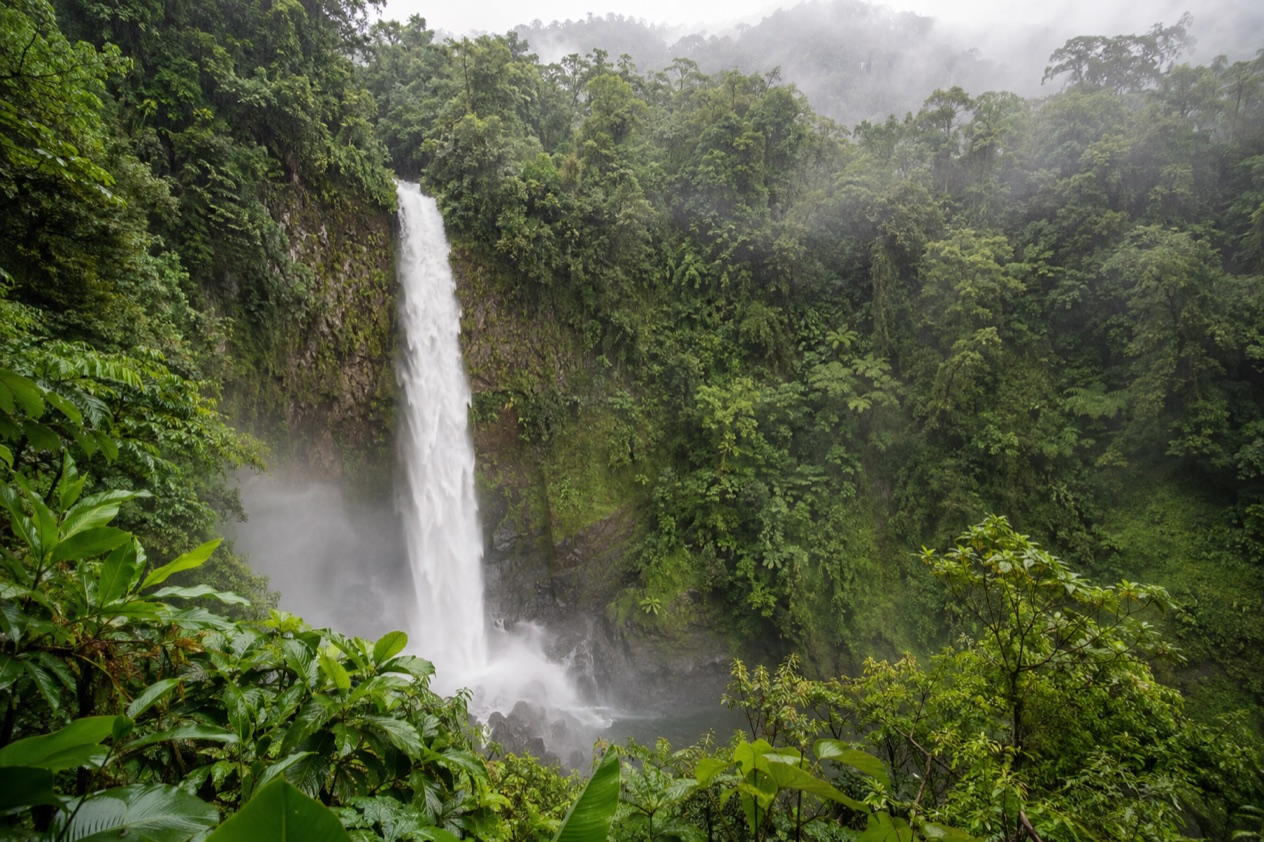
You hear the La Fortuna Waterfall before you see it: a steady rumble coming up through the trees, and a cool, damp breath of air that rises the closer you get to the edge of the gorge. Then the forest opens and the water appears, a white ribbon falling into a deep green basin. This is a visit built around one view, one long staircase and one swim, and it fits comfortably into a morning or an afternoon in the Arenal area.
Few travelers going to La Fortuna skip it, and the reason is simple: it is the picture people have in mind when they think of the town, and it delivers more than the photographs suggest.
Is visiting the La Fortuna Waterfall worth it?
Yes, for almost anyone who is comfortable on stairs and likes the idea of swimming in a forest pool at the end of a walk. It suits first-time visitors to the Arenal area best, because it gives you the whole northern lowlands in miniature: the wet green forest, the volcano country around you and a reward at the bottom.
La Fortuna is the main base for hot springs, hanging bridges and the lake, and each of those is a different kind of outing. The hot springs are about soaking and unwinding, the bridges are about walking high among the treetops, and the lake is about open water and big views.
The waterfall is the one that puts you at the foot of the falling water itself. You arrive from above, go down into the basin, and end up standing in the spray with the cliff rising around you. That descent is what sets it apart from a viewpoint where you simply look and leave.
It is also close to town, since the falls lie just outside La Fortuna. That makes it an easy piece of a day rather than a whole expedition.
You can pair it with a springs soak the same evening, or pick it as the one active thing before a lazy afternoon in the town’s cafés. Travelers with young children or limited mobility should think about the climb back up before committing, because the staircase works in both directions and the return is the harder half.
It is worth less for anyone who wants solitude. A famous waterfall near a popular town draws tour groups, and the pool at the bottom is a social place. Go with that in mind and you will enjoy the lively atmosphere. Go hoping for a private forest pool and you may be let down.
What to see at the La Fortuna Waterfall
The staircase and the first view
The visit begins at the top, where the path leads to the long staircase that drops toward the basin. Early glimpses come through gaps in the trees, so you get the falls in pieces, a flash of white, then a bend, then another angle, before the full sight arrives. The forest on either side is thick and wet, with ferns, big-leaved plants and the occasional bird calling from the canopy.
Take the steps slowly. The staircase is the real work of the visit, and the best moments come at the landings where you can stop, look up at the cliff and catch your breath. The air cools noticeably as you descend, which is a pleasant contrast with the warm lowland afternoon above.
The basin and the plunge pool
At the bottom, the waterfall drops into a green basin ringed by rock and forest. Standing near it, you feel the mist on your face and the low thunder of the water in your chest. The color of the pool shifts with the light and the recent rain, from a deep jade to a milky blue-green, and the cliff wall behind the falls is draped in moss and hanging plants.
Swimming in the pool at the bottom is a popular stop, and many visitors make it the highlight of the trip. Follow posted instructions and staff guidance around the pool, especially near the falls. Many people simply wade, cool off and take photographs from the rocks.
The river below the falls
Water leaving the basin continues downstream as a rocky, tree-lined river. Even if you do not go far, it is worth a few minutes to watch it spill over boulders and curve away into the forest. The sound changes from the roar of the falls to a quieter rush, and the light filters through leaves in a way the open basin does not.
This is a good place for a rest before the climb. Sit on a dry rock, let your clothes begin to dry, and look for butterflies and dragonflies at the water’s edge. Birds often work the river banks at quieter hours, and the wetter the day, the greener everything looks.
The volcano country around it
The falls sit in the northern lowlands, in the shadow of the Arenal Volcano, whose cone dominates the horizon around La Fortuna when the clouds lift. You will not see it from the bottom of the gorge, but on the way in and out the landscape of pasture, forest and distant peak explains why this town grew up as a base for so many outings. Clouds often hide the summit, so treat any view of it as a bonus rather than something to count on.
Hours, tickets and rules
Check the waterfall operator’s current opening hours, ticket price and rules before you go.
What you do at the bottom is straightforward. Swimming in the pool is a popular stop, so bring a swimsuit under your clothes and a towel in your bag. The waterfall is reached by a long staircase down to the basin, and the return climb is part of the visit.
For guided outings of any kind, the Costa Rica Tourism Institute (ICT) provides a list of Certified Tour Guides, which is the reference to use when choosing someone to lead you.
How to get to the La Fortuna Waterfall
The falls lie just outside the town of La Fortuna, so the town is the natural starting point. Nearly everyone staying in the Arenal area bases themselves there, among the hotels, restaurants and tour offices that line the streets beneath the volcano. Use La Fortuna as your starting point and confirm your route and transportation to the waterfall entrance before leaving town.
Because the waterfall is so close to La Fortuna, you can fit it into a day without much planning. A morning visit followed by lunch in town works well, and so does an afternoon visit before a springs soak. If you are staying farther away, confirm the route from your lodging to the entrance before setting out.
At the entrance, everything is on foot. The path leads to the top of the long staircase, and that staircase is the only route down to the basin. Wear shoes with grip, since the steps and the landings can be wet, and plan for the walk back up as part of the same outing. For anyone who finds stairs difficult, this is the point to decide, before you start down.
When to visit the La Fortuna Waterfall
Early in the day is the usual advice, and it holds up here. Mornings are cooler for the staircase, the light is gentler in the basin, and the crowds are thinner before the tour groups arrive. Afternoons bring more people and, in the wetter months, a good chance of rain, which can make the steps slick and the water in the pool murkier and stronger.
The area is green all year, but the character of a visit changes with the season. The drier part of the year, around the early months and into spring, tends to give clearer, more settled days, while the middle and later part of the year is the rainy season, with showers on most days. In the wettest months the falls run full and loud and the forest is at its lushest, but you should expect to get wet before you even reach the water.
| Month | Average high (°F) | Average low (°F) | Rain days | Precipitation (inches) |
|---|---|---|---|---|
| January | 77.6 | 67.1 | 12.9 | 8.26 |
| April | 83.8 | 69.5 | 7.2 | 3.09 |
| July | 79.4 | 70.2 | 25.2 | 12.51 |
| October | 79.9 | 70.1 | 26.0 | 14.00 |
April is the driest of these four months and the warmest, which makes it the most comfortable for the staircase and a swim. January sits in between, with a fair number of showery days but plenty of dry hours.
July and October are the months of near-daily rain, usually arriving as downpours that pass, with gray stretches in between. October in particular is deep in the green season, so a visit then means rain gear, quick-drying clothes and flexible timing.
None of this rules out a rainy-month trip. The temperatures stay warm all year, so a shower on the way down hardly matters when you are heading for a swim anyway. Just aim for the morning, keep a dry set of clothes for afterward and treat any clear spell as a gift.
Tips for your visit
Pack light but smart. A swimsuit worn under your clothes, a quick-drying towel, sunscreen, a hat and a refillable water bottle cover most of what you need. Sandals with a heel strap or closed shoes with good tread are better than flip-flops for the staircase. A small dry bag or a plastic bag for your phone and wallet is useful near the spray, and a change of clothes waiting in the car or the bag makes the trip back to town far more pleasant.
Plan on a relaxed outing rather than a rush. The staircase down, a swim and a rest by the water, and the climb back up fill a good part of a morning, and the visit is better when you do not watch the clock. Give yourself pauses on the way up, because the return is where most people feel it.
The waterfall combines easily with the other things La Fortuna is known for. A hot springs soak in the evening is the classic pairing, since warm water feels especially good after the climb. The hanging bridges make a natural second outing on another morning, and the lake gives you a quieter, wider-open day. Together they make a full, varied stay without long transfers between them.
For families, the main question is how well children handle a long staircase and a wet, rocky edge. Older children who enjoy a walk and a swim usually love it. Small children will need a hand on the steps and close attention near the water.
Travelers with limited mobility should think carefully before going down, since the only way back is up the same stairs. If you want help finding someone to lead a wider outing in the area, the ICT list of Certified Tour Guides is the place to start.
Good to know before you go
The U.S. State Department rates Costa Rica Level 2, ‘Exercise increased caution,’ due to crime; it says petty crime is common throughout Costa Rica and that violent crime also affects tourists, including armed robbery, homicide and sexual assault.
Keep your belongings close and your valuables to a minimum because petty crime is common throughout Costa Rica. Bring a little cash and a card for the town, and keep your phone in a waterproof pouch. The rainy months run alongside the Atlantic hurricane season, so in the wetter part of the year it is worth following the forecast for your dates and keeping your plans flexible.
Sources
- Open-Meteo / ECMWF ERA5, normals 1991-2020 computed for the grid cell at 10.4679N 84.6427W, checked October 8, 2026
- U.S. Department of State, Costa Rica Travel Information, Safety and security (https://travel.state.gov/content/travel/en/international-travel/International-Travel-Country-Information-Pages/CostaRica.html), checked October 8, 2026
- U.S. Department of State, Costa Rica Travel Advisory, issued April 1, 2026 (https://travel.state.gov/content/travel/en/traveladvisories/traveladvisories/costa-rica-travel-advisory.html), read via the State Department open data API on October 8, 2026
To plan your stay
- Best Time to Visit La Fortuna: Dry Months, Rainy Season, Arenal Volcano and Festivals
- Where to Stay in La Fortuna: Town Center, Volcano Road, Hot Springs Strip and Lake Arenal
- La Fortuna vs Monteverde: Hot Springs, Cloud Forest, Weather and Which to Choose
- La Fortuna in January: Weather, Hot Springs and What to Do Near Arenal