
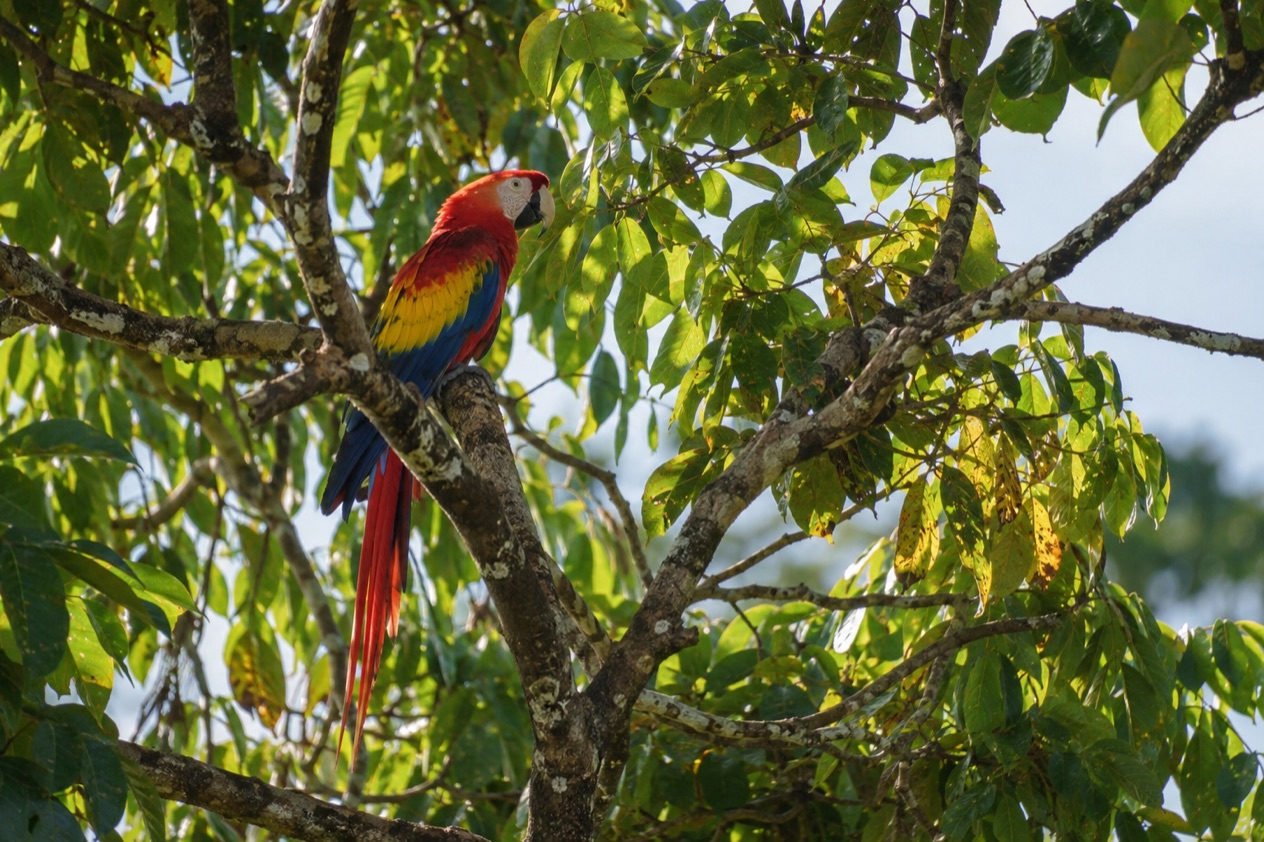
Just after dawn on the central Pacific coast, the forest at Carara fills with the raucous, rolling calls of scarlet macaws crossing the canopy in pairs, flashes of red, yellow and blue against green. Under the trees the air is damp and shaded, full of insect hum and the rustle of leaf litter. Carara is a bird-watcher’s park and a gentle introduction to Costa Rican rain forest, an easy stop between San Jose and the beaches around Jaco.
Is visiting Carara National Park worth it?
Yes, especially if you want to see birds and real forest without committing to a long trek or a remote lodge. Carara suits birders, families, photographers, and anyone driving the coast who wants one morning among tall trees before reaching the beach. It is less suited to travelers who expect a big-cat-and-volcano adventure or a full day of swimming.
What sets it apart from other parks along the Pacific is its position. Carara protects the only transitional forest in the Central Pacific, where species from the drier forests to the north and the wetter rain forests to the south meet. That mix is why the bird list is so rich, and why the park is a world-renowned ornithological destination, above all for the endangered scarlet macaw.
Carara is a short drive north from Jaco and roughly an hour and a half from San Jose. The name itself comes from the Huetar language and means river of lizards, a fitting nod to the crocodiles you can see from the nearby river bridge.
Many visitors pair the forest with the Tarcoles River bridge, a well-known spot to look down on crocodiles lying on the sandbanks. The two stops together make a satisfying half day of wildlife.
What to see at Carara National Park
Scarlet macaws
The macaws are the reason most people come. They are often seen flying at dawn and dusk, moving between roosting and feeding areas, and you usually hear them before you spot them: loud, cackling and impossible to mistake. Look up through gaps in the canopy and along the edges of the forest, where they travel in pairs, their long red tails trailing behind.
Sightings are a chance, never a promise. Binoculars help a great deal, and a quiet pace on the trail improves your odds. Dusk flights are often easier to catch from open areas near the park than from deep inside the trees, where the canopy hides everything.
The transitional forest
Walking the trails here, you pass through a forest that behaves like two at once. Species typical of dry forest stand alongside rain forest trees, so the vegetation changes in character over short distances: buttressed giants, vines hanging in loops, palms and a thick understory. Leaf-cutter ants stream across the path in long columns, and the forest floor is busy with small life.
Look for monkeys, agoutis, lizards and a changing cast of forest birds as well. Many animals stay hidden, so a slow walk with a pause every few minutes pays off more than covering ground. A certified guide can spot and name far more than most visitors manage alone.
The universal access path
Carara is the first national park in Costa Rica with a universal access path, built so that all visitors can experience the forest. It is the natural choice for wheelchair users, travelers with limited mobility, grandparents and families with strollers who still want to be among the trees.
Along it you can see endemic species such as the giant cafecillo, a towering tree that shows how big the forest really is. The path lets you take in the shade, the sounds and the details of the understory at an unhurried pace, which makes it a good first walk even for those who plan to try other trails afterward.
The Tarcoles River bridge
Not inside the park, the bridge over the Tarcoles River is a well-known place to look down on crocodiles resting on the banks and mudflats. The main park entrance lies a couple of miles south of it on the road toward Jaco, so the two fit naturally into one outing.
Stay on the bridge and watch from above, as most people do. Early or late light is kinder for photographs, and you will often see a handful of large animals lying motionless, plus shorebirds working the edges of the water.
Hours, tickets and rules
The park is open every day, with slightly later opening in the rainy months. Entry requires an online reservation, made through the national park service’s online portal, so plan it before you arrive rather than on the spot.
| Site | Open | How to book |
|---|---|---|
| Carara National Park, December to April | 7 a.m. to 4 p.m. daily | Online reservation required |
| Carara National Park, May to November | 8 a.m. to 4 p.m. daily | Online reservation required |
For hiking in national parks, the guidance is to register with the park, hold an entry permit and use a certified tour operator. The Costa Rica Tourism Institute keeps a list of Certified Tour Guides, which is the place to start if you want a guide for the trails. The reservation portal is at serviciosenlinea.sinac.go.cr.
How to get to Carara National Park
Carara sits on the Costanera Sur highway, about 56 miles from San Jose, and the trip takes about an hour and a half. The park spans the Turrubares and Garabito cantons, in the provinces of San Jose and Puntarenas, so you cross a provincial line as you approach.
The main entrance is 1.2 miles south of the Rio Grande de Tarcoles bridge, on the road to Jaco. Coming from the capital, you reach the bridge first, with its crocodile viewing, then continue a short way south to the park. This order makes it easy to stop at the river on the way in.
From Jaco, the park lies a short drive north. That makes it an easy morning outing from the beach town, and just as simple to include on a transfer between San Jose and the coast. Arrive with your reservation already in hand, since entry depends on it.
When to visit Carara National Park
Go early. The park opens at 7 a.m. in the dry months and at 8 a.m. in the rainy ones, and the first hours bring the coolest air and the most bird activity. Macaws are often seen at dawn and dusk, so the opening hour is your best bet for flights overhead. Midday turns hot and still, and the forest quiets down.
The dry season, December to April, is the easier time for walking. January in the Jaco area still sees showers on many days, though they are usually light, and April is wetter than January, with rain on most days. The green season brings more water and heavier downpours: July and October both see rain almost daily, and several days a month bring a real soaking, usually in the afternoon.
That makes morning the sensible hour in any month. Rainy-season visits have their own rewards, including lusher forest and fewer people on the trails, but bring a rain layer and expect mud. October falls within the Atlantic hurricane season, though Carara sits on the Pacific side, where afternoon rain is the pattern to plan around.
Tips for your visit
Bring binoculars, water, a rain jacket, insect repellent, sunscreen and closed shoes with good grip. The forest is humid in every month, so light, quick-drying clothing is more comfortable than heavy fabric. A small daypack is plenty, and a camera with a zoom will do more for you than a wide lens.
Plan a morning for the park itself, then add the Tarcoles River bridge on the way. Jaco is close enough that you can finish at the beach, and many travelers fit the park between San Jose and the coast. A certified guide is worth considering if you want help finding birds and animals, and the tourism institute lists those who are certified.
Families will find the universal access path the simplest way into the forest, and it suits visitors with limited mobility as well. Walk quietly, keep voices low and stop often to listen.
Good to know before you go
The U.S. State Department rates Costa Rica Level 2, ‘Exercise increased caution,’ due to crime; it says petty crime is common throughout Costa Rica and that violent crime also affects tourists, including armed robbery, homicide and sexual assault.
Petty theft is common throughout Costa Rica. Carry only what you need on the trail, and take sunscreen and water with you. Hurricane season in the Atlantic runs through the autumn, so check forecasts when traveling in those months and expect rain on the Pacific side in any green-season month.
Sources
- Costa Rica Tourism Board (ICT), Carara National Park (https://visitcostarica.com/where-to-go/protected-areas/carara-national-park), checked October 8, 2026
- SINAC (Costa Rica national parks authority), online reservations (https://www.sinac.go.cr/ES/resvlinea/Paginas/default.aspx), checked October 8, 2026
- Open-Meteo / ECMWF ERA5, normals 1991-2020 computed for the grid cell at 9.6145N 84.6285W, checked October 8, 2026
- U.S. Department of State, Costa Rica Travel Information, Safety and security (https://travel.state.gov/content/travel/en/international-travel/International-Travel-Country-Information-Pages/CostaRica.html), checked October 8, 2026
- U.S. Department of State, Costa Rica Travel Advisory, issued April 1, 2026 (https://travel.state.gov/content/travel/en/traveladvisories/traveladvisories/costa-rica-travel-advisory.html), read via the State Department open data API on October 8, 2026
To plan your stay
- Best Time to Visit Costa Rica: Dry and Green Seasons, Weather by Region and Festivals
- Where to Stay in Costa Rica: Beach Towns, Cloud Forest, Volcano Views and Which Base Fits Your Trip
- Costa Rica Airports: San Jose or Liberia? Beaches, Drive Times and Getting to Your Hotel
- Know Before You Go to Costa Rica: Entry Rules, Money, Getting Around and Local Customs