
On a clear morning above the Central Valley, the clouds peel back from the rim of Poas and a turquoise lake appears, steaming gently, while the air smells faintly of sulfur. Costa Rica packs volcanoes close to its main tourist routes, from the cloud forests above San Jose to the hot, bubbling slopes of the northwest. Visiting one is a half-day or full-day outing that suits almost any traveler.
Which volcanoes can you visit in Costa Rica?
Four volcanoes sit near the routes most visitors travel: Arenal near La Fortuna, Poas and Irazu above the Central Valley, and Rincon de la Vieja in the northwest, with the Tenorio area and its famous river as a fifth stop. Each one has its own access rules, and the clouds often hide the summit by midday, so the day is usually planned around an early start.
Poas and Irazu above the Central Valley
Poas rises within a couple of hours’ drive of San Jose, which makes it the easiest volcano to fit into a stay in the capital. Its big draw is a large active crater holding a turquoise acid lake, with steam drifting off the water. The summit is often clearer in the morning before the clouds roll in, so mornings are the time to aim for.
Irazu, above Cartago, is the tallest active volcano in the country. The crater area can be cold and windy, so a jacket and a hat matter more than they seem to from the warm valley below. On clear days a green crater lake shows in the bowl, and the landscape of gray ash and low scrub feels more like another planet than the rest of the country.
Many travelers pair the two with a coffee farm or the colonial feel of Cartago, since both sit in the same highland region. Plan for one volcano per day, because the drives are slow and the weather decides how long you linger at the rim.
Arenal near La Fortuna
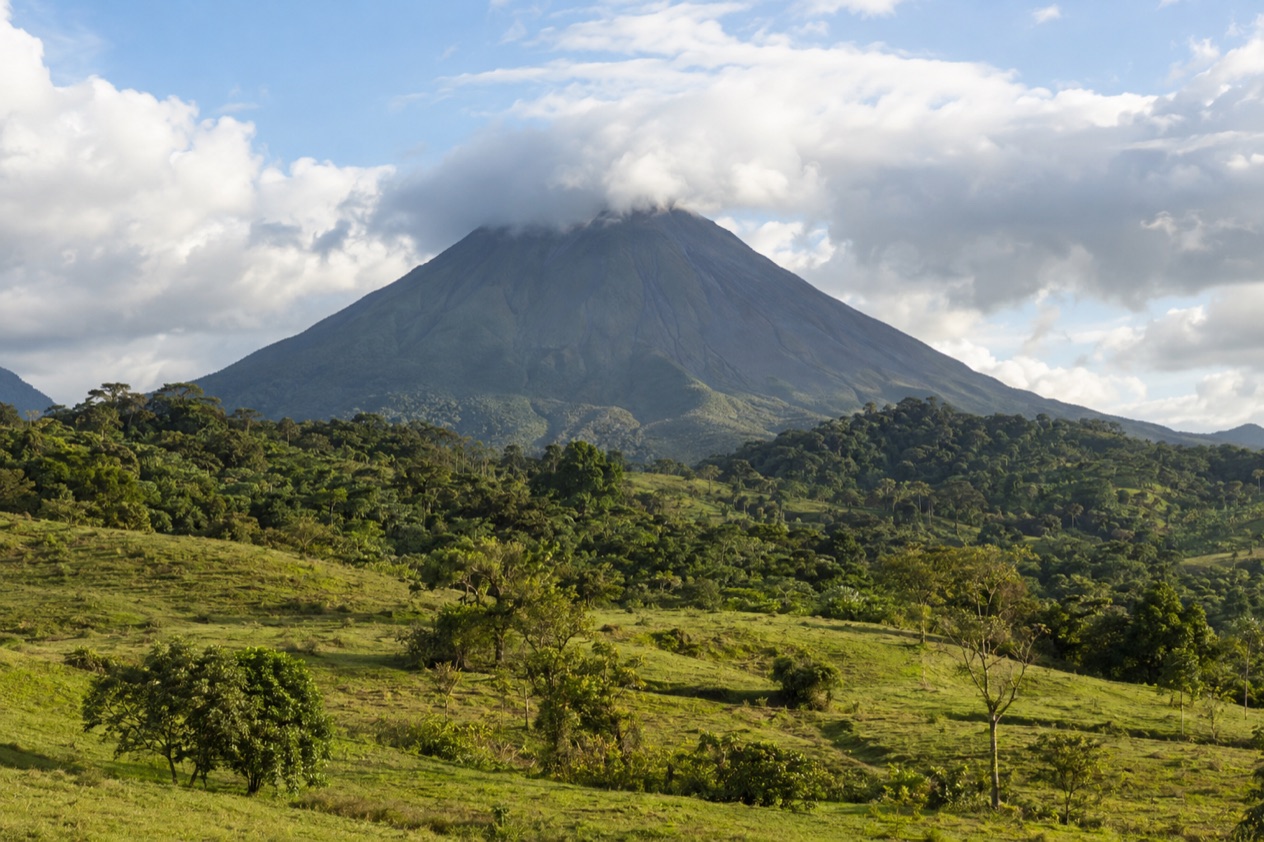
Arenal Volcano National Park lies near La Fortuna and has short trails across old lava flows and forest. On clear mornings you get views of the perfect cone and of Lake Arenal stretching out beside it. The walks are easy enough for most families and pair naturally with the hot springs and waterfalls that La Fortuna is known for. Bring a rain layer, since the cone likes to wear a cap of cloud, and treat any view of the summit as a bonus rather than a promise.
Rincon de la Vieja and the Tenorio area
Rincon de la Vieja, in Guanacaste, is a volcano you experience at ground level. Its national park has fumaroles, bubbling mud pots, forest trails and waterfalls, while the summit itself is often in cloud. It suits travelers who like to walk and who enjoy odd geology more than a postcard crater.
In the Tenorio Volcano area, the Rio Celeste turns a milky turquoise where two streams mix. A trail leads past a waterfall to the spot where the color changes, and it is one of the most photographed walks in the country. Wear shoes with grip, because forest paths in this region stay damp.
Which Costa Rica volcano is best to visit?
The best volcano depends on what you want to see: Poas for a classic crater and lake close to San Jose, Arenal for the cone and a base in La Fortuna, Irazu for height and big views, and Rincon de la Vieja for hiking among steaming vents and waterfalls.
If you want a crater and a lake
Poas is the pick when time is short. You can reach it within a couple of hours of San Jose, look into an active crater with a turquoise acid lake, and be back in the city for dinner. Go early, because the clouds tend to roll in as the day goes on and can close the view entirely.
Irazu offers a similar crater experience with a different mood. It is higher and colder, with a green lake on clear days, and it works well for travelers staying in or near Cartago who prefer a quieter, windswept landscape.
If you want a cone, forest and a base town
Arenal is the classic volcano shape, the one children draw. The park gives you short trails over old lava flows and through forest, and La Fortuna around it offers plenty to do on the same trip, from hot springs to waterfalls. It is the best choice for families and for anyone who wants a few days in one place rather than a single outing.
Think of Arenal as a landscape visit more than a spectacle. People come for the view and the walks, and a clear morning rewards an early start.
If you want to hike and see the earth at work
Rincon de la Vieja suits active travelers. Fumaroles and bubbling mud pots give the park a raw, living feel, and the forest trails lead to waterfalls. Pair it with the Rio Celeste trail in the Tenorio area if you want the turquoise river as well. Both are walking days, so good shoes and a rain layer make the experience far more comfortable.
Is Arenal still active?
Arenal is quiet now: it erupted almost continuously from 1968 and has been quiet since 2010, so visitors come for the view and the walks over old lava flows rather than for eruptions.
That change reshaped the visit. Decades ago people gathered at night hoping to see glowing rock tumble down the slope, and La Fortuna grew around that spectacle. Today the cone is still a striking sight, and the draw is the scenery, the forest and the lake rather than any display of fire.
What a visit looks like today
Arenal Volcano National Park has short trails across old lava flows and forest. Walking over the hardened flows gives you a feel for how the mountain built its slopes, and the forest edges are good places to listen for birds. On clear mornings you may get views of the cone and of Lake Arenal beyond it.
Clouds often settle on the summit later in the day, so the morning is the time to hope for an open view. If the cone stays hidden, the lava flows, the forest and the surrounding lake country still make a pleasant outing.
Making a day of it around La Fortuna
La Fortuna is the town that serves as the base, with restaurants serving casado (a plate of rice, beans, salad and a main) and plenty of places to soak after a day on foot. A good rhythm is a morning walk near the volcano, a long lunch, and an easy afternoon in the area. If rain sets in, which it can in the green season, the day shifts naturally to hot springs and cafes, where rain is part of the atmosphere rather than a spoiler.
Do you need to reserve to visit a volcano?
Yes, for the main volcano parks. Poas requires online reservation, Irazu requires online reservation for Sector Prusia and Sector Cráteres, Tenorio requires online reservation, and Rincon de la Vieja requires online reservation.
In practice this means choosing your volcano before you travel and securing your entry online, rather than counting on turning up at the gate. It also helps you plan the day around the weather, since mornings are when summits are most likely to be clear.
| Park | Online reservation |
|---|---|
| Poas Volcano National Park | Required |
| Irazu Volcano National Park (Sector Prusia and Sector Cráteres) | Required |
| Tenorio Volcano National Park (Rio Celeste) | Required |
| Rincon de la Vieja National Park | Required |
Planning around the rules
Rules at national parks change, so the park’s official page is the place to confirm the current system before you go. Look there for the details of how your visit is arranged, and book with your chosen day in mind.
Because several of these volcanoes sit in different regions, many travelers build a route that links them: the highland pair near the capital, then Arenal, then the northwest. Reserving each stop first turns the trip into a simple chain of mornings.
Good to know before you go
The U.S. State Department rates Costa Rica Level 2, ‘Exercise increased caution,’ due to crime; it says petty crime is common throughout Costa Rica and that violent crime also affects tourists, including armed robbery, homicide and sexual assault.
Volcano summits can be cold, windy and wet even when the lowlands are warm, so layers and a rain jacket belong in the day bag. Clouds often hide the top by midday, which is why early starts pay off.
Keep valuables out of sight in parked cars, since petty crime is common throughout the country, and carry water and a snack, as facilities at park entrances vary. The Atlantic hurricane season can bring days of heavy rain, so flexible plans help.
Sources
- SINAC (Costa Rica national parks authority), online reservations (https://www.sinac.go.cr/ES/resvlinea/Paginas/default.aspx), checked October 8, 2026
- U.S. Department of State, Costa Rica Travel Advisory, issued April 1, 2026 (https://travel.state.gov/content/travel/en/traveladvisories/traveladvisories/costa-rica-travel-advisory.html), read via the State Department open data API on October 8, 2026
To plan your stay
- Best Time to Visit Costa Rica: Dry and Green Seasons, Weather by Region and Festivals
- Where to Stay in Costa Rica: Beach Towns, Cloud Forest, Volcano Views and Which Base Fits Your Trip
- Costa Rica Airports: San Jose or Liberia? Beaches, Drive Times and Getting to Your Hotel
- Know Before You Go to Costa Rica: Entry Rules, Money, Getting Around and Local Customs