
Before the sun is fully up in Carara, scarlet macaws cross the sky in noisy pairs, red and yellow against the green, while howler monkeys groan somewhere deep in the canopy. Costa Rica packs rainforest, Caribbean canals, Pacific beaches and cloud forest into a small country, and the animals live in all of them.
Where can you see sloths in Costa Rica?
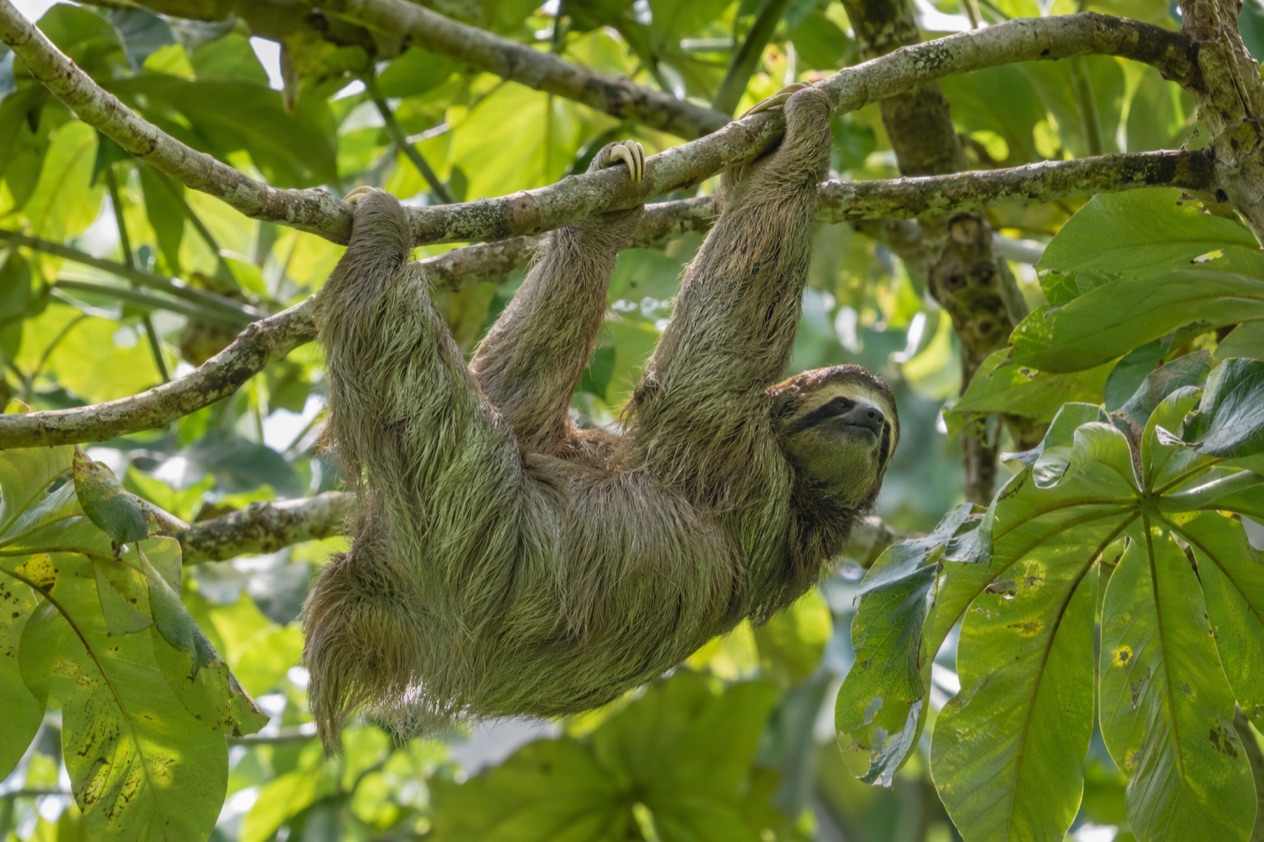
Sloths turn up in the Caribbean forests around Cahuita and in the park and gardens near Manuel Antonio on the Pacific side, and a local guide will find far more of them than you will walking alone. They are slow, gray-brown and often curled into a fork of a tree, so they look like a clump of leaves until someone points a scope at them.
Cahuita National Park on the Caribbean coast
Cahuita combines a forest trail that runs along the shore with beaches and a coral reef, and it is known for sloths and monkeys. The walk is flat and shaded, with the sea sounding just beyond the trees, so you can move at the pace of someone looking up the whole time.
Go early, when the forest is still cool and the animals are easiest to notice. Look for the odd, rounded shape high in the branches of the cecropia trees, and for the troops of monkeys that often announce themselves by rustling leaves overhead. Bring water and bug repellent, and keep your voice low, since a quiet group sees more.
Manuel Antonio and the central Pacific
In and around Manuel Antonio, sloths share the trees with white-faced capuchin monkeys, squirrel monkeys, iguanas and raccoons, all commonly seen. Visitors are asked not to feed any of them, and that matters, because the capuchins in particular are quick to learn that a backpack can hold a snack.
The park pairs wildlife with beach time, which makes it an easy choice for travelers who want a morning among the trees and an afternoon on the sand. Many people walk the trails with a guide who sets up a spotting scope, which is how you get a clear look at a sleeping sloth high above the path. Sloths barely move, so patience is the whole technique: stand, look, and let your eyes adjust to the shapes of the canopy.
Where can you see monkeys, toucans and macaws?
Monkeys, toucans and scarlet macaws are spread across the country, with Carara for macaws, Manuel Antonio and Cahuita for monkeys, and the Caribbean canals and the Osa Peninsula for a little of everything. Howler and white-faced monkeys live in many rainforests, and the birds follow the fruit trees.
Carara National Park and the Tarcoles River
Carara sits on the central Pacific coast near the Tarcoles River, a patch of transitional forest known for scarlet macaws, which are often seen flying at dawn and dusk. From Jaco it is a short drive north, which makes it an easy early start from the beach.
Dawn and dusk are the moments to be there, when the macaws move between roosting and feeding trees, calling loudly as they go. The Tarcoles River bridge nearby is a well-known place to look down on crocodiles lying on the banks below. The bridge is known for crocodiles, while the park is known for scarlet macaws.
Monteverde and the canopy
In Monteverde, visitors walk the reserve trails, cross hanging bridges through the canopy, zip-line over the treetops and take guided night walks to look for frogs, insects and sleeping birds. The bridges put you at eye level with the branches, where birds and sometimes monkeys pass.
The night walk is the most unusual of these, because the forest changes completely after dark. A guide with a flashlight finds frogs on leaves and insects on bark, and a bird tucked asleep on a branch.
Caribbean canals and Corcovado
Around Tortuguero, boats slip along the canals looking for caimans, monkeys, herons and kingfishers. Far to the south, Corcovado National Park on the Osa Peninsula protects one of the largest tracts of lowland rainforest on the Pacific side of Central America. It is remote and reached from Drake Bay or Puerto Jimenez, so it rewards travelers who want to go deep rather than quick.
When can you see turtles and whales?
Turtles nest mainly from about July to October for green turtles, with leatherbacks nesting earlier in the year, and humpback whales visit the coast twice a year, from roughly December to April and again from roughly July to October. Both are chances rather than promises, and they depend on the beach and the day.
Turtle nesting at Tortuguero and beyond
Tortuguero is a small village on the northern Caribbean coast, surrounded by canals and rainforest, with no roads in. Green sea turtles come ashore to nest on its beaches mainly from about July to October, and night walks to see them are done with a licensed guide.
The trip from San Jose takes most of a day: a road leg of about 3 to 4 hours to a boat dock, then a boat ride of about 1 to 2 hours along the canals. Most visitors stay at lodges that offer guided tours, which turns the journey into part of the stay.
Pacific nesting beaches
On the Pacific side, Ostional beach near Nosara is one of the places where olive ridley sea turtles come ashore in large numbers to nest, mostly in the green season. Near Tamarindo, Playa Grande is a nesting beach for leatherback turtles, and Playa Langosta lies within a few minutes of town. Beach towns here make easy bases for an evening outing.
Whale watching around Uvita
Humpback whales visit the coast near Uvita twice a year, which gives one of the longest whale-watching windows in the world. Boat trips leave from the coast, and you may see breaching, tail slaps or a mother and calf. As always with wildlife, sightings vary from one outing to the next, so treat each trip as a chance.
Do you need a guide to see wildlife?
A local guide spots far more than a visitor walking alone, and for turtle nesting at Tortuguero a licensed guide is the way the night walks are done. Guides know where a sloth sleeps, how to read a rustle and which tree the toucans visit.
They often carry a spotting scope, so you can look closely at an animal without going near it. That keeps both you and the wildlife at ease, and it turns a vague green wall into a series of small discoveries. On the canals and on night walks, guides are part of how the experience works.
When a guide makes the biggest difference
Camouflage is the reason. Sloths, frogs and sleeping birds are nearly invisible to untrained eyes, and a guide who has walked the same trail for years knows their usual spots. Night walks in Monteverde and turtle walks at Tortuguero are the clearest cases.
If you walk alone, go early, move slowly and stop often. Listen as much as you look, since monkeys and birds usually give themselves away by sound first. Never feed animals, however friendly they seem, and keep a respectful distance from everything you find.
Good to know before you go
The U.S. State Department rates Costa Rica Level 2, ‘Exercise increased caution,’ due to crime; it says petty crime is common throughout Costa Rica and that violent crime also affects tourists, including armed robbery, homicide and sexual assault.
Pack sunscreen, a light rain jacket, binoculars and shoes that handle mud, and keep your camera ready at dawn and dusk when animals are most active. Petty crime is common throughout Costa Rica, so keep valuables with you. At beaches, ask your hotel about the day’s sea conditions, and keep children within arm’s reach near the water.
Sources
- U.S. Department of State, Costa Rica Travel Advisory, issued April 1, 2026 (https://travel.state.gov/content/travel/en/traveladvisories/traveladvisories/costa-rica-travel-advisory.html), read via the State Department open data API on October 8, 2026
To plan your stay
- Best Time to Visit Costa Rica: Dry and Green Seasons, Weather by Region and Festivals
- Where to Stay in Costa Rica: Beach Towns, Cloud Forest, Volcano Views and Which Base Fits Your Trip
- Costa Rica Airports: San Jose or Liberia? Beaches, Drive Times and Getting to Your Hotel
- Know Before You Go to Costa Rica: Entry Rules, Money, Getting Around and Local Customs