
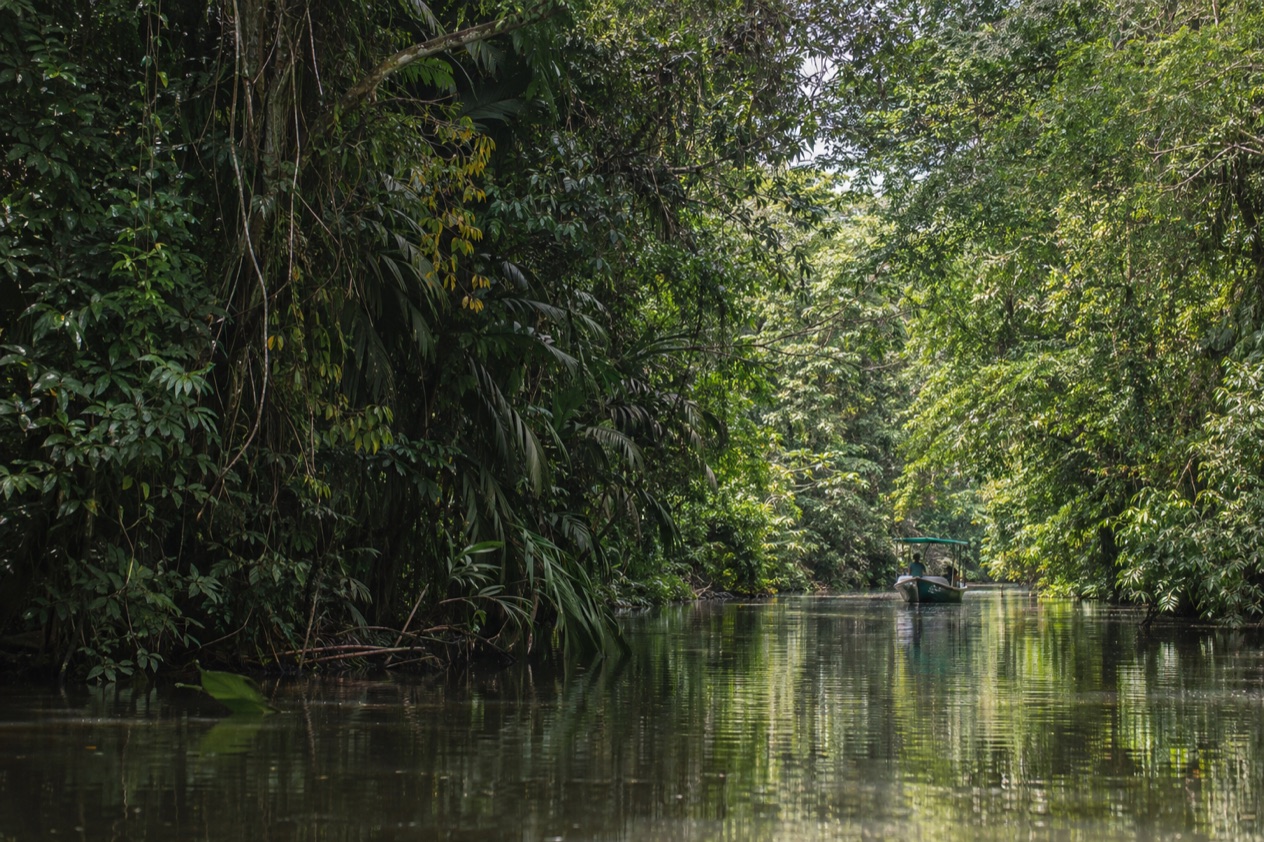
The boat slows, the engine drops to a murmur, and a green wall of rainforest closes in on both banks of the canal. A heron stands motionless on a fallen branch, a howler monkey roars somewhere out of sight, and the air smells of wet leaves and river mud. Tortuguero National Park, on the northern Caribbean coast, is a place you reach by water and explore by water, with the nesting turtles of its long beach as the great draw in the right season.
Is visiting Tortuguero National Park worth it?
Yes, if you want to watch wildlife from a quiet boat and you do not mind that getting here takes real effort. It suits nature lovers, birders, photographers, families with patient children and anyone who has always wanted to see a sea turtle come ashore at night. It is less suited to travelers who want a beach day with lounge chairs and a cocktail, because the surf here is rough and the pace is set by rivers, rain and the animals.
What sets it apart from other parks on the Caribbean side is the way the whole visit is organized around water. There are no roads into the village of Tortuguero, so visitors arrive by boat or small plane.
You glide through a web of canals at dawn, when the animals are most active, and you sleep within earshot of the surf. The park also protects the largest green turtle nesting beach in the Western Hemisphere, which gives the place a weight that few other lowland rainforests can match.
Most visitors stay at lodges that offer guided tours, which makes planning simple. The trade-off is that the trip rewards a slow rhythm. Plan to spend at least a night here rather than rushing through, and let the canals do the work of showing you the forest.
What to see at Tortuguero National Park
The park was declared a national park in 1970, and its boundaries were extended three times after that. Much of it is protected sea, with the rest a mosaic of beach, lagoon, swamp and rainforest. Nearly all of the land is set aside for absolute protection, with only a sliver given over to visitor facilities, which is why the forest feels so intact from the water.
The nesting beach and the green turtles
The long dark-sand beach is the reason the park exists. Green sea turtles come ashore to lay their eggs mainly from about July to October, and leatherbacks nest earlier in the year. The scene is quiet and slow: a female hauls herself up the sand, digs a deep nest with her flippers, and lays her eggs in near darkness.
Night walks to see the turtles are done with a licensed guide. Sightings are a chance, never a promise, since the turtles choose their own nights.
By day the beach is empty and wild, with driftwood, crashing waves and the occasional track in the sand where a turtle passed in the dark. Watch the sea from the sand, because rip currents here are very dangerous and cause several drownings of U.S. tourists each year across the country.
The canals by boat
The canals are where most visitors spend the bulk of their time. Small boats nose along narrow channels and wider lagoons, and guides cut the engine so you can listen. You may spot caimans lying along the banks, monkeys moving through the canopy, herons stalking the shallows and kingfishers flashing between the roots.
Early morning is the favorite hour, when the water is still, mist hangs low and the birds are busy. A paddle-style or quiet boat makes the most of it. Bring binoculars if you have them, since a good pair turns a distant shape in the branches into a clearly identified bird. Rain is part of the experience here, and the forest often looks its greenest in a drizzle.
Rainforest and lagoons
Behind the beach, the land is a tangle of lowland rainforest, flooded forest and lagoons. Walking is done with a guide, and what you see depends on the day: leaf-cutter ants marching along a trail, bright frogs on a leaf, the odd bird calling from the high canopy. Guides are good at spotting things that look like nothing to untrained eyes, from a camouflaged lizard to a sleeping bat on a trunk.
The forest is humid and muddy, so expect damp air and slippery ground. Patience pays off more than speed. Stand still for a few minutes and the forest starts to move around you.
Cuatro Esquinas and Cerro Tortuguero
Two parts of the park, the sector called Cuatro Esquinas and Cerro Tortuguero, require an online reservation. Cerro Tortuguero is the hill that rises above the otherwise flat coastal plain, and it gives the area its one real high point in a landscape of water and lowlands.
Because these sectors are reserved ahead of time through the official online service, build them into your plan before you travel rather than hoping for a spot on arrival. Your lodge or a certified guide can tell you how they fit into a stay.
The village and the small communities
The village of Tortuguero sits on a strip of land between the canals and the sea, and it is small enough to walk end to end in a short while. Along the sandy main path you find simple restaurants, souvenir stalls and a few shops. Nearby communities such as Barra del Tortuguero and San Francisco use bicycles as the only means of transportation, which gives you a sense of how quiet life is around the park.
A stroll through the village in the late afternoon, after the boats come back, is a pleasant way to spend the hour before dinner. You hear music from a porch, smell fried plantains and watch children ride past on bikes.
Hours, tickets and rules
The park is open every day, from early morning until the afternoon, which suits the dawn boat tours well. Two sectors are booked online ahead of time through the national park service, SINAC, which offers online purchase and reservation of entry tickets for many national parks.
| Site | Open | How to book |
|---|---|---|
| Tortuguero National Park | Every day, 6 a.m. to 4 p.m. | Online entry tickets through SINAC at serviciosenlinea.sinac.go.cr |
| Sector Cuatro Esquinas and Cerro Tortuguero | Every day, 6 a.m. to 4 p.m. | Online reservation required through SINAC |
To hike in national parks, you should register with the park, have an entry permit and use a certified tour operator. The Costa Rica Tourism Institute (ICT) provides a list of Certified Tour Guides. Night walks to see nesting turtles are done only with a licensed guide. Rip currents along the coast are very dangerous.
How to get to Tortuguero National Park
There are no roads into Tortuguero, so every route ends on the water. The village can be reached only by boat or small plane, and access to the park itself is possible only on small boats because of its extensive network of rivers and streams. That is part of the charm, and it means the journey is already the first leg of the visit.
By bus and boat taxi
The public route runs by bus from Cariari to La Pavona, and then by boat taxi from La Pavona to Tortuguero. Boat taxis also run the other way, from Tortuguero back to La Pavona. The two legs have to be timed to connect, so plan around the schedule instead of the other way around.
| Leg | Departures |
|---|---|
| Bus, Cariari to La Pavona | 6 a.m., 11 a.m. and 3 p.m. |
| Boat taxi, La Pavona to Tortuguero | 7:30 a.m., 12:30 p.m. and 4:30 p.m. |
| Boat, Tortuguero to La Pavona | 5:30 a.m., 9 a.m., 11 a.m. and 2:45 p.m. |
Many lodges arrange transport as part of a package, which spares you from stitching the pieces together yourself. Wherever you start, pack light, since you carry your bags onto small boats and along muddy paths.
By small plane
A small plane is the other way in. Flying shortens the trip and gives you a view of the green lowlands, canals and coastline from above, but it is still a small-aircraft arrival rather than a conventional airport. After you land, the rest of your stay is by boat and on foot.
To the Jalova Sector
The Jalova Sector has its own approach. Travelers go by land through Siquirres to Caño Blanco and then take a private boat, and only private transportation is available there. It is a route for people who want a different corner of the park and who are comfortable organizing a more independent trip.
When to visit Tortuguero National Park
The turtle season sets the calendar. Green turtles nest mainly from about July to October, so a visit in those months gives you the best chance of seeing one, and leatherbacks come earlier in the year. Those months can also be very wet, so you trade dry hours for wildlife. Rain here comes in heavy bursts, and in a wet month it can fall on most days.
| Month | Avg high (°F) | Avg low (°F) | Rain (inches) | Rain days |
|---|---|---|---|---|
| January | 80.0 | 71.2 | 7.05 | 16.0 |
| April | 83.3 | 73.9 | 4.45 | 11.6 |
| July | 82.1 | 73.8 | 16.72 | 28.6 |
| October | 82.7 | 73.7 | 13.80 | 26.8 |
April is the drier of these months, with fewer days of rain and a softer, more open feel to the day. January sits in between, with a good share of showers and warm nights. Temperatures barely change through the year, so the real choice is between rain and turtles. A rainy morning is not a lost morning here, since animals are often active in the damp, but a gray sky does make for dimmer photos.
Within a day, the best hours are the first ones. The park opens early, birds and monkeys are busiest at dawn, and the light is soft over the water. Afternoons are for resting at the lodge, wandering the village or taking a second, slower boat ride. Night is for the turtle walk when the season allows it.
Tips for your visit
Plan for at least a night or two so you are not rushing between boats and bus times. Pack for humidity and rain: a light rain jacket, quick-drying clothes, closed shoes that can get muddy, insect repellent, sunscreen and a dry bag or a plastic cover for your camera. Binoculars are worth the space.
- Book a lodge that includes guided canal tours and, in season, a night walk to the beach.
- Reserve the Cuatro Esquinas and Cerro Tortuguero sectors online before you go.
- Choose a certified guide from the Costa Rica Tourism Institute list for park walks.
- Leave big suitcases behind if you can, since boats and paths favor a small bag.
Families with children who enjoy being quiet and looking for animals will love the boat rides. Because the way in is by boat or small plane, and the paths are sandy and often wet, the visit is harder for travelers who have trouble with uneven ground or getting on and off small boats. Let your lodge know in advance about any mobility needs.
Pair the park with a day or two around the village. Walk the sandy lanes, watch the boats come in, and spend an evening over rice and beans cooked with coconut, a Caribbean specialty that suits a rainy night well. If you want a different kind of day, ask about the Jalova approach, which is only by private transport.
Good to know before you go
The U.S. State Department rates Costa Rica Level 2, ‘Exercise increased caution,’ due to crime; it says petty crime is common throughout Costa Rica and that violent crime also affects tourists, including armed robbery, homicide and sexual assault.
Keep valuables out of sight and keep your documents with you in a waterproof pouch.
Stay off the surf and watch the sea from the sand, since rip currents at Tortuguero are a real danger, and at night stay with your guide on the beach. Rain showers can come at any time, so a wet day is part of the plan.
Sources
- Costa Rica Tourism Board (ICT), Tortuguero National Park (https://visitcostarica.com/where-to-go/protected-areas/tortuguero-national-park), checked October 8, 2026
- SINAC (Costa Rica national parks authority), online reservations (https://www.sinac.go.cr/ES/resvlinea/Paginas/default.aspx), checked October 8, 2026
- Open-Meteo / ECMWF ERA5, normals 1991-2020 computed for the grid cell at 10.543N 83.502W, checked October 8, 2026
- U.S. Department of State, Costa Rica Travel Information, Safety and security (https://travel.state.gov/content/travel/en/international-travel/International-Travel-Country-Information-Pages/CostaRica.html), checked October 8, 2026
- U.S. Department of State, Costa Rica Travel Advisory, issued April 1, 2026 (https://travel.state.gov/content/travel/en/traveladvisories/traveladvisories/costa-rica-travel-advisory.html), read via the State Department open data API on October 8, 2026