
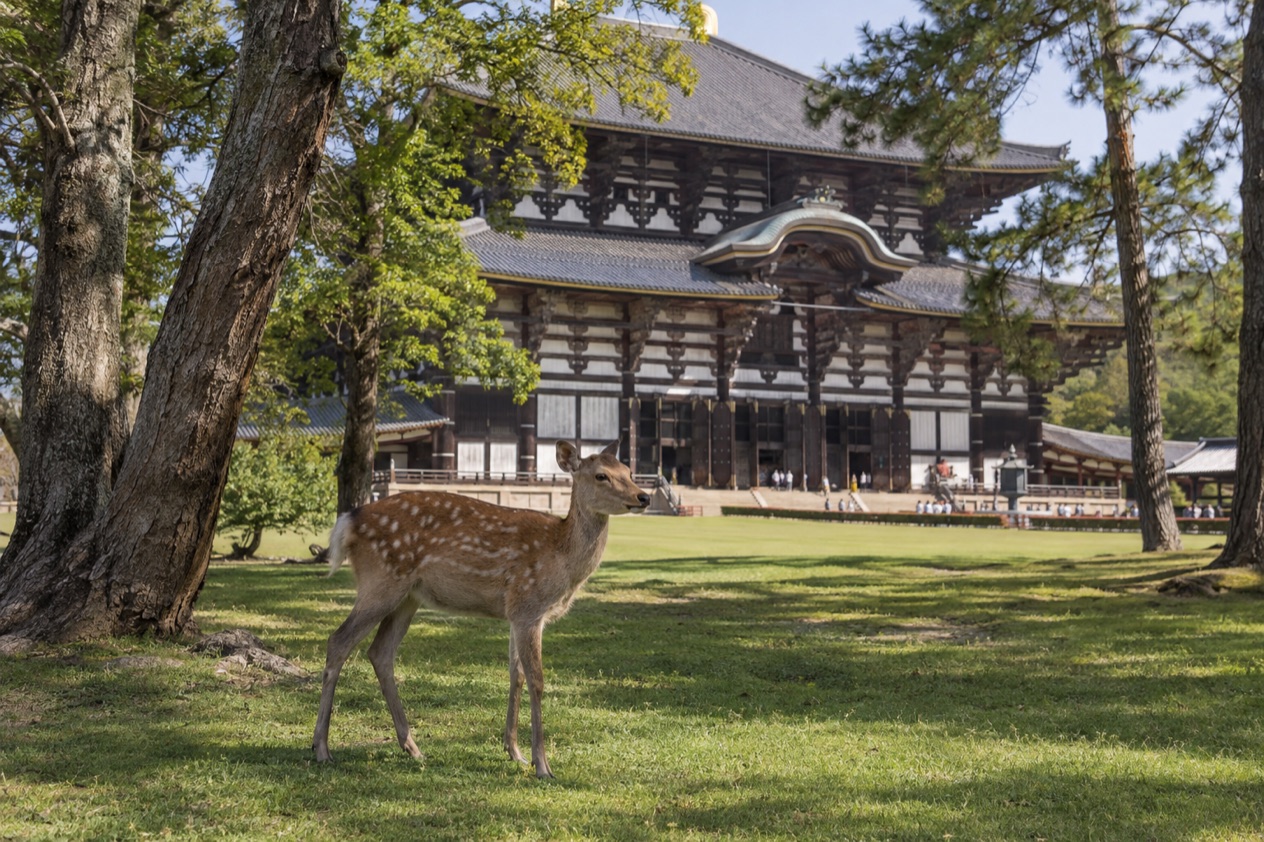
Along the paths of Nara Park, deer wait beside the vendors who sell sika senbei, the rice crackers, and a few of them bow their heads to ask for one. Beyond the trees, the roofs of old temples rise over the lawns at the foot of Mount Wakakusa. Nara is a temple town with an old-capital past, and it suits travelers who like to wander from one sanctuary to the next at their own pace.
Where is Nara and what is it like?
Nara sits in the Kansai region, east of Osaka and south of Kyoto, in the northern part of Nara Prefecture where it borders Kyoto Prefecture. The prefecture lies in the center of the Kii Peninsula, between Wakayama and Mie. It is an inland city, with mountains and old forest rather than a coastline.
The character of the place comes from its history. Heijokyo, the capital here during the Nara Period, was Japan’s first capital, and the city still carries that past in its monuments.
Several of them (Todai-ji, Saidai-ji, Kofuku-ji, Kasuga Shrine, Gango-ji, Yakushi-ji, Toshodai-ji, the Heijo Palace and Kasugayama Primeval Forest) together form the Historic Monuments of Ancient Nara, a UNESCO World Heritage Site. Nara Prefecture has three World Heritage sites in all, encompassing ancient monuments, sacred mountain trails, and some of Japan’s oldest temples and shrines.
The deer give the town its everyday scene. They were once believed to be messengers of the gods, and today they roam freely through the park. Nara suits travelers who enjoy history, parkland and temple gates, and who like to take things slowly.
Those who come looking for nightlife or a long list of attractions in one afternoon may find the pace gentler than they want. People pair Nara with Kyoto or Osaka, and both cities are reachable by train.
What is there to do in Nara?
Nara’s best-known reasons to visit sit close together around the park, and each gives a different kind of day: the deer, the great temple, and the older sites that spread out toward the west and south.
Nara Park and its deer
Nara Park covers a vast area of 660 hectares at the foot of Mount Wakakusa, and it is the heart of a visit. The deer roam freely, and visitors can feed them with the special deer crackers sold around the park. Some of the animals have learned to bow to receive a cracker, which makes feeding them a small ritual of its own.
From Kintetsu Nara Station, the park is a 5-minute walk. Both Nara Park and the old merchant quarter of Naramachi can be reached from Nara Station and Kintetsu Nara Station. Wandering between lawns, ponds and temple roofs is the pleasure here, with no fixed route to follow.
Todai-ji and the Great Buddha
Todai-ji, the Great Buddha and the wild deer are the established symbols of Nara. The temple houses a Buddha statue 15 meters high, and it is described as the largest wooden building in the world, holding the world’s largest bronze Buddha. At the Nandaimon Gate, two guardian figures 8 meters tall stand watch over those who walk in.
Inside the precincts, smoking and drone photography are prohibited. The statue and the hall are a good reason to slow down and look up, and the gate itself deserves a pause before you go on.
Kasuga Taisha and the forest paths
Kasuga Taisha is a Shinto shrine in Nara, set on the edge of the old forest of Kasugayama. Its brass lanterns are lit twice a year, in winter and in summer, a custom that draws people to the shrine when the lights come on. At other times, the lanterns and the wooded setting are what you walk among.
Kofuku-ji, another of the monuments of ancient Nara, belongs to the same part of town. Together with the shrine and Todai-ji, it lets you move from Buddhist hall to Shinto sanctuary in a single afternoon.
Heijo Palace and Horyuji
Farther out, a bus takes visitors to Heijo Palace and to Horyuji Temple. The palace site recalls the capital of the Nara Period, while Horyuji, in Ikaruga in Nara Prefecture, was founded by Prince Shotoku in 607. These two sites give the visit a quieter, more historical side than the park. What sets Nara apart from Kyoto and Osaka is its scale: the major sights gather around one park, with deer wandering between them, and the city’s role as Japan’s first capital gives the temples an earlier layer of history.
How many days do you need in Nara?
Because Nara is reachable by train from both Kyoto and Osaka, visitors fit it in as a single outing, though a night in town changes the feel of the visit.
In a single day, the park, Todai-ji, and Kasuga Taisha fit together naturally because they are all in or beside Nara Park’s main sightseeing area. You can feed the deer, step through the Nandaimon Gate, see the Great Buddha, then follow the paths toward the shrine and its lanterns. Kofuku-ji and the lanes of Naramachi make a good end to the afternoon.
With a second day, choose Horyuji or the western temple area around Saidai-ji, Yakushi-ji, and Toshodai-ji, with Heijo Palace as another option. Nara Kotsu offers 4 sightseeing bus tours covering Nara Park, Horyuji and Nishinokyo, with audio guides in English and Chinese, which is one way to see the western sites.
With more time, Kintetsu trains serve the ancient towns along the Yamanobe-no-Michi route and the access points to mountain pilgrimage trails leading to the border with Wakayama Prefecture. Nara Kotsu buses reach remote areas that rail does not serve. Kyoto and Osaka remain close enough to combine with Nara in one trip, using Nara as a base or as a day out from either city.
Where to stay in Nara
The area around Kintetsu Nara Station and Nara Park is the natural base for a first visit, since the park is a 5-minute walk from the station. Staying here puts the deer, Todai-ji and the shrine close at hand, and Naramachi is reachable from the same stations. It suits travelers who want to spend their days among the temples and return on foot.
The area around JR Nara Station suits those arriving by the JR Yamatoji rapid train from Osaka or the JR Miyakoji rapid service from Kyoto, both of which serve the station directly. Naramachi is accessible from both main stations, so either side of town gives you a way into the old quarter.
Another option is to stay in Kyoto or Osaka and visit Nara for the day. The rail links make this possible, and it suits travelers who want to keep one base for a longer Kansai trip. Staying in Nara itself gives you time to experience the city after many day-trippers have left.
For those who plan to explore the western sites such as Heijo Palace and Horyuji, any base near the stations works, since buses leave toward these places. Choose by how you plan to arrive and how much of your time you want to spend walking from the door to the park.
How do you get to Nara and get around?
Visitors reach Nara by train from Kyoto or Osaka. The closest airports are Osaka International Airport (Itami) and Kansai International Airport, both in Osaka Prefecture and about one hour and fifteen minutes away by bus and train. From Kansai Airport Station, the trip to Nara Station via JR Express and JR Rapid Express takes approximately 67 minutes, changing at Tennoji Station.
Nara has two main stations, JR Nara Station and Kintetsu Nara Station. From Osaka, the JR Yamatoji rapid train serves JR Nara Station directly, and from Kyoto the JR Miyakoji rapid service does the same. From other points in Kyoto or Osaka, the private Kintetsu train may be the most convenient alternative.
| Route | Train | Time |
|---|---|---|
| Kyoto Station to Nara Station | JR Rapid Express | Approximately 41 minutes |
| Kyoto Station to Kintetsu-Nara Station | Kintetsu Limited Express | Approximately 34 minutes |
| Osaka Station to Nara Station | JR Rapid Express | Approximately 52 minutes |
| Osaka-Namba Station to Kintetsu-Nara Station | Kintetsu Express | Approximately 34 minutes |
From Osaka-Namba Station, the Kintetsu limited express reaches Kintetsu Nara Station in 35 minutes and costs 520 yen more than the regular express, which takes 5 minutes longer. Within the city, the Kintetsu Railway and West Japan Railway (JR West) operate rail service throughout Nara, and Nara Kotsu runs an extensive bus network across the prefecture, reaching remote areas not served by rail. Gurutto buses in Nara City cost 100 yen per trip.
The Nara 1-Day Pass costs 600 yen for adults and 300 yen for children, valid for one day and covering Nara Park and the Nishinokyo areas. A bus takes visitors to Heijo Palace and Horyuji Temple.
When is the best time to visit Nara?
April and October are the months to look at first. In April, highs average in the high 60s with sunshine for much of the month, and rain falls on a little under ten days, so you can expect a mix of bright spells and showers. October is a little warmer, with highs in the low 70s and cool nights, and it is a wetter month, with around nine days of rain.
| Month | Avg. high (°F) | Avg. low (°F) | Precipitation (in) | Rain days | Sunshine (hours) |
|---|---|---|---|---|---|
| January | 47.7 | 33.4 | 2.06 | 6.2 | 118 |
| April | 67.6 | 47.7 | 3.89 | 9.6 | 173 |
| July | 89.1 | 73.4 | 6.83 | 11.2 | 157 |
| October | 72.7 | 56.3 | 5.30 | 9.2 | 149 |
July is the hot, wet month. Walking the wide grounds of the park in that heat is slower going, and showers can interrupt the day.
January is cold, with highs in the high 40s and lows just above freezing. Snow or sleet falls on many days in the month, though the total amount is small. The brass lanterns at Kasuga Taisha are lit in winter and in summer, so the shrine has a special evening in both of those seasons.
Good to know before you go
Prices in Nara are in yen, and local transport fares are modest: a Gurutto bus ride costs 100 yen, and the Nara 1-Day Pass is 600 yen for adults and 300 yen for children. Around the park, vendors sell the deer crackers, and the deer are used to people approaching them.
Inside the Todai-ji precincts, smoking and drone photography are prohibited. Summer brings heat and humidity, and rain falls on many days in July, so a light rain layer is useful in the wetter months.
Sources
- Japan National Tourism Organization, Nara (https://www.japan.travel/en/destinations/kansai/nara/), checked October 11, 2026
- Official Nara Travel Guide, getting around Nara (https://www.visitnara.jp/getting-around-nara/), checked October 11, 2026
- Official Nara Travel Guide, first-time visitors (https://www.visitnara.jp/for-first-time-visitor/), checked October 11, 2026
- Official Nara Travel Guide, Nara Park area (https://www.visitnara.jp/destinations/area/nara-park/), checked October 11, 2026
- Official Nara Travel Guide, travel to Nara (https://www.visitnara.jp/travel-to-nara/), checked October 11, 2026
- Wikipedia, Nara, Nara (https://en.wikipedia.org/wiki/Nara,_Nara), checked October 11, 2026
- Todai-ji Temple, official site (https://www.todaiji.or.jp/en/), checked October 11, 2026
- Wikipedia, Tōdai-ji (https://en.wikipedia.org/wiki/T%C5%8Ddai-ji), checked October 11, 2026
- Wikipedia, Nara Park (https://en.wikipedia.org/wiki/Nara_Park), checked October 11, 2026
- Wikipedia, Kasuga-taisha (https://en.wikipedia.org/wiki/Kasuga-taisha), checked October 11, 2026
- Wikipedia, Hōryū-ji (https://en.wikipedia.org/wiki/H%C5%8Dry%C5%AB-ji), checked October 11, 2026
- Wikipedia, Kōfuku-ji (https://en.wikipedia.org/wiki/K%C5%8Dfuku-ji), checked October 11, 2026
- Japan Meteorological Agency (JMA), Normal values 1991-2020, monthly (https://www.data.jma.go.jp/stats/etrn/view/nml_sfc_ym.php?prec_no=64&block_no=47780), station Nara, elevation 102 m, checked October 11, 2026
All our pages
When to go
- Best Time to Visit Nara: Cherry Blossoms, Fall Colors, Weather and Festivals
- Nara in January: New Year Shrine Visits, the Wakakusa Mountain Burning, Winter Weather and the Deer
- Nara in February: Setsubun, Plum Blossoms, Deer Park and Winter Weather
- Nara in March: Omizutori Fire Festival, Weather and Deer Park Days
- Nara in April: Cherry Blossoms, Deer in Nara Park and Spring Weather
- Nara in May: Deer in Fresh Green, Todai-ji, Golden Week and a Two-Day Plan
- Nara in June: Weather, Deer Park Walks and a Two-Day Plan
- Nara in July: Heat, Deer in Nara Park, Todai-ji and Summer Food
- Nara in August: Weather, Lantern Nights and What to Do
- Nara in September: Summer Heat Fading, Deer Park Walks and Temple Days
- Nara in October: Weather, Deer in Nara Park, Todai-ji and a Two-Day Plan
- Nara in November: Maple Leaves, Deer in the Park and What to Wear
- Nara in December: Deer in Winter Light, Cold Weather and the Mid-December Festival
Things to do
- Things to Do in Nara: Todai-ji, Deer in Nara Park, Kasuga-taisha and Day Trips
- Day Trips from Nara: Kyoto, Osaka, Universal Studios Japan and Mount Koya
- 3 Days in Nara: Deer, Todai-ji, Horyu-ji and Naramachi
- Nara Park and the Deer: Todai-ji, Kasuga Grand Shrine, Feeding Crackers and Getting There
Where to stay
Getting there
- Nara from Kyoto: Trains, Passes, Deer Park and a Day Out
- Kansai Airport to Nara: Bus and Train Routes, Kintetsu and JR Stations, Terminals