
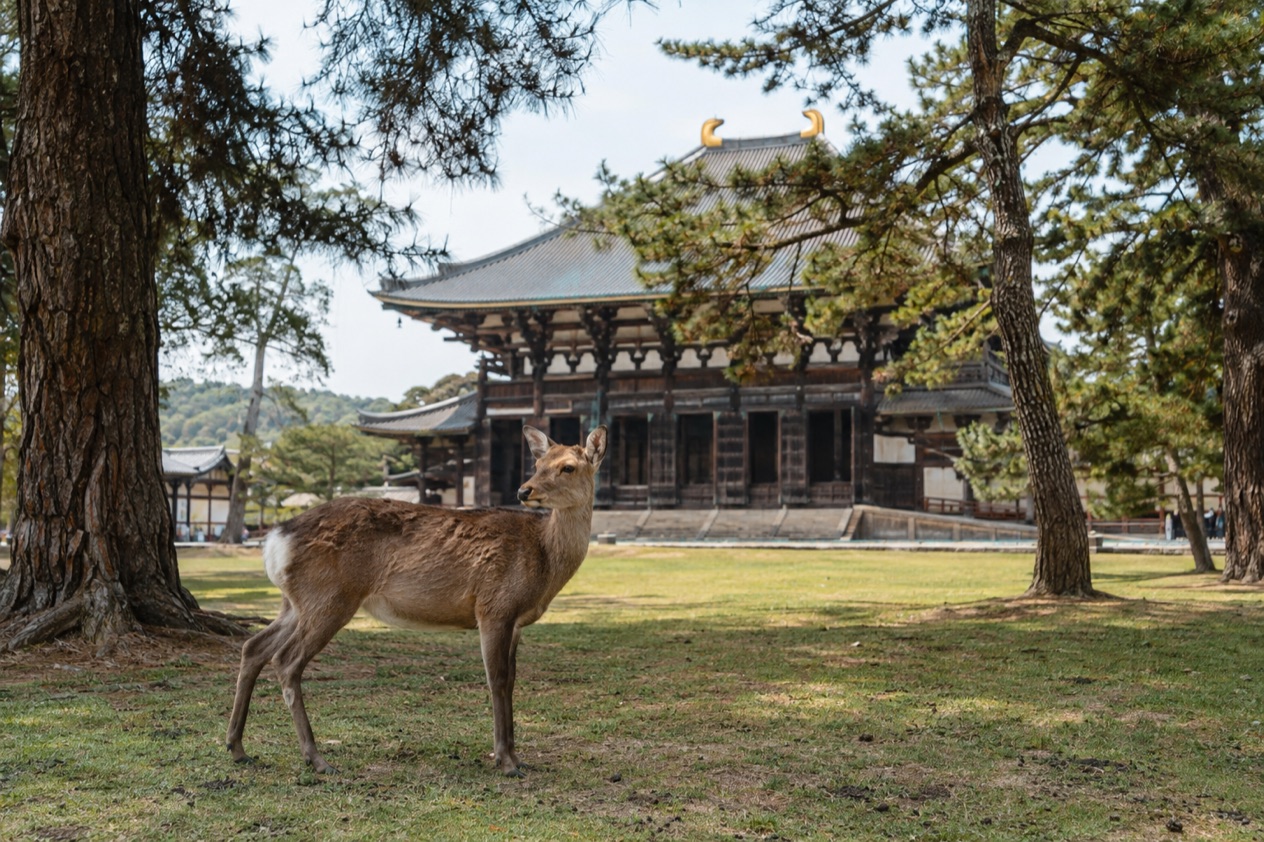
Before the shops along the roadside open, the deer of Nara Park are already up, ambling past the cracker sellers’ stalls while the foot of Mount Wakakusa turns gold. Then a train pulls out of Kintetsu Nara Station or JR Nara Station, and within the same day you can be under the tower in Kyoto, eating your way down a canal in Osaka or walking among the temples of a mountain plateau.
What are the best day trips from Nara?
The best day trips from Nara go to Kyoto and Osaka, the two cities the rails connect most directly, plus one mountain excursion to Mount Koya in Wakayama Prefecture. Together they give you temples, a castle, street food, a theme park and a monastery town, each in a different mood from Nara’s deer and wooden halls.
- Kyoto, for the station district, the old traditions of the city and its temples and shrines, reached by train from Nara.
- Nijo Castle in central Kyoto, for the shogun’s residence with its singing floors.
- Dotonbori and Shinsaibashi in Osaka, for neon, canal-side snacks and long shopping streets.
- Osaka Bay and Universal Studios Japan, for a full day of rides and the Wizarding World of Harry Potter.
- Mount Koya, for a temple settlement on a high plain, cooler than the lowlands and colorful in fall.
Each is developed below with how to approach it, what the day looks like and who it suits.
The best day trips from Nara
Kyoto: station district, temples and old traditions
Nara lies south of Kyoto, and the two are linked by train, which is why the city works so well as a day out. Kyoto Station is the arrival point, and the building itself is worth a first hour: a full floor of ramen restaurants, an Isetan department store, a theater and a Granvia hotel sit under one roof. Kyoto Tower stands a few steps from the main entrance and is visible across the city, so you never lose your bearings.
Beyond the station is a city whose culture has developed over some 1,200 years. Its traditions include machiya townhouses with their narrow wooden fronts, the Gion Matsuri festival and the hanamachi districts where geisha live and work. Wandering a few streets of machiya gives you a different picture from Nara’s broad park, closer and more urban, full of lattice windows and small shrines tucked between shops.
The Japan National Tourism Organization recommends visiting Kyoto’s shrines at less crowded times, such as early morning or late evening when they are illuminated. That fits a day trip from Nara, since you can plan one temple or shrine as the anchor of the day and leave the rest open for walking. It suits travelers who want a second old capital after Nara and are happy to pick only a few places.
Nijo Castle in central Kyoto
Nijo Castle was built in 1603 by Tokugawa Ieyasu, the first shogun of the Edo period, and it shows how a military ruler lived and governed in a city that had long belonged to the emperor. Kyoto served as Japan’s capital and the emperor’s residence for over a thousand years, and the castle stands as a counterweight to that imperial story.
The detail visitors remember is the nightingale floors. Walk the corridors and the boards chirp like a bird under your feet, an old security system meant to alert guards to anyone creeping toward the rooms. The sound turns a slow walk through the halls into something you listen to as much as look at.
It suits travelers who like history with a story attached, and who have already seen Nara’s temples and want something of a different era.
Dotonbori and Shinsaibashi in Osaka
Osaka is a charming, relaxed city known for its food, entertainment and nightlife, with some history and culture to discover on the side. Dotonbori and Shinsaibashi are the districts where that reputation plays out: signs lit up over a canal, shops lining the covered streets, and a good deal of eating on the go. Think takoyaki grilled in round molds, okonomiyaki sizzling on a flat griddle, and skewers of fried food.
From Nara the approach is by rail. The Kintetsu limited express from Kintetsu Nara runs to Osaka-Namba Station, and from Osaka or Umeda Station the Midosuji Line takes you to Shinsaibashi Station. You can also stay on the Midosuji Line to Namba Station for Dotonbori. Coming the other way, the JR Yamatoji rapid train serves JR Nara Station directly from Osaka, so the return can use either station.
This trip suits travelers who want an evening out and are happy to eat their way through a district rather than sit down to one big meal. Treat it as a pairing with Nara’s calm: temples and deer by day, then a swerve into neon and noise before the ride back.
Osaka Bay and Universal Studios Japan
Osaka Bay lies in Osaka, a major port city in the Kansai region, and it is where Universal Studios Japan stands. The park opened in 2001 and features attractions such as the Wizarding World of Harry Potter.
To get there, the bay is accessible from Osaka or Umeda stations via the JR Loop Line and the Chuo subway line, so you first reach Osaka and continue from there. That makes it a trip in two legs, and it is worth treating it as the single goal of the day rather than adding sightseeing around it.
It suits groups with children, couples who like rides and anyone who wants a day that is pure entertainment. Pick it for a day when you have already seen Nara’s main sights and want to let go of temple etiquette for a while.
Mount Koya: a temple settlement on a high plain
Mount Koya is a large temple settlement in Wakayama Prefecture, south of Osaka. The monk Kukai first settled it in 819, and it is known as the world headquarters of the Koyasan Shingon sect of Japanese Buddhism. The settlement sits on a high plain amid eight peaks, and the setting gives it a very different feeling from Nara’s gentle park.
Because of the altitude, Mount Koya is noticeably cooler than Osaka. Cherry blossom season comes around mid-April, a few weeks later than in the lowlands, and fall colors around October are a major tourist draw. That makes spring and fall the seasons when the mountain is especially tempting, and a light extra layer is sensible whatever the month.
What you do there is walk between temples, pass cedar-shaded paths and take in a place where Buddhist life is still the daily business. Mount Koya suits travelers who like a quiet spiritual stop and do not mind that it is further afield than Kyoto or Osaka. It is a place to give a day to by itself.
Day trips from Nara compared
| Trip | Best for | How to go |
|---|---|---|
| Kyoto | Station district, traditions, temples and shrines | Train from Nara (Kintetsu Railway and JR West both operate in Nara) |
| Nijo Castle, Kyoto | History of the shogun era, nightingale floors | Train to Kyoto, then on to central Kyoto |
| Dotonbori and Shinsaibashi, Osaka | Street food, neon, shopping and nightlife | Kintetsu limited express from Kintetsu Nara to Osaka-Namba in 35 minutes, 520 yen more than the regular express (5 minutes longer), then the Midosuji Line |
| Osaka Bay and Universal Studios Japan | Rides and the Wizarding World of Harry Potter | Reach Osaka or Umeda, then the JR Loop Line or the Chuo subway line |
| Mount Koya | Temples, mountain cool, blossoms in mid-April and fall colors around October | Reached in Wakayama Prefecture, south of Osaka |
To choose, start with what kind of day you want. Kyoto and Nijo Castle continue the history theme you began in Nara, and they can share one day if you keep to a few places. Osaka is the contrast, with food and nightlife, and Universal Studios Japan is a day that has nothing to do with temples at all.
Mount Koya is the outing for the traveler who wants to go deeper into Japanese Buddhism and a cooler, higher setting. In October it also offers the fall colors the mountain is known for. Match the trip to the season you are traveling in, and to whether you want to be moved, fed or entertained.
Tour or on your own?
What matters first is the kind of place you are going to. Kyoto and Osaka are cities served by rail from Nara, and Kintetsu Railway and West Japan Railway (JR West) operate service throughout Nara, so you can build the day yourself around stations, with the Midosuji Line or the JR Loop Line carrying you on once you arrive.
A different picture applies to outings that lie beyond the rail lines. Nara Kotsu operates an extensive bus network in Nara Prefecture, providing access to remote areas not served by rail, so a bus may be the answer for countryside stops in the prefecture. Mount Koya, in another prefecture, is a more involved journey, and it is the one trip where it is worth working out the connections before you leave.
Before settling on any approach, check a few things. Look at which station you will leave from, because Nara has two main ones, JR Nara Station and Kintetsu Nara Station, and each belongs to a different railway. Check how the day connects at the other end, for example whether you continue from Osaka by the JR Loop Line or the Chuo subway line to reach the bay.
Then think about what you want to do on arrival. A castle visit, a theme park or a mountain temple settlement each shapes the day differently, and a rental car or a guided option only enters the picture if the places you want do not line up with the rail map. Compare the routes against your list of places, then pick the one that leaves you the most time where you want to be.
Good to know before you go
Both Kintetsu Nara Station and JR Nara Station are good places to start, and from them Nara Park and Naramachi are both accessible. Nara is also reached from the airports at Osaka, about one hour and fifteen minutes away by bus and train, which matters if you are coming and going on a travel day. Within Nara City, the Gurutto buses are the cheap way to hop between sights before or after your outing.
| Fee | Amount | Who pays |
|---|---|---|
| Gurutto bus in Nara City | 100 yen per trip | Each rider, per trip |
Sources
- Japan National Tourism Organization, Nara (https://www.japan.travel/en/destinations/kansai/nara/), checked October 11, 2026
- Official Nara Travel Guide, getting around Nara (https://www.visitnara.jp/getting-around-nara/), checked October 11, 2026
- Japan National Tourism Organization, Kyoto (https://www.japan.travel/en/destinations/kansai/kyoto/), checked October 11, 2026
- Japan National Tourism Organization, Osaka (https://www.japan.travel/en/destinations/kansai/osaka/), checked October 11, 2026
- Wikipedia, Mount Kōya (https://en.wikipedia.org/wiki/Mount_K%C5%8Dya), checked October 11, 2026
- Wikivoyage, Koyasan (https://en.wikivoyage.org/wiki/Koyasan), checked October 11, 2026