
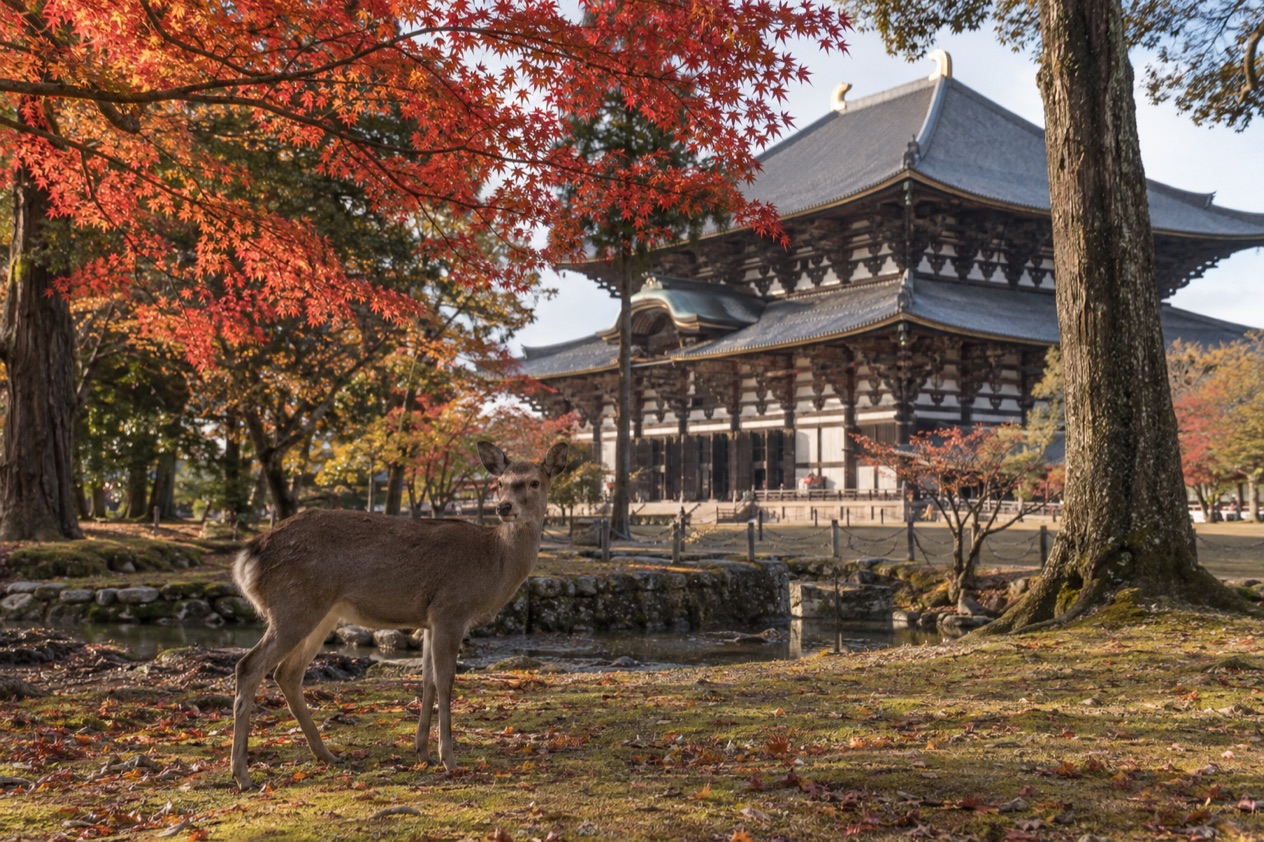
In November, the deer of Nara Park stand knee-deep in fallen ginkgo and maple leaves, nosing at the cracker sellers while the first reds spread through the trees around Todai-ji. Persimmons hang orange on bare branches in the neighborhoods behind the park, and the stone lanterns of Kasuga-taisha look darker against the changing leaves. This is a month of walking among temples and shrines in cool air, with the autumn colors arriving in the old capital.
What is the weather like in Nara in November?
November in Nara is cool and fairly dry, a clear step down from the warm days of October and a step up from the cold of December. Sweaters are enough for sightseeing, and the rain is lighter than in the month before.
| Month | Average high (°F) | Average low (°F) | Precipitation (in) | Days with 1 mm or more of precipitation | Hours of sunshine | Daylight on the 15th |
|---|---|---|---|---|---|---|
| October | 72.7 | 56.3 | 5.30 | 9.2 | 149 | 11 h 22 min |
| November | 62.8 | 45.1 | 2.80 | 7.0 | 145 | 10 h 23 min |
| December | 52.9 | 37.4 | 2.24 | 6.6 | 133 | 9 h 51 min |
What this means on the ground: you want layers. A light coat or a sweater with a scarf covers the days, and the nights call for something warmer, especially if you linger around the shrine lanterns after dark. Snow or sleet is a rarity in November here, a single flurry at most, so a winter parka is more than you need.
Rain comes on only a handful of days, and a compact umbrella or a packable shell is all it takes to keep going. Temple grounds and the paths of Nara Park turn slick and leaf-strewn after a shower, so shoes with grip matter more than heavy rain gear. Humidity is lower than in the summer months, which makes the air feel crisp rather than sticky.
Daylight is shortening noticeably, and the sun sets early enough that a full day outdoors ends with the park lit by low, amber light. Plan the big outdoor stops first and keep museums and covered halls for the hours when the light fades.
What to do in Nara in November
The big event of the month is the turning of the maple leaves. In Nara the color change usually arrives around the third week of November, with the reds deepening through the park and up toward the wooded slopes behind the shrines.
Everything else the city is known for fits the cooler weather. Nara was Japan’s first capital, at Heijokyo, 1300 years ago, and the legacy is spread across a set of temples, a shrine and a palace site that together form the Historic Monuments of Ancient Nara, with three World Heritage sites in all. Walking between them in cool air is the natural rhythm of a November visit.
Nara Park and Todai-ji
Special deer crackers are sold all around the park, and in November the animals browse under trees that are turning red and gold, which makes for the most photographed scenes of the month. Expect the deer to follow anyone holding a cracker, and keep paper maps and snacks tucked away.
At the park’s heart stands Todai-ji, the largest wooden building in the world, which houses the world’s largest bronze Buddha statue. Inside the great hall the Buddha rises to roughly fifteen meters, so large that visitors tend to fall silent at the threshold.
Smoking and drone photography are prohibited in the temple precincts. If the day turns wet, this is the place to spend it, since the main hall keeps you indoors for as long as you like.
Kasuga-taisha and the wooded hills
Kasuga-taisha is a Shinto shrine set among the trees at the edge of the park, reached along stone-lantern paths shaded by old cedar and maple. The vermilion buildings and thousands of hanging and standing lanterns look different once the leaves begin to turn, with red above and the orange of the shrine below.
Behind it lies Kasugayama Primeval Forest, part of the same World Heritage listing, a patch of woods that has long been left to itself. Even a short wander along its edge gives you the smell of damp earth and fallen leaves, the real sensory marker of autumn here. Go with sturdy shoes, since stone steps can be slick after rain.
Eating in Nara in autumn
November food in Nara leans on the harvest. Persimmons are in season, sold fresh and dried, and the region is known for kakinoha-zushi, small pressed sushi wrapped in persimmon leaves. Narazuke, vegetables pickled in sake lees, shows up at breakfast tables and in shops, while kudzu starch (kuzu) turns into soft, translucent sweets that go well with hot tea.
On chilly days, a bowl of chagayu (rice porridge simmered in tea) is the kind of local comfort food that suits the weather. Street stalls near the park sell mochi, grilled skewers and warm sweet-potato treats, and a hot drink from a vending machine is a daily ritual in November Japan. Little tea rooms hide on the lanes of the old merchant quarter of Naramachi, good for warming up between temples.
Beyond the park, Yakushi-ji, Toshodai-ji and the site of the Heijo Palace are all part of the ancient-capital heritage, each with its own atmosphere and its own set of old wooden halls. Gardens and open grounds turn yellow and red in the weeks around the middle of the month, and the cooler air suits the longer walks between them.
Getting around is straightforward. The Kintetsu Railway and West Japan Railway (JR West) operate rail service throughout Nara, while Nara Kotsu runs an extensive bus network that reaches remote areas the trains do not. Gurutto buses in Nara City cost 100 yen per trip.
A two-day itinerary for Nara in November
Day 1 belongs to the park. Reach Nara from Kyoto Station by Kintetsu Limited Express in about 34 minutes, or by JR Rapid Express in about 41 minutes, or from Osaka Station by JR Rapid Express in about 52 minutes. Start with a slow loop of Nara Park among the deer, then spend the late morning at Todai-ji, where the Great Buddha Hall is the big indoor stop of the day.
Lunch can be a plate of kakinoha-zushi or a bowl of noodles in one of the small restaurants near the park. In the afternoon, walk to Kasuga-taisha and the stone-lantern paths beneath the maples, as the daylight fades early in the month. Dinner is an izakaya (a casual pub) with local pickles, grilled fish and a cup of warm sake.
Day 2 moves into the town and out to the western temples. Begin at Kofuku-ji, then walk into Naramachi, the old merchant quarter, for lunch and a stop at a tea room or a sweets shop. From there, continue to Yakushi-ji and Toshodai-ji for their old halls and gardens, then finish at the wide grounds of the Heijo Palace site as the light turns low and golden.
If rain sets in, spend the morning in the Nara National Museum, with its Buddhist art, then retreat into the covered halls of the temples and a long lunch in Naramachi. A hot bath and a quiet evening back at your hotel cap the trip well.
Is Nara busy in November?
November is part of the autumn color season in Nara, so the city sees a steady flow of visitors drawn by the changing leaves.
The pace in the streets reflects that. The area around Todai-ji and the deer park is the main stage, and the paths between the great temples fill with walkers in coats and scarves, carrying cameras and cups of hot tea. Away from that central axis, the lanes of Naramachi and the western temples give the day a slower tempo.
The cooler weather is an advantage for those who plan well, since walking is more comfortable than in the warmer, wetter weeks of October. Because the month straddles the start of the color season, the mood changes from the beginning to the end of November, with the park greener early on and richer in red and gold later.
What to pack for Nara in November
Nara rewards layers, sturdy shoes and a bit of patience on stone paths and long temple grounds.
- A light coat or warm sweater, since the days are cool and the evenings colder.
- A scarf and gloves for the evenings around the lanterns.
- Comfortable shoes with good grip for gravel, stone steps and wet leaves.
- A compact umbrella or packable rain shell for the days with showers.
- A camera or phone with room for photos of maples, deer and temple gates.
- Slip-on shoes or socks without holes, since shoes come off at some temple halls and restaurants.
Good to know before you go
The New Year holidays, when many restaurants and attractions close, are still weeks away, so the usual round of temples, shops and restaurants is available.
Daylight ends early, which shapes the day more than the weather does, so put the outdoor sights first and keep indoor stops for the end. Note too that smoking and drone photography are prohibited in the Todai-ji precincts.
Nara in November vs October and December
Moving the trip four weeks earlier brings warmer, wetter weather and a lot more rain, and the maples have not yet turned. October suits travelers who want long, light days and plan to be outdoors for hours, but the park will be greener and the autumn color still ahead.
Moving four weeks later brings colder air, shorter days and the first real chance of snow or sleet in the city. The color season reaches its end in early December, and the New Year holidays, when many restaurants and attractions close, are close. December suits those who prefer winter light and cold, clear days over the busy part of the leaf season.
If the maples are the point of the trip, November is the month to pick, especially its second half. Choose October for the warmth, December for the cold-weather feel, and November for the balance between the two.
Is November a good time to visit Nara?
Yes, November is a very good time for Nara, especially for travelers who like to walk among old temples and shrines in cool air and watch the autumn color arrive. It suits photographers, history lovers, families who enjoy the deer and anyone who likes a tea-and-sweets rhythm to the day.
It suits less well anyone who wants beach weather or a warm-evening patio dinner, since the evenings are cold and the light fades early. On arrival, head straight for Nara Park and Todai-ji while the day is long enough to enjoy them, and save the town and the western temples for the second day.
What makes November special in Nara is the meeting of two old things: a city that served as a capital 1300 years ago, and the maple leaves turning red around its temples, with deer wandering through the middle of it all.
Sources
- Japan Meteorological Agency (JMA), Normal values 1991-2020, monthly (https://www.data.jma.go.jp/stats/etrn/view/nml_sfc_ym.php?prec_no=64&block_no=47780), station Nara, elevation 102 m, checked October 11, 2026
- Computed from the date and the latitude of the place (sunrise equation, solar elevation -0.833 degrees), October 11, 2026
- Japan Meteorological Agency, maple color-change dates 2025-2026 with difference from the 1991-2020 normal (https://www.data.jma.go.jp/sakura/data/phn_014.html), checked October 11, 2026
- Japan Meteorological Agency, kaede2020.pdf (https://www.data.jma.go.jp/sakura/data/kaede2020.pdf), checked October 11, 2026
- Japan National Tourism Organization, winter in Japan (https://www.japan.travel/en/guide/winter-guide/), checked October 11, 2026
- Japan National Tourism Organization, autumn in Japan (https://www.japan.travel/en/guide/autumn-guide/), checked October 11, 2026
- Japan National Tourism Organization, spring in Japan (https://www.japan.travel/en/guide/spring-guide/), checked October 11, 2026
- Japan National Tourism Organization, summer in Japan (https://www.japan.travel/en/guide/summer-guide/), checked October 11, 2026
- Official Nara Travel Guide, getting around Nara (https://www.visitnara.jp/getting-around-nara/), checked October 11, 2026
- Official Nara Travel Guide, first-time visitors (https://www.visitnara.jp/for-first-time-visitor/), checked October 11, 2026
- Official Nara Travel Guide, Nara Park area (https://www.visitnara.jp/destinations/area/nara-park/), checked October 11, 2026
- Official Nara Travel Guide, travel to Nara (https://www.visitnara.jp/travel-to-nara/), checked October 11, 2026
- Wikipedia, Nara, Nara (https://en.wikipedia.org/wiki/Nara,_Nara), checked October 11, 2026
- Todai-ji Temple, official site (https://www.todaiji.or.jp/en/), checked October 11, 2026
- Wikipedia, Tōdai-ji (https://en.wikipedia.org/wiki/T%C5%8Ddai-ji), checked October 11, 2026
- Wikipedia, Nara Park (https://en.wikipedia.org/wiki/Nara_Park), checked October 11, 2026
- Wikipedia, Kasuga-taisha (https://en.wikipedia.org/wiki/Kasuga-taisha), checked October 11, 2026