
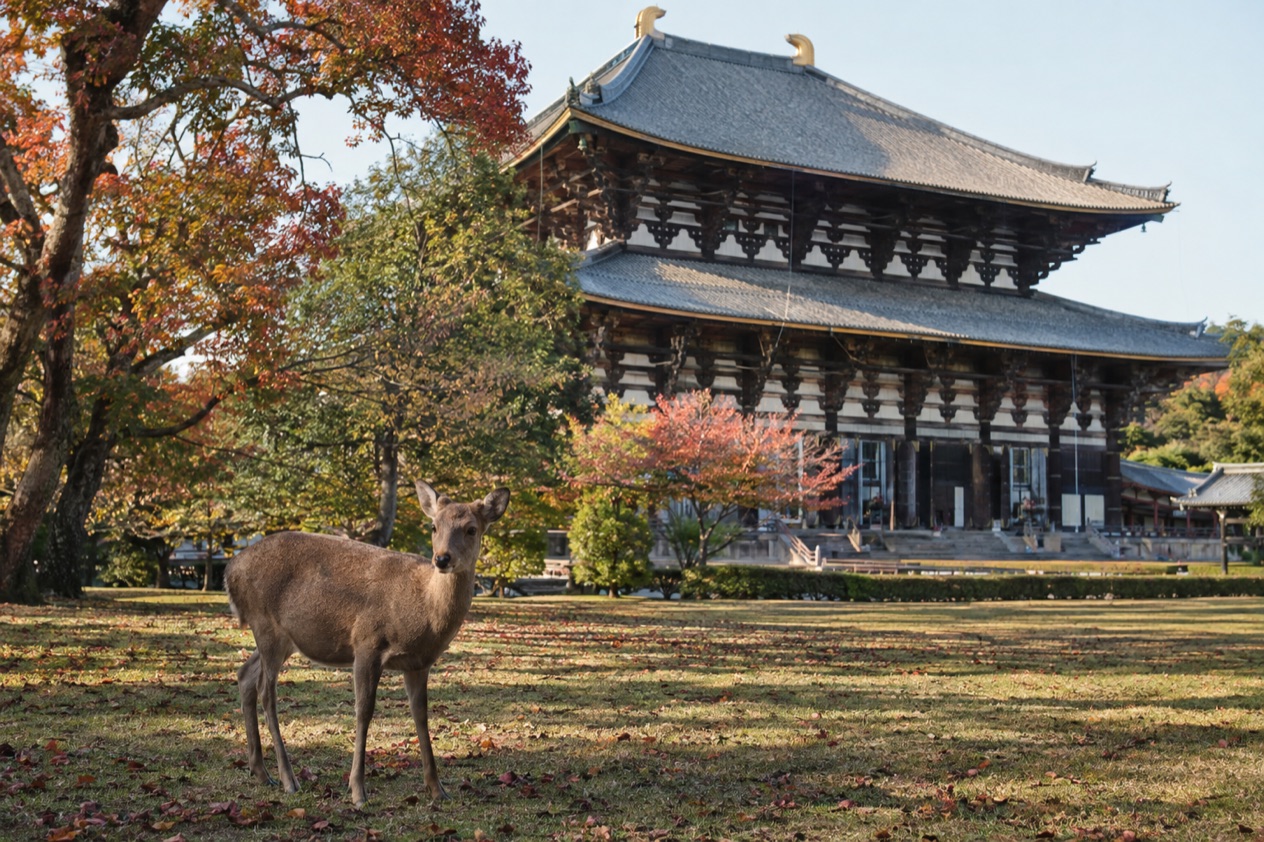
In October the deer of Nara Park wander across the lawns under maples that are still green, and the air has lost the heavy edge of summer. Persimmons start to hang orange in gardens, and the great temple roofs stand out against a softer sky. This is Nara in the weeks between the summer heat and the red leaves of late November, a month for walking between temples, feeding deer and lingering over a long lunch.
What is the weather like in Nara in October?
October in Nara is mild and comfortable, a clear step down from the sticky heat of September and not yet the chill of November. Rain still falls on a good share of the days, so an umbrella belongs in the bag.
| Month | Average high (°F) | Average low (°F) | Precipitation (in) | Days with 1 mm or more of precipitation | Hours of sunshine | Daylight on the 15th |
|---|---|---|---|---|---|---|
| September | 83.8 | 68.2 | 6.26 | 10.0 | 152 | 12 h 27 min |
| October | 72.7 | 56.3 | 5.30 | 9.2 | 149 | 11 h 22 min |
| November | 62.8 | 45.1 | 2.80 | 7.0 | 145 | 10 h 23 min |
These are the figures for Nara itself, and they describe a month of walking weather. Afternoons are warm enough for a light shirt, while evenings call for a sweater or a thin jacket once you sit down outside after a day among the temples. Humidity lingers, so a day on foot can still feel a little damp.
Rain is the main thing to plan around. Roughly a third of October’s days bring some, and the month’s total is not small, so a compact rain jacket or umbrella saves a day. Wet stone and gravel paths in Nara Park can be slippery, and shoes with a good grip matter more than a heavy coat.
The days are noticeably shorter than in September, which changes how you spend them. Temples are best seen in the daylight you have, so you plan the big sights for the first part of the day and leave the evening for dinner in the old streets. Sunshine is still generous for photographs of the pagodas and the deer.
What to do in Nara in October
The great pleasure of Nara in October is that its main sights sit close to one another in a park, so the days are built around walking, pausing and walking again. The maple leaves are still green, since the color change at Nara usually arrives around the end of November. October is therefore a month for the architecture, the deer and the food, not for red foliage.
Eight places in Nara, five Buddhist temples, a Shinto shrine, an imperial palace and a primeval forest, form the UNESCO World Heritage Site known as the Historic Monuments of Ancient Nara, inscribed in 1998. Todai-ji, Kofuku-ji, Kasuga Shrine, Yakushi-ji, Toshodai-ji, Gango-ji, Saidai-ji, the Heijo Palace site and Kasugayama Primeval Forest make up the list, and October’s mild afternoons suit moving between them on foot.
Nara Park and its deer
Nara Park lies at the foot of Mount Wakakusa and covers a vast area, with the deer roaming freely between the temples, the teahouses and the lawns. According to legend, the god of Kasuga Taisha rode a white deer, which is why the animals have long been treated as envoys of the god. They are tame enough to approach, and special crackers for feeding them are on sale all around the park.
Expect the deer to be curious and sometimes pushy once a cracker appears, bowing their heads in a habit visitors find charming. Keep the crackers in hand only when you are ready to share them, and take your time on the paths, because the park rewards wandering without a fixed plan. A rainy day brings a different mood, with wet stone lanterns and mist over the lawns.
Todai-ji and its great Buddha
Todai-ji is the temple that fills a morning. Its main hall is described as the largest wooden building in the world, and inside sits a giant bronze Buddha, the largest of its kind. The scale of the hall is what stays with you, along with the dim light, the smell of incense and the stream of visitors moving slowly past the statue.
Approach through the park and let the deer escort you to the gate. After the hall, spend time on the grounds, where old wooden buildings and stone lanterns reward a slow circuit. If rain arrives, the hall is a natural refuge, and you can wait out a shower under its wide eaves.
Kasuga Shrine and the forest behind it
Kasuga Shrine sits among the trees at the edge of the park, reached along a path lined with stone lanterns. The shrine and Kasugayama Primeval Forest behind it are part of the World Heritage listing, and the walk here feels different from the temple grounds, more shaded and more tied to the woodland. Deer wander the approach and keep you company.
October’s cooler air makes the forest path a pleasant outing, and the green canopy is still thick overhead. The vermilion of the shrine buildings stands out against the trees, and the lanterns, many of them mossy with age, add texture to photographs. Wear shoes with grip if the path is wet.
Getting to Nara
From Kyoto Station, the Kintetsu Limited Express reaches Kintetsu-Nara Station in about 34 minutes. The JR Rapid Express from Kyoto Station to Nara Station takes about 41 minutes, which makes a day trip from Kyoto realistic in either direction.
From Osaka Station, the JR Rapid Express to Nara Station takes about 52 minutes. From Osaka-Namba Station, the Kintetsu limited express reaches Kintetsu Nara Station in 35 minutes and costs 520 yen more than the regular express, which takes 5 minutes longer. Kintetsu Nara Station is the one that puts you closest to the park.
At the table, October is the season of persimmons, and Nara’s own specialties fit it well. Kakinoha-zushi is sushi pressed and wrapped in persimmon leaves, and narazuke is the local pickle, cured in sake lees. Chewy rice cakes, hot tea and small sweets make good rests between temples, and an izakaya dinner of grilled fish and sake suits the cooler evenings.
A two-day itinerary for Nara in October
Day 1 is for the heart of the park. Start in the morning at Kofuku-ji, with its pagoda rising above the pond, then walk up through the park among the deer to Todai-ji. Take your time inside the great hall and around the grounds, and stop for a bowl of noodles or a set lunch at one of the small restaurants near the park.
In the afternoon follow the lantern-lined path to Kasuga Shrine and into the edge of Kasugayama Primeval Forest. The days are shorter in October, so this order puts the largest sights first and the shaded forest when the light is softer. Evening belongs to the old streets for kakinoha-zushi, pickles and a drink at an izakaya.
If rain sets in, linger inside the Todai-ji hall and the temple buildings, and use the afternoon for a tea and sweets stop. Day 2 moves to the temples away from the park. Begin at Yakushi-ji, then continue to Toshodai-ji, both on the World Heritage list, and take in the wide wooden halls and quiet gardens. Lunch can be a simple set meal or a bowl of noodles in a small restaurant nearby.
In the afternoon go on to the Heijo Palace site, a broad open ground where the ancient capital’s palace stood and where the sky feels large. Saidai-ji is another option if you still have energy. For the evening, go back to town for kaiseki or a relaxed dinner built around local vegetables and fish. On a wet day, the temple halls themselves keep you dry.
Is Nara busy in October?
October sits between the heat of summer and the red-leaf season, and the pace in Nara reflects that in-between moment. The maples at Nara usually change color around the end of November, so the autumn color crowd that gathers for the leaves has not yet arrived.
What October offers is clearer weather for sightseeing than the humid weeks before it. Walking the park and the temples is more comfortable, and the long lunch and evening dinner are easy to enjoy in the cooler air. Rooms and tables are not something to promise or rank, so the sensible approach is to plan the main sights around the shorter daylight.
Because Nara is close to Kyoto and Osaka, many travelers see it on a day trip from either city. Staying overnight changes the feel of the town, giving you the evening streets and a slower start to the next morning. October’s mild evenings suit that choice well.
What to pack for Nara in October
October in Nara asks for layers and some protection from rain, because you spend most of the day outside on paths and temple grounds.
- A light jacket or sweater, for evenings that cool off after warm afternoons.
- A compact umbrella or rain jacket, since rain falls on a good share of the days.
- Comfortable shoes with grip that slip on and off easily, for gravel paths and temple halls.
- Short-sleeved shirts to layer under, for the warmer part of the day.
- A small bag for deer crackers and a bottle of water during long walks.
Good to know before you go
October is a month with a fair amount of rain, so the practical thing is to keep plans flexible and have indoor temple halls in mind for wet days. The Japan National Tourism Organization offers a Japan Safe Travel Information page with safety tips and government information for travelers. The Japan Meteorological Agency issues Emergency Warnings for natural phenomena of extraordinary magnitude, a system it launched on 30 August 2013.
Nara in October vs September and November
Moving the trip four weeks earlier brings you into a hotter, stickier Nara, with more rain in total and longer daylight. September suits travelers who do not mind heat and want the extra evening light, but long walks between temples are more tiring.
Moving four weeks later brings cooler air, noticeably less rain and the start of the maple color season, which usually reaches Nara around the end of November. Evenings are chilly and the days are shorter still, so the sights must fit into less daylight. A November trip suits those who come for the red leaves above all.
October suits travelers who want temple walking in mild weather without chasing the leaves. If foliage is the goal, shift later. If summer’s long daylight and warmth matter, shift earlier. Otherwise October is a balanced middle.
Is October a good time to visit Nara?
Yes, October is a good time for travelers who like to walk between temples in mild air and do not need autumn color. It suits those who enjoy deer, wooden halls, forest paths and seasonal food, and it works for a day trip or a night.
Travelers set on red maples should choose later in the autumn, and anyone who dislikes rain should keep an indoor plan ready. On arrival, start with Nara Park and Todai-ji while the day is fresh, then let the deer and the lantern-lined paths set the pace. What is special about October here is the in-between feel: green maples, persimmons ripening, deer on the lawns and a mild breeze across the temple grounds, a month when Nara moves at its own unhurried pace.
Sources
- Japan Meteorological Agency (JMA), Normal values 1991-2020, monthly (https://www.data.jma.go.jp/stats/etrn/view/nml_sfc_ym.php?prec_no=64&block_no=47780), station Nara, elevation 102 m, checked October 11, 2026
- Computed from the date and the latitude of the place (sunrise equation, solar elevation -0.833 degrees), October 11, 2026
- Japan Meteorological Agency, Emergency Warnings (https://www.jma.go.jp/jma/en/Emergency_Warning/ew_index.html), checked October 11, 2026
- Japan National Tourism Organization, safety information (https://www.japan.travel/en/japan-safe-travel-information/), checked October 11, 2026
- Japan National Tourism Organization, weather and seasons in Japan (https://www.japan.travel/en/plan/weather/), checked October 11, 2026
- Japan Meteorological Agency, maple color-change dates 2025-2026 with difference from the 1991-2020 normal (https://www.data.jma.go.jp/sakura/data/phn_014.html), checked October 11, 2026
- Japan Meteorological Agency, kaede2020.pdf (https://www.data.jma.go.jp/sakura/data/kaede2020.pdf), checked October 11, 2026
- Japan National Tourism Organization, festivals and events (https://www.japan.travel/en/see-and-do/festivals-and-events/), checked October 11, 2026
- Wikipedia, Matsuri (https://en.wikipedia.org/wiki/Matsuri), checked October 11, 2026
- Wikipedia, Takayama Festival (https://en.wikipedia.org/wiki/Takayama_Festival), checked October 11, 2026
- Official Nara Travel Guide, Nara Park area (https://www.visitnara.jp/destinations/area/nara-park/), checked October 11, 2026
- Official Nara Travel Guide, travel to Nara (https://www.visitnara.jp/travel-to-nara/), checked October 11, 2026
- Wikipedia, Nara, Nara (https://en.wikipedia.org/wiki/Nara,_Nara), checked October 11, 2026
- Wikivoyage, Nara (https://en.wikivoyage.org/wiki/Nara), checked October 11, 2026
- Japan National Tourism Organization, Nara (https://www.japan.travel/en/destinations/kansai/nara/nara-park-and-around/), checked October 11, 2026