
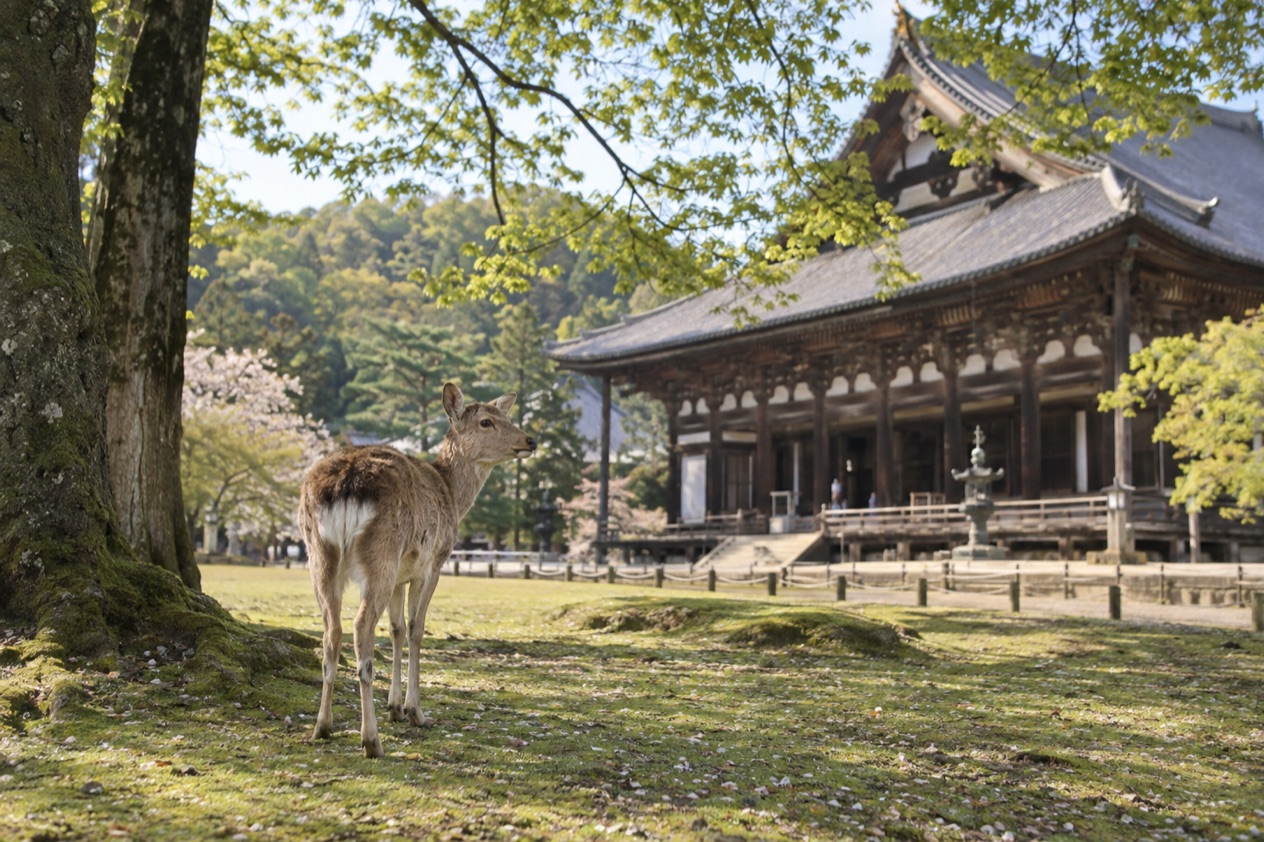
In May the deer of Nara Park stand in the shade of maples that have turned a bright new green, and they bow their heads at anyone holding a cracker. The big temple roofs sit above the leaves, and the lanes between them fill with the sound of people walking, laughing and handing over snacks to very patient animals. Nara in May is a city of temples, shrines and open lawns in a mild late-spring mood, and it suits travelers who like to spend whole days outdoors.
What is the weather like in Nara in May?
May in Nara is warm and mostly pleasant, with afternoons that feel like early summer and evenings that cool down enough for a light layer.
| Month | Average high (°F) | Average low (°F) | Precipitation (in) | Days with 1 mm or more of precipitation | Hours of sunshine | Daylight on the 15th |
|---|---|---|---|---|---|---|
| April | 67.6 | 47.7 | 3.89 | 9.6 | 173 | 13 h 01 min |
| May | 76.8 | 57.0 | 5.45 | 10.0 | 188 | 13 h 57 min |
| June | 82.6 | 65.1 | 7.25 | 11.7 | 139 | 14 h 28 min |
Afternoons in the mid-70s are comfortable for a day of walking through Nara Park, and a T-shirt is enough while the sun is out. Mornings and evenings are cooler, so a thin jacket or a simple sweater is useful at both ends of the day, as it is for most of Japan in spring.
Rain falls on about one day in three, often as a passing shower rather than a whole gray day, and the month is wetter than April. A compact umbrella or light rain jacket belongs in the daypack, because the park and the temple precincts are open-air places with few places to shelter between the buildings.
The days are long, and the light stays on the lawns and the temple roofs well into the evening. That leaves room for a late visit to a shrine or a slow dinner after the sightseeing is done.
What to do in Nara in May
The month begins inside Golden Week, the string of holidays that runs from late April into the first days of May. Constitution Memorial Day falls on May 3, Greenery Day on May 4 and Children’s Day on May 5. Children’s Day is the one with a visible tradition: carp-shaped streamers (koinobori) flutter from poles and balconies across Japan, and you may spot them on houses and shopfronts around the city.
The cherry blossom is long over by now, since the Somei-Yoshino trees reach the Kinki region in late March. May belongs to leaves instead. The maples and zelkovas that frame the paths of Nara Park are in fresh spring green, and the lawns are bright.
Nara is an ancient capital, and Heijokyo, which dates back to the Nara Period, was Japan’s first capital. The city is a place to walk, look up at wooden halls and take your time between sights.
Food is part of the day here. Nara is known for kakinoha-zushi, small pieces of pressed fish sushi wrapped in persimmon leaves, and for narazuke, vegetables pickled in sake lees. Chagayu, rice cooked in tea, is another local plate, and the cafés near the park serve kuzu sweets and cold green tea that taste right in warm May afternoons.
Nara Park and the deer
Nara Park sits at the foot of Mount Wakakusa and covers a vast area, so the first impression is of space: wide lawns, ponds, stone lanterns and tree-lined paths. The deer roam freely, and according to legend they are the envoys of the god of Kasuga Taisha, who is said to have ridden a white deer.
That is why they have protected status. The animals are tame, and visitors can approach and feed them with deer crackers sold along the roadside and around the park.
The deer learn quickly who is carrying crackers, so expect a small crowd of them to form around you. Holding a cracker up high and feeding them one at a time makes it easier to manage. In May the grass is green and the paths shaded, which makes it a good month for a long wander with no fixed destination, for families and for anyone who likes animals.
Getting to Nara from Osaka is simple by rail. The Kintetsu limited express from Osaka-Namba Station reaches Kintetsu Nara Station in 35 minutes. It costs 520 yen more than the regular express, which takes a little longer. Kintetsu Railway and JR West both serve the city, and from the stations the park opens up on foot.
Todai-ji and the Great Buddha
Todai-ji is a Buddhist temple complex in Nara Park, and it houses a Buddha statue 15 meters high. The temple, the Great Buddha and the wild deer are the well-established symbols of Nara.
You walk up through the gate and across the forecourt toward an enormous wooden hall, then step inside to stand beneath the seated bronze figure. The scale of the room is what stays with visitors, and the hall’s dim interior makes a cool break after a warm walk.
Smoking and drone photography are prohibited in the precincts. The temple belongs to the eight places inscribed since 1998 as the UNESCO World Heritage Site Historic Monuments of Ancient Nara. A shower in May does not ruin a visit here, because much of the time goes into the main hall and the quiet corners around it.
Kasuga-taisha and the old forest
Kasuga-taisha is a Shinto shrine in Nara, and it is the home of the god whose white deer gave the park’s animals their sacred status. The approach leads through trees, and the path is lined with stone lanterns. The shrine is part of the same UNESCO inscription as Todai-ji, and the inscription also includes a primeval forest, which gives the whole walk a woodland feel.
In May the shade under the trees is welcome, and the green canopy softens the light on the vermilion halls. The shrine pairs well with Todai-ji in a single day, since both lie within the park. Allow time to wander slowly here rather than ticking it off.
A two-day itinerary for Nara in May
Day 1 belongs to Nara Park. Start in the morning with the deer and the lawns, and buy a few crackers from one of the roadside sellers. Walk to Todai-ji for the Great Buddha hall, and have lunch at one of the small restaurants around the park, where kakinoha-zushi or a bowl of noodles is easy to find.
In the afternoon, follow the lantern-lined paths to Kasuga-taisha and its forest. The days are long in May, so there is time to linger under the trees and stay for a slow dinner back in town, perhaps in an izakaya, a casual pub with small plates. If rain arrives, the main hall of Todai-ji works as shelter, and a cafe stop with kuzu sweets fills a gray hour.
Day 2 moves to the old town and the ancient capital. Begin at Kofuku-ji, the Buddhist temple whose pagoda rises near the park, then wander Naramachi, the former merchant quarter, where lanes of traditional wooden houses hold small shops, cafes and craft stores. Lunch can be a set meal of local pickles and rice.
In the afternoon, head out to the site of Heijokyo, Japan’s first capital, a wide open space where the long history of the Nara Period is easier to picture than to see. For a rainy day, the Nara National Museum and the shops and cafes of Naramachi keep the plan intact. End with a meal of narazuke and rice, or a drink in town.
Is Nara busy in May?
The start of the month is shaped by Golden Week, the holiday period that runs from April 29 to May 5 and contains four official public holidays. Showa Day on April 29, Constitution Memorial Day on May 3, Greenery Day on May 4 and Children’s Day on May 5 are the days that set the calendar for the first part of the month.
Japan also has rules that add holidays around these. When a national holiday falls on a Sunday, the next working day becomes a public holiday, known as furikae kyujitsu. Any day that falls between two other national holidays becomes a holiday too, known as kokumin no kyujitsu. In some years these rules stretch the time off, so the shape of the holiday calendar shifts from one spring to the next.
After Golden Week, May settles into a calmer rhythm. The cherry blossom season is behind the city, and the month is about green leaves and open-air walking. Nara Park is large, and the deer, temples and shrines are spread across it, which gives visitors plenty of room to move at their own pace.
What to pack for Nara in May
Nara in May asks for light layers and a plan for a passing shower. Most of the time is spent outdoors, on paths and lawns and in temple precincts.
- A light jacket or simple sweater, for the cooler mornings and evenings.
- A compact umbrella or thin rain jacket, since showers come on about one day in three.
- Comfortable walking shoes, because Nara Park covers a large area.
- A sun hat and sunscreen, for long afternoons on open lawns.
- A small daypack, to carry layers and a bottle of water between sights.
Good to know before you go
May opens during Golden Week, so the public holidays of the first days shape the calendar. In urban areas, shops are generally open from 10:00 a.m. to 8:00 p.m. every day, while in rural areas they often close earlier, sometimes as early as 6:00 p.m.
Getting around the city is straightforward. Kintetsu Railway and JR West operate rail service throughout Nara, and Nara Kotsu runs an extensive bus network that reaches remote areas the trains do not. The Gurutto buses in Nara City cost 100 yen per trip.
Nara in May vs April and June
Moving the trip four weeks earlier brings cooler weather, with lows in the 40s and a lighter sweater needed through the day. Fewer hours of sunshine and slightly less daylight mean shorter outdoor days. April is also the month when the cherry blossom season has just passed in the Kinki region, which gives the park a different feel from May’s deep green.
Moving four weeks later brings real summer warmth. June has the most rain days of the three months, the fewest hours of sunshine and the longest daylight, so the park stays light late but is wetter and more humid. Walking days are still possible, though an umbrella is no longer optional.
Travelers who like mild weather and green scenery, and who want to spend long days outside, should stay with May. Those who want a cooler feel should look to April, and those who do not mind warmth and humidity can look to June for longer evenings.
Is May a good time to visit Nara?
Yes, May suits travelers who want to walk outdoors in warm, bright weather, whether with children, with a love of temples or just for the deer. It is a good month for slow days that mix gardens, halls and shrines with long meals.
Those who dislike the chance of rain, or who want the cherry blossom, should choose another month. The weather is mild and the blossom is finished, so May is not the month for flowers.
On arrival, head first to Nara Park, then to Todai-ji while the day is fresh. What stays with visitors in May is the green of the maples over the temple roofs, and a deer waiting patiently for the next cracker.
Sources
- Japan Meteorological Agency (JMA), Normal values 1991-2020, monthly (https://www.data.jma.go.jp/stats/etrn/view/nml_sfc_ym.php?prec_no=64&block_no=47780), station Nara, elevation 102 m, checked October 11, 2026
- Computed from the date and the latitude of the place (sunrise equation, solar elevation -0.833 degrees), October 11, 2026
- Japan National Tourism Organization, shop and attraction hours, national holidays (https://www.japan.travel/en/plan/business-hours-and-holidays/), checked October 11, 2026
- Wikipedia, Golden Week (Japan) (https://en.wikipedia.org/wiki/Golden_Week_(Japan)), checked October 11, 2026
- Wikipedia, Public holidays in Japan (https://en.wikipedia.org/wiki/Public_holidays_in_Japan), checked October 11, 2026
- Japan National Tourism Organization, flowers by season: cherry blossom, plum, wisteria, hydrangea, where and when (https://www.japan.travel/en/see-and-do/flowers/), checked October 11, 2026
- Wikipedia, Wisteria (https://en.wikipedia.org/wiki/Wisteria), checked October 11, 2026
- Japan Meteorological Agency, sakura2020.pdf (https://www.data.jma.go.jp/sakura/data/sakura2020.pdf), checked October 11, 2026
- Japan National Tourism Organization, spring in Japan (https://www.japan.travel/en/guide/spring-guide/), checked October 11, 2026
- Wikipedia, Kanda Matsuri (https://en.wikipedia.org/wiki/Kanda_Matsuri), checked October 11, 2026
- Wikipedia, Sanja Matsuri (https://en.wikipedia.org/wiki/Sanja_Matsuri), checked October 11, 2026
- Japan National Tourism Organization, festivals and events (https://www.japan.travel/en/see-and-do/festivals-and-events/), checked October 11, 2026
- Wikipedia, Gion Matsuri (https://en.wikipedia.org/wiki/Gion_Matsuri), checked October 11, 2026
- Wikivoyage, Nara (https://en.wikivoyage.org/wiki/Nara), checked October 11, 2026
- Japan National Tourism Organization, Nara (https://www.japan.travel/en/destinations/kansai/nara/nara-park-and-around/), checked October 11, 2026
- Official Nara Travel Guide, getting around Nara (https://www.visitnara.jp/getting-around-nara/), checked October 11, 2026
- Official Nara Travel Guide, first-time visitors (https://www.visitnara.jp/for-first-time-visitor/), checked October 11, 2026
- Official Nara Travel Guide, Nara Park area (https://www.visitnara.jp/destinations/area/nara-park/), checked October 11, 2026
- Todai-ji Temple, official site (https://www.todaiji.or.jp/en/), checked October 11, 2026
- Wikipedia, Tōdai-ji (https://en.wikipedia.org/wiki/T%C5%8Ddai-ji), checked October 11, 2026
- Wikipedia, Nara Park (https://en.wikipedia.org/wiki/Nara_Park), checked October 11, 2026
- Wikipedia, Kasuga-taisha (https://en.wikipedia.org/wiki/Kasuga-taisha), checked October 11, 2026