
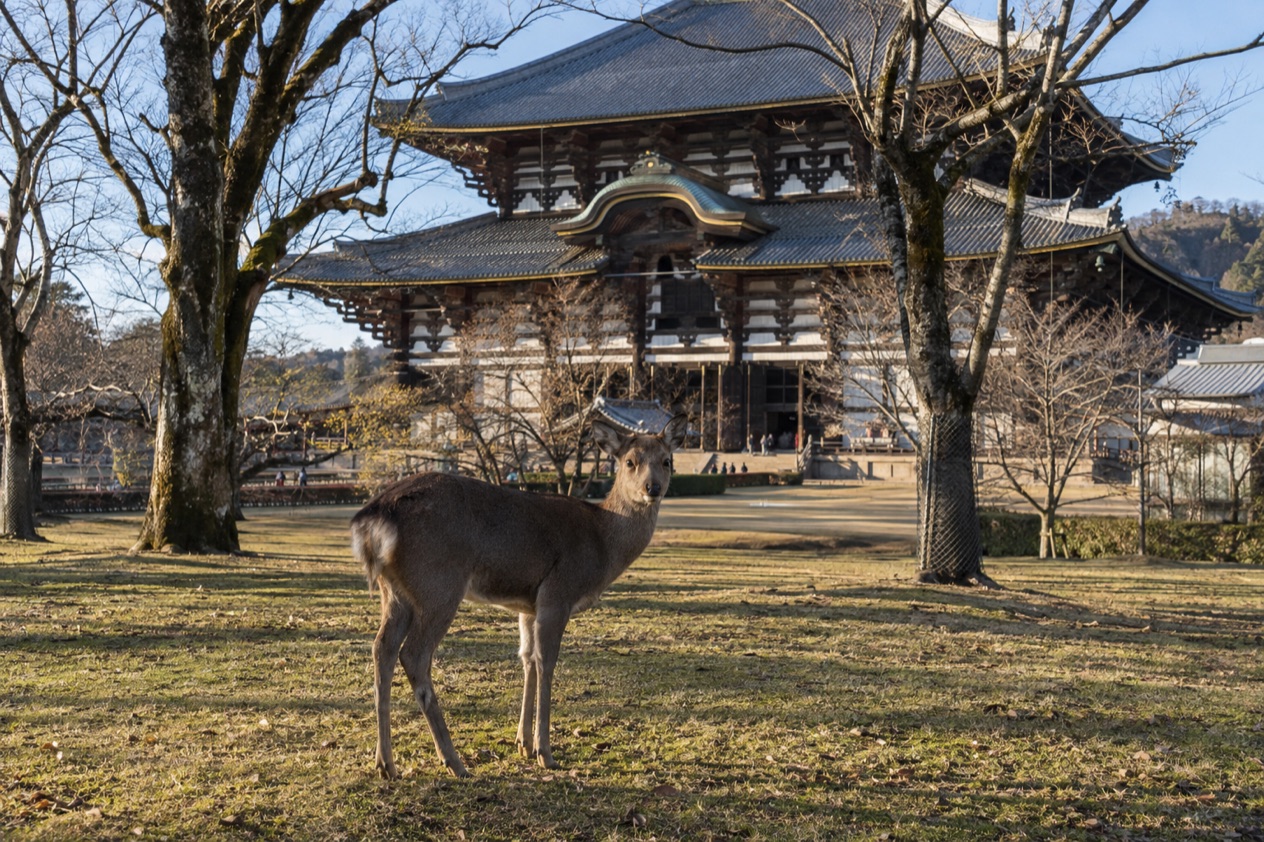
On a February morning in Nara, roasted soybeans rattle against shrine boards during Setsubun and the stone lanterns along the approach to Kasuga Taisha wait to be lit. Deer stand steaming in the frosty grass of the park. Cherry trees are still bare, but the first plum blossoms open on the temple grounds. It is a month for walking among old wooden halls in cool, bright air, before the spring crowds arrive.
What is the weather like in Nara in February?
February in Nara is cold but not harsh: cool days, frosty nights, modest rain and flurries that seldom amount to much.
| Month | Average high (°F) | Average low (°F) | Precipitation (in) | Days with 1 mm or more of precipitation | Hours of sunshine | Daylight on the 15th |
|---|---|---|---|---|---|---|
| January | 47.7 | 33.4 | 2.06 | 6.2 | 118 | 10 h 04 min |
| February | 49.8 | 33.8 | 2.48 | 6.9 | 121 | 10 h 55 min |
| March | 57.0 | 38.5 | 4.14 | 9.9 | 158 | 11 h 55 min |
Winter coats stay on all month. The highs sit around 50°F, which is fine for walking outdoors if you dress in layers, and the nights drop to just above freezing. Stone paths, temple floors and open courtyards hold the chill, so a warm base layer matters more than a heavy parka.
Precipitation is light, and some of it falls as snow or sleet. Flurries turn up on a good share of the days, yet the total snowfall for the month is only about an inch, so the city rarely turns white for long. An umbrella and shoes that handle wet gravel cover most of it. When a snowy morning does happen, the deer, the pagoda roofs and the bare branches make a striking scene.
Daylight is lengthening, and the days feel noticeably longer than in January. Sunshine is moderate, so expect a mix of bright spells and gray skies rather than a steady run of either.
What to do in Nara in February
The big date of the month is Setsubun, the eve of spring in the old calendar. At homes and shrines, people throw roasted soybeans called fukumame while shouting “Oni wa soto! Fuku wa uchi!” (Devils out! Fortune in!), sometimes aiming at someone in an oni mask. Afterward, the custom is to eat one bean for each year of your age, plus one extra for luck in the coming year.
In Nara the occasion has a special setting. Kasuga Taisha is known for its Setsubun lantern festival, when the many lanterns that line the approach and hang from the shrine’s eaves are lit. Dates move a little from one year to the next, so plan around early February rather than a fixed evening.
Nara Park, the deer and Todai-ji
Nara Park sits at the foot of Mount Wakakusa, and the deer are the first thing you notice. According to legend, the god of Kasuga Taisha rode a white deer, so the animals are treated as envoys of the god. Crackers sold along the roadside are for feeding them, and in cold weather the deer are quick to spot a visitor holding a packet.
Todai-ji is the park’s great monument. The temple’s main hall is described as the largest wooden building in the world, and it houses the world’s largest bronze Buddha. Standing in front of the statue on a gray winter day, with your breath visible in the doorway, gives the temple a weight that bright summer light does not.
Walk the park without a fixed plan. Between the temple and the shrine, the paths run through cedar and maple woods, past moss-covered lanterns and little tea stalls. In February the bare trees open up views of the hillside and the pagoda of Kofuku-ji.
Kasuga Taisha and the plum blossoms
Kasuga Taisha is the Shinto shrine at the heart of the park, reached by a long approach of stone lanterns under tall trees. It belongs, with Kasugayama Primeval Forest behind it, to the group of sites inscribed as the Historic Monuments of Ancient Nara. The vermilion halls stand out sharply against the winter woods.
February is also the tail end of the plum season. Prunus mume typically flowers from January until late February in East Asia, so you may find white or pink buds on temple grounds and in gardens, often before a single cherry bud has swelled. Plum blossoms are small and fragrant, and they reward a slow look from close up.
Temples west of the park and old Heijo
Beyond the park, Nara has more temples that are part of the same World Heritage group: Yakushi-ji, Toshodai-ji, Saidai-ji and Gango-ji. Each has its own halls and gardens, and in winter their gravel courtyards and dark timber look severe and beautiful. Together they make a day of quiet, unhurried temple visits.
The site of the Heijo Palace is another stop. Heijokyo was Japan’s first capital, dating back to the Nara Period, and today it is an open expanse with reconstructed buildings. On a cold clear day the wide grounds feel spare and impressive, and a layer or two more than you think you need is welcome.
Food keeps the cold at bay. Nara is known for kakinoha-zushi (sushi wrapped in persimmon leaves), narazuke pickles, and kuzu sweets made from kudzu starch. Hot amazake, a sweet fermented rice drink, and bowls of noodles or rice porridge suit the weather. Small cafés and tea rooms in the lanes of the old merchant quarter make good stops when you need a warm room.
If you want snow, Nara itself is not the place, since most major cities rarely see it. Ski season generally runs from December to April, with peak snowfall in Hokkaido and the high mountains of Nagano in January and February. Nara is better as a winter city for temples and food than as a base for snow sports.
A two-day itinerary for Nara in February
Day 1 belongs to Nara Park. Arrive at Kintetsu Nara Station and start early, since winter daylight is limited, with a walk toward Kofuku-ji and its pagoda. Continue to the deer area and buy crackers, then head to Todai-ji for the Great Buddha hall. Midday suits a simple lunch of noodles or kakinoha-zushi at a small place near the park.
In the afternoon, climb the gentle approach toward Kasuga Taisha through the lantern-lined woods and spend time on the shrine grounds. Early in the month, stay until dusk for the lantern lighting if Setsubun falls on your dates. For dinner, look for a warm izakaya, a casual Japanese pub, in the old town lanes. If rain or sleet arrives, shift to covered halls and tea rooms.
Day 2 moves west to the other temples. Begin at Yakushi-ji and Toshodai-ji, which sit close enough to pair in a morning, and see Saidai-ji and Gango-ji if you have energy. Lunch can be a bowl of hot noodles or a teishoku set meal near the stations.
Spend the afternoon at the Heijo Palace site, with its wide grounds and reconstructed gate, and keep the late light for the walk back. In the evening, wander the old merchant lanes for pickles, sake and sweets from kuzu. On a rainy day, trade the open palace grounds for museums and tea rooms in town.
Is Nara busy in February?
February sits in the cold stretch before Nara’s spring season, and the city’s big seasonal draw comes later. The usual first bloom of cherry blossoms at Nara arrives around the end of March, with full bloom in the first days of April, so the cherry crowds belong to a different month.
What February offers instead is a winter version of the city: plum buds, Setsubun rituals, and bare trees that open up views of the temples. Nara Park and Todai-ji are well-established symbols of the city, so you will still share the paths with other visitors, but the pace is set by cold weather and shorter days rather than a blossom rush.
The ski regions are in their peak season during these weeks, which draws winter travelers toward the mountains of Hokkaido and Nagano. Nara is a different kind of trip, one built on temples, food and slow walks. Traveling here in February fits people who prefer a low-key itinerary and are comfortable with cold air.
What to pack for Nara in February
Think layers for outdoor temple days, with warm options for evenings and wet gravel.
- A warm coat, since highs stay near 50°F and nights are cold.
- Thermal layers and a scarf, for courtyards and open palace grounds.
- Waterproof shoes with grip, for wet gravel and the odd flurry.
- A compact umbrella, for light rain and sleet.
- Gloves and a hat, for the walk to Kasuga Taisha after dark.
- Slip-on shoes or warm socks, since temple halls and some tea rooms ask you to remove your shoes.
Good to know before you go
February falls after the New Year holidays, when many restaurants and attractions are closed, so the city is back to its regular rhythm. Rail runs through Nara on the Kintetsu and JR West lines, and Nara Kotsu buses reach places the trains do not. The Gurutto buses in the city cost 100 yen per trip. From Osaka-Namba, the Kintetsu limited express reaches Kintetsu Nara Station in 35 minutes.
Setsubun dates and the exact schedule of lantern events can shift, so treat early February as the window rather than a single evening. With flurries possible, keep a little flexibility in the day and a warm indoor stop in mind.
Nara in February vs January and March
Moving four weeks earlier brings you to the coldest stretch, with slightly cooler days and shorter daylight. January also sits closer to the New Year holidays, when many restaurants and attractions are closed. The plum season is already under way, but the days are the shortest of the three months.
Moving four weeks later changes the mood a great deal. March is noticeably warmer and wetter, with more rain days and more sunshine. Plums are fading and the first cherry blossoms approach, usually around the end of the month. Walks get easier to enjoy, and the park starts to feel like spring.
Choose February if you want Setsubun and plum blossoms with winter light and a cold-weather feel. Shift to March if you want milder walking weather and the lead-up to the cherry season, and consider January only if you prefer the deepest winter mood.
Is February a good time to visit Nara?
Yes, for travelers who like cool-weather sightseeing, old temples and seasonal rituals, and who are ready to dress in layers. February suits people who would rather see Todai-ji under a gray sky than in bright crowds.
It is less suited to anyone counting on cherry blossoms or warm afternoons, since both come later. If snow sports are the goal, the mountains of Hokkaido and Nagano are the better destination. On arrival, start in Nara Park with the deer, Todai-ji and the lantern-lined path to Kasuga Taisha, then plan your temple days around the weather.
What is special about February here is the mix of old rituals and early signs of spring: soybeans thrown at Setsubun, plum buds opening on bare branches and deer in frosty grass in the park beside a thousand-year-old temple.
Sources
- Japan Meteorological Agency (JMA), Normal values 1991-2020, monthly (https://www.data.jma.go.jp/stats/etrn/view/nml_sfc_ym.php?prec_no=64&block_no=47780), station Nara, elevation 102 m, checked October 11, 2026
- Computed from the date and the latitude of the place (sunrise equation, solar elevation -0.833 degrees), October 11, 2026
- Wikipedia, Setsubun (https://en.wikipedia.org/wiki/Setsubun), checked October 11, 2026
- Japan National Tourism Organization, festivals and events (https://www.japan.travel/en/see-and-do/festivals-and-events/), checked October 11, 2026
- Sapporo Snow Festival official website (https://www.snowfes.com/english/), checked October 11, 2026
- Wikipedia, Sapporo Snow Festival (https://en.wikipedia.org/wiki/Sapporo_Snow_Festival), checked October 11, 2026
- Japan National Tourism Organization, winter in Japan (https://www.japan.travel/en/guide/winter-guide/), checked October 11, 2026
- Japan National Tourism Organization, skiing and snowboarding in Japan: regions, resorts, seasons (https://www.japan.travel/en/sports/snow/), checked October 11, 2026
- Wikipedia, Climate of Japan (https://en.wikipedia.org/wiki/Climate_of_Japan), checked October 11, 2026
- Japan National Tourism Organization, flowers by season: cherry blossom, plum, wisteria, hydrangea, where and when (https://www.japan.travel/en/see-and-do/flowers/), checked October 11, 2026
- Wikipedia, Prunus mume (https://en.wikipedia.org/wiki/Prunus_mume), checked October 11, 2026
- Japan National Tourism Organization, skiing guide (https://www.japan.travel/en/guide/skiing/), checked October 11, 2026
- Wikipedia, List of ski areas and resorts in Japan (https://en.wikipedia.org/wiki/List_of_ski_areas_and_resorts_in_Japan), checked October 11, 2026
- Japan National Tourism Organization, weather and seasons in Japan (https://www.japan.travel/en/plan/weather/), checked October 11, 2026
- Japan Meteorological Agency, cherry blossom first-bloom dates 2021-2026 and 1991-2020 normal (https://www.data.jma.go.jp/sakura/data/sakura003_07.html), checked October 11, 2026
- Japan Meteorological Agency, cherry blossom full-bloom dates 2021-2026 and 1991-2020 normal (https://www.data.jma.go.jp/sakura/data/sakura004_07.html), checked October 11, 2026
- Wikipedia, Nara, Nara (https://en.wikipedia.org/wiki/Nara,_Nara), checked October 11, 2026
- Wikivoyage, Nara (https://en.wikivoyage.org/wiki/Nara), checked October 11, 2026
- Japan National Tourism Organization, Nara (https://www.japan.travel/en/destinations/kansai/nara/nara-park-and-around/), checked October 11, 2026
- Official Nara Travel Guide, getting around Nara (https://www.visitnara.jp/getting-around-nara/), checked October 11, 2026
- Official Nara Travel Guide, first-time visitors (https://www.visitnara.jp/for-first-time-visitor/), checked October 11, 2026