
In August the cicadas drone in the cedars around Nara Park, and the deer lie in the shade of the trees with the look of animals who have settled the question of the heat. Stone lanterns line the approaches to the shrines, waiting for the evenings when candles are lit inside them. The city is hot and sticky, but it rewards slow days, long pauses under old roofs and a cold bowl of noodles in the middle of them.
What is the weather like in Nara in August?
August in Nara is hot, humid and the sunniest of the three summer months, with fewer rainy days than July before the weather starts to soften in September.
| Month | Average high (°F) | Average low (°F) | Precipitation (in) | Days with 1 mm or more of precipitation | Hours of sunshine | Daylight on the 15th |
|---|---|---|---|---|---|---|
| July | 89.1 | 73.4 | 6.83 | 11.2 | 157 | 14 h 17 min |
| August | 92.1 | 75.4 | 5.04 | 8.0 | 203 | 13 h 30 min |
| September | 83.8 | 68.2 | 6.26 | 10.0 | 152 | 12 h 27 min |
The nights barely cool the city down, so you will feel the warmth even after dark. Humidity hovers around 70 percent, which is why the air in Nara feels thick and why Honshu summers are described as hot and sultry. Light, loose clothes that dry quickly are the sensible choice, and you will likely want a change of shirt by the end of the day.
Rain comes in fewer spells than in July, but when it arrives it can be heavy, so a compact umbrella earns its place in the bag. Many travelers also find that an umbrella doubles as a parasol on the long, open paths of the park. Sunshine is generous this month, and the sun is strong enough that a hat and sunscreen matter.
The long daylight means evenings stretch out, which suits the lantern nights and a late dinner. Temple and shrine grounds are mostly outdoors, with gravel, stone steps and wooden halls, so comfortable shoes that can handle a wet path are better than anything delicate.
What to do in Nara in August
Nara in August is about the old capital’s great grounds, the lantern evenings around its shrines and cool food between the walks. Heijokyo, the city’s ancient capital site, dates back 1300 years to the Nara Period, and the three World Heritage sites here take in ancient monuments, sacred mountain trails and some of Japan’s oldest temples and shrines. In the summer heat, the trick is to pair each outdoor stretch with a roofed or shaded pause.
Nara Park, the deer and Todai-ji
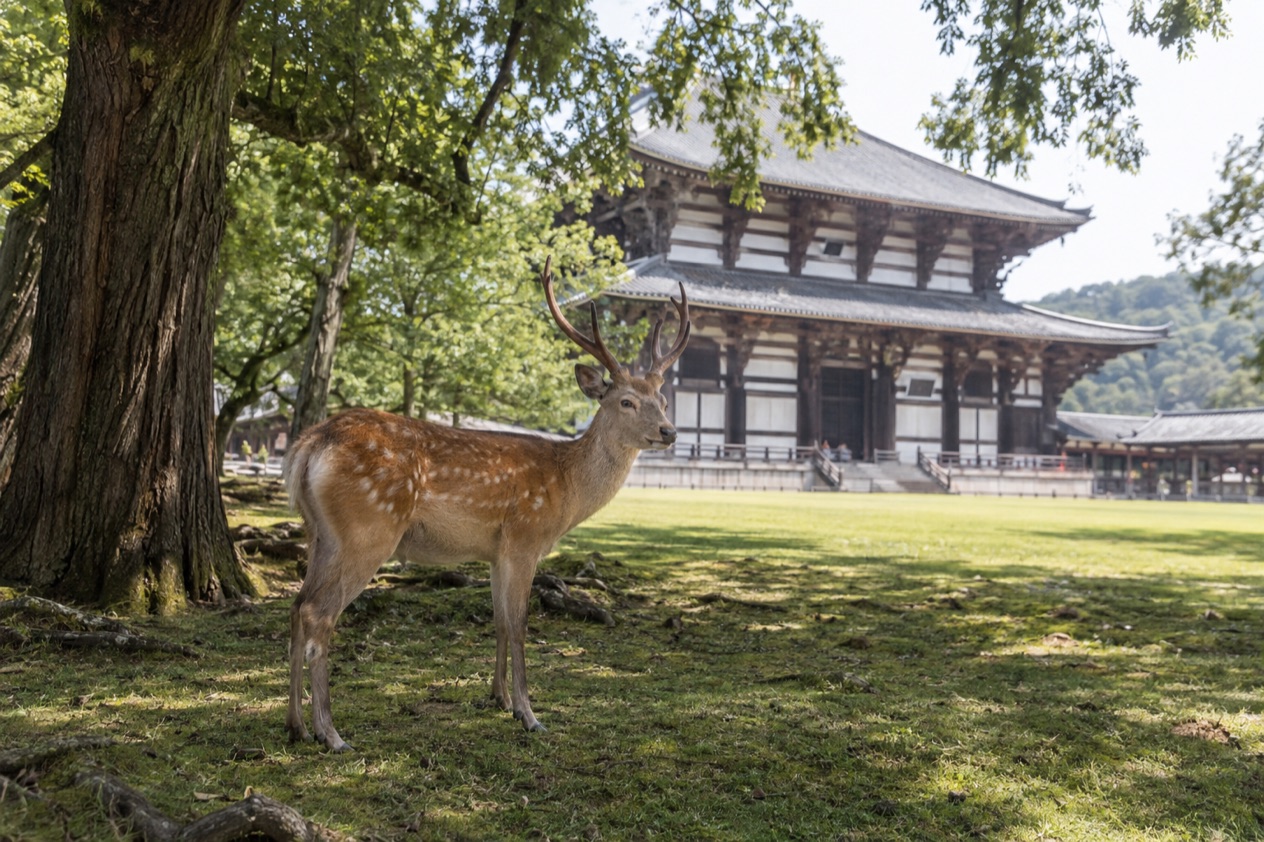
Nara Park sits at the foot of Mount Wakakusa, and its tame deer are the first thing most people picture. Special crackers for feeding them are sold all around the park, and the animals will come over as soon as you hold one up. In August the deer often rest in the shade, and the park feels more like a very large, open woodland than a sightseeing stop.
Todai-ji, with its Great Buddha, is among the established symbols of Nara. Walking toward it through the park, you pass lawns, ponds and stone lanterns, and then the huge wooden hall appears. Inside, the seated Buddha fills the room with a presence that has little to do with the weather outside, and the cooler air under the roof is a relief in itself.
Pair this visit with a slow lunch rather than hurrying on. The park is large, so plan on a loop with a stop at a tea house or a shaded bench, and carry water. Travelers who love temples and animals in equal measure will find it the most rewarding day in the city.
Lantern nights at Kasuga Taisha
Kasuga Taisha is known for its lanterns, and in mid-August they take on a different life. Around the time of Obon, when families honor their ancestors, the lanterns of the shrine are lit in an evening lantern festival, and the long approach glows with a soft orange light. The effect is the opposite of the daytime heat: dark trees, warm points of flame and the sound of footsteps on stone.
Obon is a Buddhist custom to honor the spirits of one’s ancestors, and people return to ancestral family places and clean graves. It lasts three days, and Nara feels it as a shift in pace, with families passing through and a more reflective mood in the temples. Another lantern event in the park in early to mid August lights its paths after dusk, and walking among the candles is one of the loveliest things you can do in Nara this month.
The mood is respectful and unhurried. Shoes stay on the paths and voices drop as the lights come on, and the evening works well after a day with a long break in the middle.
Food for a hot month
August cooking in the Nara area leans toward cold noodles. Somen, the thin wheat noodles, are served chilled with a dipping sauce and make a light lunch when the heat takes your appetite. Kakigori, shaved ice with syrup, is sold at tea houses and stalls, and a bowl of it with sweet red bean is a classic way to cool down.
Kakinoha-zushi, pressed sushi wrapped in persimmon leaves, is a regional specialty that travels well and makes a good picnic. Nara-zuke, vegetables pickled in sake lees, appears at the table as a salty side. For the evening, an izakaya (a casual pub) with cold beer and grilled skewers suits the long dusk well.
Other places and ways to spend the day
Kofuku-ji, with its pagoda, stands near the park and makes an easy addition to a loop through the park. The old merchant streets of Naramachi are lined with wooden houses, small shops and cafés, and ducking into them gives you a break from the sun. Both take you out of the open park for a while without leaving the history behind.
The Heijo Palace site, the old capital’s ground, is a wide open space, so the heat and the sun are felt fully there. The reconstructed gates and halls repay the visit for travelers who care about early Japan. Nara Kotsu buses reach places the trains do not, and the Gurutto buses in the city cost 100 yen per trip, a gentle way to cross town without walking in the heat.
A two-day itinerary for Nara in August
Day 1 is Nara Park and Todai-ji. Start with the park at the beginning of the day, feeding the deer and walking up to the Great Buddha hall while the air is as cool as it will get. The park is the most exposed part of the trip, so it is better done first, with water in hand and a hat on.
At midday, move to a cooler setting. A cold noodle lunch in a restaurant near the park fits the heat, and an hour in a café or a tea house gives you time to rest. In the afternoon, visit Kofuku-ji and its pagoda, which sit close to the park and need little walking in the sun.
For the evening, go to Kasuga Taisha for its lanterns, and if the mid-August lantern events are on, stay for the glow. Dinner can be at an izakaya in town. If rain sets in, Todai-ji’s great hall and the temple halls give you roofs, and a long lunch can stretch the middle of the day.
Day 2 turns to the town and the old capital. Begin in Naramachi, where the merchant houses, small galleries and cafés fit a slow morning, and the shade of the lanes helps. Stop for kakigori or a tea before heading on.
In the afternoon, take a bus out to the Heijo Palace site, the old capital’s grounds, when the day’s heat has settled in. Bring water, because the site is open and sunny, and treat it as a short, focused visit with the sun on your shoulders.
Return to the center for the evening, with a pickled-vegetable side and a grilled dinner. On a wet day, use the covered arcades of Naramachi and a long meal.
Is Nara busy in August?
August in Nara is a month of movement more than a month of fixed crowds, because Obon sends families traveling to their ancestral places. The city sits in the middle of Japan’s busiest family travel period, and the lanterns and festivals bring people out in the evenings.
Obon is a three-day custom in which people return to ancestral homes and visit and clean graves. For Nara, that means a mid-month rhythm, with local families at the shrines and the lantern events drawing evening visitors. Beyond those days, the heat itself shapes the pace, and many travelers choose to move around early or late.
Shops in urban areas are generally open from 10:00 a.m. to 8:00 p.m. every day, and in the long evening light, the town stays active well after the sun starts to set. Rural areas often close earlier, which matters if you head to outlying sights. The lantern evenings are where the city feels busiest, with people strolling through the dark paths of the park.
If you want the deer and Todai-ji with fewer people around, the practical approach is to lean on the long daylight and arrange the heaviest walking at the edges of the day. The middle can be spent in cafés and indoor halls.
What to pack for Nara in August
Pack for heat, humidity and a lot of walking on gravel and stone, with a little rain gear for the showers.
- Lightweight, breathable clothes that dry fast, since humidity makes everything feel damp.
- A hat and sunscreen for the open grounds of the park and the old capital site.
- A compact umbrella, useful for rain and as shade.
- Comfortable, closed shoes that cope with gravel and wet paths.
- A reusable water bottle, because the long walks in the heat call for it.
- A small towel or handkerchief for wiping off sweat between stops.
Good to know before you go
August is part of Japan’s hot, humid summer, and the rains of the season can still arrive in heavy bursts. Mid-month brings Obon, and when a national holiday falls on a Sunday, the next working day becomes a public holiday, which can add to the movement around the calendar. Shops in town are generally open from 10:00 a.m. to 8:00 p.m. every day.
Getting around the city is simple on paper: the Kintetsu Railway and JR West both run rail service throughout Nara, and Nara Kotsu buses cover places the rails do not reach. From Kyoto Station, the JR Rapid Express to Nara Station takes approximately 41 minutes, and from Osaka Station the same service takes approximately 52 minutes.
Nara in August vs July and September
Moving the trip to July brings more rain and a little less sunshine, with the longest days of the summer. The light stays on later into the evening, but the number of wet days is higher, and a rainy afternoon is more likely to disrupt a park day. The mood of the city is also less tied to Obon and the lantern evenings of mid-August.
September cools things down, and the highs drop noticeably, making long walks around the park more comfortable. Days are shorter, and the sunshine falls off, but the heavy heat of August eases. The mid-August lantern events and Obon are behind you, so the evenings lose that particular glow.
Travelers who want the lantern nights and the most sunshine should stay with August and plan around the heat. Those who care most about comfortable walking should consider September, and travelers who prefer long evenings with more rain risk can look at July.
Is August a good time to visit Nara?
Yes, for travelers who can handle heat and humidity and who want the lantern evenings of Obon. It rewards people who like to structure a day around a long midday break, and who enjoy temples, shrines and food in equal measure.
It is a harder month for anyone who finds hot, sticky weather draining or who wants to cover a lot of ground on foot. Those travelers will be happier in September, when the highs ease. If you do come in August, start with Nara Park and the Great Buddha at Todai-ji, then plan your evenings around the shrines.
What makes August special here is the evening. The stone lanterns that line the approaches to Kasuga Taisha come alive with flame around Obon, and the old capital, so hot at noon, turns soft and lit after dark.
Sources
- Japan Meteorological Agency (JMA), Normal values 1991-2020, monthly (https://www.data.jma.go.jp/stats/etrn/view/nml_sfc_ym.php?prec_no=64&block_no=47780), station Nara, elevation 102 m, checked October 11, 2026
- Computed from the date and the latitude of the place (sunrise equation, solar elevation -0.833 degrees), October 11, 2026
- Japan National Tourism Organization, shop and attraction hours, national holidays (https://www.japan.travel/en/plan/business-hours-and-holidays/), checked October 11, 2026
- Wikipedia, Obon (https://en.wikipedia.org/wiki/Obon), checked October 11, 2026
- Wikipedia, Public holidays in Japan (https://en.wikipedia.org/wiki/Public_holidays_in_Japan), checked October 11, 2026
- Japan National Tourism Organization, summer in Japan (https://www.japan.travel/en/guide/summer-guide/), checked October 11, 2026
- Japan National Tourism Organization, festivals and events (https://www.japan.travel/en/see-and-do/festivals-and-events/), checked October 11, 2026
- Wikipedia, Hanabi (https://en.wikipedia.org/wiki/Hanabi), checked October 11, 2026
- Japan Meteorological Agency, Emergency Warnings (https://www.jma.go.jp/jma/en/Emergency_Warning/ew_index.html), checked October 11, 2026
- Japan National Tourism Organization, safety information (https://www.japan.travel/en/japan-safe-travel-information/), checked October 11, 2026
- Japan National Tourism Organization, weather and seasons in Japan (https://www.japan.travel/en/plan/weather/), checked October 11, 2026
- Wikipedia, Awa Odori (https://en.wikipedia.org/wiki/Awa_Odori), checked October 11, 2026
- Wikipedia, Climate of Japan (https://en.wikipedia.org/wiki/Climate_of_Japan), checked October 11, 2026
- Japan National Tourism Organization, Mount Fuji guide (https://www.japan.travel/en/fuji-guide/), checked October 11, 2026
- Official website for Mt. Fuji climbing, about the climb (https://www.fujisan-climb.jp/en/about/), checked October 11, 2026
- Wikipedia, Nebuta (https://en.wikipedia.org/wiki/Nebuta), checked October 11, 2026
- Japan National Tourism Organization, Nara (https://www.japan.travel/en/destinations/kansai/nara/nara-park-and-around/), checked October 11, 2026
- Official Nara Travel Guide, getting around Nara (https://www.visitnara.jp/getting-around-nara/), checked October 11, 2026
- Official Nara Travel Guide, first-time visitors (https://www.visitnara.jp/for-first-time-visitor/), checked October 11, 2026
- Official Nara Travel Guide, Nara Park area (https://www.visitnara.jp/destinations/area/nara-park/), checked October 11, 2026
- Official Nara Travel Guide, travel to Nara (https://www.visitnara.jp/travel-to-nara/), checked October 11, 2026