
You pass through the Nandaimon, the Great South Gate, where two huge guardian statues glare down from either side of the passage. Deer wander the approach, and beyond the gate the roof of the Great Buddha Hall rises over the trees, wider and heavier than anything around it. Todai-ji is a visit built around one enormous bronze figure, and it fits comfortably into a day in Nara.
Is visiting Todai-ji worth it?
Yes, for almost anyone who is already in Nara, and especially for travelers who like to stand in front of something that is simply bigger than expected. The Great Buddha Hall is among the sights that photographs prepare you for and still surprise you. Todai-ji is a UNESCO World Heritage Site, listed as one of the Historic Monuments of Ancient Nara, and it feels like the center of gravity of the whole city.
What sets it apart from the other temples and shrines around Nara is scale and setting. The hall is 57 meters long, and it stands in a grounds that begins with a monumental gate and a path lined with deer, so the approach is part of the experience.
Many temples reward you with a garden or a quiet corner. Here the reward is size, and the sense of walking into a space built to hold a single colossal image.
It also works well for mixed groups. Travelers interested in Buddhism, in architecture or in the story of ancient Nara will find plenty to read into.
Children tend to respond to the guardians at the gate, the statue itself and the deer outside, none of which needs explaining. If you want a visit that is more about wandering than monuments, the paths of Nara Park around the temple offer that too, at the foot of Mount Wakakusa.
What to see at Todai-ji
Nandaimon, the Great South Gate
The existing gate dates to the end of the 12th century, and it is a fitting first stop because it announces the scale of everything that follows. Inside stand two Nio guardian statues, each 8.5 meters tall, one on each side of the passage. They are muscular, fierce and wide-eyed, carved to ward off anything that should not enter a sacred place.
Stand close and look up at the faces, then at the tension in the arms and legs. The gate is also where the deer tend to gather, so you may find yourself sharing the path with them as you pause to take it in.
The Great Buddha Hall (Daibutsuden)
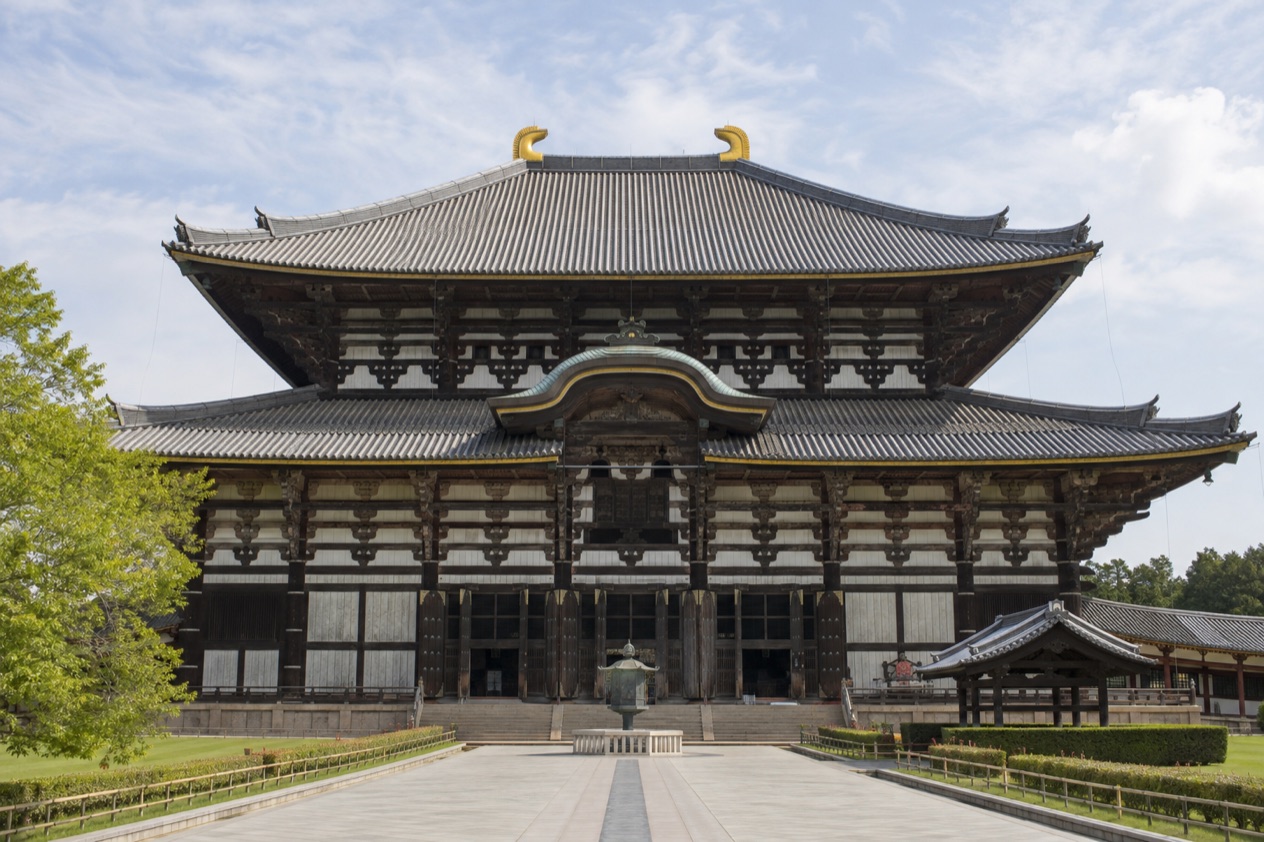
The hall is 57 meters long, 50 meters wide and 49 meters high, a vast wooden building whose heavy roof dominates the compound. Inside sits the Great Buddha, the Daibutsu, a bronze figure 14.98 meters tall and weighing 500 tonnes. Seen from the floor, the face and the raised hand seem to belong to another scale of human effort altogether.
Take time to walk around the figure and look at the surrounding details rather than only at the face. One of the supporting posts has a hole said to be the same size as one of the Daibutsu’s nostrils. Tradition holds that those who pass through it are blessed with enlightenment in their next life, and you may see people lining up to try it.
Nigatsu-do and the Shuni-e festival
Nigatsu-do is the hall where the Shuni-e festival is held from March 1 to 14. If your trip falls in early March, it gives the visit a dimension beyond the statues.
Outside those dates the hall remains part of the temple grounds and worth a look as you explore beyond the main axis. Treat it as an addition to the Daibutsuden visit rather than a separate outing.
The Culture Center and its museum
The Todai-ji Culture Center opened on October 10, 2011, and includes a museum that exhibits sculptures and treasures from the temple halls. It is a place to see pieces up close that are otherwise part of the architecture or kept inside the halls. It suits travelers who want context for what they have just seen, and anyone who likes to take the story of a temple beyond its largest building.
Hours, tickets and rules
Opening hours for the Great Buddha Hall are published on the official Todai-ji website, which is where the current schedule for the Daibutsuden is given. Check the official Todai-ji website for current Daibutsuden opening hours before your visit.
| Site | Open |
|---|---|
| Daibutsu-den (Great Buddha Hall) | Hours published on the official Todai-ji website |
Smoking and drone photography are prohibited in the precincts. Visitors arriving by motorcycle or bicycle must park in the bicycle parking lot southwest of the Great South Gate before entering. Pushing a motorcycle or a bicycle by hand into the precinct on foot is also prohibited.
When to visit Todai-ji
Nara is a year-round destination, and Todai-ji has a different character in each season. Spring brings mild days, with April highs in the high 60s and a fair share of sunshine. Rain falls on about nine or ten days that month, so a light rain layer is useful.
October is another good moment to walk the grounds. October’s milder days are well suited to walking between the gate, the hall and the park, though rain can interrupt the plan. It is a fairly humid month with rain on about nine days, so showers can interrupt the plan.
July is hot and humid, with highs near 90 and the heaviest rainfall of the months described here, so it is a month for taking things slowly and drinking plenty of water. January is cold, with highs in the high 40s and lows just above freezing. Snow or sleet falls on some days, though accumulation is slight, and the hall’s interior can feel more welcoming after a chilly walk.
For a special date, the Shuni-e festival runs from March 1 to 14 at Nigatsu-do. If your travel dates are flexible, that stretch of early March adds a ritual to what is otherwise a visit to monuments.
Tips for your visit
Wear comfortable shoes, because the visit is a walk from the approach through the gate to the hall and its surroundings. A light rain layer is sensible in April, July and October, and warm clothing in January. Do not smoke or use a drone for photography in the temple precincts.
Todai-ji sits in Nara Park, so it combines naturally with the deer, which visitors can approach and feed with crackers sold along the roadside. Nara Park and Naramachi are both reached from Nara Station and Kintetsu Nara Station, which makes it simple to build a day around the temple, the park and the old town.
Getting to Nara is straightforward from the big Kansai cities. The city lies east of Osaka and south of Kyoto, and from Osaka the JR Yamatoji rapid train serves JR Nara Station directly. From Osaka-Namba Station, the Kintetsu limited express reaches Kintetsu Nara Station in 35 minutes and costs 520 yen more than the regular express, which takes 5 minutes longer.
Travelers flying in can use Osaka International Airport (Itami) or Kansai International Airport, both about one hour and fifteen minutes from Nara by bus and train. If you ride a bicycle in town, remember to leave it in the lot southwest of the Great South Gate and walk in.
Good to know before you go
Nara has two main stations, JR Nara Station and Kintetsu Nara Station, and the temple is reached from either through the city and the park. July is the wettest of the four months profiled here, and October also brings regular rain, so a compact umbrella earns its place in your bag. Keep the deer in mind too, since they are used to visitors and to the crackers sold nearby.
Sources
- Todai-ji Temple, official site (https://www.todaiji.or.jp/en/), checked October 11, 2026
- Wikipedia, Tōdai-ji (https://en.wikipedia.org/wiki/T%C5%8Ddai-ji), checked October 11, 2026
- Japan National Tourism Organization, Nara (https://www.japan.travel/en/destinations/kansai/nara/), checked October 11, 2026
- Japan Meteorological Agency (JMA), Normal values 1991-2020, monthly (https://www.data.jma.go.jp/stats/etrn/view/nml_sfc_ym.php?prec_no=64&block_no=47780), station Nara, elevation 102 m, checked October 11, 2026
To plan your stay
- Best Time to Visit Japan: Cherry Blossoms, Autumn Colors, Weather and Festivals
- Where to Stay in Japan: Ryokan, Temple Stays, Capsule Hotels and the Best Cities to Base In
- Sending Luggage from the Airport in Japan: Hands-Free Travel, Hotel Delivery and Coin Lockers
- Know Before You Go to Japan: Entry, Money, Etiquette and Getting Around