
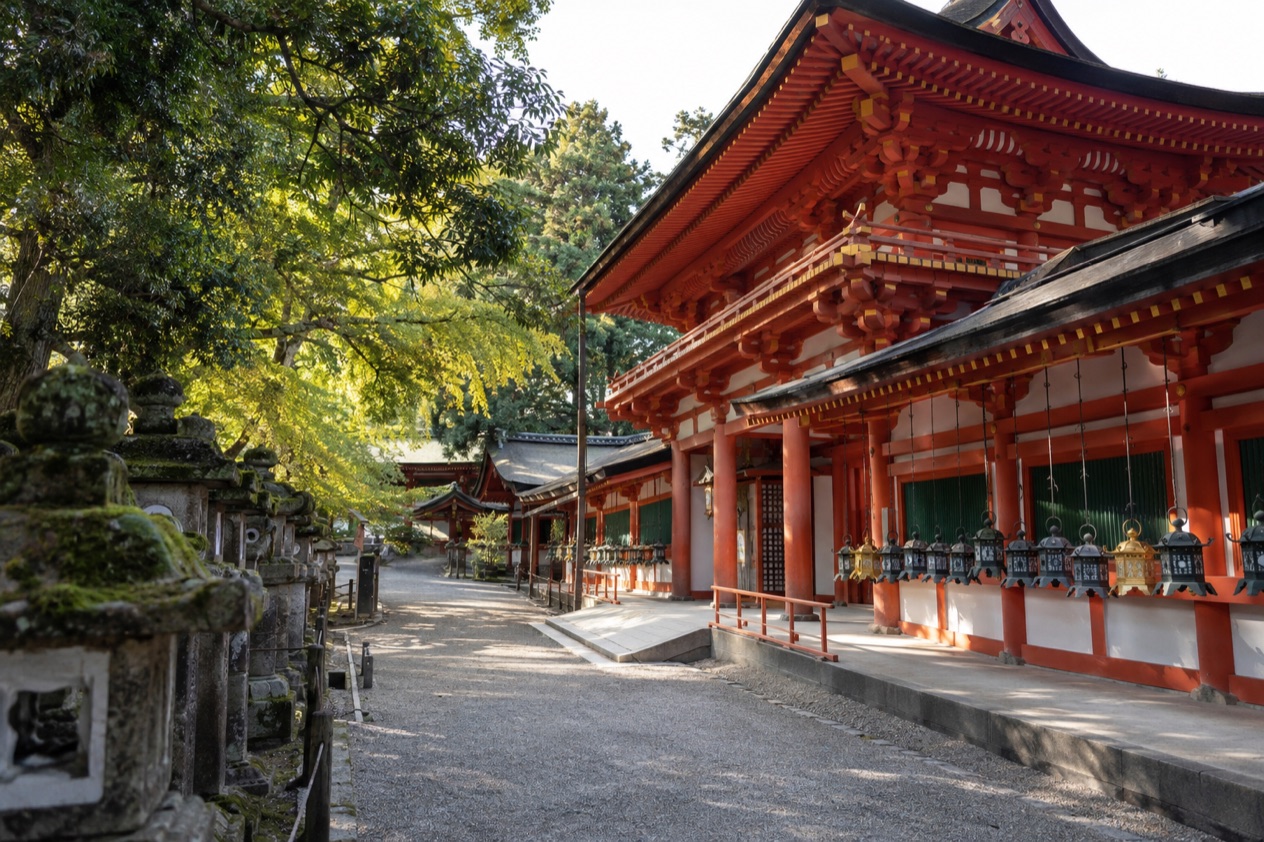
The path to Kasuga Taisha begins among deer that wander the park lawns as if they owned them, then narrows into a lane of moss-covered stone lanterns under tall trees. By the time the vermilion buildings appear, the city has fallen away behind you. This is a shrine in Nara where the walk in is as much a part of the visit as the sanctuary itself, and it suits travelers who like their sightseeing slow and wooded.
Is visiting Kasuga Taisha worth it?
Yes, especially if you like places where the setting does half the work: it suits travelers who enjoy a shrine reached on foot through a park, with lanterns, forest and deer along the way, and it is a good fit for anyone already spending time in Nara. Kasuga Taisha was established in 768 CE, and it is registered as a UNESCO World Heritage Site together with the Kasugayama Primeval Forest behind it, as part of the Historic Monuments of Ancient Nara.
What sets it apart from the other sights around Nara Park is the sense of arrival. Many temples are about a single great hall. Here the experience is a long approach, a forest edge and a shrine whose story is told through its lanterns and its rhythm of rebuilding.
The shrine has been rebuilt every 20 years, and the most recent rebuilding was the sixtieth, in 2016. That habit of renewal, common in Shinto, means the place is meant to be kept fresh rather than preserved as a ruin.
The deer add a lighter note. They are tame animals that visitors can approach, and they are believed to be sacred messengers of the Shinto gods.
Meeting them on the way to a shrine rather than at a viewing area gives the walk a character you will not find at a castle or a museum.
What to see at Kasuga Taisha
The visit unfolds in layers: first the approach, then the main shrine buildings, then the smaller sanctuaries and gardens beside them. Each has its own mood, and the seasons change them more than most places in Nara.
The lantern-lined approach
More than three thousand stone lanterns line the way to the shrine, and many more of stone or bronze hang or stand around the sanctuary itself. Moss and age have softened the stone, and the lanterns stand at different heights and in different shapes, so the lane never feels repetitive. Donors have given them over many generations, and each one is a small offering placed in sight of the gods.
The lanterns are lit only twice a year, during Setsubun Mantoro on February 3 and Chugen Mantoro on August 14 to 15. On those nights the whole approach glows. On any other day, the pleasure is in the quiet detail: the carved patterns, the green moss, the filtered light through the trees. Look for the way the lanterns follow the edge of the path, drawing your eye toward the shrine.
The main shrine and its vermilion halls
Kasuga Taisha is a Shinto shrine, and its buildings are painted in the bright vermilion that marks sacred architecture across Japan. Against the dark green of the forest the color is striking. The rebuilding cycle matters here: because the shrines have been rebuilt every 20 years, the structures follow a tradition of renewal, and the sixtieth rebuilding in 2016 is the latest chapter.
Look for the covered corridors, the hanging bronze lanterns and the way the roofs echo the hillside behind. The main sanctuary is a place to slow down, to watch worshippers bow and clap, and to take in the details of the woodwork. It is a working shrine, so the rhythm is set by prayer rather than by sightseeing.
Wisteria and the Man’yo Botanical Garden
The shrine is known for its wisteria trees, called Sunazuri-no-Fuji, which bloom in late April and early May. When they flower, long purple clusters hang over the shrine grounds, and the vermilion buildings take on a new look beside them. It is the most colorful moment of the shrine’s year.
Next to the shrine lies the Man’yo Botanical Garden, a planted space that rewards a slower stroll after the busier approach. It is a natural pairing for a visit, giving you something green and low-key to follow the shrine buildings. Walk it if you enjoy plants and quiet corners, and skip it if the deer and lanterns have already filled your day.
Wakamiya Jinja and the festival calendar
Wakamiya Jinja is a smaller shrine connected with Kasuga Taisha, and it hosts the Kasuga Wakamiya Festival from December 15 to 18 each year. Other dates mark the shrine calendar too: the Kasuga Matsuri on March 13 features gagaku, the court music of Japan, and bugaku, the dances that go with it.
These events show the shrine as a living place. The music and dance are part of the religious year, not a show staged for visitors, and the dates give a reason to plan a trip around the calendar if you want more than a quiet walk.
How to get to Kasuga Taisha
Kasuga Taisha is in Nara, in Nara Prefecture, which lies in the Kansai region. The city is east of Osaka and south of Kyoto, and it can be reached by train from both. Nara has two main stations, JR Nara Station and Kintetsu Nara Station, and Nara Park and Naramachi are both accessible from either one. The shrine is reached through the deer park, so your route to it runs through Nara Park.
From Osaka
From Osaka, the JR Yamatoji rapid train serves JR Nara Station directly. If you are starting from Osaka-Namba Station, the Kintetsu limited express reaches Kintetsu Nara Station in 35 minutes and costs 520 yen more than the regular express, which takes 5 minutes longer. Either station puts you at the edge of the park where the walk to the shrine begins.
Nara Park lies at the foot of Mount Wakakusa, and the shrine sits beyond the deer lawns, so plan on arriving at the station and continuing on foot through the park. The deer along the roadside will likely appear before the shrine does.
From Kyoto and the airports
Nara is easily accessible by train from Kyoto, which lies to its north. The two nearest airports are Osaka International Airport (Itami) and Kansai International Airport, both in Osaka Prefecture, and each is about one hour and fifteen minutes from Nara by bus and train.
Once you reach either Nara station, the destination is the park and then the shrine. Plan the day as a walk rather than a transfer, since the approach is part of what you came for.
When to visit Kasuga Taisha
Kasuga Taisha changes with the calendar more than most shrines, because its lanterns, wisteria and festivals each belong to a particular moment.
Late April and early May: wisteria
The wisteria trees known as Sunazuri-no-Fuji bloom in late April and early May. In April, Nara’s average high reaches the upper 60s, with lows in the upper 40s, and about nine and a half days see some rain. That means mild afternoons for walking, with a few showers to plan around. The park and approach are pleasant in that kind of weather, and the flowers add a purple note to the green.
February 3 and August 14 to 15: the lantern nights
The lanterns are lit only during Setsubun Mantoro on February 3 and Chugen Mantoro on August 14 to 15. These are the nights when the approach looks most striking.
January in Nara runs cold, with highs in the high 40s and lows around freezing, so February evenings call for warm layers. August comes right after July, when highs reach the upper 80s and the air is humid, so the festival nights in mid-August are warm.
March and December: festival days
The Kasuga Matsuri on March 13 features gagaku and bugaku dances, and the Kasuga Wakamiya Festival runs from December 15 to 18 at Wakamiya Jinja. Both give a ceremonial side of the shrine that a quiet weekday visit will not show.
October, the month of this writing, has highs in the low 70s and lows in the mid-50s, with about nine days of rain. It is a comfortable month for walking the lantern-lined path, though the shrine’s big spectacles fall in other months.
| Month | Average high (°F) | Average low (°F) | Rain days | Precipitation (in) |
|---|---|---|---|---|
| January | 47.7 | 33.4 | 6.2 | 2.06 |
| April | 67.6 | 47.7 | 9.6 | 3.89 |
| July | 89.1 | 73.4 | 11.2 | 6.83 |
| October | 72.7 | 56.3 | 9.2 | 5.30 |
Tips for your visit
Plan Kasuga Taisha as a walking visit combined with Nara Park, since the approach runs through the deer park and the shrine sits beyond it. Comfortable shoes matter more than anything else, because the path is long and the surface is the old stone and earth of a forest lane.
Walking with the deer
The deer of Nara Park are tame, and visitors can approach them and feed them with crackers sold along the roadside. They are also believed to be sacred messengers of the Shinto gods, which explains why they roam so freely on the way to the shrine. Treat them as part of the scenery: they will likely notice anyone holding food, so keep snacks tucked away until you want the attention.
If you have children with you, the deer will probably be the highlight of the walk. Keep an eye on bags and paper maps, which curious animals sometimes investigate.
Combining the shrine with other stops
The Man’yo Botanical Garden is adjacent to the shrine and fits naturally into the same outing. Nara Park, at the foot of Mount Wakakusa, surrounds the approach, and Naramachi is reachable from the same two stations if you want to extend the day into the old merchant quarter.
Think of the day as a loop: station, park, lantern path, shrine, garden, and back through the deer lawns. In wet weather, the forested approach still works, though a light rain jacket is a sensible companion in the months with more rain days.
What to bring
- Shoes made for a long walk on stone and earth.
- A warm layer for winter visits, when January lows sit just above freezing.
- A hat and water for July, when highs reach the upper 80s and the air is humid.
- A light rain layer for spring and autumn showers.
Good to know before you go
Kasuga Taisha is a working Shinto shrine, so the usual habits apply: a quiet voice near the sanctuary, a bow at the torii, and care when photographing worshippers. Rain falls in every season in Nara, and July brings the most, so a compact umbrella earns its place in the bag. The deer deserve a little respect too, since they are animals that live in the park rather than props for a photo.
Sources
- Wikipedia, Kasuga-taisha (https://en.wikipedia.org/wiki/Kasuga-taisha), checked October 11, 2026
- Japan National Tourism Organization, Nara (https://www.japan.travel/en/destinations/kansai/nara/), checked October 11, 2026
- Japan Meteorological Agency (JMA), Normal values 1991-2020, monthly (https://www.data.jma.go.jp/stats/etrn/view/nml_sfc_ym.php?prec_no=64&block_no=47780), station Nara, elevation 102 m, checked October 11, 2026
To plan your stay
- Best Time to Visit Japan: Cherry Blossoms, Autumn Colors, Weather and Festivals
- Where to Stay in Japan: Ryokan, Temple Stays, Capsule Hotels and the Best Cities to Base In
- Sending Luggage from the Airport in Japan: Hands-Free Travel, Hotel Delivery and Coin Lockers
- Know Before You Go to Japan: Entry, Money, Etiquette and Getting Around