
Between the deer of Nara Park and the old streets of Naramachi, a five-storied pagoda rises over the trees and the pond below it, and the dark red wood of the halls comes into view as you walk up from the station. Kofuku-ji is a temple of tall roofs, wide gravel courtyards and Buddhist sculpture, a place for an unhurried walk through more than a thousand years of Nara’s history.
Is visiting Kofuku-ji worth it?
Yes, especially for travelers who like architecture and history and want to see how a great temple of the old capital has been built, burned, rebuilt and restored over the centuries. It also suits anyone already in Nara Park for the deer, since the temple grounds sit right beside it and add a very different mood to the day.
Kofuku-ji began far from Nara. It was first established in Yamashina, in what is now Kyoto, and was moved to the east side of Heijo-kyo, today’s Nara, in 710. That journey explains a lot about the place: it grew up as a temple of the capital itself, which is why its halls and pagodas feel like a piece of the city’s skeleton rather than a retreat in the hills.
What sets it apart from the other big names around Nara Park is the mix of eras on one site. Todai-ji is known for a single enormous hall, and Kasuga Taisha for its lanterns and forest approach.
Kofuku-ji, by contrast, gathers pagodas, golden halls and octagonal halls from several centuries in one compound, and the newest of them, the Central Golden Hall, was completed only recently, so you can see a reconstruction beside buildings that have stood for ages. The temple is part of the Historic Monuments of Ancient Nara, a World Heritage Site, and it rewards a slow look at roof lines, bracket work and the heavy wooden doors.
It also works as a counterweight to the crowds and the deer. After the crackers, the bowing animals and the busy roadside, the open gravel courtyards give you room to look up, take in the proportions of each hall and think about how much of what stands here was rebuilt after fires and wars.
What to see at Kofuku-ji
The Five-storied Pagoda
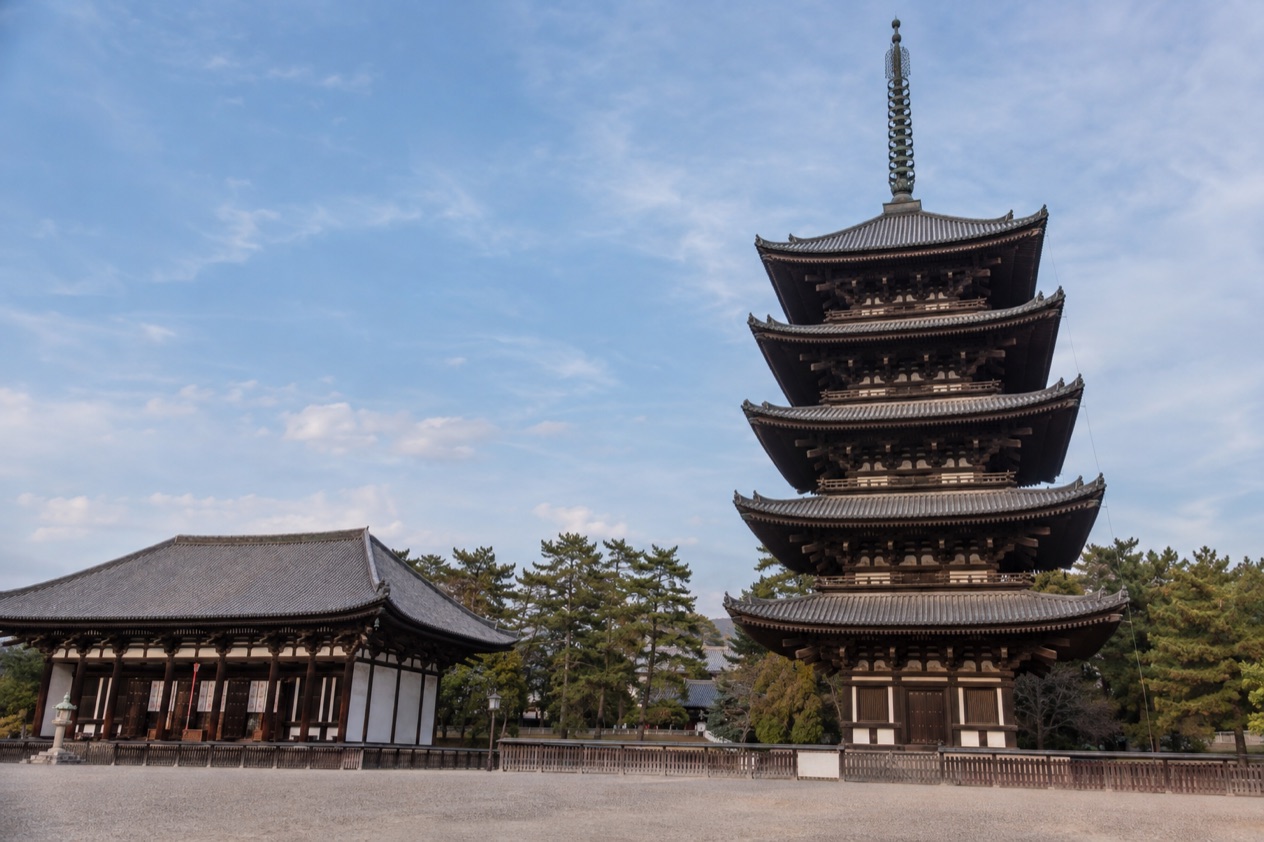
The Five-storied Pagoda, Goju-no-to, is the shape people picture when they think of Kofuku-ji. It was built in 1426 and is a National Treasure. Its five roofs step in toward the top, each one a little smaller than the one below, and the deep eaves throw long shadows across the red-painted frame.
Look at it from several places: from the edge of the pond below, where it is reflected in the water on a still day, and from the courtyard closer in, where you can follow the timber structure up to the finial at the very top. It appears on many a Nara postcard for good reason, and you can understand why once you see the whole silhouette against the sky and the trees of the park.
The Three-storied Pagoda
The Three-storied Pagoda, Sanju-no-to, dates from 1185 and is also a National Treasure. It is the smaller and older of the two pagodas, and its lines are plainer and lighter than those of its taller neighbor. Seen next to the five-storied one, it shows how pagoda design changed across the centuries, with more restraint in the proportions and less ornament in the details.
It stands apart from the main courtyard, so reaching it feels like a small detour from the main route. Take a few minutes to walk around it and notice the weathered wood, the slender roof corners and the way the structure sits among the trees rather than in an open square.
The Golden Halls: East and Central
The East Golden Hall, To-kondo, dates from 1425 and is a National Treasure. Its broad, low roof and the open base of red pillars give it a calm, balanced look beside the tall pagoda. It is one of the buildings that best shows the style of the temple’s later rebuilding, with generous eaves and a strong horizontal line.
The Central Golden Hall, Chu-kondo, is the main hall of the temple and was reconstructed and completed in 2018. Its fresh timber, bright red paint and large roof read very differently from the older buildings, and standing in front of it you get a sense of what the compound may have looked like when its halls were new. The contrast between the two halls, one centuries old and one just restored, is one of the most interesting things about the visit.
The Octagonal Halls
Kofuku-ji has two octagonal halls, and their eight-sided plans set them apart from the rectangular halls around them. The North Octagonal Hall, Hoku’endo, dates from 1210 and is a National Treasure. The South Octagonal Hall, Nan’endo, dates from 1741 and is an Important Cultural Property.
Walk around each one and notice how the roof turns at every corner, a shape that looks different from every side. Their compact, centered form makes them feel more like pavilions than great halls, and they sit in quieter corners of the compound, a good place to slow down.
The Bath House
The Bath House, Oyuya, was built between 1394 and 1427 and is an Important Cultural Property. It is a reminder that a temple of this size was also a working community, with monks who needed places to wash and prepare for rituals as well as halls for worship.
The building is modest compared with the pagodas and golden halls, and that is part of its interest. It shows the everyday side of temple life in the same compound as the great national treasures, and it rounds out a visit that otherwise focuses on the showpieces.
When to visit Kofuku-ji
Any season suits a walk among these halls, because most of the visit happens outdoors, in open courtyards and along gravel paths. What changes from month to month is the weather, and Nara has four distinct seasons that shape how the day feels. The figures here are those of Nara itself.
| Month | Average high (°F) | Average low (°F) | Precipitation (in) | Days with rain | Sunshine (hours) |
|---|---|---|---|---|---|
| January | 47.7 | 33.4 | 2.06 | 6.2 | 118 |
| April | 67.6 | 47.7 | 3.89 | 9.6 | 173 |
| July | 89.1 | 73.4 | 6.83 | 11.2 | 157 |
| October | 72.7 | 56.3 | 5.30 | 9.2 | 149 |
Spring: April
April brings mild afternoons in the high 60s, cool mornings and the most sunshine of the four months in the table. Rain falls on a good share of days, so a light jacket and an umbrella make sense. The pagoda and the halls look especially good against fresh green on the trees around the pond.
Summer: July
July is hot and humid, with afternoons close to 90 degrees and humidity above 70 percent, and rain on about a third of the days. A long walk across open gravel can feel heavy in the middle of the day. The shade of the trees around the pagodas helps, and a water bottle will be welcome.
Autumn: October
October is comfortable for walking, with highs in the low 70s and cool evenings. It is also one of the wetter months, so showers are part of the picture, and humidity stays high. The light is soft, and the red paint of the halls looks warm under gray or clearing skies. As the season moves on, the trees around the grounds begin to change color.
Winter: January
January is cold, with highs in the high 40s and lows just above freezing. Snow or sleet falls on a number of days, though the total amount is small, and the sun shines for a fair part of the month. The pagodas stand out sharply against clear winter skies, and the courtyards feel wide and open in the cold air. Dress in warm layers.
Tips for your visit
Wear shoes that handle gravel and stone paths, since the compound is mostly open ground between the halls. In summer bring water and a hat, and in the wetter months an umbrella is more useful than a raincoat because you will be moving between open courtyards.
Getting to the temple
Nara has two main stations, JR Nara Station and Kintetsu Nara Station, and both give access to Nara Park and the old district of Naramachi. From Osaka, the JR Yamatoji rapid train serves JR Nara Station directly. From Osaka-Namba Station, the Kintetsu limited express reaches Kintetsu Nara Station in 35 minutes and costs 520 yen more than the regular express, which takes 5 minutes longer.
Nara lies east of Osaka and south of Kyoto, and trains from both cities reach it. Travelers flying in can use Osaka International Airport (Itami) or Kansai International Airport, both in Osaka Prefecture and about an hour and a quarter from Nara by bus and train.
Combining it with the rest of Nara
The temple sits beside Nara Park, at the foot of Mount Wakakusa, so a visit naturally flows into the rest of the park. The tame deer there will approach visitors, and crackers are sold along the roadside for feeding them. Expect the animals to be curious and insistent, and keep any food out of sight if you would rather not be followed.
Naramachi, the old merchant district, is also reached from the same stations, and its lanes are a pleasant place for a meal or a stroll after the temple.
Pacing the day
Most of what you come to see is outside, so you can adapt the visit to your energy and the weather. Start with the pagodas and the pond, walk to the golden halls, then explore the octagonal halls and the Bath House at a slower pace. Families with children will find the open courtyards give room to move, though the gravel can be tiring for strollers and wheelchairs.
Good to know before you go
Carry some yen for small purchases in the park, such as the deer crackers sold along the roadside. The rainy months of early summer and the humid heat of July are the seasons that most affect a day outdoors, so plan some flexibility. Move through the grounds with the same respect you would show at any active temple, speaking softly near the halls and keeping to the paths.
Sources
- Wikipedia, Kōfuku-ji (https://en.wikipedia.org/wiki/K%C5%8Dfuku-ji), checked October 11, 2026
- Japan National Tourism Organization, Nara (https://www.japan.travel/en/destinations/kansai/nara/), checked October 11, 2026
- Japan Meteorological Agency (JMA), Normal values 1991-2020, monthly (https://www.data.jma.go.jp/stats/etrn/view/nml_sfc_ym.php?prec_no=64&block_no=47780), station Nara, elevation 102 m, checked October 11, 2026
To plan your stay
- Best Time to Visit Japan: Cherry Blossoms, Autumn Colors, Weather and Festivals
- Where to Stay in Japan: Ryokan, Temple Stays, Capsule Hotels and the Best Cities to Base In
- Sending Luggage from the Airport in Japan: Hands-Free Travel, Hotel Delivery and Coin Lockers
- Know Before You Go to Japan: Entry, Money, Etiquette and Getting Around