
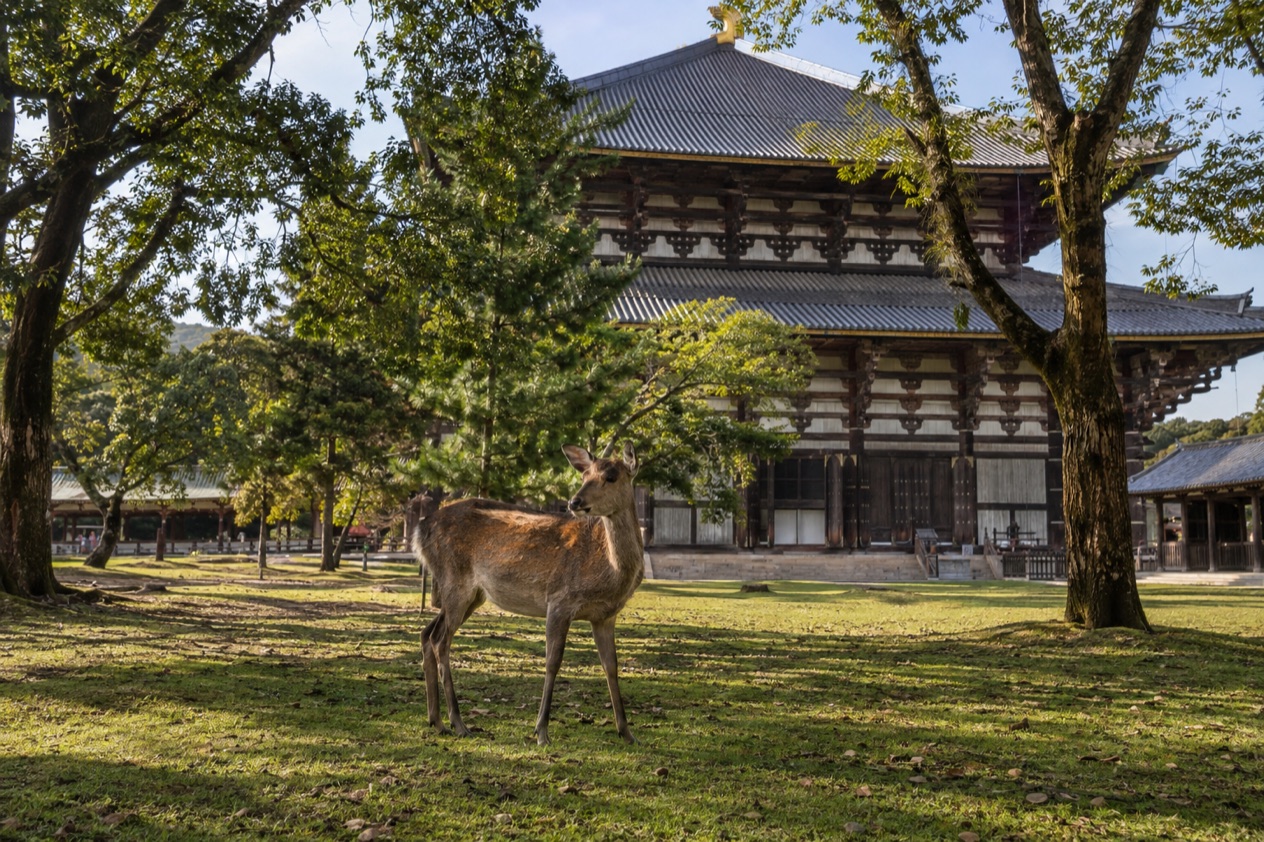
On a first morning in Nara, the deer are already out. They stand on the paths under the trees, watching for anyone who holds a paper-wrapped stack of crackers, and some of them bow their heads in a way that looks like manners and is really a request.
Beyond them rise the roofs of old temples and the slope of Mount Wakakusa. Three days here let you meet the park, walk the old town streets and spend a day among the oldest temples in the region, at an unhurried pace.
Is three days enough in Nara?
Three days is enough for most travelers who want to see Nara properly rather than as a stop between Kyoto and Osaka, and it suits anyone who likes to linger at a temple gate or a tea counter. Nara has a lot of history for its size.
It holds three World Heritage sites, and its Heijokyo was Japan’s first capital, dating back 1300 years to the Nara Period. A visit stretched over three days lets each of those ideas have its own morning.
The plan below covers the park and its great temple on the first day, the shrine, the old temple of Kofuku-ji and the lanes of Naramachi on the second, and a day out to Horyu-ji and Heijo Palace on the third. It leaves out the pilgrimage trails and the ancient towns along the Yamanobe-no-Michi route, which the Kintetsu trains serve.
It also leaves out the remote corners of the prefecture that the Nara Kotsu bus network reaches. With more time, those are the things to add, and they suit travelers who enjoy walking from one village to the next.
Day 1 in Nara
Start in Nara Park, which lies at the foot of Mount Wakakusa and is a five-minute walk from Kintetsu Nara Station. The deer come first.
They are tame, they let visitors approach, and special crackers for them are sold all around the park, so feeding them becomes the opening ritual of the morning. The deer were once believed to be messengers of the gods, which explains why they walk the paths as if they own them. Take your time on the lawns and under the trees before heading to the temple.
Todai-ji is the center of the day. You enter through Nandaimon Gate, where two enormous guardian figures stand on either side of the passage, and then walk on toward the hall that shelters the Great Buddha.
Todai-ji, the Great Buddha and the deer are the best-established symbols of Nara, and the temple belongs to the Historic Monuments of Ancient Nara, a World Heritage Site. Smoking and drone photography are prohibited in the precincts. Lunch can be a simple noodle shop or a set-meal restaurant on the lanes near the park, with a bowl of udon or a plate of pickled vegetables and rice.
The afternoon belongs to the park itself. The broad lawns and wooded paths reward wandering without a fixed plan, and Nara Park, established in 1880, is a place where a stroll turns up another pond, another stone lantern, another deer lying in the shade.
In the evening, walk back toward the station area and settle into a small restaurant or an izakaya, a casual pub where dishes arrive in small plates to share. One tip: keep crackers in a bag or pocket until you want to feed a deer, because the animals know exactly what rustles.
Day 2 in Nara
The second day moves to the shrine and the old town. Begin at Kasuga-taisha, a Shinto shrine in Nara established in 768 CE. Its brass lanterns are a signature of the place, and they are lit twice a year, in winter and in summer.
On any other day you can still walk beneath them and read the way they line the approach. The path through the trees has a rhythm of stone and wood that suits a slow start, and the mood differs from the open lawns of the previous day.
From the shrine, come back toward the town to Kofuku-ji, founded in 669 and part of the same World Heritage listing as Todai-ji. It is a temple of pagodas and halls with a long history in the city, and walking its grounds adds a different chapter to what you saw on the first day.
Naramachi comes next, the old merchant district reached from both Nara Station and Kintetsu Nara Station. Its narrow lanes and traditional wooden houses are good for browsing, and a lunch of local set meals or a cup of tea and a sweet fits easily into the stroll.
Spend the afternoon in Naramachi at your own pace, stepping into small shops and cafés as you pass them. As evening comes, return to the area around the stations for dinner, where restaurants serve everything from tempura to grilled skewers. A tip for the day: wear shoes that are easy to take off, because many traditional buildings and some restaurants ask you to remove them at the entrance, and a pair of clean socks makes that moment simpler.
Day 3 in Nara
The third day goes further out, to Horyu-ji and Heijo Palace. A bus takes visitors to both, so the day does not need a car.
Horyu-ji in Ikaruga was founded by Prince Shotoku in 607, and in 1993 it was registered, with Hokki-ji, as Japan’s first UNESCO World Heritage Site. Heijo Palace sits on the site of Heijokyo, the first capital, and gives the earlier history of the city a physical setting. Together they make a day that reaches back to the roots of Nara.
Return to town in the afternoon with time left over for the evening. Walk Naramachi again, now that you know its lanes, or cross toward Nara Park for a last look at the deer under the trees.
Dinner can be a slower affair than on earlier nights: a restaurant with a set meal of local vegetables and pickles, or a counter where the cook grills skewers in front of you. A cup of hot tea or a glass of sake before bed ends the trip on a calm note.
If you want one last thing before you leave, spend the final hour at Kasuga-taisha’s approach or on the edge of Nara Park near Mount Wakakusa. The deer are still there, and the day ends with the same sight that opened the first morning.
Where to stay for three days in Nara
For this plan, the best base is the area around Kintetsu Nara Station and JR Nara Station. Nara Park and Naramachi are both reached from these stations, so Day 1 and Day 2 begin with a walk from your door, and Kintetsu Nara Station has the five-minute walk to the park. Staying here also gives you a direct link to the rail lines that bring travelers from Osaka and Kyoto, which helps on arrival and departure day.
Travelers who like to sleep inside the old town may prefer a place in or near Naramachi, where traditional houses and small lodgings fit the mood of the district. Those who want to start each morning among the deer might look closer to the park. Either choice works with the plan, because the bus to Horyu-ji and Heijo Palace on Day 3 adds a different kind of journey and starts from the town side rather than the park side.
If you plan to add days for the Yamanobe-no-Michi route or the mountain trails, a base near the Kintetsu line makes those outings simpler to organize. For a stay of three days, the stations are the most practical anchor, with the park, the old town and the bus routes all within reach.
What to skip if you only have three days in Nara
Skip the idea of adding a second city. Kyoto and Osaka are both reachable by train, but a day away from Nara costs you a day of the plan, and Nara rewards a slower pace more than a rushed one. If you have already seen those cities or plan to visit them later, spend the extra hours on Nara itself, perhaps with a second walk through Naramachi or another long look at the park.
Skip the long pilgrimage trails and the farther reaches of the prefecture. Kintetsu trains serve the towns along the Yamanobe-no-Michi route and the starting points of mountain trails leading toward the border with Wakayama Prefecture. The Nara Kotsu bus network reaches remote areas without rail. These are outings for a separate trip with more time, where the walk itself becomes the reason to go.
Skip the temptation to see every temple and shrine. Todai-ji, Kasuga-taisha, Kofuku-ji and Horyu-ji already cover a wide span of Nara’s history, and adding more halls to the list tends to blur one gate into another. Use the spare time to sit with a cup of tea in Naramachi, return to the park for the deer, or take the bus tour that follows the same places with an audio guide in English, and let the plan breathe.
Getting around Nara in three days
Most of the first two days are on foot. Nara Park and Naramachi are both reached from Nara Station and Kintetsu Nara Station, and Todai-ji, Kasuga-taisha and Kofuku-ji sit in the park area, so you can link them without a vehicle.
Nara has two main stations, JR Nara Station and Kintetsu Nara Station. The Kintetsu Railway and West Japan Railway (JR West) operate rail service throughout Nara. Bus and rail tickets can be paid with an IC card, which also works in vending machines and convenience stores.
To reach Nara, the closest airports are Osaka International Airport (Itami) and Kansai International Airport, both in Osaka Prefecture and about one hour and fifteen minutes away by bus and train. From Osaka, the JR Yamatoji rapid train serves JR Nara Station directly, and from Osaka-Namba Station the Kintetsu limited express reaches Kintetsu Nara Station in 35 minutes, at 520 yen more than the regular express, which takes five minutes longer. From Kyoto, the JR Miyakoji rapid service serves JR Nara Station directly, and Kintetsu Nara Station can be reached from Kyoto Station in just over 30 minutes.
On Day 3, a bus takes visitors to Heijo Palace and Horyu-ji. Nara Kotsu also runs four sightseeing bus tours covering Nara Park, Horyu-ji and Nishinokyo, with audio guides in English and Chinese. The fares below apply to the local options in the city.
| Ticket | Fare | Covers |
|---|---|---|
| Gurutto bus, per trip | 100 yen | Nara City |
| Nara 1-Day Pass, adult | 600 yen | Nara Park and Nishinokyo areas, one day |
| Nara 1-Day Pass, child | 300 yen | Nara Park and Nishinokyo areas, one day |
Good to know before you go
An IC card, the rechargeable card that works on trains, buses and boats, is the simplest way to pay for local rides, and most regional cards can be used throughout Japan. The same card works in vending machines, convenience stores and some taxis, which spares you from counting coins.
Around the deer, keep food out of sight until you are ready to feed them, since they approach anyone who has crackers. Smoking and drones are prohibited in Todai-ji’s precincts, and shoes often come off at the entrances of traditional buildings.
Sources
- Japan National Tourism Organization, Nara (https://www.japan.travel/en/destinations/kansai/nara/), checked October 11, 2026
- Official Nara Travel Guide, getting around Nara (https://www.visitnara.jp/getting-around-nara/), checked October 11, 2026
- Official Nara Travel Guide, first-time visitors (https://www.visitnara.jp/for-first-time-visitor/), checked October 11, 2026
- Official Nara Travel Guide, Nara Park area (https://www.visitnara.jp/destinations/area/nara-park/), checked October 11, 2026
- Todai-ji Temple, official site (https://www.todaiji.or.jp/en/), checked October 11, 2026
- Wikipedia, Tōdai-ji (https://en.wikipedia.org/wiki/T%C5%8Ddai-ji), checked October 11, 2026
- Wikipedia, Nara Park (https://en.wikipedia.org/wiki/Nara_Park), checked October 11, 2026
- Wikipedia, Kasuga-taisha (https://en.wikipedia.org/wiki/Kasuga-taisha), checked October 11, 2026
- Wikipedia, Hōryū-ji (https://en.wikipedia.org/wiki/H%C5%8Dry%C5%AB-ji), checked October 11, 2026
- Wikipedia, Kōfuku-ji (https://en.wikipedia.org/wiki/K%C5%8Dfuku-ji), checked October 11, 2026
- Japan Meteorological Agency (JMA), Normal values 1991-2020, monthly (https://www.data.jma.go.jp/stats/etrn/view/nml_sfc_ym.php?prec_no=64&block_no=47780), station Nara, elevation 102 m, checked October 11, 2026
- Japan National Tourism Organization, IC cards, Suica, Pasmo, ICOCA, how to use (https://www.japan.travel/en/plan/ic-card/), checked October 11, 2026
- Japan National Tourism Organization, Japan Rail Pass and regional passes (https://www.japan.travel/en/plan/jr-rail-passes/), checked October 11, 2026